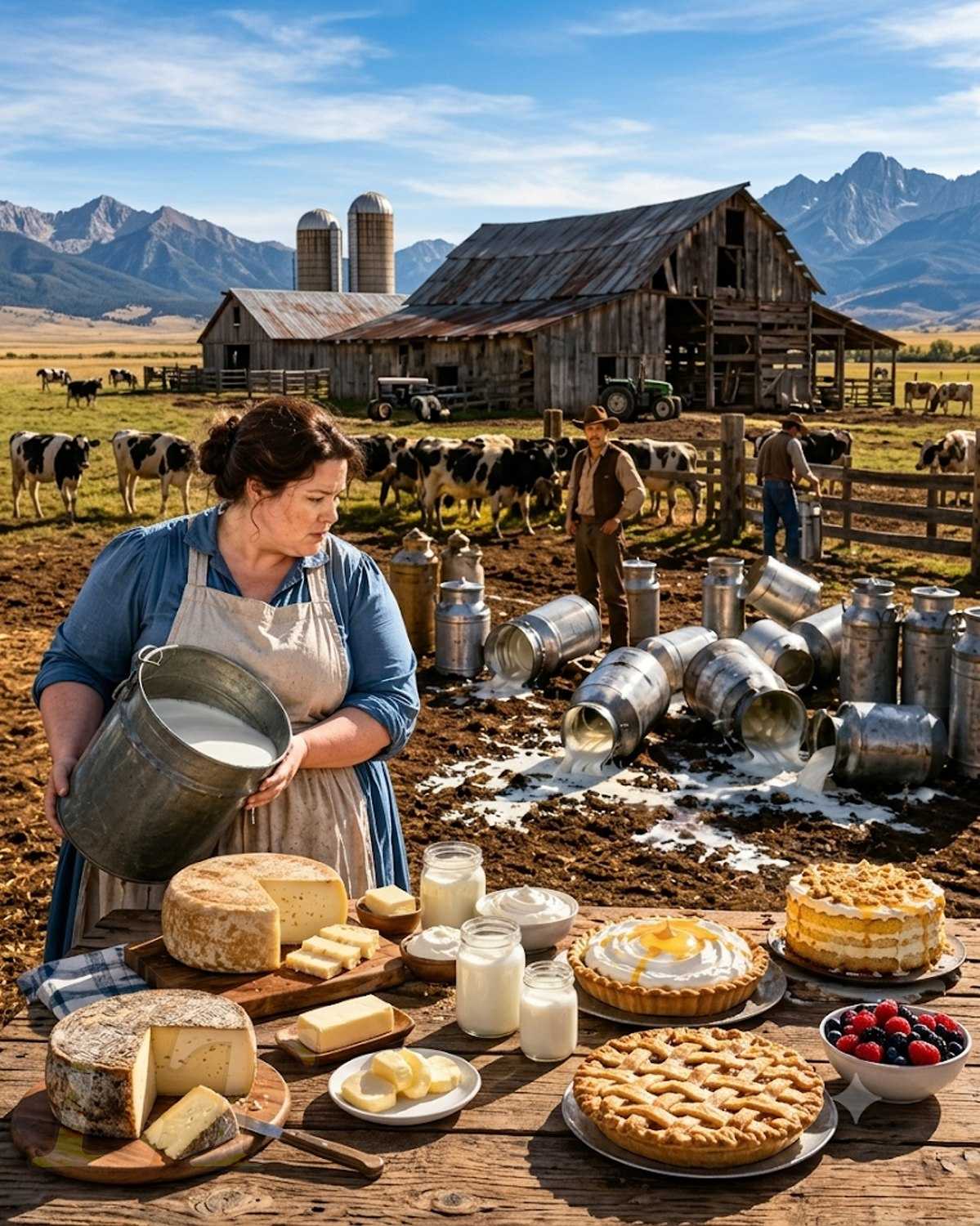
Clara read the sentence twice.
Failure to fulfill any scheduled delivery shall constitute grounds for the creditor to secure an immediate lien against the property known as Bennett Dairy Farm.
She looked up at Edwin Hargrove.
"You're telling me Walter Pierce can take my father's farm if we miss one milk delivery?"
The banker didn't answer immediately.
He adjusted his spectacles and looked down at the contract.
"I'm telling you that Mr. Pierce may have grounds to file a claim against the property if the terms of this agreement are violated."
"That's not what I asked."
Hargrove sighed.
"Yes, Miss Bennett. Under certain circumstances, he could."
Clara felt a sharp pressure behind her ribs.
For a moment, the kitchen seemed smaller.
Her father's empty chair stood across from her. His coat still hung beside the back door. The clock above the stove ticked steadily, indifferent to the fact that everything Thomas Bennett had worked for might soon belong to another man.
But Clara didn't cry.
She reached for her pencil.
"How much milk?"
Hargrove blinked.
"Pardon?"
"How much milk does the contract require us to deliver?"
"One hundred and forty gallons weekly."
"At what price?"
He consulted the document.
Clara waited.
"Twenty-six cents per gallon."
Her pencil stopped.
"That's twelve cents below the current market price."
Hargrove looked uncomfortable.
"Prices fluctuate."
"Not by twelve cents for eight consecutive months."
"Miss Bennett—"
"And if we fail to deliver the full amount even once, Pierce can claim the farm?"
"Potentially."
She wrote down the figures.
Then she looked at the banker.
"Who prepared this contract?"
"I believe Mr. Pierce's attorney."
"Did my father have independent legal representation?"
"I don't know."
"Did the bank review the terms before he signed?"
Hargrove removed his spectacles.
"The bank was not a party to that agreement."
"But you knew about it."
He hesitated.
"Your father mentioned certain obligations."
Clara studied his face.
Edwin Hargrove had been the county bank manager for nearly twenty years. He had approved loans for farmers, merchants, and ranchers throughout the valley. He knew every major businessman in town.
Including Walter Pierce.
"Did Pierce tell you to come here tonight?"
Hargrove's expression changed.
Only slightly.
But Clara noticed.
"Mr. Pierce contacted the bank regarding the farm's financial position."
"When?"
"This afternoon."
"After I refused to sell?"
The banker said nothing.
Clara leaned back.
Now she understood why Walter had seemed so certain of himself.
He wasn't simply waiting for her to fail.
He was arranging the circumstances under which failure would become inevitable.
"Mr. Hargrove," she said, "I need a complete statement of my father's outstanding bank obligations."
"I can arrange that."
"Tomorrow morning."
"That may be difficult."
"Then tomorrow afternoon."
He looked at her for a long moment.
Finally, he nodded.
"I'll have the figures prepared."
Clara folded the contract carefully.
"I'll also need copies of every payment and adjustment made during the past year."
"Those records are extensive."
"I'm a bookkeeper."
A faint expression crossed his face.
Not quite amusement.
Not quite respect.
"Yes," he said. "I've heard."
She stood.
The meeting was over.
Hargrove gathered his belongings, but before leaving, he paused at the doorway.
"Miss Bennett, may I offer you some advice?"
"Of course."
"Your father was a decent man. But he held on to this property long after the financial situation became dangerous."
Clara waited.
"Sometimes selling is the wisest decision."
She opened the door.
"And sometimes," she replied, "the person advising you to sell is the one who benefits most."
Hargrove lowered his eyes.
He said good night and left.
Clara watched his carriage disappear down the road.
Then she closed the door and returned to the kitchen.
Doraththa Marsh stood beside the stove.
"Is it bad?"
Clara looked at the contract.
"Worse than Father told me."
The older woman pressed a hand against her chest.
"Are we going to lose the farm?"
Clara couldn't bring herself to offer another promise she wasn't certain she could keep.
"I don't know yet."
Doraththa nodded slowly.
Then she did something Clara hadn't expected.
She pulled out a chair.
"Tell me what you need."
Clara looked at her.
"Every receipt you can find. Every letter Father received from Pierce. Every envelope, even if it's empty."
Doraththa straightened.
"I know where he kept some of them."
"Where?"
"In the old flour tin above the pantry."
Clara stared.
"Why would he keep business letters there?"
"Because he didn't want Mr. Pierce finding them."
The words hung between them.
Clara felt her pulse quicken.
"Bring me the tin."
Doraththa hurried into the pantry.
A minute later, she returned carrying a dented blue container covered in flour dust.
Inside were seventeen envelopes.
Some contained invoices.
Others held handwritten notes.
Three were marked with Walter Pierce's business letterhead.
Clara spread them across the table.
The first letter demanded payment for feed purchased the previous winter.
The second referenced a deduction for allegedly spoiled milk.
The third contained a warning.
Continued failure to maintain satisfactory delivery standards may require immediate enforcement of contractual remedies.
Clara examined the date.
It had been written only eleven days before her father's death.
She read it again.
Then she turned it over.
On the back, in her father's handwriting, were four words.
Ask Clara about figures.
Her throat tightened.
For several seconds, she couldn't move.
Her father had wanted her help.
He had written her name.
But he had never sent the letter.
She pressed her fingertips against the paper.
"Why didn't you call me, Daddy?" she whispered.
Doraththa quietly stepped away.
Clara remained at the table until the clock struck midnight.
Then she began working again.
She arranged the surviving documents chronologically.
January.
February.
March.
Each month revealed another discrepancy.
Pierce had deducted money for transportation costs that should have been included in the agreed purchase price.
He had charged penalties for milk allegedly delivered below quality standards, but the farm's own records showed no corresponding rejection notices.
Several payments had arrived late.
Others had been reduced without explanation.
The figures weren't enough to prove deliberate fraud.
Not yet.
But they gave Clara a reason to question nearly every amount Pierce claimed her father owed.
She took out a fresh sheet of paper.
At the top, she wrote:
PIERCE PROVISIONS — RECONCILIATION REQUIRED
Then she began listing questions.
By two in the morning, she had filled three pages.
By three, she had made a decision.
She was going to get her father's ledger back.
And she wasn't going to ask twice.
Walter Pierce arrived at Bennett Dairy Farm shortly after nine the following morning.
He came in a polished carriage accompanied by two men.
Clara recognized one as his clerk, Samuel Voss.
The other was a broad-shouldered man she had seen outside Pierce's warehouse.
Walter stepped onto the porch without removing his gloves.
"Good morning, Clara."
She stood in the doorway wearing a clean blouse and a dark skirt. Her mourning dress had been put away, but the grief beneath it remained.
"Mr. Pierce."
"I trust you've had time to reconsider."
"Yes."
He smiled.
"Excellent."
"I'm not selling."
The smile vanished.
Behind him, Samuel Voss shifted awkwardly.
Walter removed a document from his coat.
"Perhaps you should examine the offer more carefully."
"I examined it yesterday."
"Then you understand how generous I'm being."
Clara folded her arms.
"Where is my father's ledger?"
Walter blinked.
"What?"
"The account ledger you removed from this house two days after his death."
"I borrowed it for reconciliation."
"Then return it."
"Clara, these matters are complicated."
"Not this one."
Walter glanced toward his companions.
"I've been handling business with your father for years."
"And now you'll be handling it with me."
His jaw tightened.
"You seem determined to make this unpleasant."
"I'd prefer to make it accurate."
He stepped closer.
"Your father owed me money."
"Then you won't mind showing me the records supporting that claim."
"I have records."
"Good. Bring those, too."
For a moment, Walter looked as though he might lose his temper.
Instead, he laughed.
It was a short, humorless sound.
"You spent too many years in Denver, Clara. Out here, business is conducted on trust."
She met his eyes.
"Then you should have no objection to an audit."
Samuel Voss looked down at his shoes.
Walter noticed.
"Samuel," he snapped, "wait by the carriage."
The clerk obeyed.
Walter turned back to Clara.
"Your father understood that difficult decisions sometimes had to be made."
"My father is dead."
"I know that."
"Then stop using him to explain decisions you made after his death."
His face darkened.
Clara continued before he could interrupt.
"I want the ledger returned by ten o'clock."
"Or what?"
"Or I'll ask the county sheriff why a businessman removed financial records from a deceased man's home without authorization."
The man near the carriage straightened.
Walter's eyes narrowed.
"Are you threatening me?"
"No."
Clara glanced at the clock inside the hallway.
"I'm telling you what I'll do next."
For several seconds, Walter said nothing.
Then he turned abruptly.
"Samuel!"
The clerk hurried back.
"Go to the office. Bring the Bennett ledger."
Samuel hesitated.
"The original, sir?"
Walter glared at him.
"Of course the original."
Clara noticed the hesitation.
She noticed something else, too.
Samuel looked frightened.
Not of her.
Of Walter.
The clerk climbed into the carriage and departed.
Walter remained on the porch.
"You're making enemies unnecessarily," he said.
Clara looked toward the fields.
"I inherited a farm, Mr. Pierce. Apparently, the enemies came with it."
At exactly ten minutes past ten, Samuel Voss returned.
He carried a thick brown ledger tied with black cord.
Clara recognized it immediately.
Her father's initials were stamped into the leather cover.
T.B.
She held out her hand.
Samuel gave it to her.
Walter watched closely.
Clara untied the cord and opened the book.
The first pages contained familiar handwriting.
Her father's.
She ran one finger along the columns.
Milk deliveries.
Feed purchases.
Equipment repairs.
Payments received.
Then she reached the entries from eight months earlier.
She stopped.
A new contract had been recorded.
One hundred and forty gallons of raw milk every week.
Two-year term.
Twenty-six cents per gallon.
Twelve cents below the prevailing market price.
And a penalty provision that could place the entire farm at risk.
Clara looked up.
"Why did Father agree to this?"
Walter shrugged.
"He needed reliable buyers."
"At a loss?"
"Not every transaction produces an immediate profit."
"Especially when one party controls the price."
Walter's expression hardened.
Clara turned another page.
Then another.
She found the sale of the first three cows.
The amount recorded was lower than the value she remembered from the farm's older accounts.
She checked the next sale.
Then the next.
Eight cows.
All purchased by Pierce.
All credited against debts he claimed the farm owed.
She looked at him.
"Where are the bills of sale?"
"In my office."
"Signed by Father?"
"Naturally."
"Then I'll need copies."
Walter exhaled sharply.
"How long do you intend to continue this nonsense?"
"Until the numbers agree."
She turned to a page containing a series of deductions.
One entry caught her attention.
Transportation adjustment — $18.40.
She checked the corresponding delivery record.
The milk had been collected by Pierce's own wagon.
The contract placed collection costs on the purchaser.
She looked at Walter.
"Why did you deduct transportation costs when your company was responsible for collection?"
He frowned.
"That would depend on the circumstances."
"Which circumstances?"
"I'd need to review the entry."
"Then review it."
She turned the ledger toward him.
Walter didn't move.
Clara waited.
Finally, he said, "Accounting errors happen."
"Yes," she replied. "They do."
She turned another page.
"And when they happen repeatedly in favor of the same person, I start asking different questions."
Walter's face flushed.
"You'd do well to remember who you're speaking to."
Clara closed the ledger.
"I know exactly who I'm speaking to."
She held the book against her chest.
"Now I'd like you to leave."
Walter stared at her.
The farmyard had gone unusually quiet.
Pete stood near the barn.
Reuben watched from beside the fence.
Even Samuel Voss seemed reluctant to move.
Walter took one step toward Clara.
"You have seven days before the bank takes action."
"I know."
"You have workers demanding wages."
"I know."
"You have fourteen cows where there used to be twenty-two."
"I know."
"And you have no experience running a dairy business."
Clara looked at him calmly.
"Then it must be very embarrassing for you that I found mistakes in your accounts before breakfast."
Samuel made a small choking sound.
Walter turned sharply.
The clerk lowered his head.
Clara opened the farmhouse door.
"Goodbye, Mr. Pierce."
Walter's voice dropped.
"You'll regret this."
She didn't answer.
He left with his two men.
Only when the carriage disappeared did Pete approach.
"Miss Clara?"
"Yes?"
"Did you really find something wrong?"
She looked at the ledger.
"Several things."
Pete removed his hat.
"Your father always said those numbers weren't right."
Clara turned toward him.
"What do you mean?"
"He used to sit in the barn after deliveries, checking receipts. Sometimes he'd get so angry he'd tear the paper."
"Did he ever tell you why?"
Pete shook his head.
"Just said he couldn't understand how we were producing so much milk and getting poorer every month."
Clara looked toward the cows.
Fourteen remained.
The herd had been reduced.
The debts had increased.
And the farm was still producing more milk than it could sell.
Something about the situation seemed fundamentally wrong.
She turned to Reuben.
"How much did we produce yesterday?"
"About two hundred and sixty gallons."
"How much went to Pierce?"
"None yesterday. His collection is tomorrow."
"How much did we sell locally?"
Reuben gave her the figure.
Clara calculated quickly.
"And how much did we lose?"
He hesitated.
"Thirty-two gallons."
Clara looked at the milk cans beside the barn.
Thirty-two gallons.
In one day.
She felt a sudden rush of frustration.
Not because the milk had spoiled.
Because everyone had become accustomed to it.
Waste had become part of the routine.
A loss so familiar that nobody questioned it anymore.
She walked toward the barn.
"Show me exactly what happens to the surplus."
Reuben led her through the milking area.
He explained the collection schedule, the storage problems, and the difficulties of transporting milk before it spoiled.
The farm had enough cows to produce substantial quantities.
But it lacked reliable distribution.
Some local families bought milk regularly.
A few merchants purchased small amounts.
Pierce collected his contractual share.
Everything else depended on weather, transportation, and demand.
Clara listened carefully.
She asked questions about temperatures.
Storage.
Cleaning.
Delivery routes.
The age of the equipment.
Then she asked the question that changed the conversation.
"Why aren't we processing more of it?"
Reuben looked confused.
"Processing?"
"Butter. Cheese. Cream."
"We make a little butter for the house."
"What about the rest?"
He shrugged.
"We don't have the equipment."
Clara stopped.
"Are you sure?"
"Well, not the modern kind."
She looked toward the farmhouse.
A memory stirred.
Her grandmother standing over a large copper pot.
Warm milk.
Wooden molds.
Cheesecloth hanging above a basin.
A cool stone cellar lined with shelves.
She remembered the smell.
The patience.
The way her grandmother could turn ordinary milk into something families traveled miles to buy.
Clara looked at Reuben.
"Does the old stone cellar still exist?"
He nodded.
"Yes, ma'am."
"Is it being used?"
"Mostly for storage."
"And the cheese molds?"
Reuben scratched his head.
"I've seen some wooden ones down there."
Clara felt her heartbeat quicken.
"Are they damaged?"
"Some might be. I don't know."
She looked toward the farmhouse.
For the first time since returning home, she felt something other than grief, anger, or fear.
Possibility.
But she forced herself to remain practical.
Old equipment didn't automatically mean a working business.
Milk could spoil.
Cheese could fail.
Improper processing could make people sick.
She would need supplies, careful temperature control, sanitation, and reliable methods.
Still, the thought wouldn't leave her.
Her grandmother had once supported the household through difficult seasons by selling cheese.
Clara had watched her work for years.
She remembered more than she realized.
Perhaps enough to begin again.
"Reuben," she said, "bring me the cellar key."
He blinked.
"Right now?"
"Right now."
He hurried toward the house.
Clara remained beside the barn, looking across the fields.
She thought of Walter Pierce.
He had built his control around one product.
Raw milk.
He controlled the price.
He controlled the purchasing schedule.
And through the contract, he threatened the farm itself.
But what if the milk didn't remain raw?
What if the surplus became something he couldn't control?
She turned back toward the house.
Then she stopped.
There was one detail she needed to confirm.
She opened the ledger and found the contract.
Her eyes moved down the page.
The supplier agrees to deliver one hundred and forty gallons of raw milk weekly.
She read the sentence again.
Raw milk.
Not butter.
Not cheese.
Not cream.
She turned to the next paragraph.
Then the next.
There was no clause prohibiting the farm from processing or independently selling its surplus production.
Clara felt her hands grow cold.
She wasn't ready to celebrate.
A contract needed to be reviewed by someone qualified to interpret it.
But she had found a possibility.
A narrow opening.
And Walter Pierce had apparently never considered that she might use it.
That afternoon, Clara traveled into town to meet Marcus Holt.
Marcus was a lawyer in his late forties with a reputation for being meticulous and difficult to intimidate.
He had handled small property disputes for her father years earlier.
When Clara entered his office carrying the ledger, he looked surprised.
"Clara Bennett."
"Mr. Holt."
"I'm sorry about your father."
"Thank you."
He offered her a chair.
She sat and placed the contract on his desk.
"I need you to read this."
Marcus adjusted his glasses.
"All of it?"
"Especially the delivery requirements and penalty provisions."
He began reading.
Clara waited.
Outside, a wagon passed over the cobblestones.
A clock ticked above the filing cabinet.
Marcus turned one page.
Then another.
Finally, he looked up.
"Who drafted this?"
"Walter Pierce's attorney."
Marcus frowned.
"Your father signed it?"
"Yes."
"Did he consult anyone first?"
"I don't know."
Marcus leaned back.
"This is an unusually aggressive agreement."
"Can Pierce take the farm?"
"He can attempt to enforce the lien provision if the conditions are met. Whether every part would survive legal challenge is another question."
Clara nodded.
"And if we fulfill the raw milk deliveries?"
"Then he has no basis under this clause to claim a delivery default."
"What about the remaining milk?"
Marcus looked at her.
"What about it?"
"Can I turn it into cheese and sell it to someone else?"
He read the contract again.
More slowly this time.
Then he looked up.
"Nothing here appears to prohibit that."
Clara felt a small surge of relief.
"You're certain?"
"Based on this document, yes. But I'd want to review any related agreements before giving you a final opinion."
She nodded.
"Of course."
Marcus tapped the ledger.
"Why are you asking?"
Clara hesitated.
Then she told him about the wasted milk.
The old cellar.
Her grandmother's equipment.
The possibility of producing cheese and butter.
Marcus listened without interrupting.
When she finished, he sat quietly for a moment.
Then he smiled.
"Your father once told me you were the smartest person in the family."
Clara looked down.
"He never told me that."
"Perhaps he should have."
Marcus's smile faded.
"Be careful, Clara."
"Of Pierce?"
"Of anyone who stands to lose money if you succeed."
She understood.
Before leaving, she asked him to examine the questionable deductions and cattle sales.
Marcus agreed.
"I'll need copies of everything."
"You'll have them."
"And Clara?"
She paused at the door.
"Yes?"
"Don't accuse Pierce publicly until we have proof."
She nodded.
"I won't."
But as she stepped outside, she noticed a familiar carriage parked across the street.
Walter Pierce's carriage.
Samuel Voss stood beside it.
He was speaking to a man Clara didn't recognize.
When Samuel noticed her leaving the lawyer's office, his expression changed.
He turned away quickly.
Clara continued walking.
She didn't look back.
But she knew she'd been seen.
By late afternoon, she was back at the farm.
Reuben waited near the farmhouse with an old iron key.
"Found it," he said.
Clara took it.
The key was heavy and dark with age.
She remembered her grandmother carrying it on a ring attached to her apron.
"Has anyone opened the cellar recently?"
"Not that I know of."
Doraththa appeared behind him.
"I went down last autumn to look for preserving jars."
"Was the equipment still there?"
"Some of it."
Clara nodded.
"Then let's see what we have."
They walked around the farmhouse to a low stone structure built partly into the hillside.
Its wooden door had weathered badly.
Moss grew between the stones.
A rusted iron latch held the door closed.
Clara inserted the key.
It resisted.
She tried again.
The lock turned with a sharp click.
Reuben pulled the door open.
Cool air drifted out.
Clara stepped inside.
Dust floated in the narrow beam of sunlight.
Wooden shelves lined the walls.
Old crates stood stacked in one corner.
Several empty glass jars sat beneath a cloth.
And against the far wall rested a collection of wooden cheese molds.
Clara approached them slowly.
She lifted one.
The wood was dry but intact.
Another had cracked.
A third looked almost exactly as she remembered.
Beside the molds stood an old cheese press.
Its iron fittings were rusted, but the frame appeared sound.
Clara ran her hand along the wood.
She could almost hear her grandmother's voice.
Never hurry the milk, Clara. Good cheese takes patience.
Her eyes stung.
She swallowed.
Doraththa stood in the doorway.
"Your grandmother loved this place."
"I know."
"She used to say the cellar kept the family alive during the hardest winters."
Clara looked around.
For years, everyone had treated the old creamery as a forgotten part of the farm.
A relic.
Something belonging to a time that had passed.
But standing there, Clara began to understand what her father might have been thinking before he died.
Perhaps he had remembered the same thing.
Perhaps he had been searching for a way out.
She turned toward Doraththa.
"Did Father ever come down here recently?"
The older woman hesitated.
"Once."
"When?"
"A few weeks before he became ill."
"What did he do?"
"I don't know. He asked me to leave him alone."
Clara looked toward the shelves.
"Did he take anything?"
"I didn't see."
Reuben moved a wooden crate aside.
"Miss Clara?"
She turned.
He pointed toward the floor.
"There's something under here."
Clara stepped closer.
A section of the stone floor was covered by an old piece of canvas.
She bent down and pulled it aside.
Beneath it lay a narrow wooden box.
The lid was dusty.
A small brass clasp held it shut.
Clara lifted the box onto the workbench.
Her father's initials had been scratched into the wood.
T.B.
She stared at them.
Reuben leaned closer.
"What's inside?"
"I don't know."
She opened the clasp.
Inside were several folded papers, a small cloth pouch, and a photograph of her grandmother standing beside the original creamery.
Clara lifted the photograph.
Her grandmother looked younger than Clara remembered.
She stood proudly beside a table covered with cheese wheels.
Behind her, someone had written a date.
And beneath the date were three words.
Bennett Farm Creamery.
Clara felt a strange warmth in her chest.
She set the photograph aside and opened the first folded paper.
It contained handwritten instructions.
Milk temperatures.
Curd cutting.
Salting.
Pressing.
Aging.
Her grandmother's recipes.
Clara recognized the handwriting immediately.
She read several lines.
Then she opened the second paper.
It was a list of customers.
Old names.
Old prices.
Old delivery routes.
Evidence that the creamery had once been a real business, not merely a household tradition.
Reuben stared at the pages.
"Could we really make cheese again?"
Clara looked at the molds.
Then at the press.
Then at the recipes.
"Maybe."
It was the first time she'd allowed herself to say the word aloud.
Doraththa smiled faintly.
"Your grandmother would have liked that."
Clara returned to the box.
Only one folded document remained.
It was thicker than the others.
Sealed with a strip of yellowed paper.
Her father's handwriting appeared across the front.
For Clara, if she ever comes home.
She stopped breathing for a moment.
Doraththa covered her mouth.
Reuben stepped back.
Clara stared at the words.
Her father had written the note before he died.
He had placed it in the cellar.
Among the tools and recipes that might save the farm.
Her fingers trembled as she lifted the document.
She broke the seal.
Inside was a letter.
And attached to it was a small, carefully folded sheet covered in numbers.
Clara unfolded the sheet first.
She recognized the columns.
Milk deliveries.
Payments.
Deductions.
But these figures were different from the ones in Walter Pierce's ledger.
At the bottom, her father had written a single sentence.
These are the amounts Pierce actually received from the buyers.
Clara's heart began to pound.
She looked at the figures again.
Then she saw a name written beside the final entry.
Not Walter Pierce.
Not Samuel Voss.
Someone else.
Someone who had apparently been receiving money connected to the farm's milk.
She reached for her father's letter.
The first line read:
My dear Clara, if you're reading this, then Walter has probably told you that I ruined everything.
Clara pressed a hand against her mouth.
She continued reading.
Before you believe him, there is something you must know about the contract I signed.
A sound came from outside.
Footsteps.
Heavy.
Deliberate.
Reuben turned toward the doorway.
"Miss Clara?"
The cellar door moved.
Someone was standing on the other side.
Clara folded the letter quickly.
Then a man's voice called from the darkness beyond the entrance.
"Clara Bennett?"
She recognized the voice.
It belonged to Samuel Voss.
But he wasn't alone.
And when the second man stepped into the doorway, Clara saw the object he was carrying.
A leather satchel.
Stamped with the seal of Pierce Provisions.
Samuel looked at the letter in her hand.
His face drained of color.
Then he whispered:
"Miss Bennett, whatever you found in that box, you need to hide it before he gets here..."






Comments 0