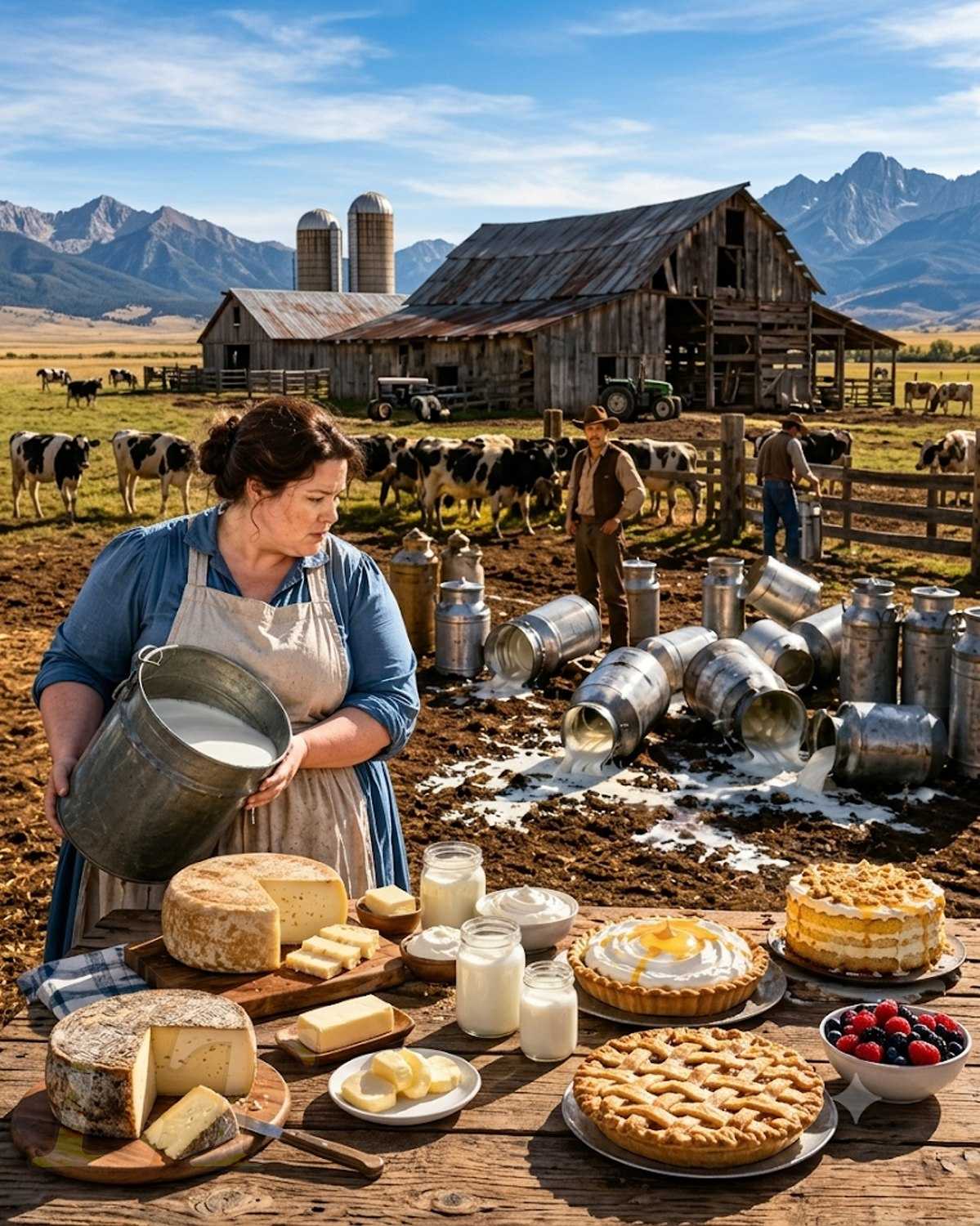
"Give me that envelope, Miss Bennett. Now."
Alderman Briggs stood beneath the farmyard lantern, his hand extended toward Clara.
Henry Bell took a frightened step backward.
The county commissioner was a heavyset man in his late fifties, with thinning gray hair, a broad face, and the practiced confidence of someone accustomed to getting his way.
His black coat was immaculate.
His leather boots were polished.
And his eyes never left the envelope in Clara's hand.
Clara didn't move.
"Good evening, Commissioner."
Briggs frowned.
"I don't have time for pleasantries."
"Then perhaps you should explain why you're standing on my property after dark."
He glanced at Henry.
"That young man has taken private correspondence belonging to me."
Clara looked at the envelope.
Walter Pierce's handwriting appeared across the front.
For Alderman Briggs.
She turned it over.
The seal had already been broken.
"Private correspondence?" she asked.
"Exactly."
"Then why was it being carried by an employee of Pierce Provisions?"
Briggs's face tightened.
"That is none of your concern."
"It became my concern when Mr. Bell brought it here."
Henry shifted nervously.
Briggs turned toward him.
"You've made a serious mistake, boy."
Henry lowered his eyes.
Clara stepped slightly forward.
"Mr. Bell came here voluntarily."
"And he'll regret it."
The words were quiet.
But they carried a threat.
Clara studied the commissioner.
She had seen men like him before.
Men who believed their titles made ordinary questions unnecessary.
Men who expected women to become nervous when spoken to sharply.
Men who confused authority with ownership.
She had spent years balancing accounts for businessmen who behaved exactly the same way.
And she had learned something important.
The louder they became, the more carefully she listened.
"Commissioner," she said, "you mentioned my appointment at the Crestwood Hotel."
Briggs's expression changed.
Only slightly.
But Clara noticed.
"Yes."
"What about it?"
He adjusted his gloves.
"I understand you're planning to introduce dairy products to the hotel's kitchen."
"I am."
"That would be unwise."
"Why?"
"Your farm has recently been the subject of a complaint."
"An inspection was conducted."
"And concerns were raised."
"The inspector found no grounds to suspend our existing milk deliveries."
Briggs looked irritated.
"That doesn't mean your new products are suitable for commercial sale."
"I haven't claimed otherwise. We're completing the necessary preparations."
"Then perhaps you should postpone your meeting."
Clara held his gaze.
"Has George Tilman asked me to postpone?"
Briggs said nothing.
"Has the hotel contacted me?"
Still nothing.
"Then I intend to keep my appointment."
The commissioner stepped closer.
"Miss Bennett, I'm offering you an opportunity to avoid embarrassment."
Clara looked at him calmly.
"How generous."
Henry made a faint sound behind her.
Briggs's face reddened.
"You seem determined to make enemies."
"No, Commissioner. I'm trying to make cheese."
For a moment, the only sound came from the cattle shifting inside the barn.
Then Briggs lowered his hand.
"Return my letter."
Clara considered the envelope.
She knew taking or retaining someone else's private correspondence could create complications.
She also knew Henry had risked his employment by bringing it.
And whatever the commissioner was trying to conceal, she would learn more by acting carefully than by provoking an unnecessary confrontation.
She handed the envelope back.
Briggs took it immediately.
But Clara had already seen enough to remember the handwriting.
And she had noticed something else.
A small blue mark near the bottom corner.
The same blue ink used on several disputed entries in her father's ledger.
"Thank you," Briggs said coldly.
Clara nodded.
"You're welcome."
He turned toward Henry.
"As for you—"
"Mr. Bell is my guest," Clara interrupted.
Briggs stopped.
"And I would appreciate it if you left my property."
The commissioner stared at her.
Then he gave a short, unpleasant laugh.
"You're very confident for a woman whose farm is nearly bankrupt."
Clara said nothing.
Briggs stepped toward his carriage.
Before climbing inside, he looked back.
"Thursday is going to be a disappointing day for you, Miss Bennett."
Clara watched him leave.
Only when the carriage disappeared did Henry release the breath he had been holding.
"Miss Bennett, I'm sorry."
She turned toward him.
"For what?"
"For bringing trouble here."
Clara looked toward the road.
"Mr. Bell, trouble was already coming."
Henry lowered his head.
She studied him for a moment.
"Why did you bring me those letters?"
He hesitated.
Then he said something she hadn't expected.
"Because your father was kind to me."
Clara felt her expression soften.
Henry continued.
"When my wife was sick last winter, Mr. Bennett gave us milk without charging. He said we could settle the bill when things improved."
Clara swallowed.
"That sounds like him."
"I never forgot it."
Henry looked toward the dark road.
"And I don't like what Mr. Pierce is doing."
Clara waited.
Henry lowered his voice.
"He's been asking questions about your creamery. About the hotel. About everyone who might buy from you."
"Why?"
Henry looked at her.
"Because if you succeed, other farmers might stop accepting his prices."
Clara felt a cold certainty settle inside her.
Walter Pierce wasn't simply afraid of losing Bennett Dairy Farm.
He was afraid of losing control.
The following morning, Clara went directly to Marcus Holt's office.
She told him everything.
The threatening letter intended for the Crestwood Hotel.
Henry Bell's warning.
Alderman Briggs's unexpected visit.
And the commissioner's attempt to discourage her from attending the meeting with George Tilman.
Marcus listened carefully.
When she finished, he leaned back in his chair.
"Did you keep copies of the letters?"
Clara shook her head.
"No. Henry showed me one, and Briggs reclaimed the other."
Marcus frowned.
"Then we need to be cautious about what we can prove."
"I know."
"Can Henry testify to what he saw?"
"Possibly. But he's frightened."
"Understandably."
Clara looked toward the window.
"Pierce is trying to stop me before I make my first sale."
Marcus nodded.
"That appears likely."
"What can I do?"
"Continue preparing your business properly. Keep records. Follow the inspection recommendations. And don't give Pierce a legitimate reason to challenge your products."
Clara sighed.
"That's exactly what I've been doing."
"Then keep doing it."
She looked at him.
"That's your legal advice?"
Marcus smiled faintly.
"Sometimes the best response to intimidation is to refuse to become distracted by it."
Clara considered that.
Then she asked, "What about the bank?"
Marcus opened a folder.
"Mr. Hargrove has reviewed the revised financial statement we submitted."
"And?"
"He agrees there are discrepancies that need explanation."
Clara leaned forward.
"Does that help us?"
"It helps establish that the figures Pierce supplied should not be accepted without examination."
"But the loan?"
"The bank is willing to consider a repayment arrangement if you can demonstrate credible future income."
Clara sat back.
Future income.
That was the problem.
She had cheese.
She had butter.
She had a plan.
But she didn't yet have paying customers.
Marcus seemed to read her thoughts.
"Your hotel appointment is important."
"I know."
"Don't go there trying to prove Pierce wrong."
Clara looked up.
"Then what should I do?"
"Go there trying to sell good cheese."
For the first time that morning, she smiled.
Back at the farm, Agnes Granger had already begun preparing the samples.
The creamery smelled of fresh milk and clean wood.
Several cheese wheels rested on the shelves.
The fresh variety had developed a smooth texture and mild, rich flavor.
The aged variety was firmer, with a deeper taste that Marta Schreiber had helped them refine.
Clara examined each wheel carefully.
Agnes watched her.
"You're going to wear a hole in that cheese if you keep staring at it."
Clara laughed.
"I'm checking the surface."
"You checked it ten minutes ago."
"And now I'm checking it again."
Agnes shook her head.
"You're worse than my mother."
Clara smiled.
"Your mother sounds like a sensible woman."
"She was. But she also knew when to stop worrying."
Clara looked at the samples.
"I don't want to make a mistake."
Agnes's expression softened.
"Clara, we've followed the process. We've kept the records. We've had Marta inspect our work. At some point, you have to let someone taste it."
Clara nodded slowly.
She knew Agnes was right.
But the meeting meant more than a possible sale.
It was the first real test of whether her idea could become a business.
If George Tilman rejected the cheese, she would have to find another buyer.
If he accepted it, the farm might finally have a reliable source of income beyond Pierce's contract.
And if Walter succeeded in poisoning Tilman's opinion before the meeting even began, the opportunity could disappear before she entered the kitchen.
Clara took a deep breath.
"Let's prepare the best samples we have."
Agnes smiled.
"Now you're talking."
Thursday morning arrived with clear skies.
Clara woke before dawn.
She dressed carefully in a clean blouse and dark skirt, pinned her hair neatly, and checked the samples one final time.
The cheese had been wrapped in clean cloth and packed in a sturdy wooden box.
She carried a notebook containing production records, prices, and estimated weekly capacity.
Elias Morgan arrived shortly after sunrise.
His wagon was clean.
His horses were rested.
And he had brought an extra blanket to protect the samples from dust.
Clara stepped onto the porch carrying the box.
Elias removed his hat.
"Ready?"
She looked toward the barn.
Pete stood near the entrance.
Agnes waved from the creamery.
Reuben raised one hand.
Doraththa watched from the farmhouse window.
Clara felt a sudden wave of emotion.
All of them were depending on her.
She swallowed.
"As ready as I'll ever be."
Elias took the box.
"Then let's go."
The journey to town took nearly an hour.
For the first part, they rode in silence.
Clara watched the fields pass.
Then Elias glanced at her.
"You're nervous."
She gave a small laugh.
"Is it that obvious?"
"Only because you've checked that box six times."
Clara looked down.
Her hand was resting on the lid.
She removed it.
"I keep thinking about what happens if he says no."
Elias considered her words.
"Then you find another buyer."
"What if they all say no?"
"Then you improve the product."
"And if that doesn't work?"
He looked at her.
"Clara, you've already done something most people said was impossible."
She frowned.
"What?"
"You got Pete Granger to stop packing his bags."
She laughed.
Elias smiled.
"That's no small achievement."
Clara shook her head.
"You're making fun of me."
"A little."
She looked toward the road.
Then her expression grew serious.
"I don't want to lose my father's farm."
Elias nodded.
"I know."
"He spent his whole life there."
"I know that, too."
She hesitated.
"Sometimes I wonder whether I came home too late."
Elias didn't answer immediately.
Then he said, "Your father was proud of you."
Clara looked at him.
"He told you that?"
"More than once."
She felt her throat tighten.
Elias continued.
"He used to say you could look at a page of numbers and see things other people missed."
Clara lowered her eyes.
"He should have asked me for help."
"Maybe."
Elias guided the horses around a bend.
"But you're here now."
Clara looked toward the town appearing in the distance.
And for the first time that morning, she allowed herself to believe the meeting might go well.
The Crestwood Hotel stood on the main street.
It was the finest establishment in the county, with a broad entrance, polished windows, and a dining room known for serving wealthy travelers and local businessmen.
Clara had passed it many times as a girl.
She had never imagined walking through its doors as a supplier.
Elias carried the wooden box.
A young employee directed them toward the kitchen entrance.
Inside, the atmosphere was busy.
Cooks moved between worktables.
Pots steamed.
Fresh bread cooled on racks.
And near the center of the room stood George Tilman.
He was a broad man in his fifties with thinning hair, a thick mustache, and the expression of someone who had spent decades being disappointed by careless suppliers.
He looked at Clara.
"Mrs. Bennett?"
"Miss Bennett."
He nodded.
"George Tilman."
She extended her hand.
"Thank you for meeting with me."
Tilman shook it briefly.
"Elias says you make cheese."
"I'm beginning a small creamery at Bennett Dairy Farm."
Tilman glanced at the box.
"Let's see it."
No pleasantries.
No wasted time.
Clara appreciated that.
She opened the box.
Inside were two carefully wrapped cheese samples.
She placed them on the worktable.
Tilman examined the first.
"Fresh cheese?"
"Yes."
He inspected the surface.
Then the texture.
"How old?"
Clara answered.
He asked about the milk.
The processing.
The storage.
The consistency of the batches.
Clara answered every question.
She showed him her records.
Tilman studied them.
"You're a bookkeeper?"
"Yes."
"That explains the paperwork."
Clara smiled faintly.
"I believe good food deserves good records."
Tilman looked at her.
Then he took a small knife.
He cut a thin slice.
He tasted it.
Clara held her breath.
Tilman chewed slowly.
His expression did not change.
He took another piece.
Then he reached for the aged variety.
He examined it.
Cut a slice.
Tasted it.
Silence.
Clara could hear a pot bubbling somewhere behind her.
Elias stood near the doorway.
Tilman took a second slice of the aged cheese.
Then he looked up.
"Who taught you to make this?"
"My grandmother. And later, Marta Schreiber."
Tilman's eyebrows rose.
"Marta Schreiber?"
Clara nodded.
"You know her?"
"I know her reputation."
He examined the cheese again.
"She knows what she's doing."
"Yes, she does."
Tilman placed the knife down.
Then he asked the question Clara had been waiting to hear.
"How much do you want per pound?"
Clara felt her heartbeat quicken.
But her voice remained steady.
"Forty-two cents for the fresh cheese. Forty-eight for the aged variety."
Tilman leaned back.
"That's not cheap."
"No."
"Why should I pay it?"
Clara looked directly at him.
"Because I can tell you exactly where the milk came from, how the cheese was made, and what quality you can expect. And because I won't promise more than I can deliver."
Tilman studied her.
Then he looked at the cheese.
He took another slice.
For several seconds, he said nothing.
Clara resisted the urge to speak.
Finally, Tilman reached for a large order book.
"How much can you supply?"
Clara felt the room grow very quiet.
"Ten pounds a week to start."
"Consistently?"
"Yes."
"Same quality?"
"That's the standard we're working to maintain."
Tilman opened the book.
"Write it down."
Clara stared at him.
"Pardon?"
"Ten pounds a week. Five fresh. Five aged. We'll begin with a trial standing order."
She felt her chest tighten.
Tilman looked up.
"Is there a problem?"
"No."
Clara quickly opened her notebook.
"No problem at all."
He wrote the order.
Then he looked at her.
"First delivery next Thursday."
Clara nodded.
"Thank you, Mr. Tilman."
He closed the book.
"Don't thank me yet. If the quality drops, the order stops."
"I understand."
"And if it stays this good..."
He glanced at the cheese.
"We may discuss larger quantities."
Clara felt a smile beginning.
She controlled it.
"Then I'll make sure you have no reason to be disappointed."
Tilman nodded.
"Good."
Clara walked out of the Crestwood Hotel holding her first commercial order.
For several steps, she said nothing.
Elias followed beside her.
Finally, he looked at her.
"Well?"
She stopped.
Then she turned toward him.
"Ten pounds a week."
Elias smiled.
"I heard."
"Five fresh. Five aged."
"I heard that, too."
Clara looked down at the order book.
Her hands were trembling.
Not from fear.
From relief.
For the first time since returning to the farm, she had proof that someone outside her family believed the cheese was worth buying.
Not because they pitied her.
Not because they had known her father.
But because the product was good.
Elias watched her.
"You did it."
Clara shook her head.
"We did it."
He smiled.
"Then we'd better get back and tell everyone."
The news spread through Bennett Dairy Farm faster than Clara expected.
Pete stared at the order.
"Ten pounds?"
Clara nodded.
"Every week?"
"Every week."
Agnes covered her mouth.
Reuben let out a shout.
Doraththa began to cry.
Clara laughed.
"Please, everyone. It's only the beginning."
Pete shook his head.
"Miss Clara, that's the first regular order we've had outside the raw milk contract in years."
Agnes took the paper.
"Forty-two cents for fresh cheese?"
"Yes."
"And forty-eight for aged?"
"Yes."
Agnes looked at Clara.
"Your grandmother would have danced around this kitchen."
Clara smiled.
"I wish she could have seen it."
Doraththa wiped her eyes.
"She would have told you to stop celebrating and start working."
Everyone laughed.
Clara nodded.
"Then we'd better listen to her."
The next several days were filled with preparation.
Clara reorganized the production schedule.
She calculated the milk needed for the hotel order.
She checked the available supplies.
She reviewed the storage conditions.
She made sure the farm could continue meeting Pierce's raw milk deliveries without interruption.
And she began planning for the weekly market.
Agnes suggested selling small portions of fresh cheese and butter.
Pete believed local families would buy if the quality remained consistent.
Reuben offered to help transport the products.
Clara agreed to test the idea.
But she insisted on careful records.
Every sale.
Every expense.
Every batch.
Every customer.
She wanted to know exactly what worked.
The first market day arrived on a Saturday.
Clara set up a simple wooden table beneath a canvas awning.
She arranged fresh cheese, butter, and small jars of honey cream.
Nothing elaborate.
No expensive decorations.
Just clean products, clearly marked prices, and a handwritten sign.
BENNETT FARM CREAMERY
At first, people passed without stopping.
Clara stood behind the table, trying not to look discouraged.
Then an elderly woman approached.
"Is that farmhouse cheese?"
"Yes, ma'am."
"May I taste it?"
Clara offered a small sample.
The woman tasted it.
Then she smiled.
"My mother used to make cheese like this."
She bought two portions.
A few minutes later, another customer stopped.
Then another.
By midmorning, Clara had sold nearly half her cheese.
Agnes handled the butter.
Reuben helped pack purchases.
Pete had come along to manage the wagon.
By noon, the table was almost empty.
Clara stared at the remaining products.
She could hardly believe it.
Then a well-dressed woman approached.
She was in her early fifties, with silver-blond hair and a confident manner.
"Are you Clara Bennett?"
"Yes, ma'am."
"I'm Ruth Caldwell."
Clara recognized the name.
Ruth Caldwell was one of the county's wealthiest residents.
She hosted weekly dinners attended by prominent families, merchants, and officials.
Ruth examined the cheese.
"I tasted some at a neighbor's house yesterday."
Clara smiled.
"I hope you enjoyed it."
"Very much."
Ruth looked at the remaining butter.
"I host a dinner every Thursday. I'd like to purchase cheese and butter from you regularly."
Clara felt her heart jump.
"A standing order?"
"Yes."
Ruth nodded.
"If you can maintain the quality, I'll pay your price."
Clara looked at her.
"Thank you, Mrs. Caldwell."
Ruth smiled.
"And if my guests enjoy it, I'll recommend you to everyone I know."
Clara felt a rush of gratitude.
"I won't disappoint you."
Ruth purchased the remaining cheese.
Then she left with a promise to send her first order the following week.
Clara stood behind the empty table.
Agnes looked at her.
"Well?"
Clara stared at the wooden boards.
"We sold everything."
Reuben grinned.
"Every last piece."
Pete laughed.
"Your father wouldn't believe it."
Clara looked toward the distant hills.
For a moment, she imagined Thomas Bennett standing beside her.
His hands rough from work.
His hat pushed back.
That familiar, tired smile on his face.
She swallowed.
Then she looked at her team.
"Let's go home."
That evening, Clara counted the money from the market.
She placed each coin carefully on the kitchen table.
Agnes sat beside her.
Pete stood near the stove.
Reuben watched with open curiosity.
Doraththa poured coffee.
Clara recorded every sale.
Then she subtracted the costs.
Milk.
Supplies.
Fuel.
Transportation.
Packaging.
Labor.
The profit wasn't enormous.
But it was real.
Clara looked at the final figure.
For the first time in months, the farm had earned money from products it controlled.
Pete leaned forward.
"Well?"
Clara looked up.
"We made a profit."
Reuben let out a cheer.
Agnes laughed.
Doraththa clasped her hands.
Clara smiled.
But beneath the happiness, she remained cautious.
One good market day didn't save a farm.
One hotel order didn't erase the debts.
And Walter Pierce still held a dangerous contract.
But now Clara had something she hadn't possessed a week earlier.
Evidence that the business could work.
She opened a fresh page.
At the top, she wrote:
CREAMERY REVENUE
Then she began planning the next week.
Two days later, Clara received another letter from the Crestwood Hotel.
She opened it with a small smile.
But the smile faded as she read.
George Tilman had received an anonymous warning concerning Bennett Dairy Farm.
The letter alleged that Clara's products were being made under questionable conditions.
Tilman wrote that he had not canceled the order.
But he expected Clara to provide documentation confirming the creamery's compliance with applicable requirements.
Clara read the letter twice.
Then she placed it on the table.
Agnes noticed her expression.
"What is it?"
Clara handed her the paper.
Agnes read it.
Her face hardened.
"Pierce."
Clara nodded.
"Probably."
"What are we going to do?"
Clara opened her records.
"We're going to give Mr. Tilman exactly what he asked for."
She gathered the inspection report, batch records, sanitation notes, and correspondence from Marta Schreiber.
Then she wrote a careful response.
She explained the farm's procedures.
She included the available documentation.
And she invited Tilman to visit the creamery himself.
No accusations.
No emotional appeals.
Just facts.
When she finished, Agnes looked at her.
"You're not going to mention Pierce?"
"Not without proof."
Agnes sighed.
"You're more patient than I am."
Clara folded the letter.
"Patience is cheaper than a lawsuit."
The following morning, Elias Morgan arrived unexpectedly.
He looked troubled.
Clara met him near the barn.
"What's wrong?"
Elias removed his hat.
"I heard something in town."
Clara felt a familiar tension return.
"About Pierce?"
Elias nodded.
"He's been speaking with other dairy farmers."
"About what?"
"Your creamery."
Clara frowned.
"Why?"
"He's telling them you're going to fail. That the hotel order won't last. That the bank will take the property before the month is over."
Clara looked toward the cows.
"He's entitled to his opinion."
Elias shook his head.
"That's not all."
She turned back.
"What else?"
"He's been asking whether anyone would be willing to testify that your products are unsafe."
Clara went still.
Elias continued.
"I don't know what he's planning. But I don't like it."
Clara felt a cold pressure settle in her stomach.
She thought of Alderman Briggs.
The anonymous warning.
The inspection complaint.
The letter Henry Bell had brought.
Walter Pierce wasn't merely trying to buy the farm anymore.
He was trying to destroy the business that might save it.
Clara looked at Elias.
"Do you trust the person who told you?"
"Completely."
"Then I need you to remember exactly what they said."
Elias nodded.
"I will."
Clara looked toward the farmhouse.
Her first commercial order was secured.
Her first market day had been profitable.
Ruth Caldwell had offered another standing order.
For the first time, the farm had a genuine chance.
And Walter Pierce knew it.
That night, Clara sat alone in the kitchen.
The house was quiet.
The ledger lay open beside her.
Her father's letter rested near the lamp.
She reviewed the week's figures.
The hotel order.
The market sales.
The expected income from Ruth Caldwell.
Then she looked at the bank statement.
The debts remained substantial.
But the numbers were beginning to change.
Slowly.
Carefully.
In the right direction.
Clara leaned back.
She thought of the day she had returned home.
The broken fences.
The unpaid workers.
The milk spilling into the mud.
The people who believed she would fail.
Then she looked at the creamery accounts.
The same milk that had once been wasted was now earning money.
Not enough to make her wealthy.
Not yet.
But enough to prove that the farm had a future.
She picked up her father's photograph.
"Daddy," she whispered, "I wish you could see this."
A knock came at the door.
Clara looked up.
It was late.
Too late for an ordinary visitor.
She stood.
"Who is it?"
No answer.
She moved toward the door.
Another knock.
Three slow taps.
Clara opened it.
Samuel Voss stood on the porch.
His coat was damp.
His face was pale.
And he looked as though he hadn't slept in days.
"Miss Bennett," he whispered, "I need to speak with you."
Clara stepped aside.
Samuel entered quickly.
He glanced toward the windows.
Then he turned back to her.
"Mr. Pierce knows about the hotel order."
"I assumed he did."
"He knows about Mrs. Caldwell, too."
Clara felt her stomach tighten.
Samuel swallowed.
"He's planning something."
"What?"
The clerk looked at the ledger on the table.
Then at the creamery records.
"Something that will make people afraid to buy your cheese."
Clara held his gaze.
"Tell me."
Samuel reached into his coat.
He removed a folded sheet of paper.
His hands were shaking.
"I found this in Mr. Pierce's office."
Clara took the paper.
At the top was a list of names.
George Tilman.
Ruth Caldwell.
Several local merchants.
And beside each name was a handwritten note.
Clara scanned the page.
Then she reached the final entry.
Her breath caught.
Alderman Briggs.
Beside his name were four words.
Complaint prepared. Awaiting incident.
Clara looked up sharply.
Samuel's eyes filled with fear.
"Miss Bennett," he whispered, "I think they're going to make someone sick."
Before Clara could respond, a sudden crash came from outside.
Glass shattered.
A horse screamed.
Samuel spun toward the window.
Clara rushed to the door.
Across the dark farmyard, a lantern lay broken beside the creamery.
And through the open cellar doorway, she saw a shadow moving between the shelves.
Someone was inside.
Someone who knew exactly where the cheese was stored.
Clara grabbed the lantern beside the door.
Then she heard the cellar door slam shut.
From the other side came the unmistakable sound of a lock turning.
And a man's voice whispered through the darkness:
"Make sure she finds it in the morning..."






Comments 0