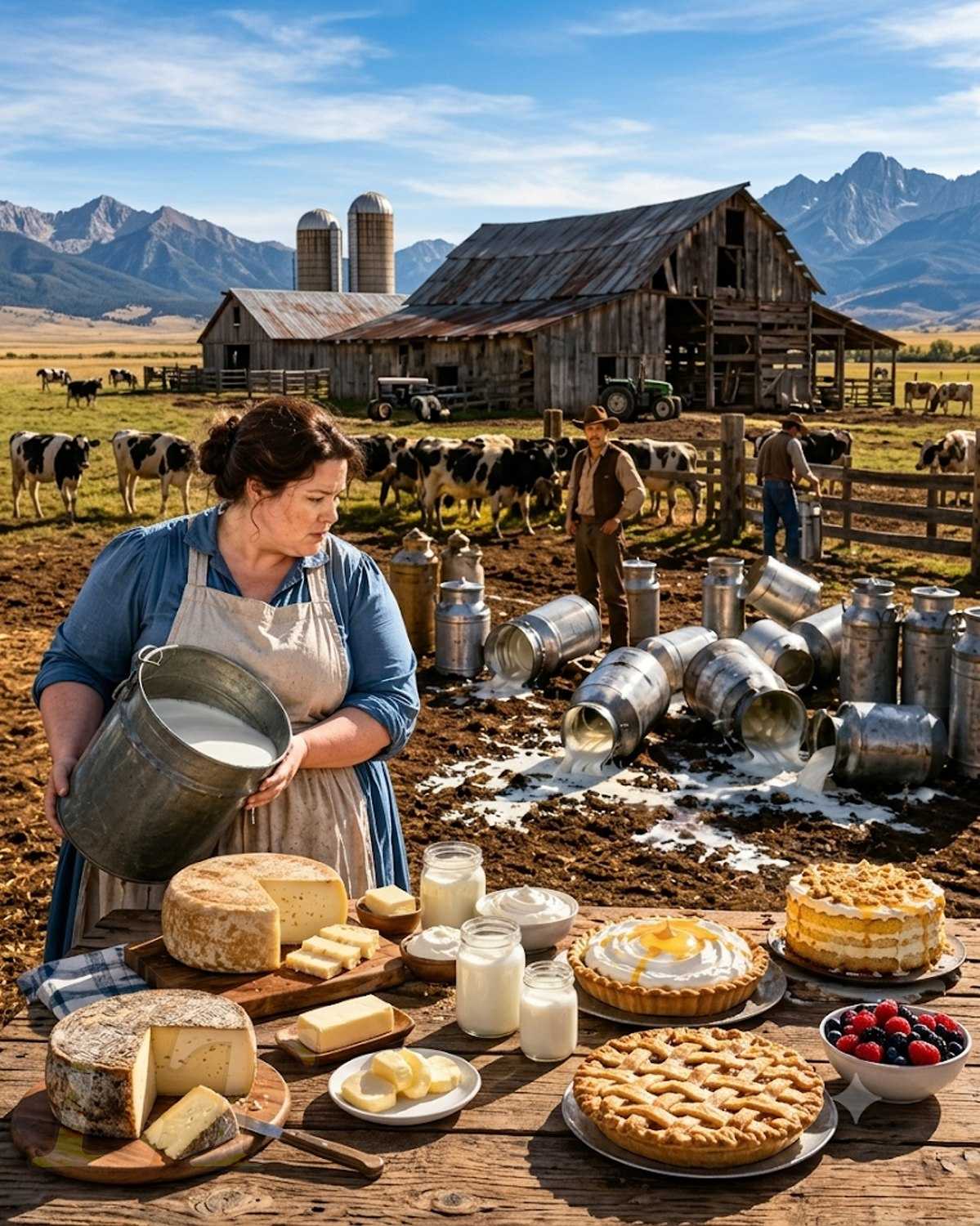
"Don't pour it out!" Clara Bennett shouted.
Reuben froze beside the overturned milk can.
Walter Pierce stood near the barn entrance, holding a folded contract. A small red number had been written beside the delivery requirement.
140.
Clara recognized the number.
And suddenly, the milk spilling into the dirt meant something entirely different.
Three days earlier, she had buried her father.
Now she was standing in the middle of everything he had left behind, watching a young farmhand pour perfectly good milk into the mud because there was nowhere else to put it.
"Miss Clara?" Reuben asked.
She stared at the white stream running between his boots.
"How much is in that can?"
"About eight gallons."
"Was there anything wrong with it?"
"No, ma'am."
"Then why were you throwing it away?"
Reuben looked toward the barn.
"Because nobody's buying it."
Clara closed her eyes for a moment.
Behind her, Pete Granger cleared his throat.
"Your father tried everything he could," he said. "The buyers wouldn't come this far for small deliveries. Mr. Pierce takes his contracted amount, and the rest just sits until we can't use it."
Walter Pierce smiled faintly.
"That's the trouble with farming, Clara. Sentiment doesn't pay the bills."
She turned toward him.
He was fifty-five, tall and thin, with silver-gray hair and a carefully trimmed mustache. His dark navy suit looked expensive enough to cover Pete's unpaid wages for several months.
Clara had known him since childhood.
He had always been polite to her father in public.
She was beginning to wonder what he had been like in private.
"Why are you here, Mr. Pierce?"
He raised the folded document.
"To save you from a very expensive mistake."
"Then you should have called first."
His smile remained, but his eyes narrowed.
"Your father owed me a considerable amount of money. I'm prepared to make an offer on the property before the bank becomes involved."
"The bank is already involved."
"Then you understand the urgency."
Clara looked at the document.
"How much are you offering?"
He named a figure.
Pete lowered his head.
Reuben stopped moving.
Clara did not react.
She had spent nine years keeping books for businesses in Denver. Before that, she had worked in smaller offices, learning the habits of men who believed a woman behind a desk was too insignificant to notice their mistakes.
She knew what a low offer looked like.
She also knew what desperation was supposed to make people do.
"That isn't an offer," she said.
Walter lifted an eyebrow.
"What would you call it?"
"An insult."
His smile disappeared.
"Your father was a good man, Clara. But he wasn't a good businessman."
She felt the words land.
Thomas Bennett had worked that farm for forty years.
He had risen before sunrise, cared for sick calves through freezing nights, repaired fences with hands swollen from arthritis, and kept delivering milk long after the business stopped rewarding him.
He had made mistakes.
Clara knew that.
But he had also died believing the farm might survive him.
She wasn't going to let Walter Pierce turn his memory into a bargaining tactic.
"My father isn't here to defend himself," she said quietly. "So I suggest you speak carefully."
Walter studied her.
Clara was thirty-one, with a full figure and a face that still carried the exhaustion of the funeral. She wore a black mourning dress beneath a worn coat, and her dark hair had been pinned back hastily that morning.
She knew what people saw when they looked at her.
A woman who had left the farm at eighteen.
A daughter who hadn't been present for her father's final difficult years.
A bookkeeper who understood numbers but supposedly knew nothing about livestock.
And, most importantly, someone they expected to surrender.
Walter folded the contract.
"Twenty-four hours," he said.
"For what?"
"To accept my offer."
"And if I refuse?"
"Then the bank can deal with you."
He stepped closer.
"Believe me, Clara. You don't want that."
She held his gaze.
"I'll take my chances."
Walter shook his head.
"Your father was stubborn, too."
He turned and walked toward his carriage.
Clara watched him leave.
Only after the wheels disappeared beyond the gate did she allow herself to breathe.
Pete removed his hat.
"Miss Bennett, there's something I need to tell you."
She already knew from his expression that it wouldn't be good.
"Go ahead."
"I can't stay."
Reuben looked at him sharply.
"Pete—"
"I've got three children at home," Pete interrupted. "Agnes has been stretching flour and potatoes for weeks. Six weeks without pay is enough."
Clara looked at the worn bag beside his feet.
He had packed before she arrived.
She couldn't blame him.
"How much are you owed?"
Pete told her.
She took a small notebook from her pocket and wrote it down.
"How many cows are still producing?"
"Fourteen."
"There were twenty-two when I left."
"Yes, ma'am."
"What happened to the other eight?"
Pete hesitated.
"Mr. Pierce bought them."
Clara stopped writing.
"When?"
"Over the last few months."
"For how much?"
"I don't know exactly."
"Did my father agree to sell them?"
Pete looked away.
"Mr. Pierce said he was settling debts."
Clara glanced toward the road.
Something about that answer troubled her.
But she needed facts before accusations.
"Pete, give me seven days."
He frowned.
"Miss Bennett—"
"Seven days to review the accounts. I'll put what I owe you in writing. If I can't find a way to pay you, I won't ask you to stay."
Pete shifted his weight.
"With respect, your father made promises, too."
The words hurt more than Clara expected.
But she nodded.
"Then don't trust my promises. Judge what I do."
For several seconds, neither spoke.
Finally, Pete picked up his bag.
Clara thought he was leaving.
Instead, he carried it back into the barn.
"I'll give you the week."
She watched him disappear through the doorway.
It was the first good thing that had happened since the funeral.
And it was barely enough to keep her standing.
By noon, Clara had inspected the milking area, counted the remaining cows, checked the feed stores, and examined the broken fences.
The farm was in worse condition than she had imagined.
Two cows needed veterinary attention.
A section of fencing near the north pasture had collapsed.
The barn roof leaked above the storage area.
Several milk cans had rusted around their seams.
The cream separator needed repair.
And there was almost no money available for supplies.
Reuben followed her with a notebook.
"How much milk do we produce each day?" she asked.
"About two hundred and sixty gallons."
She stopped.
"Each day?"
"On a good day."
"And Pierce takes one hundred and forty gallons every week?"
"Yes, ma'am."
"What happens to the rest?"
"We sell some to local families. Some goes to other buyers when they come. Some gets used here."
"And the remainder?"
Reuben looked embarrassed.
"Sometimes it spoils."
"How much?"
"Thirty or forty gallons a week. Sometimes more."
Clara wrote the figure down.
Thirty to forty gallons.
Every week.
That wasn't a small loss.
It was a business bleeding value directly into the ground.
She stared at the milk cans.
Her father had spent years trying to produce more milk.
But perhaps producing more had never been the real problem.
Perhaps the problem was what happened after the milk left the cow.
"Where's the main account ledger?" she asked.
Reuben shook his head.
"Mrs. Marsh would know."
Clara returned to the farmhouse.
Doraththa Marsh had worked for the Bennett family since Clara was a child. Her hair had turned almost completely white, and her hands trembled slightly when she poured tea.
She had prepared a simple lunch.
Clara sat down but didn't eat.
"Doraththa, where did Father keep the farm ledger?"
The older woman went still.
"Miss Clara..."
"What is it?"
"Mr. Pierce took it."
Clara placed her pencil on the table.
"When?"
"Two days after your father passed."
"Why?"
"He said he needed to calculate the debts."
"Did he leave a receipt?"
Doraththa shook her head.
"Did Father authorize him to take it?"
Another shake.
Clara stared at the untouched lunch.
The ledger contained years of deliveries, payments, purchases, and agreements.
Without it, she couldn't verify what Pierce claimed her father owed.
A businessman had removed the financial records of a recently deceased farmer.
And then offered to buy the farm for a fraction of its value.
Clara felt her grief begin to change into something harder.
"Did he take anything else?"
"Not that I saw."
"Did he go into Father's desk?"
Doraththa hesitated.
"Yes."
Clara stood.
"Show me."
The study smelled of old paper and tobacco.
Her father's coat still hung behind the door.
For a moment, she couldn't move.
She remembered him sitting at that desk when she was a girl, checking figures with a pencil worn down to almost nothing.
He had taught her to add columns before she was old enough to understand what the numbers meant.
"Numbers don't lie, Clara," he used to say.
She had believed him.
Later, she learned that people could make numbers tell almost any story they wanted.
She opened the desk drawers.
Receipts.
Feed invoices.
Veterinary bills.
A few bank notices.
But no ledger.
She gathered every surviving document and carried them to the kitchen.
For the rest of the afternoon, she worked.
Doraththa brought coffee.
Reuben came in twice with production figures.
Pete supplied old delivery records from the barn.
Clara arranged everything into columns.
Money received.
Money owed.
Cattle sold.
Feed purchased.
Milk delivered.
Interest charged.
By sunset, she had covered most of the kitchen table.
The numbers didn't agree.
Not even close.
One delivery receipt showed a payment that never appeared in the bank statement.
Another listed a deduction without explanation.
A third referred to an adjustment Clara couldn't match to any invoice.
She checked the arithmetic twice.
Then a third time.
The discrepancies remained.
At nine o'clock, Doraththa appeared in the doorway.
"You need to sleep."
"I need to finish this."
"Your father used to say that."
Clara looked up.
The older woman's eyes were wet.
"He sat at this table so many nights," Doraththa whispered. "He kept saying he'd figure it out."
Clara lowered her pencil.
"Why didn't he tell me how bad things were?"
Doraththa sat across from her.
"Because he was proud."
"He could have asked for help."
"He knew you had your own life."
Clara looked toward the dark window.
For thirteen years, she had believed her father wanted her to stay away from the farm.
He had encouraged her to study.
To work.
To make something of herself beyond the county line.
Now she wondered whether he had simply been trying to spare her the struggle that had consumed him.
"He called me two weeks before he died," she said.
Doraththa nodded.
"He was very tired."
"He asked whether I remembered Grandmother's old creamery."
The older woman looked up sharply.
Clara noticed.
"What?"
"Nothing."
"Doraththa."
The housekeeper folded her hands.
"Your father had been asking about it, too."
"When?"
"Not long before he became ill."
"Why?"
"I don't know."
Clara sat back.
Her grandmother had once made farmhouse cheese and butter in the stone cellar behind the kitchen.
Clara remembered the cool air, the wooden shelves, and the heavy wheels wrapped in cloth.
But the creamery had been abandoned years ago.
Why would her father have been asking about it?
She looked down at the figures again.
There was something she hadn't considered.
Something connected to the milk they couldn't sell.
She reached for another sheet of paper.
Then she heard a carriage approaching.
Doraththa glanced toward the window.
"At this hour?"
Clara stood.
The carriage stopped outside.
A man stepped down carrying a leather briefcase.
He was not Walter Pierce.
He wore a dark coat and a banker's stiff collar.
Clara recognized him immediately.
Mr. Edwin Hargrove.
The manager of the county bank.
She opened the door before he knocked.
"Mr. Hargrove."
"Miss Bennett."
His expression was grave.
"I apologize for coming so late."
"Has something happened?"
He glanced past her at the papers covering the kitchen table.
"I thought it best to speak with you privately."
She stepped aside.
He entered, removed his hat, and placed his briefcase on the table.
Then he took out a sealed envelope.
"Your father's loan has reached a critical point."
Clara felt her stomach tighten.
"How critical?"
Hargrove looked directly at her.
"The bank is prepared to begin proceedings unless the outstanding amount is addressed within seven days."
She nodded once.
"Then I have seven days."
"I'm afraid it's more complicated than that."
He opened the envelope.
Inside was a document bearing her father's signature.
Clara recognized the handwriting immediately.
But there was something else.
A second signature.
Walter Pierce.
And beneath it, a date that made her blood run cold.
The agreement had been signed eight months earlier.
The same month her father's financial problems had suddenly become impossible to control.
Clara reached for the document.
Hargrove placed one finger over a paragraph near the bottom.
"Miss Bennett," he said, "before you read this, there's something you need to understand."
She looked at him.
He hesitated.
Then he said:
"Your father may not have been the only person with a legal claim against this farm."
Clara lowered her eyes to the paragraph.
And there, beneath the signatures, she saw the name of the man who had been waiting for her to fail.
Walter Pierce.
But it wasn't his name that frightened her.
It was the single sentence written directly below it.
She leaned closer.
And began to read...






Comments 0