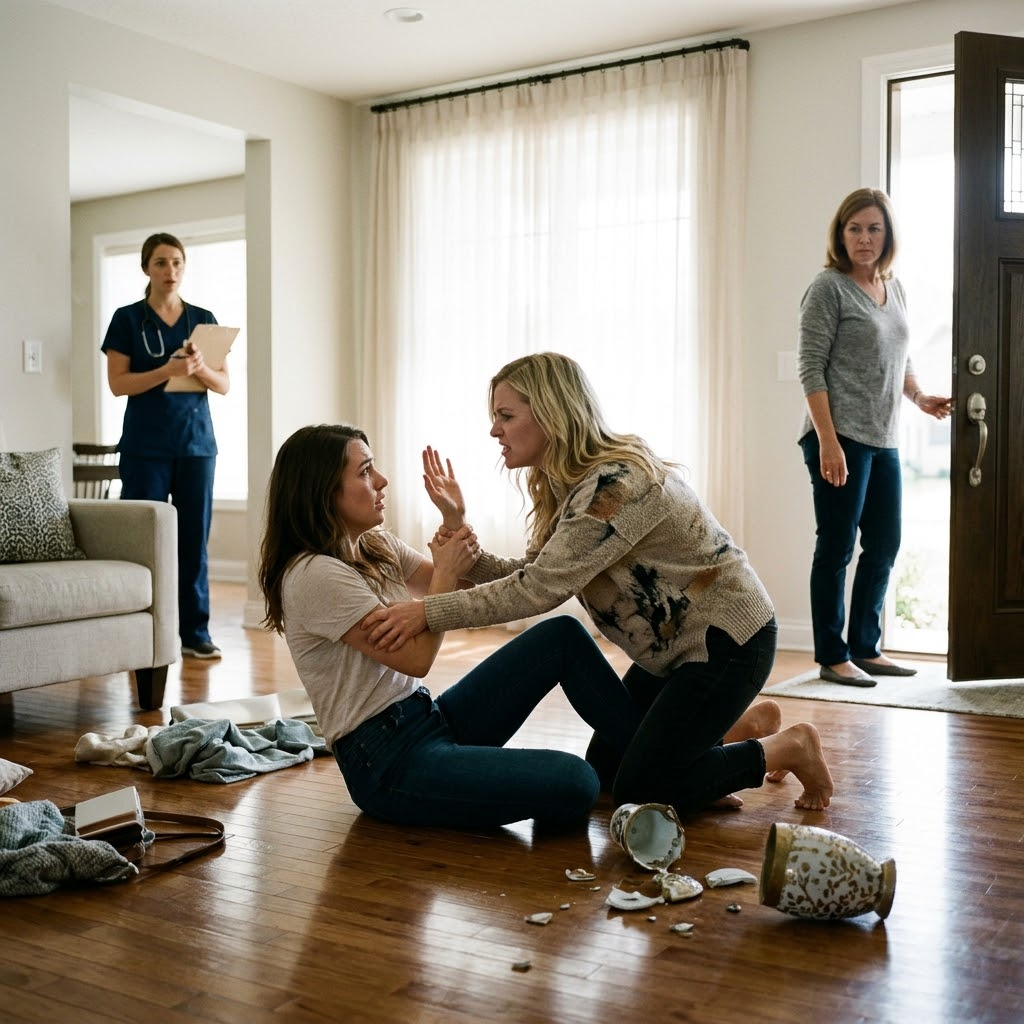
My mother whispered a name I had never heard her say before.
“Richard Vale.”
The phone continued ringing in her hand.
Jolene was still holding the bank statement, her fingers trembling around its edges. Genevieve stood near the doorway with her clipboard pressed against her side, watching my mother as though she had suddenly become a different person.
I knew that name meant something.
I just didn't know what.
“Who's Richard Vale?” I asked.
Mom's eyes snapped toward me.
“Nobody.”
She rejected the call.
The screen went dark.
“Nobody?” I repeated.
“He's an old acquaintance.”
Jolene stared at her. “Then why do you look like you've just seen a ghost?”
“Give me those papers.”
Mom reached for the folder, but Jolene pulled it against her chest.
For once, my sister wasn't obeying our mother. She was protecting something for herself, and the distinction mattered more than either of them realized.
“Not until you explain this,” Jolene said.
Her voice had lost its usual sharpness. She looked down at the statement again, moving her lips as she read the figures.
“Mom, this account has been open for years.”
“Put it away.”
“There are monthly deposits.”
“Jolene.”
“And why are our names listed as beneficiaries?”
Mom took another step forward.
“Because I told you to trust me.”
“That isn't an answer!”
The sudden shout startled even Jolene herself.
I watched my sister's face, trying to understand what she was feeling. Fear, certainly. Confusion, too. But there was something else beneath those emotions, something that looked disturbingly like recognition.
She had seen the account before.
Maybe not the statement itself, but the name, the numbers, or the arrangement.
“Jolene,” I said quietly. “Did you know about this?”
She looked at me.
“No.”
The answer came too quickly.
I didn't challenge her. I simply watched her eyes shift toward the folder.
That tiny movement told me more than her denial.
My mother noticed it, too.
“Both of you are behaving irrationally,” she said. “Those documents don't belong on the floor. Maeve, you're injured. Jolene, help your sister up. We'll discuss this when everyone has calmed down.”
It was the voice she used when she wanted to end a conversation without answering a single question.
For three years, that voice had been enough to silence me.
Not anymore.
“I want my purse.”
Mom stared at me.
“What?”
“My purse. My employment contract. My identification. All of it.”
Jolene glanced down at the handbag beside her knees.
“You're not going anywhere.”
“I am.”
“You can't even stand up.”
“Then I'll sit here until I can.”
My sister opened her mouth, but no words came out.
I placed one hand against the sofa and slowly shifted my weight. Pain shot through my ribs, and the room tilted sideways. I stopped until the dizziness eased.
Genevieve immediately approached.
“Don't try to stand yet. You may have a concussion.”
“I need to get out of here.”
“I understand. But first, I need to make sure you're medically safe.”
She crouched beside me and examined the area near my temple without touching the wound unnecessarily.
“Can you tell me whether your vision is blurred?”
“Yes.”
“Any nausea?”
“A little.”
“Do you remember being struck?”
“Yes.”
“Did you lose consciousness?”
“I don't think so.”
She looked toward my mother.
“I strongly recommend immediate medical evaluation.”
Mom folded her arms.
“She always exaggerates.”
Genevieve didn't respond to the insult.
Instead, she looked at me.
“Maeve, you have the right to seek medical attention. You also have the right to leave this house.”
“I know.”
The words felt unfamiliar in my mouth.
For so long, every decision I made had been filtered through the question of how it would affect my mother. Could she manage the stairs? Would she have enough groceries? Would Jolene remember to pay the electric bill? Would another argument make Mom's blood pressure rise?
I had convinced myself that putting everyone else first was proof that I was a good daughter.
But lying on the floor while my mother guarded a locked door, I finally understood the difference between caring for someone and allowing them to control me.
Genevieve reached for her phone.
Mom moved toward her.
“If you call the police, I'll have your agency contract terminated.”
Genevieve paused.
For a moment, I thought the threat might work.
Then she calmly replied, “You can speak to my agency after Maeve receives appropriate care.”
She turned away and made the call.
Mom's face tightened.
Jolene looked at the bank statement again.
I wanted to see it.
I needed to know why my sister's name appeared beside our mother's on an account I had never heard about.
But before I could ask, Jolene folded the page in half.
“I'm keeping this,” she said.
“No,” I replied. “You're giving it to me.”
She laughed without humor.
“You think you can order me around now?”
“I think those papers came out of my handbag.”
“They concern Mom.”
“They concern an account I helped fund without knowing it existed.”
That stopped her.
Mom turned sharply toward me.
“What did you say?”
I looked at her.
“The account number on that statement. I've seen it before.”
My mother went very still.
I continued.
“I found a recurring transfer while I was organizing the household expenses last month. I copied the account number because I couldn't identify the destination.”
Mom's lips parted.
“You had no right to examine my private finances.”
“I was paying your mortgage.”
“That doesn't give you permission to investigate me!”
“Then you should have paid your own bills.”
The sentence came out more sharply than I intended.
For a moment, I could hear nothing but my own breathing.
Jolene stared at me.
Mom looked almost offended, as if I had committed an act of cruelty by refusing to accept responsibility for her choices.
“You have no idea what I've sacrificed for this family,” she said.
I almost laughed.
Not because anything was funny, but because I had heard those words so many times that they had become a kind of family prayer.
Every sacrifice she described belonged to the past. Every sacrifice she demanded from me belonged to the future.
And somehow, mine never ended.
“I gave up my apartment,” I said. “I paid your mortgage. I paid for groceries, utilities, medication, repairs, and everything else you asked for. I emptied my savings. I took extra shifts. I stopped going out with friends because I couldn't afford it.”
Mom looked away.
“I did all of that because you told me you needed help.”
“You chose to help.”
“Yes,” I said. “I did.”
My voice remained quiet.
“But I never agreed to be trapped here.”
Jolene's expression darkened.
“You're making this sound like we kidnapped you.”
“You locked the door while I was bleeding on the floor.”
She glanced at the deadbolt.
For the first time, she seemed to notice it.
The realization lasted only a second before she hardened her expression again.
“You were acting crazy.”
“You hit me with a glass.”
“You wouldn't listen!”
Genevieve ended her call and returned to my side.
“Help is being arranged,” she said. “I also need you to understand that you should not be left alone right now.”
Mom scoffed.
“I'm her mother.”
“That's not the same thing as being medically qualified.”
The room fell silent.
I could see my mother trying to decide which argument would give her the most control. She looked at Genevieve's clipboard, then at the phone in her hand, then at the folder Jolene was holding.
Her gaze settled on the bank statement.
“Give me the papers,” she said again.
Jolene hesitated.
“Mom, what's in this account?”
“It's none of your concern.”
“You just said my name was on it!”
“Because I put it there.”
“Why?”
Mom's voice rose.
“Because I wanted to protect you!”
Jolene recoiled slightly.
I watched my mother realize what she had admitted.
Then she turned toward me.
“You've twisted everything. You've always been jealous of the relationship your sister and I have.”
For years, that accusation would have sent me into a desperate explanation. I would have listed every birthday gift I had bought, every appointment I had arranged, every night I had stayed awake worrying about them.
I would have tried to prove that I wasn't jealous.
Now I simply shook my head.
“This isn't about jealousy.”
“Then what is it about?”
“Money. Lies. And why you're so frightened of me leaving.”
Mom's eyes narrowed.
“You think a promotion makes you powerful?”
“No.”
I looked at the handbag.
“But it means I don't have to depend on you anymore.”
Jolene shifted her weight.
Her anger had become less convincing. She was still trying to look intimidating, but her eyes kept returning to the statement.
I remembered the first time she had asked me for money.
She had been thirty-two, supposedly launching her event-planning business. She'd shown me a brochure filled with photographs of elegant weddings and corporate receptions.
“I just need a little startup capital,” she had explained. “Once I book a few clients, I'll pay you back.”
I had given her nearly two thousand dollars.
She never paid me back.
A few months later, she asked for more.
When I questioned her about the business, she said the money had gone toward marketing and equipment.
I discovered later that she had purchased designer clothes, attended expensive restaurants, and paid several overdue credit card bills.
When I confronted her, she cried.
Mom told me to forgive her.
“She made a mistake,” Mom said. “Don't ruin your relationship over money.”
So I forgave her.
Then I paid another bill.
And another.
Until I could no longer remember how much she owed me.
Now, as I watched Jolene hold that bank statement, I wondered whether the money I had given her had ever been the only money available to her.
“Jolene,” I said, “how long have you known Richard Vale?”
She flinched.
Mom turned toward me.
“Stop asking questions about that man.”
“Why?”
“Because I said so.”
“That's not a reason.”
Her face flushed.
“You are injured, exhausted, and clearly not thinking straight. You need to stop talking before you make this situation worse.”
I almost smiled, but the pain in my temple made the movement impossible.
“You keep saying that.”
“Because it's true!”
“No. You keep saying it because you want me to be quiet.”
Jolene suddenly stepped between us.
“Enough.”
She placed the statement on the console table.
For one hopeful second, I thought she might finally cooperate.
Then she picked up my phone from the floor.
“I'm calling your boss,” she said.
My stomach tightened.
“What?”
“You heard me. I'll tell him you're having a breakdown. I'll tell him you can't handle the new position.”
“You don't have my boss's number.”
“I can find it.”
“Put my phone down.”
She unlocked the screen using the passcode she had once watched me enter.
I felt a different kind of fear settle over me.
My sister knew too much about my habits. She knew where I kept my spare keys, which bank I used, where I stored my documents, and how I organized my work schedule.
I had never considered that familiarity could become a weapon.
Jolene opened my contacts.
“What's his name again?” she asked, feigning innocence. “The regional director?”
I pushed myself upright despite Genevieve's warning.
“Give it back.”
Jolene looked at the blood on my face.
Then she smiled faintly.
“You really think you're leaving, don't you?”
I stared at her.
“Yes.”
She selected a contact.
Before she could press the call button, Genevieve stepped forward.
“Put the phone down.”
Jolene ignored her.
I reached for the device, but my balance faltered. Genevieve caught my shoulder before I fell.
My sister took two quick steps backward.
“Don't touch me!” she snapped at the nurse.
“No one is touching you,” Genevieve replied. “You're the one holding someone else's phone.”
Jolene looked toward Mom for support.
My mother didn't move.
She was watching the front door.
Then she looked at her phone again.
It began ringing for the second time.
The name on the screen was still Richard Vale.
Mom rejected the call.
A moment later, a message appeared.
I couldn't read it from where I sat, but I saw the effect it had on her.
Her shoulders stiffened.
Her fingers tightened around the phone.
And the color drained from her face.
“What does he want?” Jolene asked.
“Nothing.”
“Then why does he keep calling?”
Mom shoved the phone into her pocket.
“Because he doesn't understand that I don't want to speak to him.”
“Who is he?” I asked.
She looked directly at me.
“Someone you should forget.”
I had spent three years trying to forget my own needs.
I wasn't going to forget this.
“I'm not leaving without my documents,” I said.
Mom's eyes narrowed.
“You're not taking anything from this house.”
“My documents are mine.”
“The money you earned helped maintain this home.”
“And the money I earned is no longer going to maintain it.”
Jolene made a disgusted sound.
“You'd let Mom lose everything?”
I looked at her for a long moment.
“I'm not taking the house away from her. I'm stopping the automatic transfers from my account.”
“You can't do that!”
“I can.”
Mom's expression shifted.
For the first time, I saw something more than anger in her eyes.
She looked frightened by the possibility that the money might actually stop.
“How much have you already paid?” she asked.
The question was so unexpected that I almost didn't understand it.
“What?”
“How much have you paid toward the house?”
I stared at her.
“You know how much.”
“I want you to tell me.”
I thought of the spreadsheet on my laptop. Every mortgage payment, every utility bill, every grocery receipt I had saved. I had created the file to keep myself organized, never imagining it might one day become evidence of how thoroughly my family had depended on me.
“Just over one hundred and twelve thousand dollars,” I said.
Jolene's mouth fell open.
Mom didn't react.
That frightened me more than anything else.
One hundred and twelve thousand dollars was not an insignificant sum. It represented years of work, missed opportunities, and nights when I had gone to bed hungry because I had prioritized the mortgage over my own needs.
Yet my mother stood there as if I had announced the price of a loaf of bread.
“That's not possible,” Jolene whispered.
I looked at her.
“You never asked where the money came from. You just kept asking for more.”
She lowered her eyes.
Then, almost inaudibly, she said, “I thought Mom had savings.”
Mom turned toward her so quickly that Jolene stepped back.
“Don't.”
One word.
A warning.
And suddenly I understood why my sister had looked so frightened when she saw the statement.
She hadn't known everything.
But she had known enough to suspect that our mother's story was incomplete.
Genevieve approached me again.
“Maeve, we need to get you medical attention. Can you walk with assistance?”
“I think so.”
“Don't rush.”
She helped me to my feet, keeping one hand near my elbow.
Pain flared through my side, but I remained standing.
The room swayed.
I focused on the sofa until the dizziness eased.
Mom watched us without moving.
“Where do you think you're going?” she demanded.
“To get medical help.”
“You can't just leave in the middle of this conversation.”
I looked at her.
“You locked the door.”
She glanced toward the deadbolt.
For a moment, she seemed unable to find a response.
Then Jolene reached for the statement on the console table.
“Wait,” she said.
Her voice was different now.
Quieter.
She turned the paper over and examined the handwritten note clipped to the back.
I watched her eyes move across the lines.
Her lips parted.
She looked at Mom.
Then at me.
“Maeve,” she whispered, “this account wasn't opened three years ago.”
My mother stopped breathing for a moment.
Jolene held up the page.
“It was opened before Mom's accident.”
She looked down at the statement again.
Then she read the date aloud.
It was eight years earlier.
Eight years before Mom broke her hip.
Eight years before I moved back home.
Eight years before I began paying the mortgage.
I stared at the account number.
The transfers I had discovered were only the most recent entries in a much longer history.
The money had been there long before my sacrifices began.
And if the account had existed for eight years, then the question wasn't simply why my mother had hidden it from me.
The question was why she had needed my money at all.
Jolene slowly turned the page.
At the bottom was a line of small print identifying the original trustee.
She read the name.
Then she looked at me with an expression I had never seen on her face before.
“Maeve,” she whispered, “the original trustee was Dad.”
My father had been dead for eleven years.
Before I could ask another question, Mom's phone vibrated again.
This time, she didn't reject the call.
She answered it.
And the voice coming through the speaker said my name.






Comments 0