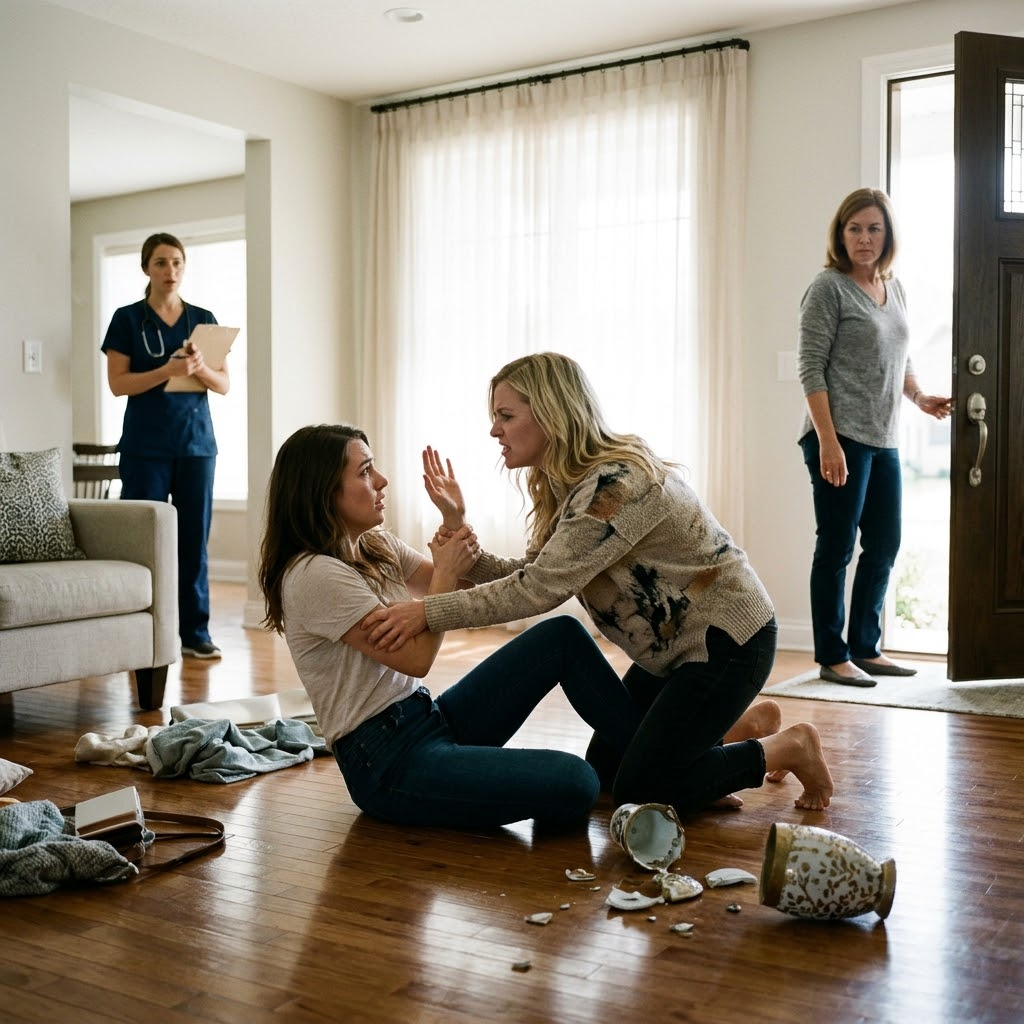
Jolene slammed my shoulder against the hardwood floor and screamed, "Give me the purse!"
My mother turned the deadbolt, trapping her injured daughter inside.
Beside my hand lay a broken crystal glass and a torn piece of paper bearing a bank account number.
For the first time in three years, I stopped begging my family to love me.
I had never imagined that the sound of a locked door could hurt more than shattered glass.
Yet as the deadbolt clicked into place, I understood exactly what my mother had chosen.
She had chosen my sister.
Again.
"Hold her still!" Mom shouted.
Jolene pressed her knee against my ribs. Pain spread through my side as I tried to pull myself upright. My left temple throbbed, and warm blood slipped past my eyebrow, blurring half the room.
The crystal tumbler Jolene had struck me with lay broken several feet away. Tiny fragments glittered beneath the afternoon light. A decorative vase had also shattered when I fell, scattering pale ceramic pieces across the floorboards.
My burgundy handbag rested beside my right hip.
Jolene reached for it.
I caught the strap.
"Let go!" she snapped.
I looked at her, trying to recognize the sister I had known since childhood.
She was thirty-five, six years older than me, with a short auburn bob and an expensive forest-green cardigan. Her clothes always looked new, even though she claimed she could barely afford groceries. She wore the expression of someone who had never seriously considered the possibility that another person might refuse her.
"Jolene," I whispered, "you hit me."
She stared at the blood on my face.
For one brief second, I thought she might finally understand what she had done.
Then she tightened her grip on my arm.
"You made me do it."
Those five words hurt almost as much as the blow.
Behind her, Mom stood beside the front door with one hand resting on the lock. At sixty-one, she had perfected the art of appearing fragile whenever responsibility threatened to fall on her shoulders. Her silver-gray hair was neatly arranged, and her plum sweater hung smoothly over beige trousers.
She looked like a woman who needed help.
She had spent three years convincing everyone that she did.
"Maeve, stop making this worse," she said. "Just give your sister the bag."
I swallowed.
"Call an ambulance."
Mom's mouth tightened.
"You're not dying."
"Then you won't mind calling one."
Her eyes hardened.
That was when I realized she wasn't confused. She wasn't frightened by the blood or the broken glass. She was calculating what would happen if someone outside our family learned what had taken place inside it.
She glanced toward the open doorway behind the living room.
Genevieve stood there in deep teal medical scrubs, holding a cream-colored clipboard against her chest.
The home-health nurse had arrived less than fifteen minutes earlier.
She had witnessed enough to understand that this wasn't an ordinary family argument.
"Someone needs to call emergency services," Genevieve said.
Mom immediately turned toward her.
"This is a private family matter."
"Your daughter is bleeding."
"She fell."
I stared at my mother.
Even now, with Jolene's knee digging into my side, Mom had invented a lie before anyone had asked her a question.
Genevieve lowered her clipboard slightly.
"Ma'am, I saw what happened."
For the first time, Jolene looked uncertain.
Then her expression changed again.
"You don't know anything about us," she snapped at Genevieve. "Stay out of it."
Genevieve didn't move.
I wanted to thank her, but my throat felt too tight.
Instead, I concentrated on breathing.
In.
Out.
Slowly.
I had spent three years learning to manage pain without allowing anyone to notice how much it cost me.
At first, that skill had been useful.
Now it was the only thing keeping me from falling apart.
Three years earlier, Mom had shattered her hip in a fall.
I had been twenty-six, living alone in a small apartment near my workplace, paying my own bills and finally saving enough to consider buying a place of my own. I worked in freight logistics, coordinating shipments across several states. The hours were brutal, but I liked the work. Every delayed truck, missing pallet, and scheduling crisis presented a problem I could solve.
My life was exhausting.
It was also mine.
Then Mom was hospitalized.
Jolene arrived at the hospital wearing oversized sunglasses and carrying a designer handbag. She cried in front of the nurses, announced that she couldn't bear to see our mother suffering, and disappeared before anyone could ask her to stay overnight.
I remained.
I signed paperwork, arranged rehabilitation appointments, spoke with insurance representatives, and learned how to help Mom move safely from a bed to a wheelchair.
When the hospital finally discharged her, Mom couldn't manage the stairs in her house.
Jolene stood in the kitchen while I helped Mom settle into a chair.
"We'll have to work something out," she said.
I should have recognized the danger in those words.
Instead, I asked what she needed.
Mom took my hand.
"Just until I'm stronger, sweetheart. I don't know what I'd do without you."
I gave up my apartment two weeks later.
I moved my belongings into my childhood bedroom and told myself it was temporary. I could save money by living at home, help Mom recover, and return to my independent life when she no longer needed me.
But recovery became an excuse.
Every time Mom improved, a new problem appeared. Her physical therapy became too tiring. The house needed repairs. The insurance paperwork was confusing. Jolene was supposedly searching for better work but never seemed to find time to attend an interview.
The bills accumulated.
My savings disappeared.
Then Mom started asking me to pay the mortgage.
"It's only for a little while," she said.
I paid it.
The electricity bill came next. Then the water, internet, groceries, prescriptions, and repairs to the washing machine.
I worked ten-hour days, returned home, cooked dinner, and spent evenings organizing Mom's medications.
Jolene slept until late morning whenever she wasn't attending one of her supposed event-planning meetings.
She described herself as an elite event planner, although in three years I had seen her organize only two small birthday parties.
Whenever I questioned her, she accused me of being jealous.
"You have a steady job," she would say. "You don't understand what it's like trying to build a business."
I stopped arguing.
It seemed easier to pay another bill than to spend an hour defending myself against someone who had no intention of listening.
By the end of the first year, my savings had fallen to a few hundred dollars.
By the end of the second, I was using credit cards to cover expenses I couldn't afford.
And by the third year, I had exactly forty-seven dollars in my personal savings account.
Forty-seven dollars.
I remembered the number because I had checked my banking app during lunch the day before everything changed.
I had stared at the screen until the numbers blurred.
Then I had closed the app, returned to my desk, and completed a shipment report worth more money than I could earn in several months.
That afternoon, my regional director called me into his office.
He told me the company was opening a new regional operations hub two hours upstate. The position required someone who understood logistics, could manage difficult personnel, and remained calm when everything went wrong.
He offered me the job.
Regional Operations Manager.
My salary would triple.
The company would provide a car, cover relocation expenses, and help me secure temporary accommodation while I found a permanent apartment.
I sat across from him, staring at the offer letter.
"Are you sure you want me?" I asked.
He smiled.
"Maeve, you've been doing half the job without the title for two years."
For the first time in a long while, someone had looked at my work and recognized its value.
I signed the contract that afternoon.
I didn't tell my family immediately.
I knew they would protest, and I wanted time to organize everything before the arguments began.
I booked a month of certified home-health care with Genevieve, who had excellent references and experience helping patients recover mobility after serious injuries.
I prepaid the service.
I stocked the pantry with groceries, labeled Mom's medication schedule, and prepared a care binder containing emergency contacts, insurance details, appointment dates, and every household bill.
I also wrote down the name of the company handling the mortgage.
I wasn't abandoning Mom.
I was arranging professional care and finally allowing myself to live.
But I underestimated how deeply my family had come to depend on my surrender.
That morning, I discovered Genevieve standing on the porch with her clipboard, looking confused.
Mom had called the agency and attempted to cancel the contract.
She claimed she had never requested a nurse and didn't want strangers entering her house.
When I confronted her, she folded her arms.
"I don't need some woman telling me when to take my medicine."
"Genevieve isn't here to control you. She's here to help."
"I have you."
"I'm leaving, Mom."
She stared at me as if I had spoken in a foreign language.
Then she called Jolene.
My sister arrived twenty minutes later.
The argument lasted nearly an hour.
They accused me of selfishness, ingratitude, and betrayal. They reminded me of every birthday dinner Mom had cooked, every school uniform she had bought, every sacrifice parents supposedly made for their children.
I reminded them that I had paid the mortgage for three years.
Jolene laughed.
"Nobody forced you."
Mom looked away.
That response had always been their most effective weapon. Whatever I gave was described as my choice, and whatever they demanded became my obligation.
I told them I was moving.
I told them my bank account would no longer cover their expenses.
And I told them the home-health contract was already paid, so there was no reason for Mom to go without care.
Jolene's face turned red.
"You can't just walk out!"
"I can."
"You think you're better than us because you got some stupid promotion?"
"No."
"Then prove it. Stay."
I picked up my duffel bag.
That was when she grabbed the crystal tumbler from the kitchen counter.
I remembered the sudden movement more clearly than the impact itself.
One moment, she was standing in front of me, furious and breathing hard.
The next, the heavy glass struck my temple.
A burst of white light filled my vision.
I stumbled backward, caught my foot against the edge of the rug, and fell.
The vase broke beneath my arm.
Then Jolene was on top of me.
Now, back on the hardwood floor, I looked at her hand gripping my purse strap.
"Please," I said, although I wasn't pleading for myself anymore. "Just let me go."
She leaned closer.
"You're going to cancel the lease. You're going to tell your boss you changed your mind. Then you're going to apologize to Mom."
I stared at her.
"And if I don't?"
Her eyes narrowed.
"Then you can find out what happens when you stop being useful."
My mother stepped away from the door.
"Jolene, get the bag."
Genevieve moved forward.
"Let her go."
Mom turned sharply.
"I said this is a family matter!"
"And I said she needs medical attention."
"You're being paid to care for her, not interfere in our lives."
Genevieve's expression changed.
"Actually, I'm being paid to provide medical care. Which is exactly what I'm trying to do."
For a moment, no one spoke.
Then Mom looked at Jolene.
"Get her phone, too."
My sister reached toward my pocket.
I twisted away, and pain flared through my ribs.
"Stop!" Genevieve shouted.
Jolene froze.
The nurse had taken another step forward. Her clipboard was no longer held against her chest. She had placed it on the console table beside the doorway.
"I witnessed the assault," she said. "I will tell the truth about what happened here."
Mom's face lost some of its color.
"You wouldn't dare."
"I would."
Jolene looked toward the front door, then back at me.
I could see her thinking.
She had always relied on the assumption that I would protect her. When she missed rent on an apartment she had briefly tried to maintain, I covered it. When she overspent on clothes, I lent her money. When she lied to Mom about her business, I remained silent because I didn't want another argument.
She believed my silence meant consent.
She had never understood that it meant exhaustion.
"Give me the purse," she repeated.
I loosened my fingers around the strap.
Not because I was surrendering.
Because I needed to think.
The bag contained my wallet, identification, relocation documents, and the signed employment contract. It also contained a small folder of financial records I had collected during the previous month.
Those records had begun as a practical effort to organize the household bills.
Then I noticed a recurring charge I couldn't explain.
A transfer had been leaving an account connected to Mom's mortgage payments every month. The amount was too large to be a utility bill and too consistent to be an accidental charge.
When I asked Mom about it, she told me not to worry.
When I asked Jolene, she accused me of snooping.
I had saved the account details and planned to investigate them after moving.
I didn't yet understand what the records meant.
But I knew my family was hiding something.
And now they were willing to hurt me to keep me from leaving.
I looked at my mother.
"Why are you so afraid of me going?"
She blinked.
"What?"
"You keep saying I owe you. You keep saying I can't leave. But if everything is fine, why does it matter where I live?"
"Because you're my daughter!"
"That doesn't answer the question."
Her lips parted.
For the first time that afternoon, she had no immediate response.
Jolene yanked the handbag strap.
I let it slide several inches.
She mistook the movement for surrender and pulled harder.
Then I looked directly at her.
"Do you even know where the money goes?"
Her expression changed.
It was small, almost invisible.
But I saw it.
Her fingers tightened around the strap.
"What money?"
"The money I've been paying into this house."
Mom moved quickly.
"Don't listen to her, Jolene."
That was when the room became completely silent.
Not because anyone had stopped breathing.
Because Jolene had turned toward our mother.
"What does she mean?"
Mom stared at me with a look I had never seen before.
It wasn't anger.
It wasn't disappointment.
It was fear.
Real fear.
I felt a cold, unfamiliar clarity settle over me.
For three years, I had believed I was the only person in the house keeping track of the money. I had believed Mom's medical bills explained the financial pressure, that Jolene's failures explained the constant emergencies, and that my sacrifice was the only thing preventing everything from collapsing.
But the expression on my mother's face suggested there was another explanation.
Something she had never intended me to discover.
Genevieve reached for her phone.
Mom immediately stepped toward her.
"Put that away."
"No."
"You cannot call anyone."
"Watch me."
Jolene released the purse strap long enough to turn toward the nurse.
The pressure on my ribs eased.
I drew a painful breath and pushed myself onto one elbow.
My mother noticed.
"Stay down," she ordered.
I ignored her.
Using the edge of the sofa for support, I managed to sit upright. The room tilted, and I pressed my fingertips against the floor until the dizziness passed.
Genevieve crouched several feet away.
"Maeve, can you tell me your full name and whether you lost consciousness?"
"Maeve Bennett. I don't think so."
"Do you know what day it is?"
I answered.
She nodded, but her expression remained serious.
"I'm going to arrange medical assistance."
Mom shook her head.
"She doesn't need a hospital."
"That's not your decision to make for her."
I looked at Genevieve.
"Thank you."
The words came out quietly.
They seemed to enrage my mother more than shouting would have.
"After everything I've done for you," she said, "this is how you repay me?"
I stared at her.
Everything she had done for me.
I tried to remember the last time she had asked how my work was going, whether I was tired, or whether I had enough money left for myself.
I couldn't.
But I remembered every time she had called me selfish for buying something unnecessary, even when that something was a new pair of work shoes.
I remembered the evening I had eaten crackers for dinner because the grocery budget had run out.
I remembered Jolene arriving home with shopping bags and asking me to cover another bill.
And I remembered the forty-seven dollars.
"I repaid you for three years," I said.
My voice was still weak, but it didn't shake.
"Every month. Every bill. Every emergency. I paid you back until I had almost nothing left."
Mom's eyes flashed.
"You lived here!"
"And I paid for it."
Jolene stepped toward me again.
"Shut up."
"No."
The word surprised all three of them.
It surprised me, too.
Jolene stopped.
I continued before I could lose my nerve.
"I arranged care for Mom. I paid for it in advance. I bought groceries. I organized every bill. I did everything you asked, and you still tried to stop me from leaving."
Mom's mouth tightened.
"You are making a terrible mistake."
"Maybe."
I looked at the locked front door.
"But it will be my mistake."
Genevieve stood and picked up her clipboard.
"I need to make a phone call."
She moved toward the interior doorway, keeping her eyes on the three of us.
Mom remained beside the front door.
Jolene stood between me and the handbag.
For several seconds, no one moved.
Then my sister bent down and seized the bag.
I reached for the strap, but she pulled it away.
"Let's see what you're hiding," she said.
She opened the zipper.
My wallet fell onto the floor, followed by my keys and a folded relocation schedule.
Jolene snatched up the employment letter.
Her eyes moved across the first page.
Then she looked at the salary figure.
Her mouth fell open.
"Mom."
My mother didn't answer.
Jolene turned the page.
"Mom, she wasn't just thinking about leaving."
She held the contract up.
"She already signed."
Mom stepped toward her.
"Give me that."
Jolene ignored her and searched deeper into the bag.
She found the folder containing the financial records.
I watched her pull it free.
The folder was thin, held together by a black elastic band. Inside were copies of account statements, several transaction printouts, and a handwritten note with a number I had circled twice.
I had planned to examine those records in the privacy of my new apartment.
Now Jolene was holding them over a floor scattered with broken glass.
She flipped through the pages.
At first, her expression showed irritation.
Then confusion.
Then something close to panic.
She stopped at the final statement.
"Mom," she whispered, "why is your name on this account?"
My mother went completely still.
Genevieve stopped in the doorway.
I looked at the statement in Jolene's hand.
At the top was the name of a financial institution I recognized.
Beneath it was the account number I had copied from the unexplained transfers.
And beside the account holder's name was a second name.
My sister's.
Jolene looked up at our mother.
"Why are we both listed as beneficiaries?"
Mom lunged for the paper.
Jolene pulled it back.
Then she turned to the last page, where a single handwritten note had been clipped behind the statement.
Her face drained of color.
She read the first line silently.
Then she looked at me.
For the first time in my life, my older sister appeared genuinely afraid of what I might know.
"Maeve," she whispered, "where did you get this?"
Before I could answer, my mother's phone began ringing beside the locked front door.
She looked at the screen.
And when she saw the name of the person calling, she whispered a name I had never heard her say before—






Comments 0