The photograph showed my father's handwriting beneath a sentence that made my hands go cold.
Maeve, if you're reading this, it means your mother failed to tell you the truth.
I stared at the screen until the words blurred.
The envelope lay open in Jolene's photograph, its edges torn unevenly, as though someone had ripped it apart in a hurry. My name was written across the front in the familiar blue ink I remembered from birthday cards and notes he used to leave beside my breakfast.
Eleven years had passed since his funeral.
Three weeks had passed since my twenty-ninth birthday.
And now, after a day of discovering that my family had concealed a trust fund and after learning that my mother had deliberately hidden a letter from my father, I was looking at a message that suggested he had known exactly what would happen.
My phone rang.
Jolene.
I answered without greeting her.
"Where did you find the letter?"
There was a pause.
"Hello to you, too."
"Jolene, where is it?"
"At home."
"With Mom?"
"She doesn't know I have it."
I pressed my free hand against my forehead, careful not to touch the bandage.
"You called Genevieve's agency and demanded that they destroy her report."
Silence.
Then Jolene said, "How do you know about that?"
"Genevieve told me."
"She had no right to involve herself in our family."
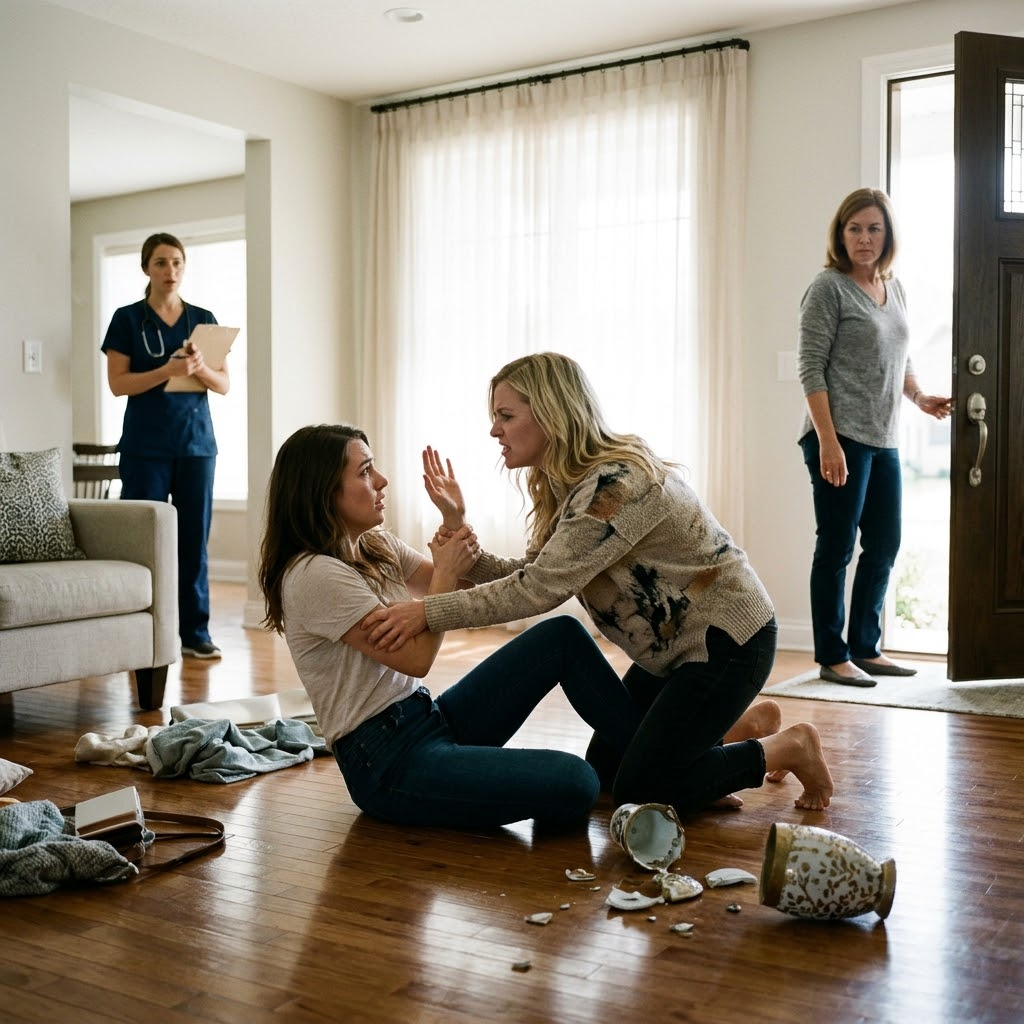
"She witnessed you pinning me to the floor while Mom locked the door."
"You keep saying it like I planned to hurt you."
"You struck me with a glass."
"I was angry!"
"And you tried to take my purse."
"You were leaving us with nothing!"
I closed my eyes.
There it was again. The same accusation, repeated in different forms until I was expected to defend myself rather than ask why they believed they owned my future.
"I wasn't leaving you with nothing," I said. "I prepaid a month of professional care for Mom. I stocked the pantry. I organized the bills. I arranged everything before I left."
"Mom said the nurse was trying to take over."
"Mom canceled the contract because she wanted me to stay."
Jolene didn't answer.
I heard a door close on her end of the call.
"Look," she said finally, her voice lower, "I know what happened yesterday was bad."
"Bad?"
"I shouldn't have hit you."
The admission should have meant something.
A part of me had spent years waiting for Jolene to acknowledge even one of the things she had done. I had imagined her apologizing for the money, the lies, the endless emergencies that somehow became my responsibility.
But hearing her admit what she had done did not erase the image of her kneeling over me while blood ran down my face.
"Why did you open Dad's letter?" I asked.
"Because Mom told me to get rid of it."
My fingers tightened around the phone.
"What?"
"She found it in a locked drawer in her bedroom. She was going to burn it, but I took it before she could."
"Why would she burn a letter from Dad?"
"I don't know."
"You expect me to believe you took it to protect me?"
"No." Jolene's answer came so quickly that I paused. "I took it because I wanted to know what was inside."
For once, she wasn't pretending to be noble.
I appreciated the honesty more than I wanted to admit.
"What does it say?"
"I haven't read all of it."
"Jolene."
"I'm serious. Some of the pages were stuck together, and the last page is missing."
"How many pages?"
"Four. Maybe five. The envelope was sealed, but Mom had already opened it years ago. She folded the letter back up and hid it."
"How do you know she opened it?"
"Because the seal was broken before I touched it."
I looked at the photograph again.
The torn edge of the envelope was unmistakable.
"Send me every page."
"I can't."
"Why not?"
"Because Mom has been looking for the letter all morning. I had to put it somewhere she wouldn't find it."
"Where?"
"Somewhere safe."
I almost laughed.
"Jolene, you attacked me yesterday. Forgive me if I'm not willing to take your word for anything."
"I know."
Her voice cracked slightly.
For several seconds, neither of us spoke.
Then she said, "Maeve, there's something else."
I waited.
"Mom knows Richard contacted you. She called him last night and threatened to sue him if he disclosed anything about the trust."
My stomach tightened.
"What did he say?"
"I don't know. She wouldn't tell me. But after the call, she went into Dad's old study and started tearing papers out of the filing cabinet."
I sat straighter.
"That room hasn't been used in years."
"I know."
"Why would she suddenly be searching it?"
"Because she thinks Dad left something behind."
I glanced at the financial records spread across my desk.
"What kind of something?"
"I don't know, Maeve. That's why I'm calling you."
I rubbed my temple gently.
"Jolene, I need you to listen carefully. If you have Dad's letter, don't destroy it. Don't give it to Mom. Don't let anyone alter it. I want Richard to examine it."
"And what happens to me?"
The question caught me off guard.
"What do you mean?"
"Once Richard finds out what Mom did, what's going to happen to us?"
I stared at the hotel wall.
For three years, I had answered every question about my family's future as if it were my responsibility to guarantee that nobody suffered consequences.
I wasn't doing that anymore.
"I don't know," I said. "But I know we can't keep pretending nothing happened."
Jolene exhaled shakily.
"Mom says Dad would never have wanted us fighting over money."
"Then why did she hide the trust?"
"I don't know."
"Why did she keep the letter from me?"
"I don't know."
"Why did you try to steal my purse?"
This time, she didn't answer.
I waited.
Finally, she whispered, "Because I was scared."
The admission was so quiet I nearly missed it.
"Scared of what?"
"Of losing everything."
I looked at the account statements.
"You've never paid the mortgage."
"I know."
"You've never paid the utility bills."
"I know."
"I gave you money for your business, your credit cards, and your rent. You told me you needed help, and I believed you."
"I know, Maeve."
"Then what were you scared of losing?"
Her breathing became uneven.
"Mom told me that if you left, the house would be taken away. She said the trust wasn't enough to cover everything, and she said Dad had made mistakes before he died."
I frowned.
"What mistakes?"
"She never explained."
"And you believed her?"
"I wanted to."
I leaned back against the chair.
That was the part I understood, even if I couldn't forgive it.
Jolene had built her life around our mother's promises because those promises allowed her to avoid responsibility. As long as I kept paying, Jolene never had to confront the possibility that she had become dependent on someone she treated with contempt.
I had done something similar, only I had called it love.
"I need the letter," I said.
"I'll bring it to you."
"No. Don't come to the hotel. Send it directly to Richard's office or arrange a neutral handoff with him."
"Mom will know."
"She already knows I spoke to him."
"She'll be furious."
"That's her problem."
Jolene fell silent.
Then she asked, "Do you hate me?"
The question landed harder than I expected.
I thought about the glass striking my temple. I remembered the pressure of her knee against my ribs, the way she had reached for my handbag while Mom guarded the door.
"I don't know what I feel about you yet," I said honestly. "But I know I can't trust you right now."
She began to cry.
I didn't rush to comfort her.
That was new.
For most of my life, whenever Jolene cried, I had felt responsible for making the tears stop. I would apologize even when I hadn't done anything wrong, offer money when she complained about being broke, or agree to whatever she wanted because I couldn't bear the tension.
This time, I let the silence remain.
After a minute, she whispered, "I'll contact Richard."
"Good."
"And Maeve?"
"Yes?"
"I'm sorry I hurt you."
I closed my eyes.
"I hear you, Jolene."
It wasn't forgiveness.
It wasn't reconciliation.
It was simply the truth.
When the call ended, I saved the photograph she had sent and forwarded it to Richard with a brief explanation. I asked him to preserve the message and advise me on how to obtain the original letter safely.
Then I opened the photograph again.
My father's handwriting was slightly slanted, with the capital letters leaning forward. I remembered how he used to write my name on envelopes when I was little, carefully printing each letter as if it mattered that I could recognize it.
The visible sentence was only a fragment.
But it was enough to make me wonder what else he had written.
My phone rang again.
Richard.
"Maeve, I've seen the photograph," he said. "Did Jolene tell you where the original letter is?"
"She says she has it, but she won't tell me where."
"That's probably for the best until we can arrange a secure transfer."
"Can you read the handwriting?"
"I can identify your father's writing, yes. The visible sentence appears consistent with his other correspondence."
I swallowed.
"Do you know what he meant by the truth?"
"I have a theory, but I won't present it as fact until I verify the underlying records."
"What theory?"
Richard paused.
"Your father asked me several questions about the documentation surrounding your birth. He wanted to know whether a change had ever been made to the original records and whether the change had been properly authorized."
My heart began pounding.
"Are you saying my birth certificate was changed?"
"I'm saying your father suspected that the records available to him were inconsistent. I don't know whether the discrepancy was clerical, legal, or something more significant."
"Did he think I wasn't his daughter?"
"I can't answer that yet."
I gripped the edge of the desk.
"Why does everyone keep saying that?"
"Because I don't want to mislead you, Maeve. If I tell you something that isn't supported by the evidence, I could cause you unnecessary distress."
I looked at the photograph.
My mother had signed for the letter.
She had kept it for eleven years.
She had written a note instructing someone not to let me discover what Dad knew about my birth.
There was no innocent explanation that I could see.
"Can you request my original birth records?" I asked.
"Yes. We'll need to follow the appropriate process, and access may depend on the records involved. I'll explain the options when we meet."
"Then let's do that."
"We have an appointment with an independent trusts-and-estates attorney tomorrow morning. I recommend we also discuss the birth records with a qualified professional who can help establish what documents exist and what they mean."
I agreed.
Before ending the call, I asked one more question.
"Richard, did my father ever say why he wanted the letter delivered when I turned twenty-nine?"
"He wrote that he wanted you to be old enough to make your own decisions without pressure from other family members."
I looked down at my hands.
"Did he say what decision I would need to make?"
"No."
His answer was immediate.
"But he made it clear that the choice had to be yours."
After the call ended, I remained at the desk for a long time.
The words stayed with me.
The choice had to be yours.
Perhaps that was what my father had wanted to protect.
Not just money.
Not just property.
The right to decide what kind of life I wanted, without someone else using family loyalty to make the decision for me.
I had spent three years surrendering that right.
I wasn't going to surrender it again.
That afternoon, Genevieve came to the hotel with a copy of her written incident report.
I had asked her to meet me in the lobby because I wanted to keep the arrangement public and documented. She arrived carrying a plain folder and wearing the same deep teal scrubs she had worn at my mother's house.
She looked relieved when she saw me standing.
"How are you feeling?"
"Better than yesterday."
"That's good. Please don't overdo it."
We sat at a small table near the reception desk.
Genevieve placed the folder between us.
"This is a copy of the report I submitted to my agency. It records what I personally witnessed, including your mother's attempt to block the door and Jolene's efforts to restrain you."
I opened the folder.
The report was factual and detailed. It included the time she arrived, the condition of the room, the injury to my temple, and the words she remembered hearing.
There were no accusations beyond what she had observed.
No speculation.
No dramatic embellishment.
It was exactly what I needed.
"Thank you," I said.
"You're welcome."
I looked up.
"Did Jolene really contact your agency?"
"Yes. She demanded that the report be destroyed and said the incident had been exaggerated. My supervisor refused."
"Did she explain why?"
Genevieve shook her head.
"She said our involvement could expose a secret your father had paid to keep buried."
The sentence made my stomach tighten again.
"Those were her exact words?"
"Yes. My supervisor wrote them down immediately after the call."
"Could I obtain a copy of that record?"
"You can request it through the agency. I can't give you another employee's internal notes without authorization, but I'll make sure your request reaches the appropriate person."
I nodded.
"That's fair."
Genevieve studied me for a moment.
"Maeve, can I ask you something?"
"Of course."
"Did you know your family was capable of behaving that way?"
I looked down at the report.
I wanted to say no.
I wanted to insist that yesterday had been an isolated incident, a terrible mistake caused by anger and panic.
But I remembered the years of financial pressure, the manipulation, and the way my mother had treated my independence as a personal betrayal.
"I knew they could be cruel," I said. "I didn't think they'd go that far."
Genevieve nodded slowly.
"Sometimes people cross a line because they believe the person they've hurt will keep protecting them."
I thought about the number of times I had lied to friends to cover for Jolene, or told coworkers that Mom was improving when she was refusing treatment, or hidden my financial problems because I didn't want anyone to think badly of my family.
"That's probably true," I said.
"Are you planning to return home?"
"No."
"Good."
She didn't say it triumphantly.
She said it with quiet relief.
I folded the report and placed it back in the folder.
"I need to ask you something about Mom's care. If she refuses professional assistance, what happens?"
"The agency will document the refusal and follow its procedures. If she has the capacity to make her own medical decisions, she generally has the right to decline services. But that doesn't mean you're obligated to provide care yourself."
I let the words settle.
For three years, my mother had treated my availability as an entitlement.
I had assumed that if she refused help, the responsibility automatically returned to me.
Now I understood that there was another possibility.
She could refuse care.
And I could refuse to become her caregiver.
Genevieve stood.
"Please keep the report somewhere safe. If you need me to verify what I witnessed, I'll cooperate with the appropriate authorities."
"Thank you."
She hesitated before leaving.
"Maeve, there's one more thing."
I looked up.
"What is it?"
"When I returned to the house after my shift, your mother was standing outside the front door. She asked me whether you had told anyone about the trust."
My stomach tightened.
"What did you say?"
"I told her that I wouldn't discuss your private communications with her."
"And then?"
Genevieve's expression became troubled.
"She asked whether you had mentioned a name."
"Which name?"
"She didn't say it at first. Then she asked whether you had spoken to anyone named Daniel Mercer."
I stared at her.
The name meant nothing to me.
"Who is Daniel Mercer?"
"I don't know. But when I told her I couldn't answer, she said, 'If that man has contacted Maeve, everything is already ruined.'"
A chill moved through me.
My mother had been frightened by Richard's call.
She had tried to suppress Genevieve's report.
She had hidden my father's letter.
And now she was worried about someone named Daniel Mercer.
"Did she say anything else?"
Genevieve shook her head.
"No. She went back inside and locked the door."
I thanked her again and watched her leave.
Then I took out my phone and opened a blank note.
I wrote down the name.
Daniel Mercer.
Beneath it, I added the date and the circumstances in which I had learned it.
I didn't know who he was.
I didn't know what he had to do with my birth, the trust, or my father's letter.
But I knew my mother had reacted to his name as though it threatened something she had spent years trying to protect.
I began searching my old emails and saved contacts.
Nothing appeared.
I searched the documents Richard had sent.
Nothing.
I checked the trust statements.
Still nothing.
For several minutes, I sat staring at the screen, frustrated by how little I knew.
Then I remembered the photograph of the letter.
I opened it again and enlarged the visible portion.
The first sentence was clear.
Maeve, if you're reading this, it means your mother failed to tell you the truth.
Below it, the beginning of another paragraph was visible, but the photograph cut off most of the text.
I zoomed in.
The letters were blurry.
I could make out only a few words.
The records were changed...
My pulse quickened.
I enlarged the image again, trying to distinguish the handwriting.
Then I noticed something in the lower corner.
A small handwritten date.
Not the date my father had written the letter.
A later date.
The ink was darker, and the handwriting was different.
Someone had added a note to the bottom of the page after the letter was written.
I stared at the photograph.
The added line contained three words.
Daniel knows everything.
Before I could call Richard, my phone rang.
Jolene.
I answered immediately.
"Where is the letter?"
She was breathing hard.
"Maeve, you need to listen to me."
"Where is it?"
"Mom found out I took it."
My stomach dropped.
"What happened?"
"She came into my room. She searched everything. I told her I didn't have it, but she knew I was lying."
"Do you still have the letter?"
"Yes."
"Then get it to Richard."
"I can't."
"Why not?"
"Because Mom isn't alone."
I stood up so quickly that pain shot through my ribs.
"What do you mean?"
Jolene's voice dropped to a whisper.
"There's a man here. I've never seen him before. Mom let him into Dad's old study, and he's looking through the filing cabinets."
"Who is he?"
"I don't know. But he asked Mom where she had hidden the original birth records."
My fingers went cold.
"Jolene, get away from him. Take the letter and leave if you can do so safely."
"I can't. He's standing between me and the hallway."
I heard a muffled voice in the background.
Then Jolene whispered, "Maeve, I think he found what he came for."
"What did he find?"
She didn't answer.
Instead, I heard footsteps approaching her phone.
A man's voice spoke, low and unmistakable.
"Jolene, who are you talking to?"
My sister gasped.
Then the call went dead.
I stared at the screen.
A second later, a message arrived from Jolene's number.
It contained no words.
Only a photograph.
The image showed a yellowed birth certificate spread across my father's old desk.
My name was printed near the top.
My mother's name appeared beneath it.
But the space where the father's name should have been had been altered.
And beside the correction was a signature I recognized from the trust documents.
Richard Vale's.






Comments 0