“Do not let Maeve find out what her father knew about her birth.”
Richard's words remained suspended between us.
I sat on the edge of the hotel bed, my phone pressed against my ear, while the documents from my father's trust lay scattered across the desk. The bandage around my temple pulled whenever I moved my face. My ribs ached with every breath, and the room's soft lighting made my headache feel like a pulse beating behind my eyes.
But none of that frightened me as much as the sentence Richard had just read.
“What does that mean?” I asked.
“I don't know yet,” he replied. “The note was written beneath your mother's signature on the delivery receipt. Your father instructed me to preserve the envelope and confirm that it reached you when you turned twenty-nine.”
“Did you?”
“No. I believed your mother had delivered it to you privately. I had no reason to think otherwise until I contacted her today.”
I closed my eyes.
Eleven years.
For eleven years, my mother had known that a letter existed, and for eleven years, I had lived without knowing it.
“Could she have destroyed it?”
“Possibly. But I don't want to speculate before we establish the facts. I have the original estate records, copies of the trust documents, and the delivery receipt. I can arrange a meeting tomorrow.”
“Can you send me copies tonight?”
“Some of the records, yes. I'll use a secure method. Please don't confront your mother again until we've had a chance to review everything.”
I almost laughed at the word confront.
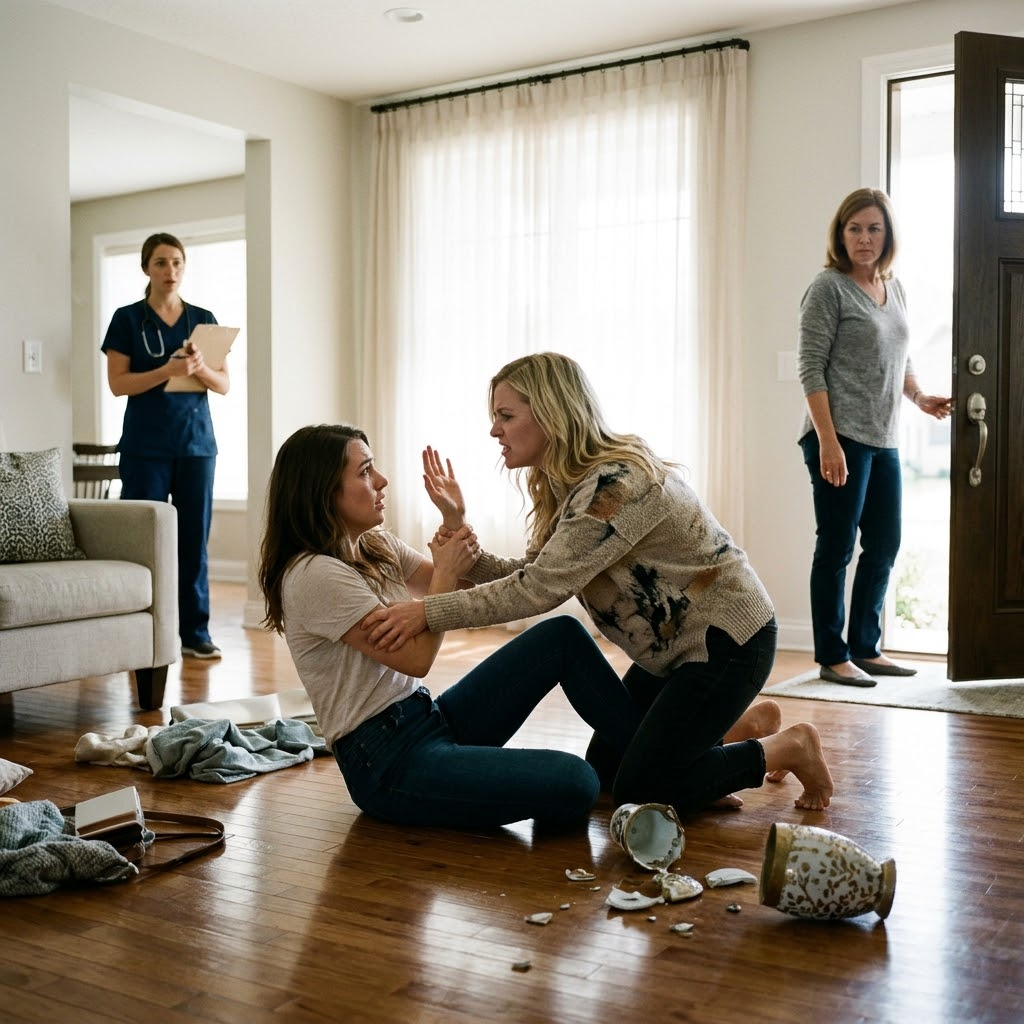
My mother had already made her position clear. She had locked me inside a house while my sister restrained me, and she had watched me bleed while demanding that I surrender my handbag.
Whatever happened next, I couldn't pretend that a calm conversation would solve everything.
“Richard, I need to know whether I have any legal rights to that trust.”
“You may. The documents need to be reviewed carefully, including the terms governing distributions and the trustee's responsibilities. I can explain what the records establish, but I won't make promises before we've examined them.”
It was the first answer anyone had given me that day without trying to control what I thought.
“Thank you,” I said.
“One more thing, Maeve. Preserve the original records you found. Don't write on them, discard them, or let anyone else take possession of them. If you can safely make copies, do so. And please keep your medical records from today's incident.”
“I will.”
After the call ended, I sat without moving.
My father had been dead for eleven years. I remembered his hands, his quiet laugh, and the way he used to check the locks before going to bed. I remembered him sitting at the kitchen table with a calculator, explaining that money wasn't simply something people earned and spent. It was something they had to understand.
He had never told me there was a trust.
He had never mentioned a sealed letter.
And now I was supposed to believe that he had left instructions concerning my birth.
I opened the laptop again and began organizing the documents.
I wasn't ready to think about what the letter might contain.
First, I needed to understand the money.
Then I needed to understand my mother.
Only after that could I decide what to do with the truth about my father.
My phone vibrated with a new message.
It was from Genevieve.
Maeve, I hope you're receiving proper care. I've documented what I witnessed today. My agency may contact me regarding the incident, but I will tell them exactly what happened. If you need a copy of my written account, I'll provide one.
I read the message twice.
Then I typed a reply.
Thank you for standing up for me when my own family wouldn't.
Her answer arrived a minute later.
You shouldn't have had to ask anyone to stop them from hurting you.
I placed the phone beside the laptop.
For the first time since leaving the house, I allowed myself to cry.
Not loudly.
Not dramatically.
The tears simply came, slipping down my cheeks as I sat surrounded by papers that suggested my entire understanding of my family might be wrong.
I cried for the apartment I had surrendered.
For the savings I had emptied.
For the years I had spent believing that if I became useful enough, patient enough, and generous enough, my mother would eventually look at me with pride.
And I cried because, even now, a part of me still wanted her to call and explain everything.
I wanted her to tell me there was a reasonable explanation for the trust.
I wanted her to tell me the letter had been misplaced.
I wanted her to tell me that the words Richard had read were part of a misunderstanding.
But my mother hadn't called.
Instead, my phone lit up with a message from Jolene.
Mom says you're making accusations that could destroy this family. You need to come home and talk to us before you make things worse.
I stared at the screen.
Then another message appeared.
She says you misunderstood the papers.
I typed three words.
I was bleeding.
I sent them.
Jolene didn't reply.
The following morning, I woke with a headache so intense that I needed several minutes to remember where I was.
For a moment, I thought I was back in my childhood bedroom, listening to Mom move around the kitchen.
Then I saw the hotel curtains, the unfamiliar desk, and the bandage reflected in the mirror.
The previous day returned in pieces.
Jolene's hand gripping my arm.
The crystal glass striking my temple.
My mother's fingers turning the deadbolt.
And Richard's voice reading the words beneath the delivery receipt.
Do not let Maeve find out what her father knew about her birth.
I sat up carefully and reached for the glass of water on the bedside table.
My discharge instructions were beside it. I read them again, reminding myself to rest, avoid driving, and seek further medical attention if my symptoms worsened.
Then I checked my phone.
There were six missed calls from my mother.
Four from Jolene.
One voicemail from an unknown number.
I listened to the voicemail first.
A woman's voice spoke in a professional, measured tone.
“Hello, Maeve. This is Dana from the home-health agency. We need to discuss the circumstances surrounding Genevieve's scheduled placement at your mother's residence. Mrs. Bennett contacted us last night and requested that your prepaid contract be canceled. She also made several allegations regarding the arrangement. Please call us when you're available.”
I lowered the phone.
Mom had tried to cancel the care contract again.
Even after I left injured.
Even after Genevieve witnessed the assault.
She was still trying to control the situation.
I called Dana back.
She answered on the second ring.
“Maeve, thank you for returning my call. First, I want to make sure you're safe.”
“I'm receiving medical care and staying somewhere else.”
“I'm glad to hear that. Genevieve provided a preliminary account of what happened. She also said your mother attempted to prevent you from leaving.”
“She did.”
“I want you to know that our agency will preserve the records associated with your contract. Your mother cannot simply erase the documentation of the services you purchased.”
I exhaled slowly.
“Can she cancel the service?”
“We'll need to review the terms of the agreement. If the patient refuses care, we may need to arrange an alternative, but any refund or cancellation will be handled according to the contract. We won't make assumptions about what happened.”
“That seems fair.”
“Genevieve has also reported that you were injured. If you need documentation of the scheduled visit or the cancellation request, we can provide it.”
“Yes, please.”
Dana gave me an email address and explained what she could send.
Before ending the call, she added, “Maeve, I want to be clear about something. Our staff members are not expected to remain silent if they witness abuse. Genevieve did the right thing by seeking help.”
I thanked her.
When the call ended, I felt a small but important shift.
My mother could still lie.
She could still accuse me of being selfish.
She could still try to convince relatives that I had abandoned her.
But she could no longer guarantee that everyone would accept her version of events.
I had a witness.
I had medical records.
And I had a contract showing that I had arranged care before leaving.
I opened my laptop and created a folder for everything related to the incident.
I saved the hospital paperwork, the messages from Genevieve, the home-health contract, and the financial statements.
Then I made a second folder for the trust.
I named it Dad's Estate.
The simple act of typing his name brought back a memory.
My father had once taken me to a bank when I was seventeen. He had helped me open my first savings account and insisted that I read every page before signing.
“You don't need to understand every word immediately,” he had told me. “But you need to know what you're agreeing to, and you need to know where to go when something doesn't make sense.”
I had forgotten how often he said things like that.
Perhaps I had been too young to recognize how carefully he prepared me for adulthood.
Or perhaps I had simply assumed that the most important things he wanted me to know would be spoken aloud.
I looked at the folder on my screen.
Maybe he had tried to tell me something.
Maybe my mother had stopped him.
I couldn't know yet.
But I could find out.
Richard arrived at the hotel shortly after noon.
He was in his early sixties, with neatly combed gray hair and a navy suit that looked more practical than expensive. He carried a leather briefcase and a thin document envelope.
When I opened the door, his gaze immediately went to the bandage on my temple.
“Maeve, I'm sorry,” he said.
“For what?”
“For contacting you with difficult information before I understood the full circumstances surrounding your situation.”
“You didn't hit me with a glass.”
His expression tightened.
“No. But I should have verified what happened to the letter much earlier.”
I stepped aside.
He entered and placed his briefcase on the desk.
“I won't stay long if you're tired,” he said. “We can postpone the discussion if your symptoms are troubling you.”
“I want to understand the documents.”
“Then we'll proceed carefully.”
He opened the briefcase and removed several copies.
The first was the trust agreement.
The second was a summary of my father's estate.
The third was a list of transactions associated with the trust account.
I looked at the dates.
“What exactly was this trust supposed to do?”
Richard adjusted his glasses.
“Your father established it to provide financial security for you and your sister. The terms allowed certain expenses to be paid under defined circumstances, including education, medical needs, and other distributions approved according to the trust's provisions.”
“Was Mom allowed to use the money?”
“That depends on the transaction. She was named as a beneficiary, but that did not automatically make her the owner of every asset in the trust. The document also appointed an independent trustee to oversee its administration.”
I leaned forward.
“Who was the independent trustee?”
Richard looked at the page.
“A financial institution initially handled that responsibility. Your father later appointed an individual to serve as successor trustee under specified conditions.”
“Who?”
“I'm still confirming the transition records. The institution's files are incomplete, and I don't want to give you a name that might be incorrect.”
I felt frustration rise in my chest.
“Everyone keeps telling me there are answers, but nobody seems able to give them to me.”
“I understand.”
“Do you?”
He didn't look offended.
“I understand that you have been injured, that you may have been deprived of information concerning your father's estate, and that you're now trying to determine what happened to money that may have been intended for your benefit. I also understand that an attorney who gives you a confident answer before reviewing the records can cause additional harm.”
I sat back.
He was right.
I hated that he was right.
“What about the transactions?” I asked.
Richard placed the statements in front of me.
“The records I have so far show several substantial transfers over the years. Some appear to have been authorized distributions. Others require further investigation. We need the underlying bank records, the trustee's approvals, and the documentation supporting each payment.”
I scanned the figures.
One transfer had occurred eleven years earlier, shortly after Dad died.
Another had occurred eight years ago.
Several more appeared during the three years I had been paying the household bills.
“Could these transfers have paid the mortgage?”
“Possibly. But we need to establish where the money went. A bank statement alone does not prove that a particular transfer was improper.”
I nodded.
“Then we get the records.”
“Exactly.”
He opened another envelope.
Inside was a copy of the delivery receipt for the sealed letter.
My mother's signature appeared at the bottom.
Beneath it was the handwritten note.
I read the words again.
Do not let Maeve find out what her father knew about her birth.
My fingers tightened around the paper.
“Did Dad write the letter himself?”
“The instructions in his estate file indicate that he prepared it personally. I haven't seen the original envelope since it was delivered to your mother.”
“Why would he write something about my birth when I was eighteen?”
“Your father was concerned about a matter he considered important to your future. He instructed me to ensure the letter reached you when you turned twenty-nine.”
“Why that age?”
“I don't know. He did not explain the reason in the instructions I retained.”
I looked up.
“Did he ever tell you anything about my birth?”
Richard was quiet for several seconds.
“He asked me to review some records concerning your birth certificate and the original documentation provided when you were born. He was concerned about an inconsistency.”
My mouth went dry.
“What inconsistency?”
“I don't have enough verified information to answer that yet.”
“Was he my biological father?”
Richard held my gaze.
“I cannot responsibly answer that question based on what I have in front of me.”
I looked away.
For eleven years, I had mourned my father without questioning whether he was my father in every sense of the word.
He had taught me to ride a bicycle.
He had sat beside me during school performances.
He had stayed awake when I had a fever and made pancakes on Saturday mornings.
He had been the person I called when I couldn't solve a problem.
If there was something about my birth he had known and my mother had hidden, it wouldn't erase those memories.
But it would change the story I had told myself about the family I belonged to.
“Do you think my mother knows where the letter is?” I asked.
“I believe she received it. Beyond that, I cannot say.”
“She told you it never existed.”
“Yes.”
“And you believe she lied?”
Richard folded his hands.
“I believe the delivery receipt contradicts her statement. Whether she misplaced the letter, destroyed it, or deliberately withheld it is something we need to establish.”
I looked at the note.
“Can you recover the original?”
“Possibly. I have contacted the records department that handled the delivery. They are searching their archived files. If the envelope was returned or stored, we may find it.”
“And if we don't?”
“Then we proceed with the evidence available to us.”
I appreciated his refusal to promise an easy answer.
For the first time since my mother had locked the door, I felt as though I was participating in my own life rather than reacting to someone else's demands.
Richard reviewed the next steps with me.
He recommended that I consult an attorney experienced in trusts and estates before making any legal decisions. He explained that the trust documents might give me grounds to request a formal accounting, but the outcome would depend on the governing terms and the evidence.
He also advised me to preserve all records of the household payments I had made.
“If those payments are relevant to the trust transactions, they may help establish a timeline,” he said. “Even if they are not directly connected, they provide useful context.”
I showed him my spreadsheet.
He examined it carefully.
“You've kept excellent records.”
“I thought I was just trying to keep the bills organized.”
“Sometimes ordinary records become important for reasons their creator never anticipated.”
I almost smiled.
“That sounds like something Dad would have said.”
Richard looked down at the spreadsheet again.
“He was a meticulous man.”
“You knew him well?”
“Well enough to know he cared deeply about both his daughters. He was especially concerned that neither of you should become financially dependent on someone who might use money to control you.”
The words landed heavily.
I thought of my mother demanding that I cancel my promotion.
I thought of Jolene trying to take my handbag.
I thought of the three years during which every financial decision I made had somehow become a decision I made for them.
“Did Dad expect this to happen?” I asked.
“No,” Richard said. “But he understood that money can create complicated family dynamics. That's why he tried to establish safeguards.”
He packed the documents back into their envelopes.
Before leaving, he gave me his direct office number and asked me to contact him if my mother or sister attempted to pressure me into signing anything.
“I also want to be clear that you don't need to make any decisions about the trust today,” he said. “Your immediate priorities are your health, your safety, and preserving the records.”
I walked him to the door.
“Richard?”
He turned.
“Did my father love me?”
The question escaped before I could stop it.
His expression softened.
“Yes, Maeve. From everything I knew of him, he loved you very much.”
“Then why didn't he tell me?”
Richard paused.
“I suspect that's the question the letter was meant to answer.”
After he left, I stood by the closed door for a long time.
Then I returned to the desk and opened the folder marked Dad's Estate.
I scanned every page Richard had provided.
I created a timeline of the transfers.
I added the dates of my household payments.
I wrote down every question I needed answered.
It wasn't enough to know that my mother had hidden something.
I needed to understand what she had hidden, why she had hidden it, and whether she had used my trust in her to keep me financially trapped.
I worked until the afternoon light began fading behind the curtains.
Then I heard my phone vibrate.
Jolene had sent a message.
Mom says you met with Richard.
I didn't respond.
Another message arrived.
She says you don't understand what Dad wanted.
I stared at the screen.
A third message followed.
Maeve, please. I need to talk to you alone.
I read it twice.
Then I typed, Why?
The reply came almost immediately.
Because Mom isn't the only person who knows what happened.
I sat perfectly still.
For the first time, I wondered whether Jolene's fear had nothing to do with the money in the trust.
I wondered whether she had known about the letter all along.
And then my phone rang.
It was Genevieve.
I answered.
“Hello?”
“Maeve, I'm sorry to call so late,” she said. “I need to tell you something about your mother.”
My stomach tightened.
“What happened?”
“After I left the house, I returned to the agency office to complete my incident report. A few minutes ago, my supervisor called me. Someone claiming to be a relative contacted the agency and demanded that we destroy the report.”
I closed my eyes.
“Who?”
“She wouldn't give me the name at first. But when my supervisor asked for identification, the caller said something that made him stop the conversation.”
“What did they say?”
Genevieve hesitated.
“They said that if the report became part of a police investigation, it would expose a secret your father had paid to keep buried.”
I felt the blood drain from my face.
“Did they identify themselves?”
“Yes.”
“Who was it?”
Genevieve's voice dropped to a whisper.
“It was your sister, Jolene.”
Before I could answer, another message appeared on my screen.
It was from Jolene.
Maeve, I found the original letter.
And beneath it was a photograph of an envelope bearing my father's handwriting—with my name on the front and a date written across the seal.
My twenty-ninth birthday.
And someone had already torn it open.






Comments 0