I stared at Jolene's name until the letters blurred.
For several seconds, I couldn't breathe properly. The hotel room was silent except for the low hum of the air conditioner and the faint traffic beyond the window. On my laptop, my father's handwritten words remained fixed beneath the hospital's official seal.
If anything happens to me, the person who arranged the false authorization is the only one who can explain why my daughter was never supposed to see this record.
Jolene Bennett.
My sister.
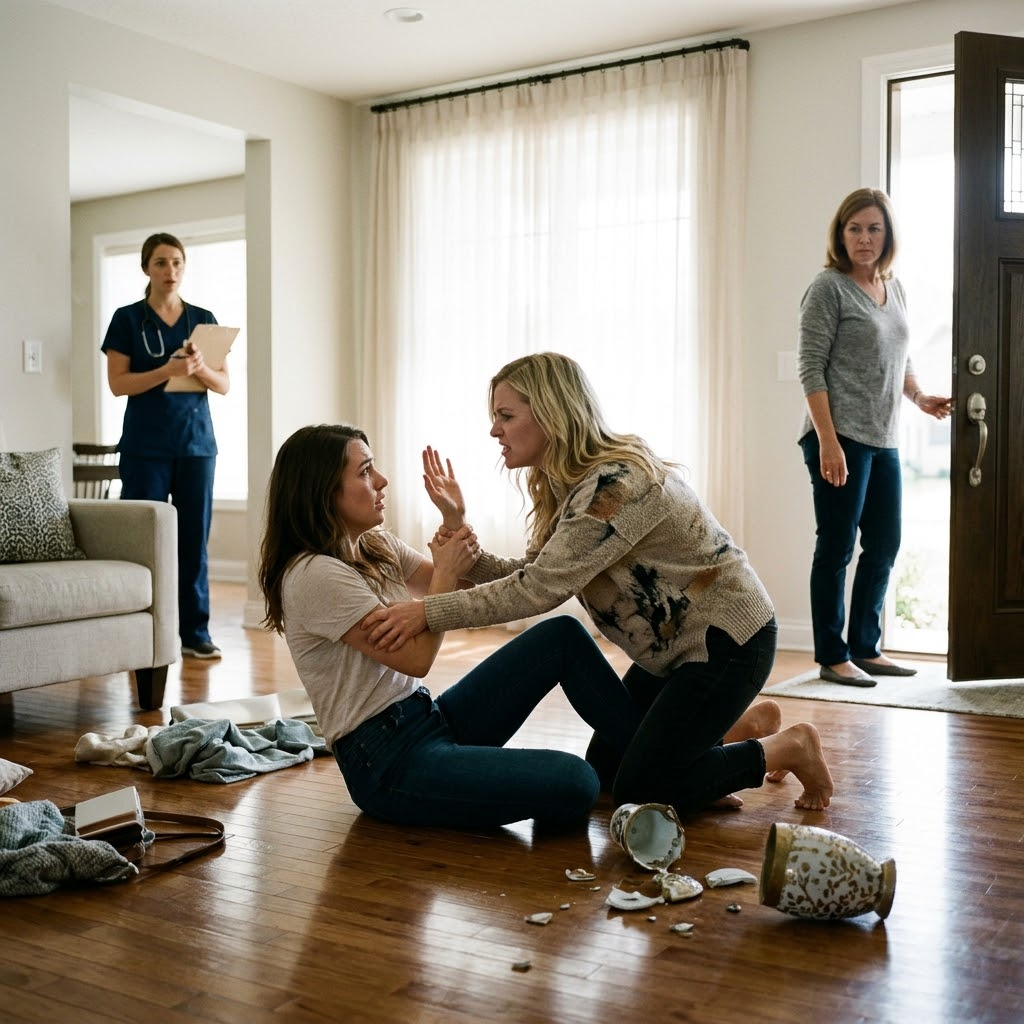
The woman who had helped me carry groceries when we were children. The woman who had borrowed my clothes, stolen the last piece of cake from my plate, and cried against my shoulder when her first business venture failed. The woman who had recently watched our mother stand guard at a locked door while I lay injured on the floor.
I had believed Jolene was selfish, frightened, and too dependent on our mother to make decisions of her own.
I had never imagined she might be connected to the forged authorization.
I called Patricia immediately.
"Maeve, I've read the declaration," she answered. "I know what you've found."
"Did Jolene forge Dad's signature?"
"We don't know that. His note identifies her as someone who could explain the authorization. That is not the same as proving she prepared it."
"But why would he write her name?"
"Because he believed she knew something important. We need to find out what she knew and when she learned it."
I looked at the document again.
"What does the declaration say about Daniel?"
"It confirms that Daniel was present at the hospital when you were born. It also records that your mother identified him as a person who might be your biological father. The medical report does not establish biological paternity conclusively."
"Then how do we find out?"
"Through the appropriate records and, if necessary, reliable biological testing conducted with informed consent. We also need to establish the circumstances surrounding the disputed authorization."
I swallowed.
"What about Dad's statement that he knew the truth?"
"That may refer to the relationship between your mother and Daniel, or it may refer to something more specific. We shouldn't assume he meant that he had definitive proof of your biological parentage."
I closed my eyes.
For eleven years, I had been living inside a story whose most important facts had been withheld from me. Now, even my father's final words required careful interpretation.
"Can you arrange a meeting with Jolene?" I asked.
"Yes. I'll contact her through the appropriate channels and ask her to provide a statement. I recommend that you not confront her alone."
"I won't."
"And Maeve?"
"Yes?"
"Whatever the records eventually establish, you do not have to decide today what your relationship with your sister will become."
I thanked her and ended the call.
Then I sat motionless for several minutes.
I wanted to call Jolene and demand answers. I wanted to hear her voice, watch her face, and ask why my father had written her name beside a warning that sounded almost like a final accusation.
But I had learned something during the past few days.
Urgency was not always the same as progress.
If I wanted the truth, I had to stop letting fear dictate the order in which I pursued it.
I saved the medical report, backed up the email, and sent the complete document to Patricia.
Then I waited.
Jolene arrived at Patricia's office that afternoon.
I was already seated in the conference room when she entered.
She wore the same gray sweater she had worn during our last conversation, and her hair was pulled back without much care. She looked at me, then at Patricia, and finally at the closed folder on the table.
"Is it true?" she asked.
I kept my voice steady.
"Did you arrange the false authorization?"
Jolene's face crumpled.
"No."
The answer came so quickly that I almost believed it immediately.
Then she sat down and covered her face with both hands.
"I didn't write Dad's signature," she whispered. "I swear I didn't."
Patricia waited until Jolene looked up.
"Do you know who prepared the authorization?"
Jolene nodded.
"Daniel prepared the draft. Mom told me that he was helping them resolve the birth-record problem."
"Did you know the authorization carried a signature that did not belong to your father?"
"I knew something was wrong with it."
My chest tightened.
"What does that mean?"
Jolene looked at me.
"I was twenty years old when Dad died. I was scared, and Mom told me that the trust would be frozen if the birth-record issue became public. She said we could lose the house, the money for her medical care, and everything Dad had worked for."
"So you helped her?"
"I thought I was helping her protect us."
"That's not what I asked."
Jolene lowered her eyes.
"Yes. I helped her."
Patricia leaned forward.
"Please explain exactly what you did."
Jolene took a shaky breath.
"Daniel sent Mom a draft authorization. She showed it to me because she wanted me to print the pages and organize them with Dad's other documents. I noticed that the signature looked different from his usual handwriting."
"Did you tell your mother?"
"Yes."
"What did she say?"
"She said Richard had reviewed the filing and that everything had been arranged legally. She told me the signature was a copy taken from another document."
Patricia made a note.
"Did you believe that explanation?"
"At first, yes. Then I heard Mom and Daniel arguing. He said the medical record should be enough to establish the facts, and she said she didn't want the record examined because it would expose something about the trust."
I stared at my sister.
"What did you do?"
"Nothing."
The word fell between us.
Jolene began to cry.
"I was afraid of losing everything. I thought if I stayed out of it, the adults would resolve the problem. I didn't understand how serious it was until after the document had been submitted."
"Did you know Mom delivered it?"
"Yes."
"Did you know Dad had refused to sign it?"
Jolene nodded.
"How?"
She reached into her bag and took out a folded sheet of paper.
"Because I found this in his desk after he died."
She placed it on the table.
It was a short handwritten note, dated the day before my father died.
I will not authorize a change to Maeve's birth record without the original medical evidence. No one has permission to sign my name. If this instruction is ignored, the person who submits the document must answer for it.
My father's signature appeared at the bottom.
I recognized it immediately.
Patricia examined the paper and asked Jolene how she had obtained it.
"I took it from the desk because I was afraid Mom would find it," Jolene said. "I kept it hidden in a box with some of my old school papers. I should have given it to someone years ago."
"Why didn't you?"
"Because I knew I had helped with the filing. I thought if anyone found out, I would be blamed too."
I looked at my sister.
"Did you know Mom was letting me pay the mortgage while money was being moved through the trust?"
Jolene nodded.
"I knew about the ten-thousand-dollar payment. I didn't know the full accounting. But I knew you were paying more than your share, and I didn't stop you."
Her honesty did not erase what she had done.
But it gave us something we had not had before: a statement that could be checked against the documents.
Patricia collected the note and documented its condition.
"Jolene, we'll need a complete written statement from you, including the dates you remember and the names of everyone involved. You may wish to obtain independent legal advice about your own position."
Jolene nodded.
"I understand."
I looked at her.
"Why are you telling us now?"
She wiped her face.
"Because I saw the photograph of Dad holding you. I found it in Mom's room after you left. She had put it in a drawer with the original letters."
I waited.
"On the back, Dad had written something," Jolene continued. "It said, 'My daughter, regardless of what the records say.'"
My throat tightened.
Jolene looked at me through her tears.
"I spent years believing that if the truth came out, everything we knew would collapse. But Dad already knew there might be a difference between biology and family. He still chose you. And I let Mom convince me that protecting the secret mattered more than protecting you."
For the first time, I saw my sister without the excuses she had used to shield herself.
She had made choices.
She had benefited from them.
And now she was beginning to acknowledge their consequences.
"I can't promise we'll be close again," I told her.
"I know."
"I can't promise I'll forgive you soon."
"I know."
"But if you continue telling the truth, I'll listen."
Jolene nodded.
It was not forgiveness.
It was a beginning.
The following week, Patricia received the complete trust accounting.
The records showed that the trust had held sufficient assets to cover several major household expenses during the period when my mother repeatedly told me there was no money available. Some distributions had been legitimate and consistent with the trust terms. Others required further explanation.
The ten-thousand-dollar payment to Jolene had been recorded as a beneficiary distribution.
Several payments had also been made to Elaine Bennett.
The accounting did not prove that every dollar could legally have been used for the mortgage, but it established that my mother had access to funds she had not disclosed to me.
More importantly, the records showed that my personal contributions had never been recorded as loans or reimbursable advances. There was no agreement requiring me to pay the household expenses, and no documentation showing that the family had intended to repay me.
I had paid because I believed my mother needed help.
She had allowed me to believe that no alternative existed.
Patricia explained that recovering every dollar would not be automatic. We would need to assess the legal basis for any claim and distinguish ordinary household contributions from payments made under misleading circumstances.
I understood.
I did not need to win every possible claim to begin rebuilding my life.
But I did need to stop being financially responsible for people who had concealed information from me.
I formally ended my contributions to the household bills.
I also submitted a written request for an accounting of any remaining trust distributions and confirmation of my rights as a beneficiary.
My mother initially objected.
She sent long messages about loyalty, family duty, and the sacrifices she had made after my father died. She reminded me of the years she had spent raising Jolene and me, and she insisted that I was turning a painful misunderstanding into a legal battle.
I read the messages without responding emotionally.
Then I forwarded them to Patricia.
When my mother finally called, I answered.
"I don't understand how you can do this to me," she said.
I was sitting at the desk in my new apartment, looking at the lease I had signed that morning.
"Do what?"
"Cut off the money. Leave us to manage everything alone."
"I'm not cutting off money that belongs to you. I'm ending my personal contributions to the household."
"You know I can't manage the mortgage by myself."
"Then we need to establish what resources are available and what expenses you can afford."
"You're my daughter."
"Yes. That doesn't mean I'm required to pay every bill without knowing the truth about our finances."
She began to cry.
I felt the familiar pull of guilt, but I did not let it decide what I said next.
"I will cooperate with a reasonable plan for your care. I'll help arrange the services you need, and I'll make sure the information is provided to the professionals involved. But I will not return to the arrangement we had before."
"What am I supposed to do?"
"Work with Patricia to understand your finances. If the trust can lawfully cover certain expenses, those resources need to be considered. If they cannot, we need to find another sustainable plan."
"You make it sound so easy."
"No," I said quietly. "I make it sound necessary."
She fell silent.
Then she whispered, "I never thought you would leave."
That was the problem.
She had believed my willingness to help was permanent, regardless of what she did or what it cost me.
"I stayed because I loved you," I said. "I am leaving because I need to be able to love myself, too."
I ended the call.
For several minutes, I sat with my hands resting on the desk.
I felt sad.
I also felt free.
Those feelings could exist together.
The sealed medical report finally provided the missing context.
It did not establish my biological parentage by itself, but it confirmed that Daniel Mercer had been present when I was born and that the hospital had documented a discrepancy requiring further review. A later declaration showed that my mother had acknowledged a relationship with Daniel before her marriage to Thomas.
The records supported the conclusion that Daniel could be my biological father.
They did not prove it conclusively.
With Patricia's guidance, I arranged for a properly conducted DNA test with Daniel's informed consent.
He agreed without hesitation.
When we met, it was in a professional office with Patricia present. Daniel was in his late fifties, with silver beginning to show at his temples and an expression that seemed caught between regret and hope.
He did not try to hug me.
He did not ask me to call him Dad.
He simply sat across from me and said, "I should have insisted that the records be handled properly years ago. Whatever the test establishes, you deserved the truth."
I studied him.
"Why did you prepare the authorization?"
He looked down at his hands.
"Your mother told me that Richard had approved the process and that the authorization was intended to preserve the case while the records were reviewed. I prepared a draft, but I knew the signature had to be verified. I told her not to submit it without proper confirmation."
"Did you know it carried a false signature when it was filed?"
"I suspected there was a problem when Richard told me the filing had been submitted. I should have demanded that the document be withdrawn and reported. Instead, I allowed your mother to persuade me that it could be corrected quietly."
"Why?"
"Because I was afraid that a public dispute would hurt you. I told myself that silence was protecting you, but I was also protecting myself from the consequences of a relationship I had kept secret."
His answer was not flattering.
It was, however, more honest than the excuses I had heard from my mother.
"Did you know my father had refused to sign?"
"Yes. Thomas told me directly that he would not authorize an amendment without the original medical evidence. I should never have allowed a draft to be used in a way that contradicted his instructions."
"Why didn't you tell me the truth when you first contacted me?"
"Because I wanted to be certain of the facts before I approached you. I also feared that if I told you everything at once, you would see me only as the man who had helped create the secret."
I considered his words.
"That's exactly what I see right now."
He nodded.
"I understand."
The DNA test took several days to process.
During that time, Daniel did not pressure me to meet again. He did not send gifts or ask for updates. He communicated through Patricia when necessary and respected the boundaries I had established.
When the results arrived, Patricia reviewed them with me privately.
The test established with a high degree of certainty that Daniel Mercer was my biological father.
I read the report slowly.
Then I placed it on the table.
For a moment, I felt nothing at all.
I had expected grief, anger, perhaps even relief.
Instead, I felt the quiet exhaustion of someone who had finally received an answer after spending too long chasing the question.
Thomas had not been my biological father.
He had been my father in every way that had shaped my life.
Daniel was the man whose biology connected him to me.
Those facts did not cancel each other out.
I called Daniel later that afternoon.
"The test confirms it," I said.
He was silent for a moment.
"Thank you for telling me."
"I need you to understand something. I'm not ready to have a father-daughter relationship with you."
"I understand."
"I may never want the kind of relationship you imagined."
"I understand that, too."
"I am willing to get to know you slowly, if you respect my boundaries."
His voice trembled slightly.
"I would be grateful for that opportunity."
We ended the call.
I did not cry.
I didn't need to decide what Daniel would mean to me for the rest of my life.
I only needed to decide what I was comfortable with now.
For the first time, that decision belonged entirely to me.
The investigation into the forged authorization continued for several months.
The records established that Daniel had prepared the draft, Elaine had delivered the disputed filing, and Richard had certified a separate document without properly verifying the underlying authorization. Jolene's statement and the handwritten note from Thomas supported the conclusion that the filing had proceeded against his explicit instructions.
The evidence did not establish that Richard had written the false signature. It also did not establish that Daniel had personally forged it. The question of who physically wrote the signature remained unresolved, and Patricia made sure no one confused suspicion with a proven fact.
What the records did establish was that the document had been submitted under Thomas's name after his death and that the filing process had been mishandled.
The relevant authorities received the documentation for review. Richard cooperated with the requests and acknowledged that he had failed to verify the authorization adequately. Daniel provided the correspondence he retained. Elaine signed a formal statement describing her role in delivering the filing and concealing the dispute from me.
The birth record was reviewed through the appropriate legal process, and the official documentation was corrected to reflect the verified information while preserving the distinction between biological parentage and legal parentage.
Thomas remained recognized as the father who had raised me.
His estate records were updated to reflect the proper beneficiary information, and the trust was administered according to its verified terms.
The accounting also helped establish the extent of the household expenses I had paid and the distributions my mother and sister had received. Patricia advised me about the options available for seeking reimbursement. I pursued a fair resolution rather than trying to punish everyone for every wrong.
The final agreement required the remaining financial records to be disclosed, established a sustainable plan for my mother's necessary care, and resolved the outstanding claims relating to the household contributions.
I recovered part of the money I had paid under circumstances that had not been honestly explained to me.
It wasn't every dollar.
But it was enough to give me a stable financial foundation and a clear end to the arrangement that had kept me trapped.
My mother moved into a smaller apartment she could afford with her verified resources and the support arranged through the care plan. She was no longer dependent on me to manage every expense, and I was no longer expected to sacrifice my future to maintain a household that had been built on withheld information.
Jolene sold what remained of her failed business inventory, found steady work coordinating events for a local venue, and began paying her own bills. She cooperated fully with the accounting and did not ask me for money.
Our relationship remained strained for a long time.
We spoke occasionally.
Sometimes we argued.
Sometimes we sat together without discussing the past.
I did not pretend that trust could be restored through a single apology. Jolene had to demonstrate, through repeated choices, that she could be honest even when honesty cost her something.
Slowly, she began to do that.
My mother also wrote me a letter.
She acknowledged that fear had become her excuse for controlling information, money, and decisions that should never have belonged solely to her. She admitted that she had treated my willingness to help as an obligation and had allowed my sacrifices to become invisible.
She did not ask me to forgive her immediately.
I appreciated that.
I kept the letter, but I did not use it as a reason to return to the old arrangement.
Forgiveness, if it came, would not require me to surrender my boundaries.
A year after the investigation began, I stood in the living room of my own apartment, unpacking the last box from my old life.
My new job had become everything I had hoped it would be. I managed a regional logistics team, earned a salary that allowed me to save comfortably, and had built a routine that belonged to me.
My apartment was modest compared with the house where I had spent my childhood, but it was quiet, warm, and entirely mine.
There were no overdue bills waiting for me to discover.
No one expected me to cancel my plans because another person had failed to manage their responsibilities.
And no one could turn my love into a financial obligation without my consent.
On the shelf above my desk stood a photograph of Thomas.
Beside it was a smaller photograph of Daniel and me taken during one of our carefully planned meetings. We had begun to know one another as two adults rather than as a father and daughter trying to fill an absence overnight.
He had told me stories about his life, answered my questions honestly, and accepted that some subjects would remain difficult for me.
We were not close in the way I had been close to Thomas.
We were building something different.
That was enough.
Jolene visited me one Saturday afternoon carrying a paper bag of groceries and a small potted plant.
"I brought lunch," she said.
I looked at the plant.
"What's that for?"
"Your windowsill. You keep forgetting to buy something green."
I laughed softly.
It was the first time in years that my sister had brought something into my home without expecting me to solve a problem in return.
We ate at the small kitchen table.
She told me about her job, a difficult client, and the apartment she had rented. I told her about my team and the promotion I had recently received.
Neither of us pretended that the past had disappeared.
But for the first time, we were able to talk about the future without making me responsible for hers.
Before she left, Jolene stood near the door.
"I know I can't undo what happened," she said. "But I'm grateful you let me try to make things right."
I looked at her for a long moment.
"I'm grateful you're trying."
She nodded, accepting the answer without demanding more.
After she left, I placed the plant on the windowsill.
Then I sat at my desk and opened the final page of Thomas's letter.
The words were simple.
He had written that he loved me, that the truth about my birth could never erase the years we had shared, and that he wanted me to have the freedom to decide what my identity meant to me.
He had not asked me to protect his reputation.
He had not asked me to forgive anyone.
He had asked me to live honestly and make my own choices.
I folded the letter carefully and returned it to its envelope.
For years, I had believed that the truth would destroy the family I knew.
Instead, the truth had shown me which parts of that family were built on love and which parts had depended on my silence.
I could grieve what had been lost without returning to it.
I could care about my mother without paying for every consequence of her decisions.
I could forgive Jolene gradually without pretending her betrayal had not hurt me.
I could know Daniel without replacing Thomas.
And I could finally build a life in which my own needs mattered.
That evening, I made dinner, opened the windows, and watched the city lights come on.
My phone rested on the table, quiet.
No emergency waited for me.
No hidden document demanded an immediate answer.
No one was asking me to prove my love by sacrificing something else.
I sat down, took a slow breath, and began to eat.
For the first time in years, the life in front of me belonged to me.
And that was a future worth keeping.






Comments 0