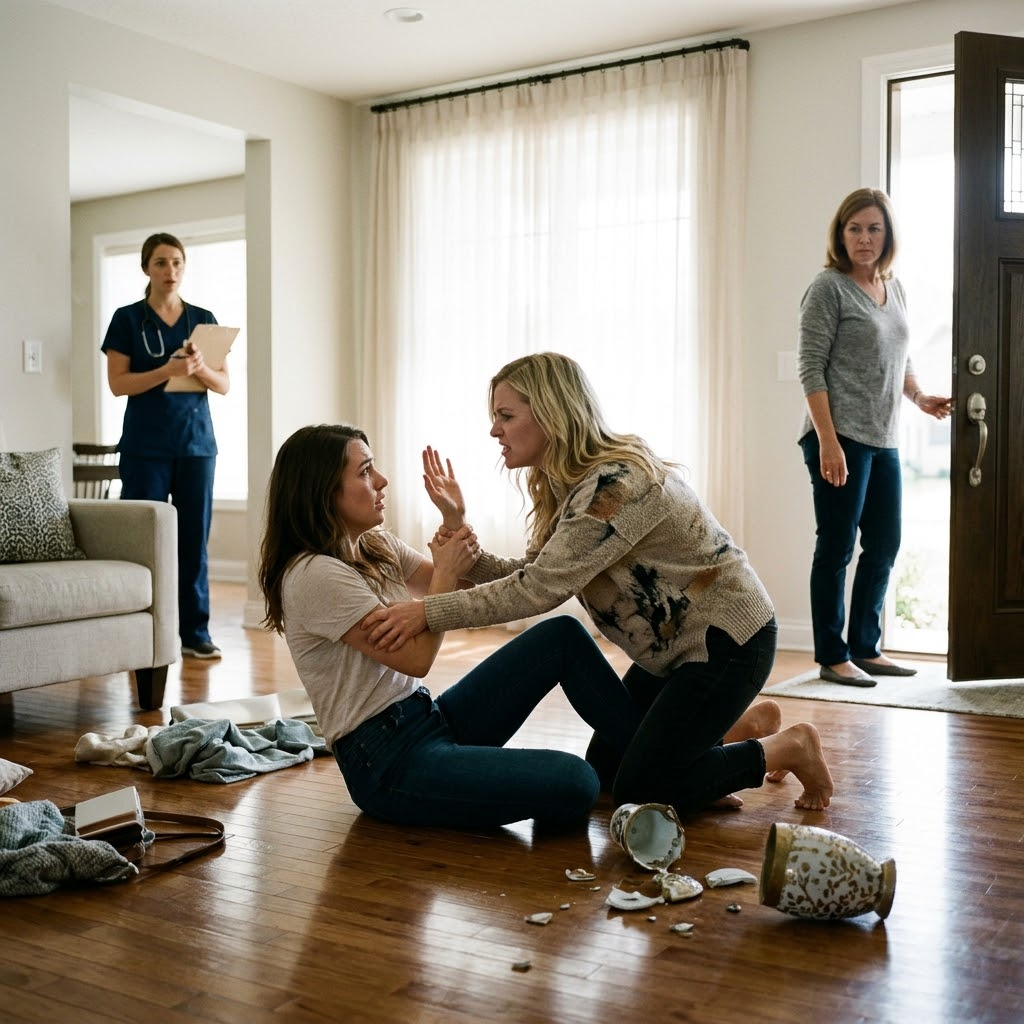
“Maeve Bennett?” the voice on my mother's phone asked.
I stood beside the sofa, one hand gripping its back for support, while Genevieve watched the blood running from my temple. My mother held the phone against her ear so tightly that her knuckles had turned pale. Jolene stood beside the console table, clutching the bank statement that named our dead father as the original trustee.
Nobody moved.
“Yes,” my mother finally answered. “She's here.”
A pause followed.
Then the man on the other end said, “Put her on the phone, please. It's about her inheritance.”
My mother's face went white.
Jolene dropped the statement.
The paper landed on the hardwood floor beside a fragment of broken porcelain, and for a moment, I couldn't hear anything except the pounding of my own heart.
My inheritance.
The words seemed to belong to someone else's life.
My father had died eleven years earlier, when I was eighteen. He had been a quiet, practical man who worked long hours, kept receipts in labeled envelopes, and believed every promise should be written down. He had taught me how to balance a checkbook and how to recognize when a person was trying to sell me something I didn't need.
He had also taught me that family was supposed to be the one place where you didn't have to keep score.
I had spent the last three years learning how wrong that belief could be.
“Who is this?” I asked.
My mother covered the phone's microphone.
“It's a private matter.”
“Apparently, it's my inheritance.”
“Don't start.”
“Then tell me who you're talking to.”
Her eyes flashed.
For a second, I thought she might order me to sit down again, as if I were a child who had spoken out of turn at the dinner table. Instead, she turned away and lowered her voice.
“Richard, this is not a good time.”
The man replied loudly enough for me to hear.
“It's been eleven years, Elaine. There will never be a good time if you keep avoiding it.”
Mom closed her eyes.
That reaction told me more than the name had.
She knew him well.
And whatever he had called about, she had been expecting it for a long time.
Genevieve stepped closer to me.
“Maeve, we need to leave for medical evaluation.”
I nodded, although my attention remained fixed on the phone.
“Tell him I'll speak to him,” I said.
Mom shook her head.
“You're not in a condition to discuss legal matters.”
“I can decide whether I want to speak to someone.”
“You have a head injury.”
“Which is why I need medical care, not another argument.”
Her mouth tightened.
Richard's voice came through the speaker again.
“Elaine, I can hear her. Give her the phone.”
Mom hesitated.
Then she held it out as if the device had suddenly become dangerous.
I took it with my uninjured hand.
“Hello?”
“Maeve?” the man asked.
“Yes.”
“My name is Richard Vale. I was your father's attorney.”
I remembered the name vaguely. After Dad died, several adults had come to our house to discuss paperwork. I had been too overwhelmed by grief to understand most of it. Mom handled the arrangements, and I assumed that was what parents did when their children were barely adults.
“I'm sorry to contact you under these circumstances,” Richard continued. “Are you somewhere safe?”
I looked at my mother.
She was staring at me with an expression that mixed anger and desperation.
“I'm not sure,” I answered honestly.
Richard paused.
“Has someone injured you?”
Before I could respond, Mom reached for the phone.
I turned away.
“Yes,” I said. “My sister hit me. My mother locked the front door.”
Silence followed.
Then Richard's voice became firm.
“Are you receiving medical attention?”
“A nurse is here. She's arranging help.”
“Good. Please don't sign anything or agree to transfer any money until you've spoken with me. Do you understand?”
I looked at the bank statement on the floor.
“Yes.”
“Have you seen a document referring to the Bennett Family Trust?”
My stomach tightened.
“No. I've seen an account statement with my father's name listed as the original trustee.”
Richard exhaled slowly.
“Then we need to speak as soon as you're medically cleared. There are matters concerning that trust that should have been explained to you years ago.”
My mother made a small, strangled sound.
I looked directly at her.
“What matters?”
“I can't responsibly discuss the details until I've verified the documents,” Richard replied. “But I can tell you this: your father did not leave your mother with complete control over the trust assets.”
Mom lunged for the phone.
I moved it away.
“Richard, stop!” she shouted.
He ignored her.
“Maeve, please write down my office number. I will also send you a secure message with the information you need. Do not use your mother's email address or a device she controls.”
I repeated the number he gave me.
“Why would I need to do that?”
“Because your father's estate plan included safeguards designed to protect the beneficiaries' interests.”
His voice softened.
“And because I have reason to believe those safeguards were never properly explained to you.”
The call ended.
I stood perfectly still.
The living room seemed smaller than it had a few minutes earlier. The broken vase, the blood on the floor, the handbag beside Jolene's feet, and the deadbolt on the front door all belonged to the same terrible reality.
My family hadn't merely prevented me from leaving.
They had tried to keep me from discovering something my father had arranged years before his death.
Something that might have belonged to me.
“Give me the phone,” Mom demanded.
I handed it to Genevieve instead.
She slipped it into my handbag and placed the bag beside me.
“No,” I said when Mom reached toward it. “You're not taking it.”
Her hand stopped.
“You have no idea what you're talking about.”
“Then explain it.”
She looked at Jolene.
My sister was still staring at the statement.
“Mom,” Jolene whispered, “what did Dad leave us?”
Mom's face tightened.
“He left us nothing useful.”
“But Richard said—”
“Richard doesn't live here. He doesn't know what it cost me to raise you girls.”
Jolene looked up.
“He said there was a trust.”
“Your father made a great many arrangements without consulting me.”
“Were we beneficiaries?”
Mom didn't answer.
Jolene's expression changed.
“Were we?”
“Both of you need to calm down.”
I almost laughed at the familiar command.
Every time my mother was cornered by a question, she attempted to turn the conversation into a problem with our emotions.
If we were upset, we were unreasonable.
If we were angry, we were ungrateful.
If we demanded answers, we were disrespectful.
And if we stopped asking, she treated our silence as permission.
Not anymore.
“Genevieve,” I said, “can you help me get to the door?”
She nodded.
Mom stepped into our path.
“You're not leaving until we settle this.”
Genevieve looked at her steadily.
“You cannot keep her here against her will.”
“This is my house.”
“And she is an adult who needs medical attention.”
Mom's eyes narrowed.
“You have no authority here.”
“I don't need authority over your home to help an injured person leave it.”
For a moment, I thought my mother might physically block us.
Then Jolene spoke.
“Let her go.”
Mom turned toward her.
“What did you say?”
Jolene swallowed.
“She's bleeding. Let her go to the hospital.”
I stared at my sister.
She wasn't suddenly remorseful. I knew her too well to believe that. But the trust statement had changed the balance between them, and she was beginning to understand that obedience might cost her something.
Mom's voice became dangerously quiet.
“You have no idea what you're asking me to do.”
“Then tell me what happened.”
“Not now.”
“When, Mom? After Maeve leaves? After she talks to Richard? After we discover that Dad left money and you never told us?”
Mom slapped the console table with her palm.
“Enough!”
The sound echoed through the room.
Jolene flinched.
Genevieve moved between Mom and me.
I leaned heavily against her arm, fighting the dizziness that had begun to return.
“Maeve,” she said, “we need to go.”
I nodded.
Together, we moved toward the entrance.
My mother didn't step aside immediately. She watched us approach with an expression of cold disbelief, as if she couldn't comprehend that the daughter who had obeyed her for three years might actually walk past her.
Then Genevieve stopped in front of the deadbolt.
“Please unlock the door.”
Mom stared at her.
“I'm not finished talking to my daughter.”
“You can speak to her later, through an appropriate channel.”
The word appropriate seemed to offend her.
But after a long moment, she turned the lock.
The bolt slid back.
I reached for the handle.
Behind me, Jolene spoke.
“Maeve, wait.”
I turned.
She held the trust statement against her chest.
“Please don't leave without telling me what you know.”
I looked at her for several seconds.
“You hit me.”
Her face crumpled briefly.
“I know.”
“You could have seriously injured me.”
“I know.”
“And you tried to take my bag.”
“I was angry.”
“So was I.”
My voice remained low.
“But I didn't hit you.”
Jolene lowered her eyes.
For the first time, she had no excuse ready.
I wanted to believe that meant something. I wanted to believe my sister could recognize the line she had crossed and choose not to cross it again.
But I couldn't afford to build another future around what I hoped she might become.
“I don't know what Dad left us,” I said. “I don't know why Mom hid it. And I don't know what Richard is going to tell me.”
Jolene nodded slowly.
“But I know this,” I continued. “Whatever the truth is, I'm not giving up my job, my money, or my right to leave because either of you demands it.”
I turned toward the door.
Mom's voice stopped me.
“If you walk out, don't expect me to welcome you back.”
I looked at her over my shoulder.
For years, those words would have terrified me.
I would have imagined the guilt, the accusations, the relatives who would call to tell me that a good daughter didn't abandon her mother.
I would have worried about whether Mom could manage the house and whether Jolene would pay the bills.
But I was standing beside the open door, bleeding from the head, and neither woman had asked whether I was frightened.
Neither had asked whether I was in pain.
They were still concerned about what I might discover.
“I wasn't planning to come back to this arrangement,” I said.
Then Genevieve helped me out.
The paramedics arrived within minutes.
They examined my pupils, checked my vital signs, and asked me to describe what had happened. I answered as clearly as I could, although the headache had become sharper and the light seemed too bright.
One paramedic photographed the visible injury with my consent.
Another asked whether I felt safe returning home.
I looked toward the house.
Through the open doorway, I could see Mom standing in the hallway. Jolene was beside her, holding the folder.
“No,” I answered.
The paramedic nodded without judgment.
“Then we'll document that.”
I was taken to the hospital for evaluation. The injury required careful examination, and the doctors monitored me for signs of concussion. Fortunately, the scans showed no serious internal bleeding. I had a significant scalp wound, bruising along my ribs, and a concussion that required rest and follow-up care.
The doctor told me to avoid driving, strenuous activity, and making important decisions until the worst symptoms had passed.
I agreed.
For once, I didn't feel compelled to prove I could endure more than my body allowed.
Genevieve stayed until a nurse confirmed that I was stable. Before leaving, she gave me her agency's contact information and explained that she would document what she had witnessed.
“I wish I could have stopped it sooner,” she said.
“You did help me.”
She looked down at her clipboard.
“I should have called for emergency assistance the moment I saw you were injured.”
“You were threatened, too.”
“That doesn't make what happened acceptable.”
I appreciated that she didn't try to turn the moment into a speech about courage. She had witnessed something ugly and was choosing to tell the truth about it.
That mattered.
After she left, I called my regional director.
I expected him to be irritated that I was contacting him outside business hours.
Instead, he answered immediately.
“Maeve? Is everything all right?”
“No,” I said. “I've been injured, and I need to explain why I may require a few days before relocating.”
He listened without interrupting.
I told him enough to explain the situation without sharing every detail of the trust. I described the assault, the hospital visit, and the conflict at home.
When I finished, he was quiet for a moment.
“Your position is secure,” he said. “Your start date can be adjusted if necessary. We'll arrange temporary accommodation so you don't have to return to an unsafe environment.”
I closed my eyes.
For three years, I had treated every need of my own as an inconvenience to someone else.
Now my employer was offering practical help without demanding that I prove I deserved it.
“Thank you,” I whispered.
“Don't thank me for doing what we should do for our people. Focus on getting well. We'll handle the logistics.”
After we hung up, I lay back against the hospital pillow.
My head hurt.
My ribs hurt.
My family had betrayed me in a way I was only beginning to understand.
But beneath the pain was a strange sense of space.
I had a job waiting for me.
I had a place to go.
And I no longer had to pretend that remaining in that house was the only responsible choice available to me.
My phone vibrated on the bedside table.
A message had arrived from an unfamiliar number.
This is Richard Vale. I am sending you the contact information for my office. Please confirm when you are medically able to speak. I also recommend that you preserve any financial records you have concerning your father's estate.
A second message followed.
There is one important issue I need to verify before we discuss the trust.
I stared at the screen.
Then another message appeared.
Your father left specific instructions concerning the day you turned twenty-nine.
My birthday had been three weeks earlier.
I read the sentence twice.
The timing felt too precise to be accidental.
I typed a reply.
What instructions?
The message showed as delivered.
No answer came immediately.
I set the phone down and tried to rest.
But my thoughts kept returning to the statement Jolene had dropped on the floor.
The account had existed for eight years before I began paying the household bills. My father had been the original trustee. Both my mother and sister were listed as beneficiaries.
And Richard had mentioned safeguards designed to protect the beneficiaries' interests.
I wondered what those safeguards were.
I wondered why my mother had never told us about them.
Most of all, I wondered why a man who had been dead for eleven years had left instructions that would take effect when I turned twenty-nine.
A nurse came in to check my blood pressure.
She asked whether I needed anything.
I told her I was all right.
For the first time that day, I almost believed it.
By early evening, the hospital had released me with instructions for concussion care and a recommendation that someone trustworthy remain nearby during the first night.
I had no intention of returning to my mother's house.
My employer arranged a temporary hotel room, and a colleague offered to bring me a change of clothes from the office once I was ready.
I took a rideshare there after the medical team confirmed I was safe to travel with assistance.
The room was quiet and clean.
I placed my handbag on the desk and carefully removed everything inside it.
My wallet.
My keys.
My employment contract.
The folder of financial records.
A small notebook containing the account number I had copied from the household ledger.
I laid the documents in order.
The first statement showed a recurring transfer from the account used to pay the mortgage. The destination account was registered under a trust name I didn't recognize.
The second document listed the original trustee.
My father's name appeared in black ink.
The third contained the names of the beneficiaries.
Elaine Bennett.
Jolene Bennett.
Maeve Bennett.
My name was printed last.
I sat very still.
If I was a beneficiary, why had no one told me?
If the trust held money, why had I spent three years paying expenses that might have been covered by its assets?
And if the trust had been created to protect us, why had my mother behaved as if my departure threatened her survival?
I opened my laptop and logged into the spreadsheet where I had tracked the household bills.
I had recorded every payment I could verify, including the mortgage, utilities, insurance, groceries, repairs, and medical expenses.
I began comparing the dates with the transactions on the trust statements.
At first, the numbers seemed unrelated.
Then I noticed that several large transfers had occurred shortly before Mom asked me to cover emergency expenses.
One transfer had been made two days before she told me the mortgage payment was overdue.
Another had appeared in the account the same week I had borrowed money from a coworker to pay the electricity bill.
I checked the dates again.
Then a third.
The pattern was too consistent to ignore.
Money had been leaving the trust.
Money had been leaving my account.
And the household bills had continued to be presented to me as urgent obligations that only I could meet.
I leaned back, feeling a fresh wave of nausea.
I couldn't yet prove that the transfers were connected. I didn't know who had authorized them or where the money had gone.
But I knew what I needed to do next.
I would preserve every record.
I would speak to Richard.
And I would not allow my mother or sister to take the documents away from me again.
My phone vibrated.
Richard had replied.
I have reviewed the date of your birth against the instructions in your father's estate file. I need to ask you something before we arrange a meeting.
I typed, What is it?
His response arrived almost immediately.
Did your mother ever tell you that your father purchased a life insurance policy shortly before he died?
I frowned.
I remembered Dad mentioning insurance when I was a teenager, but I had assumed it was an ordinary policy meant to cover funeral costs and household expenses.
I typed, She told me there was a policy, but she said it was used to pay his medical bills.
Richard's reply took longer this time.
That is not what the file indicates.
My fingers went cold.
Before I could ask what he meant, another message appeared.
Maeve, I have located the original beneficiary designation. Your father changed it shortly before his death.
I stared at the screen.
Then the phone rang.
Richard Vale's name appeared.
I answered.
“Hello?”
“Maeve,” he said, his voice unusually careful, “I need you to listen closely. The trust statement you found is only part of what your father left behind.”
I gripped the edge of the desk.
“What else did he leave?”
Richard paused.
Then he said, “A sealed letter, addressed to you, with instructions that it must not be opened until your twenty-ninth birthday.”
My breath caught.
“Where is it?”
“That's the problem,” Richard replied. “According to my records, the letter was delivered to your mother eleven years ago.”
I looked at the documents spread across the desk.
“Then she has it.”
“Possibly.”
His voice lowered.
“But when I contacted her office this afternoon, she told me something that made me question whether the letter is still where it should be.”
I sat completely still.
“What did she tell you?”
Richard took a breath.
“She said your father never wrote you a letter.”
Then I heard the sound of paper being unfolded on his end of the line.
“Maeve, I have a copy of the delivery receipt. Your mother signed for the envelope herself, and beneath her signature, she wrote a note that I have never seen before.”
“What's the note?”
Richard didn't answer immediately.
Then he read the words aloud.
“Do not let Maeve find out what her father knew about her birth.”






Comments 0