"Against me?"
The deputy nodded.
I stared at him, waiting for him to correct himself.
He didn't.
For several seconds, the only sound in the hospital room came from the monitor beside my bed.
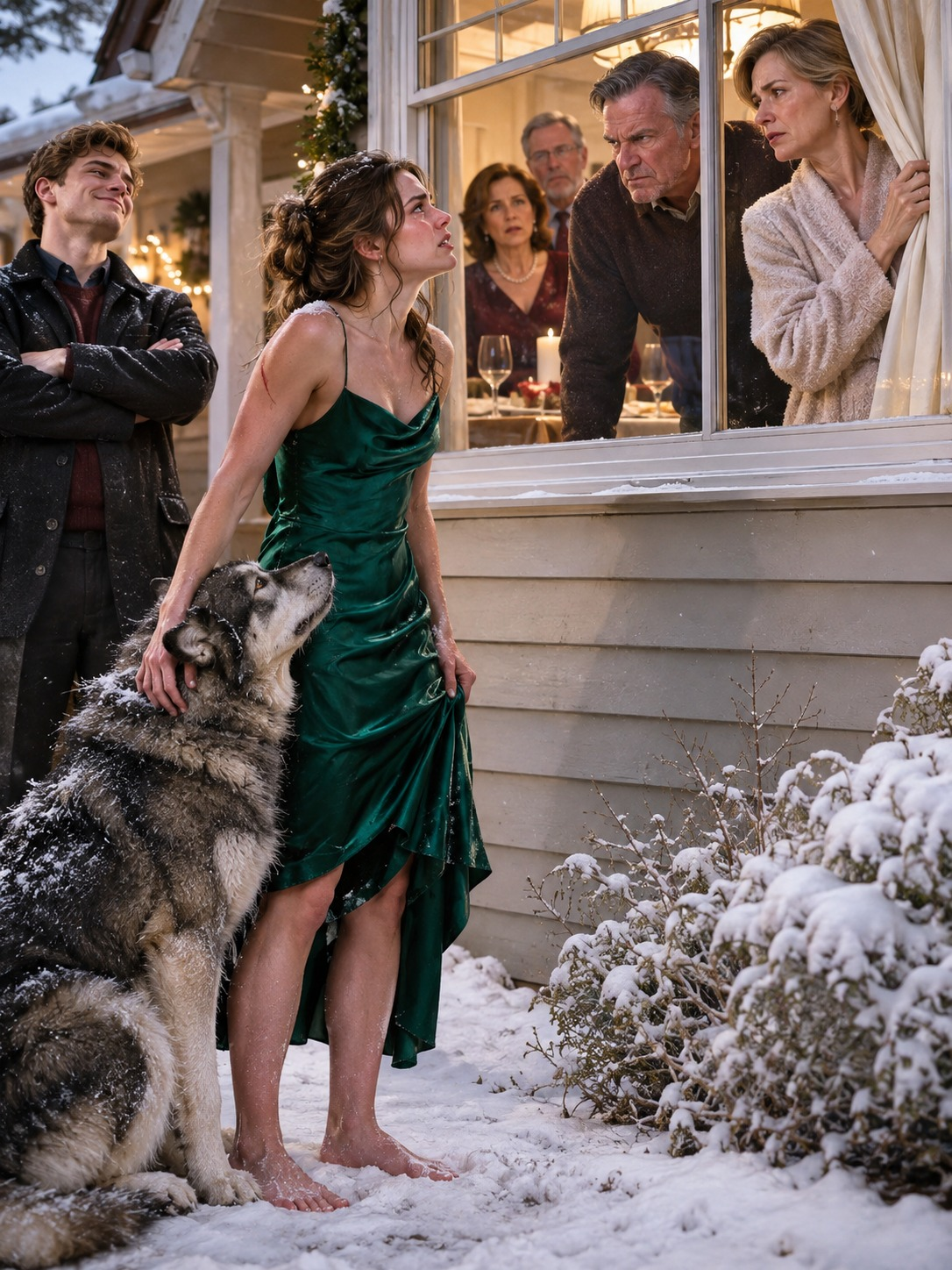
My mother had watched my father throw me outside.
She had seen me standing barefoot in the snow.
She had closed the curtains while I begged her to help me.
And now she had reported me to the police.
"What did she say I did?"
The deputy glanced at his notebook.
"According to your mother, you became aggressive during a family gathering last night."
I blinked.
"Aggressive?"
"She stated that you had been drinking and became involved in an argument concerning a property dispute."
I felt my stomach tighten.
"That's not what happened."
He raised his hand gently.
"I'm here to hear your side."
I nodded, although my hands had already begun trembling.
He continued reading.
"She claims you threatened several family members, damaged property, and attempted to leave through a window when your father tried to calm you down."
I stared at him.
For a moment, I genuinely couldn't speak.
Then I laughed.
It wasn't because anything was funny.
It was because the story was so outrageous that my mind couldn't immediately process it.
"My father tried to calm me down?"
"That's what she reported."
"He threw me through that window."
The deputy looked up.
"Can you explain exactly what happened?"
I took a deep breath.
Then I told him everything.
I explained Grandma's will and the ownership arrangement.
I described Vince's desire to purchase a condominium and my father's insistence that I surrender my inheritance.
I told him about the invitation, the dinner, the gifts, and the document Dad had placed beside my plate.
I explained how Vince blocked my path when I attempted to leave.
How Dad grabbed my arm.
How he dragged me toward the sunroom.
How my mother stood there without intervening.
The deputy listened carefully.
Occasionally, he asked questions.
"Did you threaten anyone?"
"No."
"Did you strike your father?"
"No."
"Did you damage anything inside the house?"
"No."
"How much alcohol did you consume?"
"A few sips of sparkling wine at midnight."
He wrote something down.
I continued.
I described the locked doors, the curtains, the padlocked gate, and my brother releasing Yukon.
When I explained how Yukon helped me escape through the opening beneath the fence, the deputy stopped writing.
"You're telling me you walked from that property to the interstate without shoes?"
"Yes."
"In those temperatures?"
I nodded.
He looked toward my bandaged feet.
His expression became noticeably more serious.
"Who else was present during the argument?"
"My aunt Nina and Uncle Carl."
"Are they related to you?"
"Nina is. Carl is a longtime family friend."
"Did either of them attempt to intervene?"
"No."
"Did either of them come outside to help you?"
"No."
He closed his notebook briefly.
"Your mother mentioned that you were emotionally unstable."
I looked away.
Of course she had.
Whenever I challenged my family's behavior, Mom described me as emotional.
Whenever I refused to cooperate, she called me difficult.
Whenever I became upset after being mistreated, she used my reaction as evidence that I was the problem.
Apparently, she had decided to use the same strategy with law enforcement.
"Did she mention that I'm lying here with frostbite?"
The deputy shook his head.
"Your family didn't know where you were when the initial report was made."
I looked at him.
"What time did she contact you?"
"Shortly after eight this morning."
Eight.
My father had thrown me outside shortly after midnight.
For approximately eight hours, my family hadn't known whether I was alive.
They hadn't called emergency services while I was freezing in their yard.
They hadn't reported me missing when they discovered I was gone.
They had waited until morning.
And when they finally contacted the authorities, they hadn't asked anyone to find me.
They had accused me of wrongdoing.
I felt sick.
"Did they say they were worried about me?"
The deputy hesitated.
"They expressed concern about your behavior."
That answer told me everything.
I turned toward the window.
Snow continued falling outside.
People were walking across the hospital parking lot wearing thick coats, hats, and gloves.
Some carried coffee.
Others hurried toward their cars.
The world was continuing normally.
Meanwhile, I was discovering that my family had already begun rewriting the worst night of my life.
The deputy explained that he would document my statement and request permission to obtain relevant medical information.
He also wanted to speak with Mac and the paramedics.
I agreed to cooperate.
Before leaving, he handed me his contact information.
"If anyone contacts you about changing your statement, let us know."
I looked at him.
"Do you think they'll do that?"
He didn't answer directly.
"Just keep us informed."
After he left, I sat motionless for nearly twenty minutes.
Emily eventually returned.
She found me staring at the wall.
"Are you okay?"
I shook my head.
"My mother told them I attacked my family."
Emily pulled up a chair.
"I'm sorry."
"I don't understand."
My voice broke.
"How can she do that?"
Emily didn't attempt to explain my mother's behavior.
She simply reminded me that my medical condition was documented and that the people who found me could provide their own accounts.
I nodded.
But something deeper was bothering me.
My mother hadn't merely abandoned me.
She was actively trying to make people believe that I deserved what happened.
That realization was harder to accept than I expected.
The following morning, Mac arrived carrying coffee and a small bag of pastries.
He noticed my expression immediately.
"What happened?"
I told him about the police report.
He listened.
Then he slowly placed his coffee on the bedside table.
"You're kidding."
"I wish I was."
"Your mother said you climbed out the window yourself?"
"Apparently."
He shook his head.
"That's quite a story."
I looked down.
"What if they believe her?"
Mac frowned.
"Why would they?"
"Because there are five of them."
He didn't respond immediately.
I continued.
"My father, my mother, Vince, Aunt Nina, and Uncle Carl. Five people who can tell the same story."
"And there's you."
"Exactly."
Mac leaned forward.
"There's also me. The ambulance crew. The doctors. Your injuries."
He pointed toward the window.
"And whatever evidence is still at that house."
I wanted to believe him.
But I knew how convincing my father could be.
He had spent decades presenting himself as a hardworking, respectable family man.
People admired him.
Neighbors trusted him.
He knew how to speak calmly when outsiders were watching.
Very few people had seen the version of him that existed behind closed doors.
My mother was even more convincing.
She could cry at exactly the right moment.
She could describe cruelty as concern.
She could make herself sound like a helpless parent struggling with an unreasonable daughter.
I had watched her do it for years.
Now my future might depend on whether other people recognized it.
Mac stayed until lunchtime.
Before leaving, he showed me another photograph of Yukon.
This time, Yukon was sitting beside Mac's daughter, who was holding a large stainless-steel food bowl.
His ears were upright.
His expression looked almost impatient.
"He's eating better than I am," Mac said.
I smiled.
"That's normal."
"He's also apparently decided that every blanket in the building belongs to him."
"Also normal."
For a few minutes, we laughed.
Then Mac promised to return the following day.
I watched him leave and wondered how a stranger had become more dependable in forty-eight hours than my own family had been in twenty-nine years.
Over the next several days, the doctors continued monitoring my feet.
Some areas began showing encouraging signs of recovery.
Others did not.
The pain changed constantly.
Sometimes it was sharp.
Sometimes it felt like burning.
Sometimes I experienced sensations I couldn't properly describe.
Sleeping became difficult.
Walking was impossible without assistance.
Even sitting upright for extended periods exhausted me.
The medical staff remained patient, but I could see the concern in their faces whenever they examined two particularly damaged toes.
I began preparing myself for the possibility that I might lose them.
I tried imagining what my life would look like afterward.
Would I be able to work normally?
Would I need special shoes?
Would I ever enjoy long walks with Yukon again?
The doctors answered what they could.
The rest remained uncertain.
Then, on my fourth day in the hospital, Emily entered my room with an unusual expression.
"Laney, you have a visitor."
I smiled.
"Mac?"
She shook her head.
"Your mother."
My smile disappeared.
I gripped the blanket.
"How did she find me?"
"I don't know. She's downstairs asking to see you."
I immediately felt cold despite the heated room.
"What does she want?"
"She says she's worried about you."
I almost laughed.
Emily explained that nobody would allow my mother into the room without my permission.
I could refuse the visit.
Security could escort her away if necessary.
I looked toward the door.
Part of me wanted to say no immediately.
Another part wanted answers.
I wanted to see whether Mom could look at my injuries and still defend what she had done.
I wanted to know whether she regretted closing those curtains.
Most of all, I wanted to hear her apologize.
"Can someone stay nearby?"
"Of course."
I swallowed.
"Let her come up."
Ten minutes later, my mother appeared in the doorway.
She was wearing a beige winter coat, neatly pressed black pants, and the pearl earrings Dad had given her several Christmases earlier.
She carried a bouquet of pink carnations.
Her eyes filled with tears the moment she saw me.
"Oh, sweetheart."
She hurried toward the bed.
I stiffened.
She noticed.
Her arms stopped halfway toward me.
For a moment, we simply looked at each other.
Then she placed the flowers beside my bed.
"You look terrible."
I didn't respond.
She pulled up a chair.
"I've been worried sick."
I stared at her.
"Have you?"
Her expression tightened.
"Of course I have."
"Then why didn't you open the window?"
She looked toward the door.
"Laney, please."
"Why didn't you open it?"
She sighed.
"Your father was upset."
"I was freezing."
"I know."
"You saw me."
"I know."
"You closed the curtains."
She pressed her lips together.
"I didn't want to make things worse."
I felt something twist inside my chest.
"Worse for whom?"
She looked offended.
"That's not fair."
I stared at her.
Not fair.
Those words had followed me throughout my childhood.
It wasn't fair to question Vince.
It wasn't fair to upset Dad.
It wasn't fair to make Mom choose sides.
Apparently, even after everything that had happened, expecting my mother to acknowledge my suffering was still considered unfair.
She glanced at my bandaged feet.
"What are the doctors saying?"
"They might have to amputate two of my toes."
Her face changed.
For the first time, she looked genuinely shocked.
"Amputate?"
"Yes."
"Oh, Laney."
She covered her mouth.
I waited.
Surely now she would understand.
Surely the possibility of permanent injury would finally make her recognize the seriousness of what she had done.
She reached for my hand.
I pulled it away.
"Did Dad know how cold it was?"
She looked uncomfortable.
"He wasn't thinking clearly."
"Did you?"
She lowered her gaze.
"Mom."
"Yes."
The answer came quietly.
I stared at her.
She knew.
She had known exactly how dangerous it was.
And she had still walked away.
I turned toward the window.
"Why are you here?"
She appeared surprised.
"To see my daughter."
"Then why did you tell the police I attacked everyone?"
Her expression changed immediately.
The tears disappeared.
"That's not exactly what I said."
"The deputy told me."
"Things got confused."
"You said I climbed out the window."
"Your father remembers it differently."
"I remember being thrown."
"Laney, please lower your voice."
I hadn't realized I was speaking loudly.
Mom leaned closer.
"We don't need strangers hearing our private business."
I looked at her.
"Private business?"
"Family matters should stay within the family."
"My feet might never recover."
"I understand that."
"No, you don't."
She glanced toward the hallway again.
Then she reached into her handbag.
"I brought something."
For one foolish moment, I thought she might have brought my phone.
Or my keys.
Or perhaps Grandma's photograph from the mantel.
Instead, she removed a large brown envelope.
She placed it carefully on the blanket beside me.
"What is that?"
"Something your father wanted you to look at."
My heart began pounding.
I recognized the envelope.
It was the same kind Dad used to store important household documents.
I looked at Mom.
"You're joking."
"Just hear me out."
She opened it.
Inside was another copy of the quitclaim deed.
My name.
Vince's name.
The signature line.
Everything was there.
I couldn't breathe.
"You brought that here?"
She spoke quickly.
"Your father thinks resolving the property situation would help everyone move forward."
I stared at the document.
I had spent four days in the hospital.
I couldn't walk.
I was facing the possibility of losing two toes.
And my mother had brought the very document that started everything.
"Get it away from me."
"Laney."
"Take it away."
"Please listen."
She lowered her voice.
"Your brother has made commitments. There are deadlines. People are depending on him."
I looked at her in disbelief.
"I'm in a hospital bed."
"I can see that."
"Then why are you talking about Vince?"
"Because this affects everyone."
I began laughing again.
That same terrible, disbelieving laugh.
Mom looked irritated.
"You're making this harder than it needs to be."
I stared directly into her eyes.
"You came here for my signature."
"No."
"That's why you brought flowers."
"Don't be ridiculous."
"You didn't come to apologize."
She shook her head.
"Your father is willing to put everything behind him."
I felt my entire body become tense.
"He's willing?"
"Yes."
"He threw me outside, and he's willing to forgive me?"
"That's not what I meant."
"Then what did you mean?"
She folded her hands.
"If you sign, we can settle this privately. Nobody needs to lose their family over a misunderstanding."
I looked at my feet.
Then at the document.
Then back at her.
"A misunderstanding?"
She reached into her handbag again and removed a pen.
"Just think about it."
I stared at the pen.
Four days earlier, Dad had placed another pen beside my dinner plate.
Now Mom was holding one beside my hospital bed.
Different room.
Same demand.
I pressed the nurse call button.
Mom's eyes widened.
"What are you doing?"
"Asking you to leave."
"Laney, don't embarrass me."
"Leave."
She grabbed the envelope.
"You need to understand something."
Her voice had changed.
The gentle concern was gone.
"If you keep talking to the police, your father could get into serious trouble."
I nodded.
"He should."
She stared at me.
"You would do that to your own father?"
"He did this to himself."
Her face hardened.
"You've always been selfish."
I felt the words strike me.
But this time, I didn't apologize.
I didn't defend myself.
I didn't try to convince her that I was a good daughter.
I simply pointed toward the door.
Emily entered moments later.
"Is everything all right?"
"No," I said. "I want her to leave."
Mom immediately changed her expression.
She looked wounded.
Confused.
Almost helpless.
"I'm only trying to help my daughter."
Emily remained professional.
"She's asked you to leave."
Mom gathered her handbag and the envelope.
Then she looked at me.
"You're going to regret treating your family like this."
I didn't answer.
She walked toward the door.
Just before stepping into the hallway, she turned around.
"And don't think everyone else remembers that night the way you do."
Then she left.
Emily closed the door.
I stared at the empty chair beside my bed.
The pink carnations remained on the table.
I asked Emily to remove them.
I couldn't stand looking at them.
That evening, I contacted the deputy and told him about Mom's visit.
I explained the document, the pen, and her attempt to persuade me to stop cooperating with the investigation.
He listened carefully.
Then he asked whether anyone had witnessed the conversation.
I mentioned Emily and explained that she had entered near the end.
He thanked me.
Before hanging up, he said he would contact me again soon.
I assumed that meant several days.
Instead, he returned the following afternoon.
He was accompanied by another investigator.
Both looked unusually serious.
The deputy placed a folder on the bedside table.
"We've spoken with the other people who were present that night."
My heart began racing.
"All of them?"
"Yes."
He opened the folder.
There were five separate statements inside.
My father's.
My mother's.
Vince's.
Aunt Nina's.
Uncle Carl's.
The investigator pulled his chair closer.
"There's something unusual about these accounts."
I looked at the papers.
"What?"
The deputy placed his finger beneath a highlighted paragraph.
"They all claim you did something before your father opened that window."
I swallowed.
"What did I supposedly do?"
He turned the first statement toward me.
Then I saw the accusation my entire family had agreed to make.






Comments 0