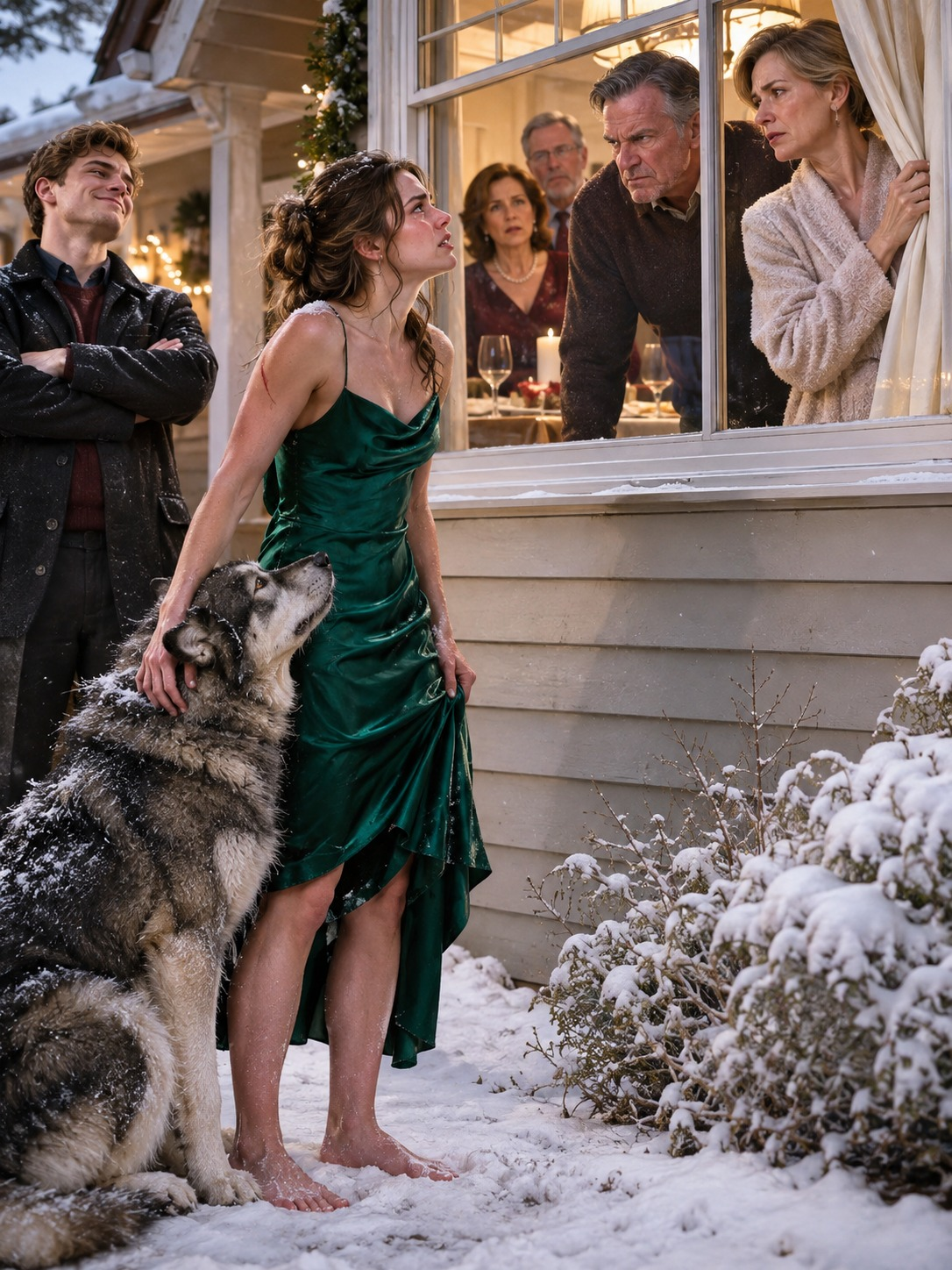
"Stay with me, sweetheart. Don't close your eyes."
The voice belonged to a man I didn't recognize.
I tried opening my eyes, but my eyelids felt impossibly heavy.
Something covered my shoulders.
A blanket, perhaps.
I could hear an engine running nearby, followed by the distant sound of someone speaking through a phone.
"Female, probably late twenties. Severe cold exposure. She's conscious, but barely."
I wanted to explain that I was twenty-nine.
I wanted to tell him that my name was Laney.
Instead, I managed a single word.
"Yukon."
The stranger leaned closer.
"What was that?"
"My dog."
He looked over his shoulder.
"That big fella right there?"
I nodded weakly.
"Don't leave him."
"All right. Nobody's leaving anybody."
Those words were the first promise anyone had made to me that night without asking for something in return.
The stranger was a truck driver named Mac.
I would later learn that he was fifty-eight years old, divorced, and the father of two grown daughters.
He had spent more than thirty years driving commercial trucks across the Midwest.
He had witnessed accidents, helped stranded motorists, and survived more Minnesota winters than he cared to remember.
But according to him, nothing had prepared him for what he saw beside the interstate that New Year's morning.
A young woman wearing a torn emerald-green evening dress.
Barefoot.
Barely conscious.
An enormous gray wolfdog standing protectively beside her.
At first, Mac thought there had been a car accident.
He searched the roadside for a damaged vehicle.
When he couldn't find one, he pulled over, called emergency services, and grabbed a blanket from his truck.
Yukon initially refused to let him approach.
He stood between Mac and me, watching every movement.
Mac stopped several feet away.
"Easy, buddy. I'm trying to help her."
Yukon growled softly.
Mac placed the blanket on the ground.
He spoke gently.
"She's in trouble, and I think you know that."
Perhaps Yukon understood his tone.
Perhaps he sensed that I was no longer frightened.
Whatever the reason, he eventually moved aside.
Mac wrapped the blanket around me and followed the emergency dispatcher's instructions while waiting for the ambulance.
He stayed beside me.
He kept talking.
He told me his name.
He told me that he was carrying a shipment of household supplies.
He told me that his youngest daughter had recently graduated from nursing school.
He told me about a diner near Duluth that served the best blueberry pancakes in Minnesota.
I remember very little of those conversations.
But I remember his voice.
Steady.
Patient.
Kind.
He didn't demand answers.
He didn't ask what I had done to deserve being outside.
He didn't tell me that I should have made better decisions.
He simply wanted me to stay alive.
At some point, I opened my eyes and saw Yukon lying beside me.
His head rested near my shoulder.
Mac was crouched nearby.
"That's some dog you've got there."
I tried smiling.
"He saved me."
Mac nodded.
"I believe it."
I looked toward the highway.
The passing headlights seemed distant and unreal.
"Where are we?"
"You're safe. Help's coming."
I began crying.
Mac appeared concerned.
"Are you hurting somewhere?"
I shook my head.
Then I nodded.
Then I started crying harder.
I didn't know how to explain what had happened.
How could I tell a complete stranger that my father had thrown me through a window because I refused to surrender my inheritance?
How could I explain that my mother had closed the curtains while I begged her for help?
How could I admit that the people I had spent my entire life trying to please had abandoned me in temperatures that could kill me?
"My family," I whispered.
Mac leaned closer.
"What about your family?"
"They put me outside."
His expression changed.
"Outside where?"
"The house."
"Without your coat?"
I nodded.
"Without shoes?"
Another nod.
He looked down at my feet.
For several seconds, he said nothing.
Then he quietly muttered something under his breath.
I couldn't hear the words.
But I understood the anger in his voice.
It was the first time that night someone had been angry on my behalf.
The ambulance arrived shortly afterward.
Its flashing lights illuminated the snowbanks and the side of Mac's truck.
Two paramedics approached carrying medical equipment.
Yukon immediately stood.
Mac raised his hands.
"Easy, big guy. They're here to help."
One of the paramedics knelt beside me.
"Can you tell me your name?"
"Laney."
"Laney, I'm Rachel. We're going to take care of you."
She asked me several questions.
My age.
Whether I had consumed alcohol.
Whether I had fallen.
Whether I knew how long I had been outside.
I tried answering, but my thoughts were becoming increasingly confused.
I remembered dinner.
The deed.
The window.
The curtains.
The snow.
Everything else seemed disconnected.
When Rachel asked about my shoulder, I began crying again.
"My dad."
"What happened with your dad?"
"He threw me."
She looked toward her colleague.
Neither of them spoke for a moment.
Then Rachel returned her attention to me.
"Okay, Laney. You're with us now."
They prepared to move me into the ambulance.
I immediately reached toward Yukon.
"No."
Rachel stopped.
"What's wrong?"
"My dog."
Yukon stood beside the stretcher.
His ears were lowered.
He watched the paramedics with obvious uncertainty.
"We can't take him in the ambulance," Rachel explained gently.
I shook my head.
"Please."
Mac stepped forward.
"I'll take care of him."
I looked at him.
"Promise?"
"Absolutely."
"Don't take him back to my family."
Mac's expression hardened.
"I won't."
"Please don't."
"I heard you, sweetheart."
He placed a hand against the side of the stretcher.
"Your dog stays with me until we figure things out."
I looked at Yukon one last time.
"Good boy."
His tail moved.
Then the paramedics lifted me into the ambulance.
The doors closed.
For the first time since leaving Grandma's property, I was separated from the animal who had refused to abandon me.
I felt terrified.
Rachel noticed.
"Your friend will take care of him."
"He's not my friend."
She looked confused.
"The man outside?"
"I don't know him."
She glanced toward the closed doors.
"Well, I'm glad he found you."
So was I.
During the ambulance ride, I drifted in and out of consciousness.
I remember medical equipment.
A blood pressure cuff tightening around my arm.
Rachel asking me to keep looking at her.
Another voice communicating with the hospital.
I remember wondering why my feet felt so strange.
They seemed disconnected from the rest of my body.
I couldn't properly move my toes.
My shoulder hurt whenever the ambulance turned.
At one point, I asked Rachel whether I was going to die.
She didn't dismiss the question.
She didn't laugh or tell me I was being dramatic.
"We're doing everything we can to get you through this," she said.
"You're in the right place."
I nodded.
Then I asked her something else.
"Can you call my grandma?"
Rachel looked down at me.
"What's her number?"
I opened my mouth.
And remembered.
Grandma was dead.
She had been dead for nearly three years.
I began crying so hard that Rachel had to remind me to breathe slowly.
"I'm sorry," I whispered.
"You don't need to apologize."
"I forgot."
"That's okay."
"I forgot she was gone."
Rachel held my hand.
For the remainder of the journey, she stayed beside me.
When we arrived at the hospital, several people were waiting.
They moved quickly.
They transferred me onto another bed, removed my wet clothing, examined my injuries, and began treating the effects of severe cold exposure.
Everything happened beneath painfully bright lights.
I heard unfamiliar medical terms.
Hypothermia.
Frostbite.
Circulation.
Tissue damage.
Someone asked whether I had any allergies.
Someone else examined my shoulder.
A doctor spoke to me, but I couldn't concentrate long enough to understand everything he said.
I kept asking about Yukon.
Eventually, a nurse assured me that the truck driver had contacted the hospital and was arranging temporary care for him.
Only then did I allow myself to close my eyes.
When I woke again, daylight was visible through the window.
For several seconds, I didn't know where I was.
The room smelled like disinfectant.
A monitor beeped beside my bed.
My arm was connected to an IV.
Thick blankets covered my body.
I tried moving.
Pain immediately reminded me that something terrible had happened.
My shoulder ached.
My legs felt heavy.
My feet were wrapped in protective dressings.
I stared at them.
Then everything came rushing back.
Dad's hand around my arm.
The open window.
Mom's face behind the glass.
Vince releasing Yukon.
I pressed my hands against my eyes.
It hadn't been a nightmare.
A nurse entered shortly afterward.
She introduced herself as Emily.
"Good morning, Laney."
"What time is it?"
"Almost eleven."
I looked toward the window.
"New Year's Day?"
She nodded.
I had survived the night.
That realization should have filled me with relief.
Instead, I felt strangely empty.
Emily checked my temperature and examined the equipment beside my bed.
"How are you feeling?"
"I don't know."
"That's understandable."
I looked down at my feet.
"Are they okay?"
Her expression became careful.
"The doctor will explain everything when he comes in."
"Can I walk?"
"Not right now."
"Will I be able to?"
She pulled a chair closer.
"We're going to take this one step at a time."
I hated that answer.
Not because she had said anything wrong.
Because I recognized what people sounded like when they were trying to prepare you for bad news.
"How bad is it?"
Emily didn't pretend.
"You have significant frostbite. The doctors are monitoring the affected areas closely."
I swallowed.
"Am I going to lose my feet?"
"We don't know the full extent of the damage yet."
She rested her hand gently against my arm.
"The important thing is that you're here."
I stared at the ceiling.
My father had wanted me to sign a piece of paper.
I had refused.
Now I was lying in a hospital bed, wondering whether I would ever walk normally again.
The absurdity of it made me want to scream.
Instead, I asked for water.
Emily helped me drink.
Then she asked whether there was anyone I wanted the hospital to contact.
I hesitated.
My parents were listed as emergency contacts in several of my records.
Until that morning, I had never thought to change them.
"Not my family."
Emily looked at me.
"All right."
"Please don't tell them where I am."
She nodded.
"We can discuss restricting visitors and protecting your information."
I felt a small amount of relief.
Then I remembered Mac.
"The truck driver. Do you know where he is?"
"He's been calling to check on you."
"Really?"
"He called twice this morning."
A stranger had called twice.
My family hadn't called once, as far as I knew.
Emily smiled.
"He also wanted you to know that your dog is safe."
I closed my eyes.
"Thank God."
Mac arrived that afternoon.
He carried a paper bag containing a few personal items he thought I might need.
A toothbrush.
A hairbrush.
A pair of warm socks.
A phone charger, although I didn't have my phone.
He looked uncomfortable standing beside the hospital bed.
"Didn't know what to bring."
I began crying.
He immediately looked alarmed.
"Did I do something wrong?"
I shook my head.
"No."
He placed the bag on the bedside table.
"Well, that's good."
I looked at the socks.
They were thick, gray, and completely ordinary.
But something about them overwhelmed me.
A stranger had gone into a store and purchased warm socks for me.
My own mother had watched me stand barefoot in the snow and closed the curtains.
I couldn't stop crying.
Mac pulled up a chair.
He didn't tell me to calm down.
He simply waited.
When I could finally speak, I asked about Yukon.
Mac smiled.
"He's doing better than you, that's for sure."
"Where is he?"
"My daughter knows someone who works with large dogs. He's staying somewhere warm and secure."
"He's eating?"
"Like a horse."
I laughed.
It hurt my shoulder, but I laughed anyway.
Mac reached into his jacket and removed his phone.
"Want to see him?"
He showed me a photograph.
Yukon was lying on a thick blanket inside a spacious enclosure, his enormous paws stretched forward.
A bowl of water sat nearby.
He looked tired but comfortable.
I touched the screen.
"Thank you."
Mac nodded.
"He's a good animal."
"He really is."
"Wouldn't let me get near you at first."
"He was protecting me."
"I figured."
Mac studied the photograph for a moment.
Then he looked at me.
"That dog was the reason I noticed you."
I frowned.
"What?"
"I saw something moving near the shoulder. Thought it was a wolf at first."
He shook his head.
"Then I saw you down beside him."
I looked at Yukon again.
If he hadn't been there, Mac might have driven past.
Just like everyone else.
I pressed the phone against my chest.
Mac waited quietly.
After several minutes, he asked whether I remembered telling him about my family.
I nodded.
"Did your father really put you outside?"
I looked toward the window.
"Yes."
"Was there some kind of accident?"
"No."
I told him about the inheritance.
The quitclaim deed.
Vince's condominium.
The argument.
My father's hands.
My mother's curtains.
I told him how the doors had been locked and how Vince had released Yukon.
Mac listened without interrupting.
When I finished, he leaned back in his chair.
His jaw was clenched.
"Have you spoken to the police?"
"Not yet."
"You should."
I nodded.
But the idea terrified me.
Reporting my father meant admitting that what happened wasn't simply another family argument.
It meant making the situation real in a way I couldn't undo.
Mac seemed to understand my hesitation.
He looked at my bandaged feet.
"Laney, whatever they're going to call this, it wasn't an argument."
I stared at him.
He continued.
"People don't accidentally leave someone barefoot outside at twenty below."
I looked away.
For years, I had defended my family whenever anyone questioned their behavior.
I had explained Dad's temper.
Excused Mom's silence.
Justified Vince's demands.
Now a man who had known me for less than a day understood something I had spent twenty-nine years refusing to acknowledge.
My family had hurt me.
And I didn't owe them another excuse.
Later that afternoon, a doctor entered my room.
His name was Dr. Bennett.
He explained that my body temperature had stabilized and that my shoulder injury, although painful, appeared manageable without surgery.
Then he discussed my feet.
Several areas had sustained serious frostbite.
Two toes were particularly concerning.
He explained that the full extent of the injury could take time to become clear.
They would continue monitoring circulation and tissue recovery.
I listened carefully.
But one sentence remained in my mind.
"There is a possibility that some tissue won't recover."
I looked down at the blankets.
"Meaning what?"
He paused.
"Meaning we may eventually need to consider amputation."
The room became silent.
Mac looked toward the floor.
I stared at the doctor.
"How much?"
"It's too early to make that determination."
I nodded because I didn't know what else to do.
The doctor explained the next steps before leaving.
Mac remained beside me.
Neither of us spoke.
Eventually, I whispered, "I bought that dress because I wanted to look pretty."
Mac turned toward me.
I started laughing and crying at the same time.
"That's all I wanted. A nice dinner. A new dress. One normal night with my family."
He handed me a tissue.
"I know."
"I didn't even ask them for anything."
"I know."
"I just wanted to keep what Grandma gave me."
Mac looked directly into my eyes.
"Then keep it."
His voice was firm.
"Don't let them take anything else from you."
Shortly before he left, Emily returned with a hospital social worker.
They discussed my safety, my emergency contacts, and the possibility of arranging a conversation with law enforcement.
I agreed.
I was finally ready to tell someone officially what my family had done.
The social worker stepped outside to make arrangements.
Mac promised to return the following morning.
I thanked him again.
After he left, I lay quietly beneath the blankets, watching snow fall beyond the hospital window.
For the first time all day, I felt that I might have some control over what happened next.
Then Emily entered.
She was holding a clipboard.
Her expression was different.
"Laney, there's something we need to discuss."
I looked at her.
"What happened?"
"Someone contacted the hospital looking for you."
My stomach tightened.
"Who?"
"Your mother."
I immediately sat straighter.
"Did you tell her I was here?"
"No. We haven't confirmed anything to her."
I exhaled.
Emily hesitated.
"She made some statements that concerned us."
"What statements?"
Before she could answer, someone knocked on the door.
The social worker stepped inside.
She was accompanied by a uniformed sheriff's deputy.
He carried a small notebook.
"Miss Laney?"
I nodded.
He closed the door behind him.
"Your family contacted our department this morning."
I felt my heart begin pounding.
"Did they tell you what happened?"
He pulled a chair toward my bed.
"Your mother filed a report."
I stared at him.
"A report about my father?"
He opened his notebook.
"No, ma'am."
Then he turned the page toward me.
"She filed a report against you."






Comments 0