I unfolded Grandma's letter carefully.
The paper had yellowed slightly around the edges, and the familiar handwriting brought tears to my eyes before I finished reading the first sentence.
Uncle Mitch pulled a chair beside me.
Mac stood near the bedroom doorway.
Nobody hurried me.
I took a deep breath and continued reading.
"My darling girl, there is one last thing I never told your father. For many years, I have been putting a little money aside. Nothing extravagant, but enough to help you when life becomes difficult."
I stopped.
I looked toward Mitch.
"Did you know about this?"
He shook his head.
I returned to the letter.
"Your father believes he knows everything about my finances. That has never been entirely true. Some things are better kept private, especially when people begin counting money that doesn't belong to them."
Despite my tears, I smiled.
That sounded exactly like Grandma.
She had always possessed a quiet sense of humor, particularly when someone underestimated her.
I continued reading.
"I have arranged for these savings to pass directly to you. My attorney has the necessary information. I hope you will use them to build a life that makes you happy, whether that life takes you far away from this house or brings you back to it."
I looked at the document beneath the letter.
It contained information concerning a savings account and a beneficiary designation.
My name appeared clearly.
I could hardly believe what I was seeing.
Grandma had left me something beyond my share of the house.
Something Dad and Vince had apparently never discovered.
Something they hadn't been able to pressure me into surrendering.
I returned to her letter.
"Please remember that you do not owe anybody your happiness. You have spent so much of your life taking care of other people. I hope someday you will allow yourself to be taken care of, too."
My vision blurred.
I wiped my eyes and continued.
"If you ever find yourself living in this house, plant something beautiful beside the kitchen window. Open the curtains every morning. Invite people who make you laugh. Let the house be filled with warmth, even during the coldest Minnesota winters."
I pressed the letter against my chest.
For several moments, I couldn't speak.
Mitch placed his hand over mine.
"She certainly knew how to keep a secret."
I laughed through my tears.
"Apparently."
Mac smiled from the doorway.
"Smart lady."
I nodded.
"The smartest person I've ever known."
The final paragraph was short.
"Whatever happens, Laney girl, remember that I loved you before you accomplished anything, before you earned anything, and before you ever did a single thing for me. You never had to prove that you deserved my love. You were always enough."
I began crying.
Not the frightened tears I had cried outside the window.
Not the angry tears I had cried in the hospital.
These were different.
For the first time in months, I felt as though something broken inside me was beginning to heal.
Grandma had understood what I needed long before I understood it myself.
And somehow, even after her death, she had found another way to remind me.
Inside the velvet pouch, I discovered her wedding ring.
It was a simple gold band with a tiny diamond.
I remembered watching it sparkle whenever she kneaded bread or worked beside me in the garden.
There was a small note attached.
"For the woman who taught me that kindness can be stronger than stubbornness."
I slipped the ring onto my finger.
It fit almost perfectly.
Mitch smiled.
"She would've liked seeing you wear that."
I looked down at my hand.
"I wish she could."
He squeezed my shoulder.
For a while, we remained together in Grandma's bedroom, surrounded by the belongings my family had left behind.
Then I carefully returned the letters and documents to the wooden box.
I carried it into the kitchen.
This time, I didn't feel like a visitor.
A few days later, Margaret helped me contact the financial institution named in Grandma's documents.
The process required verification and additional paperwork, but the beneficiary designation was valid.
Grandma had accumulated nearly sixty-eight thousand dollars over many years.
I was astonished.
She had lived modestly.
She rarely purchased anything expensive.
She repaired clothing instead of replacing it.
She grew vegetables, preserved food, and kept careful records of her household expenses.
Little by little, she had created a financial cushion that would eventually become mine.
The money didn't make me wealthy.
But it gave me something I desperately needed.
Breathing room.
I could address medical expenses, complete necessary repairs, and prepare the house for a safer future without immediately worrying about every dollar.
When Margaret confirmed that the funds were separate from the disputed property arrangements, I felt another enormous weight disappear.
Dad hadn't known about them.
Vince hadn't received them.
Nobody had been entitled to promise them away.
Grandma's final gift had remained exactly where she intended it to be.
Several weeks later, the remaining property settlement requirements were completed.
Margaret called me into her office.
She placed a document on the table and smiled.
"Congratulations, Laney."
I looked at the paperwork.
My name appeared as the sole owner.
There was no second owner listed.
No unresolved transfer.
No remaining lifetime occupancy rights belonging to my parents.
The necessary documents had been recorded.
The settlement was complete.
Grandma's house was officially mine.
All of it.
I stared at the page for so long that Margaret eventually laughed.
"You can believe it."
I looked up.
"Nobody can take it away?"
"Your family no longer has an ownership or occupancy interest in the property."
I covered my mouth.
Then I began crying again.
Margaret handed me a tissue.
I laughed.
"I swear I used to cry a lot less."
"You've had quite a year."
That was certainly one way to describe it.
The settlement had addressed the outstanding property interests and civil claims through carefully documented financial arrangements.
Vince's remaining assets and obligations were handled under separate agreements, including his responsibility to repay the prospective buyers.
I wasn't responsible for returning the thirty thousand dollars he had accepted.
I wasn't responsible for Dad's debts.
I wasn't responsible for financing anybody's future.
For the first time, my financial life belonged entirely to me.
The criminal proceedings had also reached their conclusions.
Dad was serving his sentence.
Mom and Vince were living under the requirements imposed through their respective cases.
The restrictions protecting me remained in effect.
I had no desire to follow every detail of their daily lives.
Susan continued providing necessary updates, but eventually those updates became less frequent.
My family had occupied nearly every waking thought for months.
Now there were entire days when I didn't think about them at all.
Aunt Nina sent another apology.
This time, she didn't ask me to forgive her.
She simply acknowledged that she had failed me and accepted that I might never want a relationship with her again.
I appreciated that she had finally stopped making demands.
I wasn't ready to welcome her back into my life.
Perhaps I never would be.
But I was grateful that she had ultimately told the truth.
Uncle Carl remained distant.
Christa moved forward with her own life.
The buyers were no longer involved with Grandma's property.
And the forged documents that had once threatened my inheritance had become evidence of deception rather than instruments capable of taking my home.
There were no more signatures for my father to demand.
No more paperwork for my mother to conceal.
No more promises Vince could make using something that belonged to me.
The matter was finished.
Now I had a house to restore.
And a very large dog waiting to come home.
Mac helped me organize the repairs.
Uncle Mitch spent several weekends working beside him.
They replaced damaged sections of fencing, repaired the gate, and arranged for professionals to inspect the heating system.
The backyard needed considerable attention.
Grandma's garden had been neglected.
Several flower beds were overgrown.
The apple trees needed pruning.
The cedar sauna required repairs.
I loved every minute of it.
Even when I became tired.
Even when my feet hurt.
Even when progress seemed painfully slow.
Every improvement represented a choice I was making for myself.
One afternoon, Mac found me standing in the sunroom.
I had avoided entering it during my first inspection.
Even afterward, I had remained uncomfortable whenever I approached the doorway.
But that afternoon, I finally walked inside.
The window was still there.
The same window Dad had opened on New Year's Eve.
I stared at it.
My heart began pounding.
For a moment, I could almost hear his voice.
I could almost feel the cold air against my skin.
Mac stopped beside me.
"You doing okay?"
I nodded slowly.
Then I shook my head.
"Not really."
He waited.
"I hate this window."
He examined it.
"Then let's replace it."
I looked at him.
"Just like that?"
"Your house. Your window."
I stared at the glass.
Then I smiled.
A week later, contractors removed the old window and replaced it with a beautiful, energy-efficient picture window overlooking the backyard.
I chose a design with a broad sill where I could place plants.
I painted the sunroom a warm cream color.
I purchased a comfortable reading chair.
I brought in a small bookshelf and several soft blankets.
Then I hung pale yellow curtains.
Curtains that reminded me of sunlight.
On the morning everything was finished, I stood in the middle of the room and looked around.
The place where I had experienced the worst moment of my life had become one of the most beautiful rooms in the house.
I walked toward the window.
Outside, the apple trees were beginning to blossom.
I opened the curtains.
And I left them open.
The following Saturday, Yukon finally came home.
Denise helped us prepare for his arrival.
The repaired enclosure and reinforced fencing provided the secure outdoor space he needed, and I had arranged continuing support from people experienced with wolfdogs.
I had also obtained the necessary ownership documentation through the property settlement and completed the relevant veterinary and local requirements.
There would be no uncertainty about where he belonged.
He belonged with me.
Mac opened the vehicle door.
Yukon stepped down and immediately began examining the familiar surroundings.
He sniffed the grass.
The fence.
The apple trees.
Then he looked toward the house.
I stood on the porch.
"Come on, buddy."
His ears lifted.
He trotted toward me.
When he reached the steps, he stopped and looked up.
I opened the front door.
"You're home."
He walked inside.
For several minutes, he explored every room.
He sniffed the furniture.
Investigated the kitchen.
Examined Grandma's former bedroom.
Then he wandered into the sunroom.
I followed him.
He stood beside the new window, looking toward the backyard.
After a moment, he turned in a circle and settled onto the large bed I had purchased for him.
I sat in my reading chair.
He rested his head beside my feet.
I reached down and stroked his fur.
"Much better than sleeping in the snow, huh?"
His tail thumped against the floor.
I laughed.
Then I looked toward the garden.
We had survived together.
And now we were home together.
As summer arrived, my recovery continued.
I no longer needed the cane for most everyday activities, although I still used it when walking longer distances or navigating uneven ground.
The loss of my toes had permanently changed certain aspects of my balance.
There were shoes I could no longer comfortably wear.
There were days when discomfort reminded me of everything that had happened.
But my life was no longer defined by those limitations.
I returned to work gradually.
I resumed activities I had once enjoyed.
I began taking photographs of the garden.
I learned new ways to exercise safely.
And every evening, weather permitting, I walked around the property with Yukon beside me.
Sometimes we stopped beneath the apple trees.
Sometimes we sat near the garden.
Sometimes we simply enjoyed the quiet.
I also continued speaking with a counselor who helped me work through the fear and grief I carried.
Healing wasn't always predictable.
There were moments when a slammed door startled me.
There were nights when old memories returned.
But those moments became less frequent.
And when they happened, I knew I had people I could call.
Mac.
Mitch.
Friends I had gradually reconnected with.
People who cared about me without requiring anything in return.
One afternoon, Mac arrived carrying a large wooden object wrapped in an old blanket.
"Got something for you."
I looked suspiciously at the package.
"What did you buy?"
"Didn't buy it."
He placed it on the porch.
"Found it in the garage while we were cleaning."
He removed the blanket.
I immediately recognized Grandma's old wooden sign.
WELCOME HOME.
The paint was faded.
One corner had been damaged.
But it was unmistakable.
I touched the lettering.
"I thought they threw it away."
"Guess they didn't think it was worth much."
I smiled.
"They were wrong."
Mac had repaired the damaged corner and carefully restored the lettering.
Together, we hung it beside the front door.
I stepped back.
For the first time since returning to the property, the entrance looked exactly right.
Grandma's sign was home again.
So was I.
By autumn, the garden had produced tomatoes, carrots, herbs, and more zucchini than I knew what to do with.
Uncle Mitch visited frequently.
He helped me harvest apples and told stories about Grandma that I had never heard before.
Mac's daughters came over for dinner.
Denise visited Yukon.
Margaret stopped by one afternoon to see the finished house.
Even Emily, the nurse who had cared for me during my hospitalization, received a handwritten thank-you card and a photograph of Yukon resting in the sunroom.
I wanted the people who had helped me to know what their kindness had made possible.
Especially Mac.
One evening, while we were sitting on the porch, I handed him a framed photograph.
It showed Yukon and me standing beneath Grandma's apple trees.
On the back, I had written a message.
"Thank you for stopping when everyone else kept driving."
Mac read it quietly.
Then he cleared his throat.
"You're trying to make an old man emotional."
I laughed.
"Is it working?"
He looked away.
"Maybe."
I smiled.
He placed the photograph carefully beside him.
"You know, I still think about that night sometimes."
"So do I."
He nodded.
"That dog was determined somebody was going to notice you."
I looked toward Yukon, who was sleeping near the porch steps.
"He wouldn't give up."
"Neither did you."
I thought about those words.
For months, I had remembered myself as the frightened woman lying helplessly in the snow.
But I had also been the woman who refused to sign.
The woman who crawled beneath the fence.
The woman who kept moving when every part of her wanted to stop.
The woman who told the truth even when five people insisted she was lying.
I hadn't survived alone.
But I had fought to survive.
And I was finally proud of that.
When December arrived, the first significant snowfall covered the property.
I stood beside the sunroom window and watched the flakes drift toward the ground.
Yukon was delighted.
He raced through the secure backyard, occasionally stopping to bury his nose in the snow.
I laughed at him.
For the first time since New Year's Eve, watching snow fall didn't fill me entirely with fear.
It was beautiful again.
Not harmless.
Not something I would ever take for granted.
But beautiful.
As the holidays approached, I decided to host a dinner.
Nothing elaborate.
Just the people who had become important to me.
Mac and his daughters.
Uncle Mitch.
Denise.
A few friends.
We decorated the house with lights, placed Grandma's ornaments on the Christmas tree, and filled the kitchen with the smell of fresh bread.
I made her apple pie.
Mitch insisted on helping, although his definition of helping involved eating pieces of apple whenever he thought I wasn't looking.
Mac complained that Yukon received better treats than everyone else.
Yukon ignored him.
The house was filled with laughter.
Exactly the way Grandma had wanted.
On New Year's Eve, one year after the night that changed my life, we gathered around the dining room table.
I had considered avoiding the holiday entirely.
But eventually, I decided I didn't want my father to own that date forever.
It belonged to me as much as any other day.
So we celebrated.
There were no legal documents on the table.
No arguments about money.
No demands disguised as family obligations.
Only food, conversation, and people who were happy to be together.
Shortly before midnight, Mitch raised his glass.
"To Mom," he said.
I smiled.
Everyone raised their glasses.
"To Grandma."
We drank to her memory.
Then Mac looked at me.
"And to Laney."
I shook my head.
"Oh, come on."
He smiled.
"Absolutely."
Mitch raised his glass again.
"To the woman who brought this house back to life."
I felt tears gathering in my eyes.
But I was smiling.
When midnight arrived, everyone cheered.
Yukon lifted his head from his bed, looked around in mild confusion, and returned to sleep.
I laughed.
Then I stepped into the sunroom.
Outside, the backyard glowed beneath the moonlight.
Snow covered the apple trees.
The temperature had dropped considerably.
Inside, the house was warm.
I wore thick socks and comfortable slippers.
Grandma's ring rested on my finger.
Behind me, I could hear Mac telling a terrible joke.
Mitch was laughing.
Someone was cutting another piece of pie.
I looked toward the window.
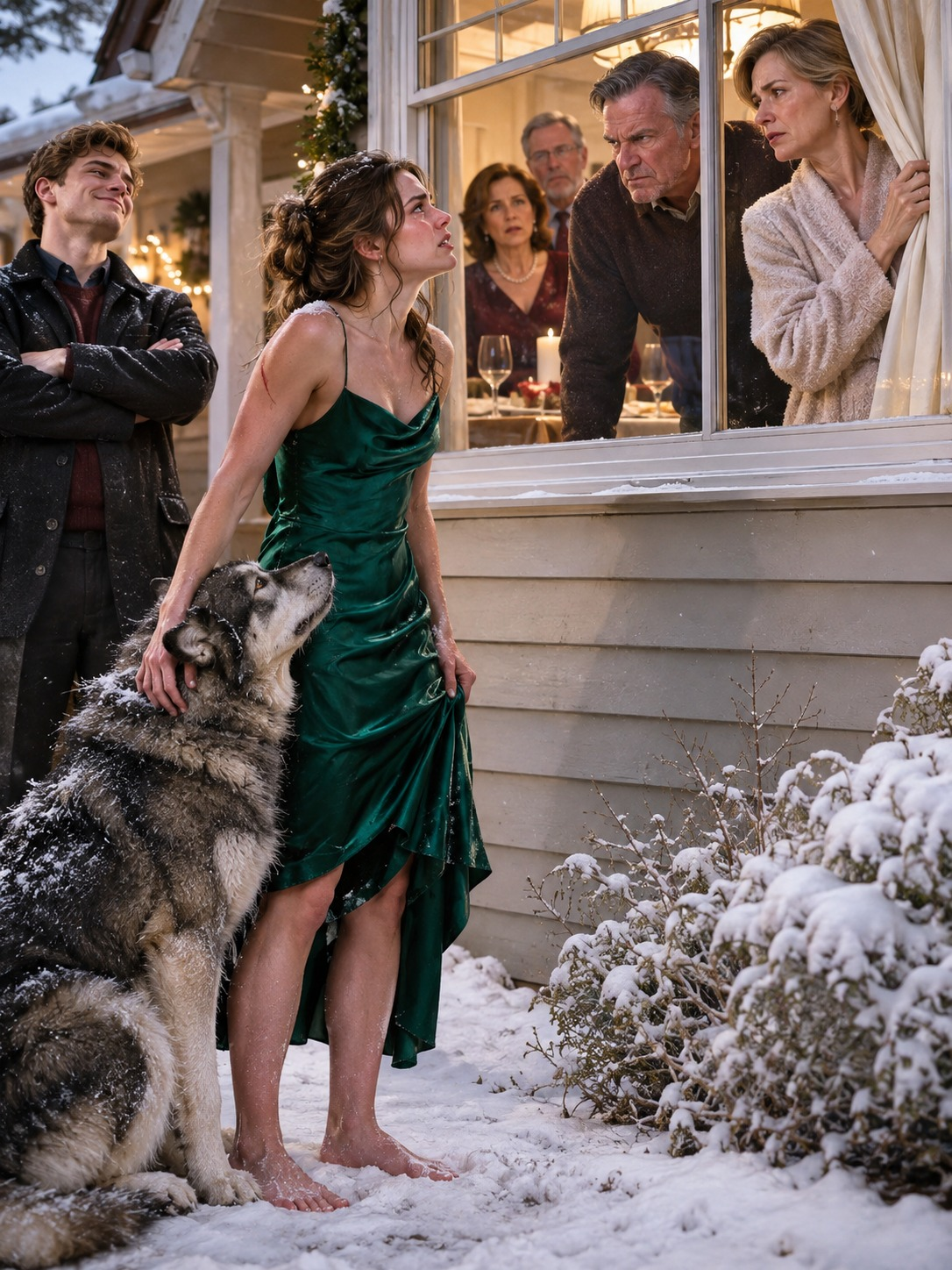
A year earlier, I had stood on the other side of the glass, begging my family to let me inside.
Now the curtains were open.
The doors were unlocked for my guests.
And nobody in this house would ever be left outside because they refused to surrender something that belonged to them.
Yukon wandered into the room and pressed his head against my hand.
I stroked his fur.
"Happy New Year, buddy."
He leaned against my leg.
I looked toward Grandma's photograph on the bookshelf.
"I kept my promise."
For a moment, I imagined her standing beside me.
Smiling.
Wearing her favorite apron.
Telling me that the pie needed more cinnamon.
I smiled through my tears.
"I hope you like what I've done with the place."
The house creaked softly in the winter wind.
I returned to the dining room.
Mac pulled out a chair for me.
Mitch handed me a slice of pie.
Someone asked whether I wanted more coffee.
I sat down.
And for the first time in my life, I understood that home wasn't a place where I had to earn permission to belong.
It was a place where my presence was welcomed.
Where my voice mattered.
Where saying no didn't cost me love.
My father had tried to take my inheritance.
My brother had tried to turn my future into his financial solution.
My mother had closed the curtains when I needed her most.
They had taken things from me that could never be completely restored.
But they hadn't taken everything.
They hadn't taken my grandmother's love.
They hadn't taken my courage.
They hadn't taken Yukon.
And they hadn't taken my future.
I was twenty-nine when I nearly lost my life defending my right to keep a home.
A year later, I had gained something far more valuable than the property itself.
I had gained the freedom to live without fear of disappointing people who had never respected me.
I had found a family that understood kindness without conditions.
And I had finally learned to offer myself the same compassion Grandma had given me throughout my childhood.
Later that night, after everyone had gone home, I checked the doors, turned off the kitchen lights, and walked into the sunroom.
Yukon followed me.
I settled into my favorite chair and pulled Grandma's quilt across my lap.
He lay beside me.
Outside, snow continued falling.
Inside, the fireplace warmed the house.
I listened to the quiet.
It wasn't the terrible silence I remembered from that frozen field.
It was peaceful.
Safe.
Mine.
I reached down and rested my hand against Yukon's head.
Then I closed my eyes.
There was nothing left to prove.
Nobody left to please.
No signature waiting on the dining room table.
Tomorrow, I would wake up in Grandma's house, make coffee in her kitchen, and watch Yukon play beneath the apple trees.
And the day after that, I would do whatever made me happy.
Because this house belonged to me.
My life belonged to me.
And finally, after everything I had endured, I was exactly where I wanted to be.
Home.






Comments 0