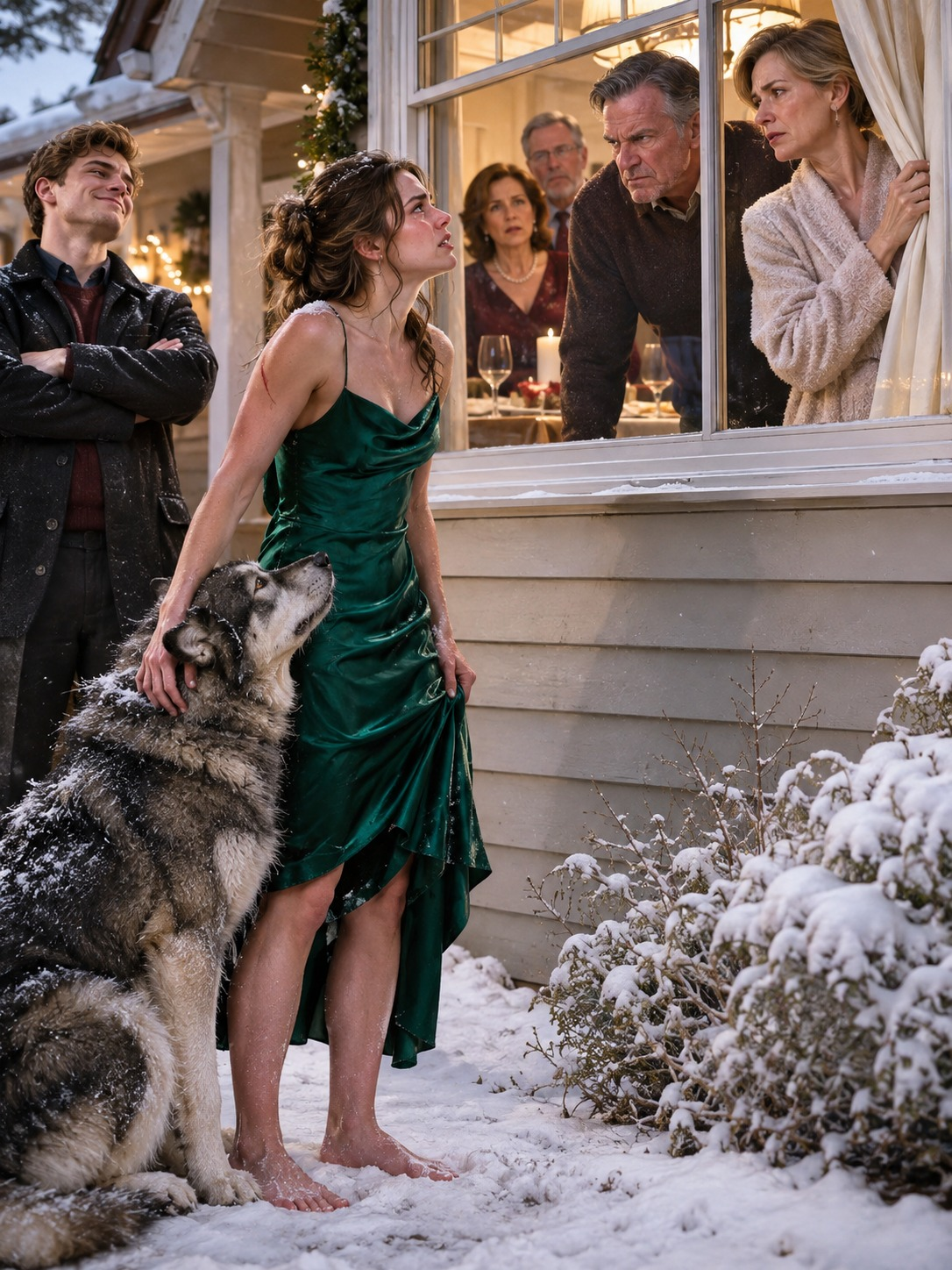
I pushed the pen away and whispered, "I'm not signing it."
My father slammed his palm against the legal document.
My brother's name was already printed beneath mine.
The only thing missing was my signature.
This wasn't a family discussion.
It was an ambush.
For several seconds, nobody moved.
The television in the living room was broadcasting the celebrations from Times Square. Thousands of strangers were cheering, kissing, and welcoming another year beneath a shower of silver confetti.
At our dinner table in northern Minnesota, six people sat in absolute silence.
My father stared at me.
My brother, Vince, leaned back in his chair.
My mother studied the embroidered tablecloth as though she had suddenly discovered something fascinating in its pattern.
Aunt Nina reached for her wineglass.
Uncle Carl cleared his throat.
I looked down at the document again.
QUITCLAIM DEED.
Two words that seemed harmless enough until I understood what they meant for my future.
"Dad," I said carefully, "where did you get this?"
"That's not important."
"It has my name on it."
"Obviously."
"And Vince's."
My brother smiled.
"Come on, Laney. Don't make this harder than it needs to be."
I turned toward him.
"What exactly am I making harder?"
He exchanged a glance with our father.
It lasted less than a second, but I saw it.
They had discussed this before.
They had planned it.
And judging by the uncomfortable silence around the table, I was the only person who hadn't been invited to those discussions.
My name is Laney. I was twenty-nine years old that winter, and until that night, I still believed there were certain boundaries even my family wouldn't cross.
I knew my father had a temper.
I knew my mother had spent most of her marriage finding ways to excuse it.
I knew Vince had grown up believing that anything he wanted would eventually become his.
But knowing those things wasn't the same as understanding what people were capable of when they believed you stood between them and something they wanted.
Especially when that something was worth hundreds of thousands of dollars.
Especially when they had already decided it belonged to them.
"Your brother needs the money," Dad said.
I looked at Vince.
"For what?"
"The condo. We've talked about this."
"You talked about selling the house. I told you I wasn't interested."
"Things change."
"My answer hasn't."
My father's jaw tightened.
I recognized that expression immediately.
When I was eight, it had appeared after I accidentally broke a glass in the kitchen.
When I was sixteen, it had appeared after I asked why Vince was allowed to borrow the family car whenever he wanted, while I had to walk to my weekend job.
When I was twenty-three, it had appeared after Grandma told him that I was old enough to make my own decisions.
Back then, Grandma had been sitting beside me.
Tonight, her chair was empty.
"Your grandmother would have wanted us to take care of each other," Mom finally said.
Her voice was soft.
Reasonable.
Almost comforting.
That was what made it so dangerous.
"Grandma wanted Vince and me to own the house equally," I replied. "That's why she wrote it into her will."
Mom's mouth tightened.
"She didn't understand everything."
"She understood exactly what she was doing."
Dad lifted his glass.
"Don't talk about your grandmother like you knew her better than we did."
I almost laughed.
Not because anything was funny.
Because the alternative was crying.
For the last five years of Grandma's life, I had driven to her house nearly every weekend. I had taken her grocery shopping, helped her manage her medication, shoveled her driveway, repaired her garden beds, and sat beside her during appointments.
When her arthritis made kneading bread difficult, I became her hands.
When she couldn't sleep, I stayed awake with her.
When she died, I was the person holding her fingers.
Vince had visited twice during her final year.
One of those visits was to borrow money.
Yet somehow, I was the selfish one.
"Nobody's asking you to do anything unreasonable," Aunt Nina said.
I turned toward her.
She gave me the kind of sympathetic smile people wear when they've already decided your feelings are inconvenient.
"Your brother is starting a family. You should be happy for him."
"I am happy for him."
"Then help him."
"Giving him my inheritance isn't helping him. It's giving away my future."
Uncle Carl shifted in his chair.
"Property causes more trouble than it's worth sometimes."
"Then why does everyone want mine?"
Nobody answered.
Vince stopped smiling.
My mother reached for the serving spoon, although everyone had finished eating.
I looked around the table.
The honey-glazed ham sat beneath a sheet of aluminum foil. Half a homemade apple pie remained on the counter. Empty wineglasses caught the glow of the chandelier.
Beside my mother's chair was the cream-colored fleece bathrobe I had bought her.
She had loved it.
She had hugged me when she opened the package.
She had disappeared upstairs to put it on, then returned to the dining room smiling.
"This is exactly what I needed," she had said.
I had spent forty minutes choosing that robe.
I had checked three stores because I wanted something soft enough for her sensitive skin.
Now she couldn't even look at me.
"How much is the condo?" I asked Vince.
"That's none of your business."
"But paying for it is?"
Dad pointed toward the document.
"Sign it."
"No."
"Laney."
"No, Dad."
The word sounded unfamiliar coming from my mouth.
Not because I had never refused him before, but because I had never done it so plainly.
No apology.
No explanation.
No promise to reconsider.
Just no.
For years, I had softened my boundaries until they barely existed.
I had said things like, "Maybe next month," when I meant I couldn't afford something.
I had said, "I'm sorry, but I have plans," when I meant I didn't want to spend another Saturday doing unpaid work for my brother.
I had apologized for being tired, for being busy, for needing money, for having opinions.
Grandma used to notice.
"Laney girl," she once told me while we were washing dishes, "you don't have to make yourself smaller just because somebody else wants more room."
At twenty-nine, I was finally trying to understand what she meant.
My father picked up the pen.
He placed it directly in front of me.
"Your brother has responsibilities."
"So do I."
"He has a wife."
"I know."
"He wants children."
"That's wonderful."
"And you're sitting on half a house you don't even live in."
I folded my hands in my lap.
"Grandma gave me that half."
"She made a mistake."
The words struck harder than I expected.
For a moment, I could hear Grandma's laugh.
I remembered the flour on her apron, the little radio beside her kitchen window, the way she always called Yukon a handsome troublemaker.
I remembered her telling me that one day I would have something nobody could take away.
My father was sitting at her table, telling me that her final gift had been a mistake.
"No," I said. "She didn't."
Vince leaned forward.
"You're seriously going to ruin everything over money?"
"You're the one asking for money."
"Because I need it."
"Then get a mortgage you can afford."
His face changed.
Dad stood.
The legs of his chair scraped against the hardwood floor.
"Enough."
I felt my heartbeat accelerate.
My mother looked up.
For one foolish second, I thought she was about to intervene.
Instead, she said, "Laney, please don't upset your father."
There it was.
The sentence that had governed our entire household for as long as I could remember.
Don't upset your father.
Don't embarrass your brother.
Don't make things difficult.
Don't ask for too much.
Nobody ever seemed concerned about upsetting me.
I reached for my purse.
"I'm going home."
Vince stood immediately.
"Sit down."
I ignored him.
My father moved around the table.
"We're not finished."
"I am."
My voice was steadier than my hands.
I had driven nearly two hours to be there. I had brought groceries, presents, sparkling wine, and homemade potato salad because my mother had told me she wanted a peaceful family evening.
I had even bought myself a new dress.
Emerald-green satin.
It was the first thing I had purchased purely for myself in three years.
When I tried it on at the store, the saleswoman told me the color made my eyes look beautiful.
I had smiled at my reflection.
I had imagined taking photographs beside Grandma's fireplace.
I had imagined laughing with my family.
I had imagined beginning the new year without carrying the same old resentment.
Instead, I was standing beside a dinner table while five people waited for me to surrender the most valuable thing I owned.
I slipped my purse over my shoulder.
"Happy New Year."
Vince stepped into the hallway.
He blocked my path.
"You're not leaving until we settle this."
I stared at him.
He was my older brother.
The same boy who had once taught me how to ride a bicycle, then laughed when I fell into a hedge.
The same teenager who had borrowed money from my summer-job savings and never paid it back.
The same man who had called me three months earlier because he needed help moving furniture.
I had always shown up.
Always.
"Move, Vince."
He didn't.
Behind me, Dad said, "You think you're better than everybody now?"
I turned.
"No. I think I'm allowed to own what Grandma left me."
"You didn't earn that house."
"Neither did Vince."
Aunt Nina gasped.
Uncle Carl put down his drink.
My mother whispered my name.
Dad crossed the remaining distance between us.
His face was red.
I could smell bourbon on his breath.
"After everything we've done for you?"
I looked at him.
Everything they had done for me.
I remembered paying my own college expenses.
Working double shifts.
Driving an unreliable car through Minnesota winters because Vince needed the newer one.
I remembered birthdays that had been forgotten and promises that had quietly disappeared.
But I also remembered being a little girl who had loved her father.
A girl who had waited beside the window for him to come home.
A girl who had believed that if she worked hard enough, behaved well enough, and asked for little enough, one day he would look at her with the same pride he showed her brother.
That little girl was still somewhere inside me.
She was the reason I had come that evening.
She was the reason I had brought presents.
She was the reason I had believed my mother when she promised there wouldn't be any yelling.
I wanted to tell my father all of that.
Instead, I said, "I'm leaving."
He grabbed my upper arm.
Pain shot through my shoulder.
"Dad, let go."
"You need to cool your head."
He began pulling me toward the sunroom.
I looked at my mother.
"Mom?"
She stood beside the table.
Her hands were clasped against the front of her new bathrobe.
She didn't move.
Vince stepped aside.
Not to let me leave.
To let our father take me past him.
The sunroom was unheated during winter. Grandma used to fill it with tomato seedlings in spring and baskets of apples in autumn.
It had always been one of my favorite places in the house.
Now the floor felt cold beneath my shoes.
Dad pulled me farther inside.
"You're hurting me."
"Then stop fighting."
I wasn't fighting.
I was trying to keep my balance.
Behind us, the television audience erupted into another round of cheering.
Somebody laughed on the broadcast.
Somebody shouted, "Happy New Year!"
Dad released my arm.
For half a second, I thought he had come to his senses.
Then he walked toward the large window overlooking the backyard.
I watched him reach for the latch.
"Dad?"
He unlocked it.
A blast of freezing air rushed into the sunroom.
The temperature outside was twenty degrees below zero.
I knew because I had checked my phone before driving there.
My coat was still hanging beside the front door.
My gloves were inside its pockets.
My car keys were in my purse.
I took a step backward.
My father turned toward me.
"Maybe you'll learn some gratitude."
I looked past him, toward the dining room.
My mother was approaching the doorway.
Our eyes met.
I waited for her to tell him to stop.
She said nothing.
My father reached for me again.
And the window was already open.






Comments 0