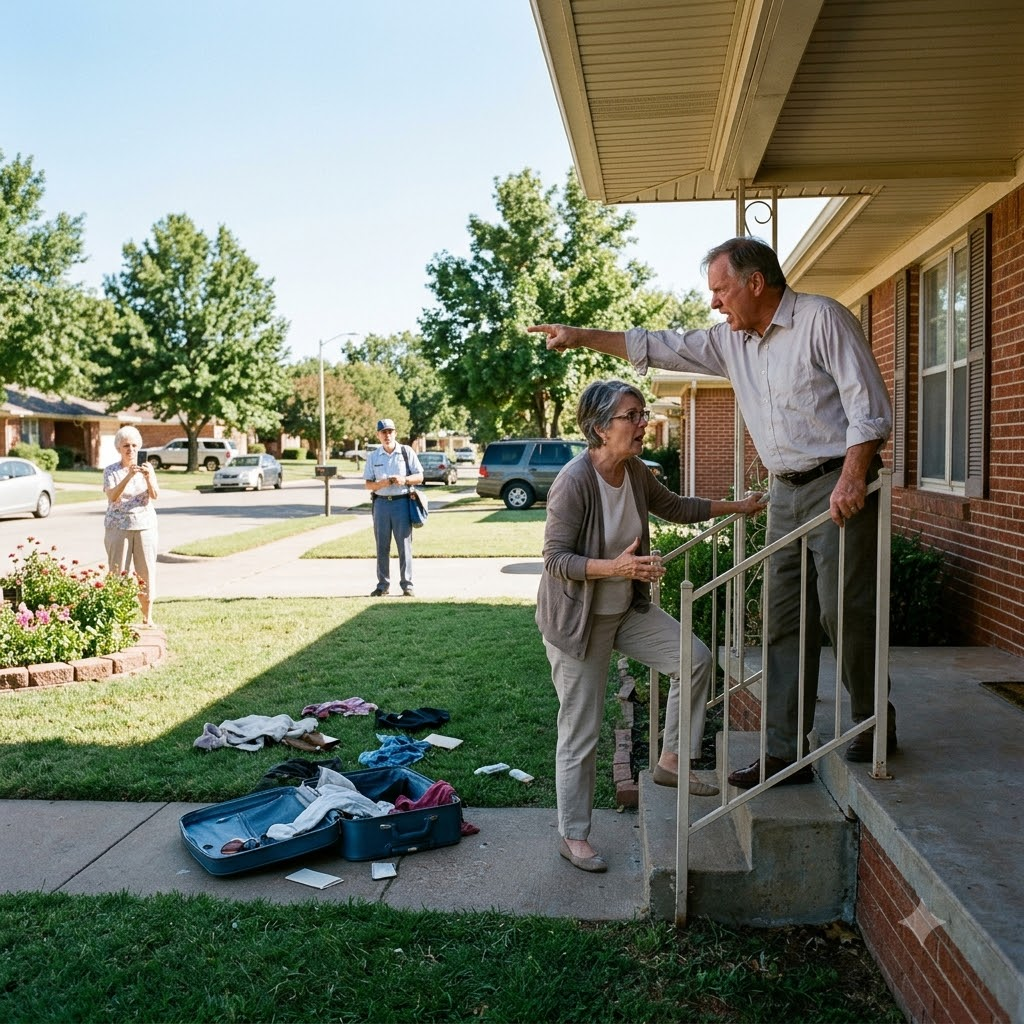
"That's my signature," I whispered. "But I never signed that paper."
Norah Pruitt turned her laptop toward me, and I stared at the document that could take everything my grandfather had left me.
My full name appeared beneath a paragraph transferring mineral interests to Prairie Line Minerals.
STELLA BENNETT RUTHERFORD.
The letters looked almost perfect.
The capital S curved the way I wrote it. The R in Rutherford had the same long downward stroke I had developed during thirty-one years of signing school documents.
But there was one mistake.
A tiny mistake.
And whoever had forged my name hadn't noticed it.
"Look at the middle initial," I said.
Norah leaned closer.
"What about it?"
"I never connect the B to the following letter."
She studied the signature.
On the screen, the final stroke of the B flowed directly into the R.
"You're certain?"
"Absolutely."
I held up my injured right hand.
"I've signed my name thousands of times. My grandfather taught me cursive when I was six. He always told me to lift my pen between my middle name and my last name."
Raymond Cole leaned over Norah's shoulder.
"Can that help prove it's forged?"
"It's one point of comparison," Norah replied. "We'll need handwriting analysis and the original document if we can obtain it."
I stared at the date.
Yesterday.
The day before Grandpa's will was read.
"How could I have transferred something I didn't even know I'd inherited?"
Norah adjusted her glasses.
"That's another serious question. Walter's estate documents may establish when the interests passed to you, but the recording date alone doesn't prove this deed is valid."
"Then the county won't accept it?"
Her expression became careful.
"The county clerk records documents. Recording doesn't necessarily establish that the signature is genuine or that the person signing had the authority claimed."
My stomach tightened.
"So someone can file a fake document?"
"Someone can attempt to. And when that happens, we challenge it through the proper legal channels."
I looked around the table.
Margaret Ellis had gone pale.
Raymond stood with his arms folded.
Nobody seemed surprised enough.
"Did you know this might happen?" I asked.
Norah shook her head.
"I knew someone might pressure you. I didn't know they'd go this far."
I pointed at the screen.
"Then I want to know who did."
Norah immediately began making calls.
She contacted the county clerk's office to request a certified copy of the recorded instrument and information about its submission.
Then she called an attorney in Oklahoma City who handled real estate litigation.
His name was Thomas Keene.
I listened as she explained the situation.
"Possible forged signature. Mineral deed. Recently inherited property. Recording made this morning."
She paused.
"Yes. We have the estate documents."
Another pause.
"And the client denies signing anything."
I sat motionless.
Client.
For the first time in my life, I was the client in a legal dispute.
Not a teacher attending a school board meeting.
Not a wife signing paperwork Grant placed in front of me.
Not a daughter helping settle a relative's estate.
I was a woman whose property had apparently been targeted by people willing to put her name on a document she had never seen.
Norah ended the call.
"Thomas can meet us this afternoon. He's going to review the deed and advise us on emergency measures."
"Can we stop the transfer?"
"We can seek appropriate court relief and notify the parties that the signature is disputed. I don't want to promise a result before we've reviewed the evidence."
I nodded.
I appreciated that.
Grant had spent years promising things he couldn't deliver.
I was beginning to value people who admitted what they didn't know.
Raymond pulled out a chair.
"Stella, there's something else."
I looked at him.
"What now?"
"That photograph of Grant and Celeste outside the courthouse."
My chest tightened.
"What about it?"
"The man standing between them."
"Do you recognize him?"
Raymond nodded.
"His name is Victor Harlan."
Margaret looked up sharply.
"Victor?"
"Yes."
She pushed back her chair.
"That can't be good."
I stared at them.
"Who is Victor Harlan?"
Raymond answered.
"A private investment broker. He's been involved in several mineral acquisition deals across Oklahoma."
"Does he work for Prairie Line?"
"He's connected to people who do."
I remembered the voice on Celeste's phone.
Tell Stella the offer expires at five.
"Was he the man with my sister?"
"That's what we need to establish."
Margaret looked at the photograph again.
Then she said, "I met him once."
"When?" I asked.
"Six years ago. During the dispute over the missing geological report."
I felt a familiar wave of frustration.
Every answer opened another door.
Behind every door stood someone who had known more about my grandfather's property than I did.
"Did Grandpa trust him?"
Margaret shook her head.
"No."
"Then why was he involved?"
"He claimed to represent investors interested in the exploration data."
"Did he get the report?"
"We never proved that."
I looked toward Norah.
"Could he have helped forge the deed?"
"Possibly," she said. "But we need evidence before accusing anyone."
I understood.
Still, the photograph remained on the screen.
Grant.
Celeste.
Victor Harlan.
My husband and my sister standing beside a man connected to the company trying to obtain my mineral rights.
It was difficult to believe they had met by accident.
At one o'clock, Norah drove me to an urgent care clinic in Kingfisher.
Raymond followed in his truck.
The physician examined my wrist and ordered X-rays.
Fortunately, there was no obvious fracture.
But the swelling and tenderness were consistent with a significant sprain, and the doctor recommended a brace, rest, and follow-up if the pain persisted.
She also cleaned the scrapes on my palms.
"How did this happen?" she asked.
I hesitated.
The old instinct returned.
Tell a harmless story.
Say I tripped.
Say I fell while carrying luggage.
Protect Grant from embarrassment.
Then I remembered the suitcase striking the concrete.
The deadbolt sliding shut.
Doreen's trembling hands as she recorded everything.
"My husband grabbed my wrist and shoved me," I said.
The physician stopped writing.
She looked at me.
"Are you safe from him now?"
"I believe so."
She asked several questions, documented my injuries, and offered information about domestic violence resources and reporting options.
I accepted the information.
I had spent most of my adult life teaching children to ask for help when something frightened them.
Yet asking for help myself felt almost impossible.
After the appointment, Norah drove me to meet Thomas Keene.
He was a tall, soft-spoken attorney in his early fifties, with reading glasses and a desk covered in neatly organized folders.
He listened without interrupting.
When I finished, he asked one question.
"Mrs. Rutherford, did you ever authorize your husband to sign documents on your behalf?"
"No."
"Any power of attorney?"
"Not that I know of."
"Any prior agreement allowing him to manage inherited property?"
"No."
He nodded.
"Then we begin by documenting exactly what you did and didn't authorize."
For nearly two hours, we reviewed the timeline.
Grandpa's death.
The will reading.
Grant's paperwork.
The assault.
The drive to the farmhouse.
The recorded deed.
Thomas took careful notes.
He asked whether I had examples of my genuine signature.
I almost laughed.
"Thousands."
"Good."
"I was a teacher. I signed attendance records, field trip forms, report cards, purchase orders, and parent letters for decades."
He smiled slightly.
"Then we'll have plenty of comparison material."
Norah handed him copies of the estate documents.
Thomas examined the deed again.
Then he frowned.
"Interesting."
I leaned forward.
"What?"
"The notary acknowledgment."
He pointed to a section near the bottom.
The notary was listed as Evelyn Price.
The location was Oklahoma County.
The acknowledgment stated that I had personally appeared before her yesterday.
"Where were you yesterday?" Thomas asked.
"At home in Edmond most of the day. I went grocery shopping around noon."
"Did you meet with a notary?"
"No."
"Did you visit an office downtown?"
"No."
"Did anyone bring documents to your house?"
I shook my head.
"Grant was at work until evening."
Thomas made another note.
"Then we'll investigate the acknowledgment as well."
I looked at the seal.
Evelyn Price.
I had never heard the name.
But someone had used it to make the document look official.
And someone had expected me never to notice.
We returned to the farmhouse shortly before five.
I was exhausted.
My wrist was wrapped in a brace.
My purse contained medical paperwork, copies of the disputed deed, and Thomas's contact information.
I had never imagined that inheriting a farm would require a lawyer, a physician, and a sheriff's investigator within twenty-four hours.
Raymond was waiting near the porch.
He had repaired the temporary lock on the equipment shed and checked the security cameras.
"Anything unusual?" Norah asked.
"Nothing since morning."
I looked toward the fields.
The wheat moved gently in the afternoon breeze.
It was beautiful.
For a moment, I understood why Grandpa had refused to leave.
Then my phone rang.
Celeste.
I stared at the screen.
Norah noticed.
"You don't have to answer."
"I know."
But I wanted to.
I wanted to hear my sister explain why she had been standing beside Grant and Victor Harlan.
I pressed the button.
"Hello."
"Stella."
Her voice sounded different.
Less cheerful.
More cautious.
"Where are you?"
"Why?"
"I need to talk to you."
"Then talk."
A pause.
"Not over the phone."
I looked at Norah.
"Why not?"
"Because some things are better discussed in person."
I almost laughed.
"Funny. You seemed perfectly comfortable discussing my inheritance with Grant."
Silence.
Then Celeste said, "He told me you were being difficult."
"Did he tell you he hurt me?"
Another pause.
"Stella, I don't want to get involved in your marriage."
"You already are."
"That's not fair."
"Neither was watching him try to take my farm."
Her voice sharpened.
"Nobody's trying to take anything from you."
I looked at the legal folder in my lap.
"Then explain the mineral deed recorded under my name."
The line went silent.
I waited.
Finally, Celeste whispered, "What deed?"
I closed my eyes.
"Don't."
"Stella, I swear I don't know what you're talking about."
"Then why were you at the courthouse with Grant?"
A sharp intake of breath.
"Who told you that?"
"I saw a photograph."
Celeste didn't answer.
I felt something inside me sink.
"Why were you there?"
She lowered her voice.
"Victor said there were estate documents that needed to be corrected."
"Victor Harlan?"
"Yes."
"What corrections?"
"I don't know."
"Celeste."
"I don't!"
For the first time, she sounded genuinely frightened.
I sat down on the porch bench.
"Then why did you go?"
She was quiet for several seconds.
"Because Victor said Grandpa's will might not be valid."
My heart began pounding.
"What?"
"He said there were questions about the property transfers."
"Who told him that?"
"I don't know."
"Why would he tell you?"
Another pause.
Then she said, "Because he was helping me with the penthouse."
I stared across the fields.
"What does the penthouse have to do with my farm?"
Celeste exhaled.
"Stella, you don't understand. The property in Los Angeles isn't as simple as everyone thinks."
I sat upright.
"What do you mean?"
"There's a mortgage."
I frowned.
"Grandpa owned that penthouse for years."
"I know."
"Why would there be a mortgage?"
"Because he borrowed against it."
I looked at Norah.
She was watching my expression.
"How much?" I asked.
Celeste hesitated.
"One point eight million."
I nearly dropped the phone.
"One point eight million dollars?"
"Please don't shout."
"I'm not shouting."
"Well, you sound like you're judging me."
I closed my eyes.
My sister had inherited a five-million-dollar penthouse.
Even with a mortgage, it was still an extraordinary gift.
But Celeste sounded as though Grandpa had cheated her.
"Did you know about the mortgage before the will reading?"
"No."
"Then how did Victor find out?"
"He reviewed the property records."
"And what did he offer?"
Silence.
I knew that silence.
I had heard it from Grant.
From Margaret.
From Raymond.
It was the silence people used when they hoped I would stop asking questions.
"Celeste," I said quietly, "what did Victor offer you?"
She sighed.
"He said he could help arrange financing."
"Against the penthouse?"
"Yes."
"How much?"
"Enough to settle the mortgage and give me some cash."
I stared at the horizon.
"And what did he want in return?"
She didn't answer.
"Celeste."
"He said there might be a family agreement involving both properties."
My stomach tightened.
"What family agreement?"
"I don't know the details."
"Did you sign anything?"
A long pause.
Then she whispered, "Not yet."
I closed my eyes.
Thank God.
"Don't sign anything," I said.
"Stella—"
"I'm serious. Don't sign anything Victor gives you until your own attorney reviews it."
She laughed bitterly.
"Now you're giving me financial advice?"
The old insult stung.
For decades, Celeste had treated me like the simple older sister who stayed in Oklahoma while she built a glamorous life.
I had let her.
But I was finished letting people mistake kindness for stupidity.
"Yes," I said. "I am."
She went silent.
Then her voice softened.
"Stella, I didn't know Grant hurt you."
I looked down at my wrist brace.
"Would it have mattered?"
"Of course."
"Then why did you tell me not to make things harder?"
She began to cry.
I could hear it.
Small, uneven breaths.
"I thought you were refusing to help him."
I stared at the phone.
"Help him?"
"Victor said Grant's company could collapse."
"That's not my responsibility."
"He's your husband."
"He threw me out of our house."
Celeste said nothing.
I took a slow breath.
"Listen carefully. I don't know what Victor promised you. I don't know what Grant told you. But someone recorded a deed with my forged signature, and I am not going to pretend that's a misunderstanding."
My sister whispered, "Forged?"
"Yes."
"Oh, God."
For a moment, I believed her fear.
Then she said something that made me stop breathing.
"Stella, Victor told me you had already agreed."
I closed my eyes.
"Agreed to what?"
"To let him handle the mineral rights."
I stared at the wheat fields.
"No."
"He said Grant had your permission."
"No."
"He showed me a document."
My voice became very quiet.
"What document?"
"A signed authorization."
I gripped the phone.
"Did you see my signature?"
"Yes."
"Was it notarized?"
"I think so."
I looked toward Norah.
She was already reaching for her notebook.
"Celeste, where is that document now?"
"Victor has it."
"Did you get a copy?"
"No."
"Then ask him for one."
"Stella—"
"Please."
My sister hesitated.
Then she whispered, "I'll try."
The call ended.
I sat motionless.
Norah approached.
"What happened?"
I told her.
When I finished, her expression was grim.
"A separate authorization could explain how they attempted to present the transaction as legitimate," she said. "But we need to see it."
I looked at her.
"Could Grant have forged more than one document?"
"It's possible."
I stared at the farmhouse.
Grandpa had prepared this place as a refuge.
But he had also left behind a trail of secrets that seemed to grow darker with every hour.
That evening, Margaret returned with dinner.
She brought chicken soup, bread, and a folder of geological notes.
Raymond joined us at the kitchen table.
For the first time since arriving, I felt almost normal.
Four people sharing a meal.
No shouting.
No accusations.
No one demanding that I sign anything.
I hadn't realized how much I missed that.
After dinner, Norah called.
She had obtained additional information about the recorded deed.
"The instrument was submitted electronically through a document recording service," she explained.
"Can they identify who submitted it?"
"We're working on that."
"What about the notary?"
"Thomas is checking the commission information and will seek the appropriate records."
I rubbed my forehead.
"Is there anything I can do?"
"Yes. Rest your wrist. Preserve every message. And don't communicate with Grant about the property without legal advice."
I almost smiled.
"That last part won't be difficult."
Norah hesitated.
"Stella, there's another matter."
My stomach tightened.
"What?"
"Your grandfather left a sealed memorandum concerning the distribution of his estate."
I sat upright.
"Is that the envelope you brought earlier?"
"Yes."
"What does it say?"
"I haven't opened it yet. Walter instructed me to review it with you after certain documents were confirmed."
"Why?"
"Because it concerns information he believed might cause conflict between you and Celeste."
I looked toward the window.
The fields were dark now.
"More conflict?"
"I'm afraid so."
I closed my eyes.
"Norah, I don't know how much more I can take."
Her voice softened.
"I know."
We were quiet for a moment.
Then she said, "Your grandfather loved both of you. Whatever he wrote, remember that."
I swallowed.
"I'll try."
After the call, I went to the living room.
Grandpa's photograph stood on the mantel.
He was smiling beside his old tractor.
I picked it up.
"Why didn't you tell me?" I whispered.
The house remained silent.
I thought about Celeste.
The penthouse.
The mortgage.
Victor Harlan.
The forged deed.
And the strange possibility that my sister had been manipulated just as Grant had tried to manipulate me.
For most of our lives, Celeste and I had been rivals.
She was the beautiful one.
I was the dependable one.
She left Oklahoma.
I stayed.
She inherited the penthouse.
I inherited the farm.
But Grandpa had always insisted that comparing gifts was a foolish way to measure love.
"One day," he used to say, "you girls will understand that I gave each of you what I hoped you needed."
I had never understood what he meant.
Now I wondered whether he had known something about Celeste that I didn't.
My phone buzzed.
A text from my sister.
Stella, I found something.
I sat down.
Another message appeared.
Victor left his briefcase in my hotel room while he went downstairs.
My pulse quickened.
I know I shouldn't have looked.
I stared at the screen.
Then a photograph arrived.
It showed a document bearing the Prairie Line Minerals logo.
Across the top were the words:
CONFIDENTIAL ACQUISITION SUMMARY.
Below that was a list of names.
Walter Bennett.
Grant Rutherford.
Celeste Bennett.
And mine.
I enlarged the photograph.
Beside Celeste's name was a dollar amount.
$250,000.
I felt sick.
My sister had been promised money.
But for what?
Another message arrived.
Stella, I didn't know about this.
Then another.
There's a second page.
I waited.
The typing indicator appeared.
Disappeared.
Appeared again.
Finally, Celeste sent a photograph.
I opened it.
At the top was a heading:
BENNETT FAMILY MINERAL INTERESTS — PROPOSED DISTRIBUTION.
Below it were several paragraphs of legal language.
I scrolled slowly.
Then I reached the final section.
A handwritten note had been added in the margin.
The handwriting was unmistakable.
Grandpa's.
But the words made no sense.
Celeste must never learn what happened in 1998.
I stared at the sentence.
My sister had sent the photograph without realizing what it contained.
I was still trying to understand when another message appeared.
Stella, Victor just came back.
A second later:
He's asking who I sent the pictures to.
Then the typing indicator vanished.
I called her immediately.
No answer.
I tried again.
Straight to voicemail.
My hands began shaking.
Then my phone lit up with an incoming video call.
Celeste.
I answered.
The screen was dark.
I heard my sister breathing.
Then a man's voice spoke close to the microphone.
"Mrs. Rutherford, I believe you have something that belongs to me."
The camera shifted.
For one brief second, I saw Celeste sitting on the edge of a hotel bed.
Her face was pale.
Her eyes were filled with tears.
Then Victor Harlan stepped into view.
He held a document in his hand.
And across the top, in large black letters, was a name I had never expected to see.
WALTER BENNETT — CONFIDENTIAL PATERNITY AGREEMENT.






Comments 0