"Walter Bennett sent me!" the stranger whispered through the opening back door. "And if you want to stay alive, don't turn on another light."
Raymond Cole stepped in front of me so quickly that his shoulder struck the kitchen counter.
"Who are you?" he demanded.
The door opened another three inches.
A woman stood in the darkness, one hand gripping the frame and the other holding a small leather satchel against her chest.
She looked to be in her late fifties, with short dark hair streaked with gray, a weathered face, and a pair of glasses hanging from a cord around her neck.
Her blue denim jacket was covered with dust.
"Raymond," she said, sounding almost offended. "Put your phone down before you give me a heart attack."
Raymond stared at her.
"Margaret?"
"Unless you've forgotten what I look like."
He lowered his phone slightly.
"Margaret Ellis? What in God's name are you doing here?"
She looked past him.
Her eyes settled on me.
"You must be Stella."
I couldn't move.
"How did you unlock that door?"
Margaret glanced at the key in her hand.
"Your grandfather gave me an emergency key."
"Grandpa died three weeks ago."
"I know."
"Then why are you coming into his house in the middle of the night?"
Her expression softened.
"Because he asked me to make sure you received something before the wrong people found it."
Raymond moved toward the door.
"Margaret, somebody's been watching the property. We just received a photograph of Stella's car."
"I know."
Those two words made my stomach tighten.
Raymond stopped.
"What do you mean, you know?"
Margaret stepped inside and closed the door behind her.
"Because I saw the vehicle."
"What vehicle?"
"A black SUV parked near the county road. No headlights. Engine running."
My pulse quickened.
"Was it my husband?"
"I couldn't see the driver."
Raymond looked toward the front window.
"Where is it now?"
"Gone. At least for the moment."
He rubbed his jaw.
"You should have called me."
"I tried. Your phone went straight to voicemail."
Raymond checked his screen.
Three missed calls.
He muttered something under his breath.
I stood between them, feeling like a child listening to adults discuss a danger nobody wanted to explain.
"Excuse me," I said.
They both turned.
"I've had enough surprises for one day."
Margaret opened her mouth.
I raised my left hand.
"No. Please listen."
My voice trembled, but I kept speaking.
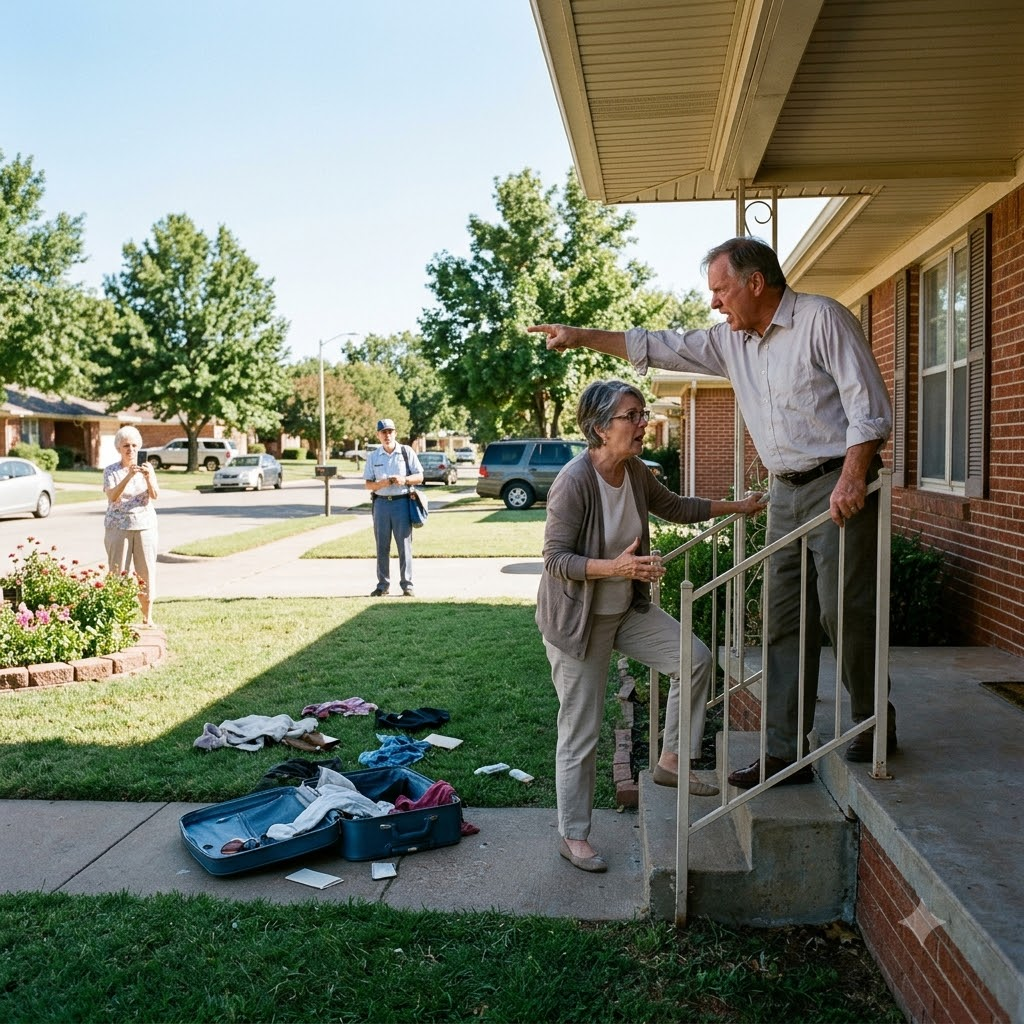
"This morning, I learned that my grandfather left me eight hundred acres of land. My sister laughed at me. My husband tried to force me to sign away the mineral rights. When I refused, he injured my wrist, threw my belongings onto the lawn, and locked me out of the house I've lived in for thirty-eight years."
Margaret's face changed.
I continued.
"I drove here because I had nowhere else to go. Then I discovered Grandpa had secretly renovated this farmhouse, left a warning about my husband on the refrigerator, and arranged for people I barely know to show up in the middle of the night."
I looked directly at her.
"So before anyone tells me to be patient, I want to know one thing."
"What is it?" Margaret asked quietly.
"What is under my land that makes people behave this way?"
Nobody answered.
And that silence told me more than either of them intended.
Margaret finally pulled out a kitchen chair.
"May I sit down?"
I nodded.
She placed her leather satchel on the table.
Raymond remained standing near the back door.
"Stella," Margaret began, "my name is Dr. Margaret Ellis. I'm a petroleum geologist. I worked for several energy companies before starting my own consulting practice."
I stared at her.
"A geologist?"
"Yes."
I almost smiled.
Of all the people who could have appeared at Grandpa's farmhouse, a geologist was the last one I expected.
"I taught Earth Science for thirty-one years."
"Your grandfather told me."
"He told you about me?"
"Frequently."
Margaret reached into her satchel and removed a faded photograph.
She slid it across the table.
It showed Grandpa standing beside a drilling rig in an open field.
He was younger, perhaps in his late sixties, wearing his favorite brown jacket and holding a rolled survey map.
Beside him stood Margaret.
The photograph had been taken years earlier.
I picked it up.
"I've never seen this."
"Your grandfather didn't want many people knowing about that project."
"What project?"
Margaret folded her hands.
"In the late 1990s, Walter allowed a small exploration company to conduct geological testing on part of his property."
I looked at the photograph again.
"Oil exploration?"
"Yes."
My mind immediately returned to Grant's papers.
Mineral Deed and Assignment.
Oil.
Gas.
Hydrocarbons.
Royalties.
"Did they find something?"
Margaret glanced at Raymond.
He nodded.
"Tell her."
She took a slow breath.
"They found evidence of a potentially productive petroleum formation beneath portions of your grandfather's acreage."
I sat very still.
For a moment, I heard only the hum of the refrigerator.
Then I asked, "How productive?"
"That's complicated."
"Try me."
Margaret gave a small, reluctant smile.
"Your grandfather said you'd say that."
She opened the satchel again.
This time she removed several folded diagrams.
The first was a geological cross-section.
I recognized the familiar layered bands representing sedimentary rock formations.
The second showed a series of survey lines.
The third contained measurements, annotations, and handwritten calculations.
I leaned forward.
"These are subsurface maps."
"Correct."
"And these lines indicate structural contours?"
"Yes."
I examined the numbers.
My heart began beating faster.
"You're showing me a possible hydrocarbon trap."
Margaret nodded.
"Among other things."
I looked at her.
"Grandpa knew about this?"
"He knew there was evidence worth investigating."
"Then why didn't he develop it?"
"Because finding evidence isn't the same as producing oil. There were technical questions, financial questions, and ownership issues."
I glanced at the map.
"What ownership issues?"
Margaret hesitated.
"That's part of what Norah needs to explain."
I sat back.
Again.
Another piece of the story locked behind someone else's permission.
Margaret seemed to recognize my frustration.
"Stella, I'm not trying to keep you in the dark. But I don't want to give you an inaccurate picture of something that could affect your entire future."
I studied her face.
She looked tired.
Not frightened exactly.
But worried.
"Then tell me what you know for certain."
She nodded.
"Your grandfather owned substantial mineral interests associated with the farm. He received inquiries from buyers over the years. Some offers were ordinary. Others were unusually aggressive."
"Prairie Line Minerals?"
Her eyes sharpened.
"That name was among the recent inquiries."
I felt cold.
"Grant already had their paperwork waiting at home when we returned from the will reading."
Margaret exchanged another look with Raymond.
"How much did they offer?" she asked.
"Three hundred thousand dollars."
Margaret's fingers tightened around her pen.
Raymond swore softly.
I looked between them.
"Is that a bad offer?"
Margaret considered her answer.
"Without a complete valuation, I can't give you a precise number. But based on the information I've reviewed, I would not advise you to accept it."
"Why?"
"Because your mineral interests may be worth considerably more."
"How much more?"
She looked down at the maps.
"Potentially millions."
I stared at her.
The room seemed to tilt.
Millions.
My grandfather's farm.
The place Celeste had called a dust bowl.
The land Grant had dismissed as worthless until the moment it became mine.
I placed my left hand flat on the table.
"How many millions?"
Margaret didn't answer immediately.
Then she said, "One preliminary valuation scenario placed the recoverable value attributable to your grandfather's interests near two million dollars."
I couldn't speak.
Two million dollars.
The number didn't feel real.
It felt like something printed on a lottery ticket.
Something that belonged to strangers.
Not to a retired schoolteacher whose husband had just canceled her credit cards.
Margaret leaned forward.
"Stella, please understand. That's not two million dollars sitting in a bank account. It's an estimate based on assumptions about recoverable resources, costs, commodity prices, and the interests actually owned. The final value could be different."
I nodded slowly.
I understood estimates.
I had spent years explaining to students that scientific conclusions depended on evidence and uncertainty.
But even allowing for uncertainty, the difference between three hundred thousand dollars and a possible two million was enormous.
And Grant had tried to force me to sign.
My throat tightened.
"He knew."
Raymond said nothing.
I looked at him.
"Grant knew the farm wasn't worthless."
"There's reason to believe he had information Walter didn't want him to have."
I felt something inside me harden.
For years, Grant had made me feel foolish whenever I asked questions about money.
He said I didn't understand business.
He said my teaching career had sheltered me from the real world.
He said I was too trusting, too emotional, too easily confused.
Yet when I finally read a contract carefully, he had thrown me out of our home.
Not because I was stupid.
Because I wasn't.
Margaret spread another map across the table.
"This is where things become important."
The map showed the northern portion of Grandpa's farm.
Several colored lines crossed the property boundary.
A small circle marked an old test location.
"Your grandfather kept the original exploration records," she explained. "Some were never submitted to the companies now expressing interest."
"Why not?"
"Because the exploration agreement didn't require him to disclose every privately obtained interpretation."
I traced one of the contour lines.
"These numbers suggest a structural closure."
"Yes."
"And the formation extends beyond Grandpa's property."
"That's our interpretation."
I looked up.
"Then other landowners might have similar resources beneath their farms."
"Possibly."
"Do they know?"
"Some have received offers."
"From Prairie Line?"
Margaret nodded.
"Among others."
I thought about the families who had lived around Grandpa for decades.
People who worked long hours, worried about crop prices, and sometimes sold pieces of land to pay medical bills.
"What if someone offered them a few thousand dollars for rights worth much more?"
Margaret's expression became serious.
"That's one reason Walter wanted you to understand what you owned before making decisions."
I stared at the map.
Grandpa had not merely left me a farm.
He had left me a responsibility.
But something still bothered me.
"Why didn't he just tell me before he died?"
Margaret looked toward Raymond.
This time, he answered.
"Because he didn't know who you would tell."
I frowned.
"What does that mean?"
"Your grandfather loved you, Stella. But he knew you told Grant almost everything."
I opened my mouth.
Then closed it.
He was right.
For most of my marriage, I had treated honesty as an obligation that belonged entirely to me.
I told Grant when I received a pension adjustment.
I told him when my sister sent money for Christmas.
I told him when Grandpa gave me an antique necklace.
Meanwhile, Grant kept separate accounts, secret loans, and business troubles he refused to discuss.
Raymond continued gently.
"Walter believed that if he told you about the mineral interests, Grant would learn about them too."
I looked down.
"And then?"
"Then Walter feared someone would pressure you into giving them up."
The room fell silent.
I remembered Grandpa's last birthday.
We had eaten chocolate cake in his nursing home.
He had held my hand and asked whether Grant was treating me well.
I told him everything was fine.
Grandpa looked at me for a long time.
Then he said, "You know you can always come home, don't you?"
I laughed.
"Grandpa, I'm sixty-three."
He squeezed my fingers.
"Home doesn't have an age limit."
I had thought he was being sentimental.
Now I understood he had been offering me an escape.
I covered my mouth.
Margaret quietly pushed a box of tissues toward me.
A few minutes later, my phone vibrated.
Grant.
I stared at his name.
Raymond noticed.
"Don't answer unless you want to."
I almost ignored the call.
Then I remembered the way Grant had looked at the will reading.
The sudden interest in the acreage.
The questions about exclusions.
The paperwork already waiting at home.
I needed to know how much he knew.
I answered.
"Hello?"
"Where the hell are you?"
His voice was sharp and impatient.
I kept mine steady.
"Somewhere safe."
"Don't play games, Stella."
"I'm not."
"Did you call that lawyer?"
I glanced at Margaret.
"Why?"
"Because you're making a terrible mistake."
I felt my pulse quicken.
"What mistake?"
"That land is a liability. Taxes, maintenance, insurance. You can't afford it."
"Then why does Prairie Line want it?"
Silence.
I waited.
"Because they're willing to take a risk," he finally said.
"On the mineral rights?"
Another pause.
"Stella, stop pretending you understand this."
I looked at the maps covering the kitchen table.
"I understand more than you think."
His breathing changed.
"Who's been talking to you?"
I didn't answer.
"Stella."
"Good night, Grant."
"Don't you dare hang up."
I ended the call.
My hand was shaking.
But beneath the fear was something unfamiliar.
Satisfaction.
For once, I had ended a conversation before Grant decided it was over.
Raymond watched me.
"You all right?"
"No."
I set the phone down.
"But I think I will be."
Margaret gave me a small smile.
Then Raymond's phone rang.
He looked at the caller ID.
His expression darkened.
"County dispatch," he said.
He answered.
"Cole speaking."
I watched his face as he listened.
"Where?"
Another pause.
"Was anyone hurt?"
He stood.
"All right. I'll stay here."
He ended the call.
"What happened?" Margaret asked.
Raymond looked toward the windows.
"Somebody reported a suspicious vehicle near the north property entrance."
My stomach tightened.
"The black SUV?"
"Possibly."
"Did they find it?"
"No. But a deputy found fresh tire tracks near the old equipment shed."
Margaret sat upright.
"That's where Walter kept the cabinet."
I looked at the brass key.
Number 4.
Raymond followed my gaze.
"Stella, where did you put that key?"
I held it up.
"Right here."
He exhaled.
"Good."
Margaret gathered the maps.
"We should move these somewhere secure."
"Why?" I asked.
"Because someone may be looking for the same records."
I stared at her.
"Then shouldn't we call the sheriff?"
"Raymond already has."
"Shouldn't we tell them about the cabinet?"
Raymond hesitated.
"First, we need to know whether it's been disturbed."
I looked at the clock.
Almost eleven.
The old equipment shed stood several hundred yards from the farmhouse.
Beyond it stretched acres of darkness.
I was exhausted, injured, and frightened.
But I was also furious.
"Then we check it tomorrow," I said.
Margaret nodded.
"At first light."
Raymond moved toward the front door.
"I'll park my truck closer to the house and stay until the deputy makes another pass."
"You don't have to do that," I said.
"Your grandfather would disagree."
He put on his hat.
"Lock the door behind me."
I watched him walk across the porch.
The motion light illuminated his truck.
For a moment, everything was quiet.
Then Margaret spoke.
"Stella, there's something else you should know."
I turned.
She was staring at the geological maps.
"What?"
"Your grandfather didn't trust the first company that approached him about the mineral rights."
"Why not?"
"Because their representative knew details that weren't supposed to be public."
I frowned.
"What details?"
"The approximate depth of the formation. The location of the old test site. The existence of certain private records."
"Could someone have obtained them from the exploration company?"
"Possibly."
She removed a thin folder from her satchel.
"But Walter suspected the information came from someone closer to the family."
My chest tightened.
"Grant?"
Margaret didn't answer.
Instead, she opened the folder.
Inside was a photocopy of an old letter.
The date was nearly eighteen months earlier.
At the top was the logo of Prairie Line Minerals.
Below it was a request for a meeting concerning Walter Bennett's mineral interests.
I read the first paragraph.
Then the second.
The company claimed to have been referred by someone familiar with Walter's estate planning.
I looked up.
"Who referred them?"
Margaret turned the page.
There was a handwritten note at the bottom.
A name.
I leaned closer.
Before I could read it, my phone vibrated again.
This time, it wasn't Grant.
It was an unfamiliar number.
A photograph appeared on the screen.
The picture showed the old equipment shed.
Its door stood open.
And beneath the photograph was a message.
Tell Raymond Cole to stop lying to you.
I stared at the words.
Another message arrived.
Ask him what happened to the original geological report.
Then a third.
And ask him why your grandfather changed his will three days after Raymond visited him.
My mouth went dry.
I slowly raised my eyes toward the front window.
Raymond's truck was still parked beside the porch.
But Raymond was no longer inside it.
Margaret stepped closer.
"Stella? What's wrong?"
I turned the phone toward her.
She read the messages.
The color drained from her face.
Then she whispered something that made my blood run cold.
"That report was supposed to have been destroyed."
I looked at the folder in her hands.
"What report?"
Margaret didn't answer.
Outside, the porch light flickered.
A heavy knock struck the front door.
Then Raymond's voice came through the wood.
"Stella, open up. There's something you need to see."
I moved toward the door.
Margaret caught my arm.
"Wait."
Another knock.
"Stella!"
I looked through the narrow window beside the entrance.
Raymond stood on the porch.
He wasn't alone.
A second man stood behind him, mostly hidden in shadow.
Then Raymond stepped aside.
The stranger moved into the light.
And Margaret whispered his name.






Comments 0