"Grant!"
I shouted his name across the courthouse hallway.
He didn't stop.
My husband pushed past a man carrying a stack of legal folders and hurried toward the emergency exit.
"Grant Rutherford, stop!"
Emily's voice echoed behind me.
For one terrible moment, I thought he would escape.
Then Bradley Voss stepped directly into his path.
"Grant, don't make this worse."
Grant stopped so abruptly that his shoulder struck the wall.
"Get out of my way."
Voss didn't move.
"You just testified under oath. Running out of the courthouse after learning investigators recovered additional documents is not going to help you."
Grant looked over his shoulder.
His eyes found mine.
And for the first time in thirty-eight years, I saw something I had never expected to see on his face.
He was afraid of me.
Not because I could hurt him.
Because I knew the truth.
"Stella," he said, "you need to listen."
I stood beside Emily.
"No."
He blinked.
"Just give me five minutes."
"You've had thirty-eight years."
His face tightened.
"Don't do this in front of everyone."
I looked around the hallway.
Lawyers.
Court employees.
People waiting for hearings.
For years, Grant had used those words to silence me.
Don't embarrass me.
Don't make a scene.
Don't let people know our business.
I took a breath.
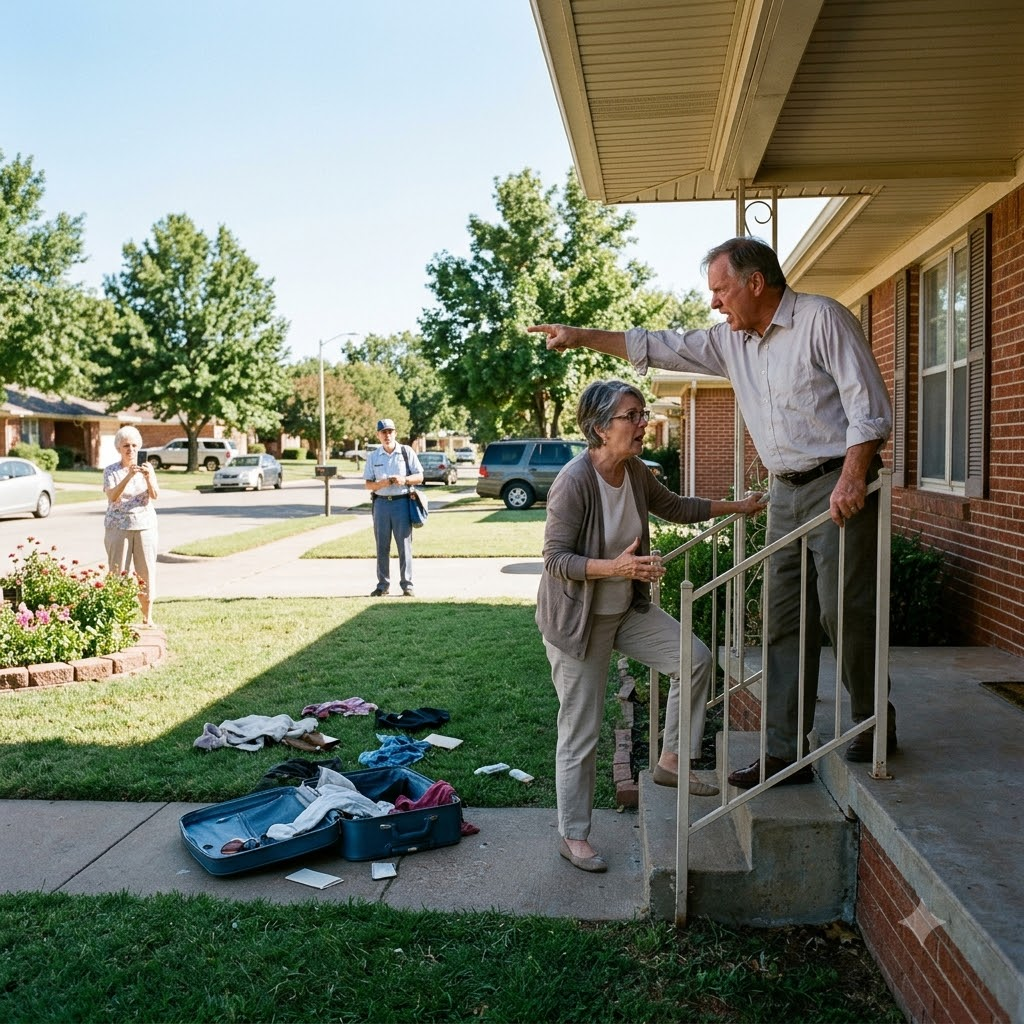
"You weren't worried about embarrassing me when you threw my suitcase onto the lawn."
His jaw clenched.
"That was different."
"No, Grant. It wasn't."
Norah stepped beside me.
"Stella, Thomas is speaking with the investigators. We should wait for the documents before discussing anything further."
I nodded.
Grant looked at her with open hatred.
"You've poisoned her against me."
Norah remained calm.
"Your own actions brought us here."
Bradley Voss put a hand on Grant's shoulder.
"Come with me."
This time, Grant obeyed.
I watched him disappear into a conference room.
Then Emily reached for my hand.
"Mom?"
I looked at her.
"Yes?"
She smiled through her tears.
"I've never heard you talk to Dad like that."
I glanced toward the closed door.
"Neither has he."
We waited almost an hour.
Thomas spoke with Daniel Mercer by phone while Norah reviewed the information investigators had provided.
Victor Harlan had been located at a private airfield outside Oklahoma City.
He was being questioned in connection with the incidents at the farm and the suspected fraudulent documents.
The briefcase recovered from his vehicle contained copies of several agreements, correspondence, and a set of records investigators believed could help explain the mineral acquisition scheme.
But the document that mattered most was an agreement dated June 18, 1998.
The same date on Grandpa's letter.
The same date Grant had witnessed an arrangement between Walter Bennett and Richard Harlan.
Thomas returned to the conference room where we were waiting.
His expression was serious.
"We have more information."
I sat upright.
"About Grant?"
"About the agreement."
He placed a copy of a document on the table.
The heading read:
LIMITED GEOLOGICAL DATA ACCESS AND CONDITIONAL MINERAL OPTION AGREEMENT.
I stared at the words.
"What's a conditional mineral option?"
Thomas sat across from me.
"In this context, it was an agreement giving another party a limited opportunity to acquire specified mineral interests if certain conditions were satisfied."
I frowned.
"So Grandpa agreed to sell?"
"Not exactly. The original agreement appears to have granted a limited option. It did not automatically transfer the mineral interests."
I looked at Norah.
"Then why did Victor act like he owned them?"
Thomas turned a page.
"Because the version circulated through the Harlan companies contained different terms."
My stomach tightened.
"Different how?"
"The altered version purported to extend the option and expand the property interests covered."
I stared at him.
"Someone changed Grandpa's agreement?"
"That's what the documents suggest."
I looked down at the original.
The agreement had an expiration date.
December 31, 1999.
More than twenty-six years ago.
I pointed to it.
"Then the original option expired."
"On its face, yes, unless some separate legally effective action changed that result. We haven't found evidence of a valid extension."
I felt my chest loosen.
For weeks, Victor had behaved as though a thirty-year-old document gave him power over my inheritance.
Now it appeared that the document he relied on had been changed.
"Who authorized the alterations?" I asked.
Thomas exchanged a glance with Norah.
Then he placed another page in front of me.
It was a memorandum.
Dated years after the original agreement.
At the bottom was a signature.
Grant Rutherford.
I stared at it.
My husband.
Again.
The memorandum was written in formal business language.
It referred to a revised mineral schedule.
An extended acquisition period.
And an acknowledgment that the revised documents could be used in negotiations with future owners of the Bennett property.
I read it twice.
Then a third time.
"Grant signed this?"
Thomas nodded.
"The copy identifies him as the person who requested the revisions."
I looked at the date.
2018.
Eight years earlier.
Grant had been fifty-seven.
We had just celebrated our thirtieth wedding anniversary.
I remembered that year clearly.
He had taken me to dinner at a steakhouse in Oklahoma City.
He ordered an expensive bottle of wine.
He told me the roofing business was finally becoming profitable.
I believed him.
I had no idea he was secretly involved in an attempt to control my grandfather's mineral interests.
"Why would he do this?" I whispered.
Thomas looked at the document.
"The records suggest he was negotiating with Harlan-related businesses concerning his own financial obligations."
I closed my eyes.
"Debt."
"Yes."
I looked at him.
"How much?"
He hesitated.
"We're still verifying the full amount. But the correspondence indicates that Grant sought relief from substantial obligations in exchange for helping secure the mineral interests."
I stared at the paper.
My husband had tried to use my grandfather's property to pay his own debts.
And when Grandpa died, Grant had tried to make the arrangement permanent by obtaining my signature.
When I refused, he threw me out.
I felt sick.
Then I remembered something.
"Thomas, what about the one hundred and fifty thousand dollars?"
He nodded.
"That payment appears connected to a later acquisition effort. We're tracing it."
I looked toward the courthouse window.
The sky was bright.
People walked along the sidewalk carrying coffee cups and briefcases.
Ordinary people.
Living ordinary lives.
I wondered how many of them were married to someone who had been lying for decades.
That afternoon, Celeste came to the farmhouse.
She looked exhausted.
The bruise on her cheek had begun to fade, but her eyes were still swollen from crying.
Emily sat beside her at the kitchen table.
Lucas stood near the window.
For the first time, the four of us were together in Grandpa's house.
Two sisters.
A daughter.
And a nephew whose existence had been hidden from me for twenty-eight years.
Celeste stared at the floor.
"I don't know where to begin."
I sat across from her.
"Begin with the truth."
She nodded.
"In 1998, I was terrified."
Her voice shook.
"Lucas was a baby. I wasn't married. I had no idea how to raise him."
Lucas lowered his eyes.
Celeste looked toward him.
"I loved you. I always loved you."
He nodded slowly.
"I know."
She wiped her face.
"Richard Harlan had helped arrange some financial matters for Grandpa. He knew about Lucas. He knew I was afraid of losing control of my life."
I listened.
"He convinced me that a private agreement would protect Lucas and keep everything confidential."
I frowned.
"Why did Grandpa agree?"
"Because Richard threatened to expose information and create legal trouble around the arrangements for Lucas's care."
I looked at Norah.
She nodded.
"The records suggest Richard used the family's fear and uncertainty as leverage."
Celeste continued.
"Grandpa agreed to limited geological data access and a short-term mineral option. He believed Richard would stop interfering with us."
I felt my stomach tighten.
"And Grant?"
Celeste closed her eyes.
"He was there."
I stared at her.
"Why?"
"Because he knew Richard through business contacts. He introduced them."
I felt cold.
"My husband introduced Grandpa to the man who threatened you?"
Celeste nodded.
"Yes."
I looked down at my hands.
For years, Grant had told me he barely knew the Harlans.
He said Victor was just a broker.
He claimed he had never been involved in Grandpa's business.
All lies.
"Did Grant know Richard was threatening you?" I asked.
Celeste hesitated.
"I believe he knew Richard was using the situation to pressure Grandpa. I can't tell you exactly what Richard said to him."
I nodded.
I didn't want guesses.
I wanted facts.
Celeste took a shaky breath.
"Stella, there's something else."
I looked up.
"What?"
"When Grant began negotiating with Victor years later, he asked me to help."
My chest tightened.
"Help how?"
"He wanted me to persuade Grandpa that selling the mineral interests would be best for everyone."
I stared at her.
"Did you?"
She nodded.
"Once."
I closed my eyes.
"I remember."
She looked surprised.
"You do?"
"Grandpa called me afterward. He sounded angry. He said Celeste had been talking about money again."
She began crying.
"I'm sorry."
I looked at her.
"Why did you do it?"
"Because Victor promised to help refinance the penthouse. I was drowning in debt, and I was afraid the truth about Lucas would become public."
I stared at her.
"Celeste, you could have told me."
She shook her head.
"I was ashamed."
I felt tears rise.
"Of having Lucas?"
"No."
She looked toward her son.
"Of lying to you for so long."
Lucas walked to the table.
He placed a hand on her shoulder.
Celeste covered it with hers.
I watched them.
For a moment, I thought about all the years we had lost.
Birthdays.
Christmas mornings.
Family dinners.
The ordinary moments that could never be recovered.
Then I looked at my sister.
"I can't pretend none of this happened."
She nodded.
"I know."
"But I don't want another twenty-eight years of secrets."
She began crying harder.
"Neither do I."
The following morning, I received a call from Raymond Cole.
I almost didn't answer.
Then I remembered Grandpa's words.
The person who first betrayed me was someone I welcomed into my home.
I answered.
"Raymond."
"Stella, I know you don't trust me."
"That's correct."
He sighed.
"I deserve that."
I waited.
Then he said, "I've given Daniel Mercer everything I have."
"What does that mean?"
"Copies of my consulting agreement, the payments I received, and the correspondence with Richard Harlan's representatives."
I looked toward Grandpa's desk.
"Why now?"
"Because I should have done it years ago."
I said nothing.
Raymond continued.
"Your grandfather trusted me to investigate the Harlans. I let my own financial problems influence decisions I should have made differently."
I closed my eyes.
"Did you steal the geological report?"
"No."
"Did you help Victor?"
"I shared information I shouldn't have shared. But I didn't help him forge your signature or threaten your family."
I took a breath.
"That's something investigators will have to determine."
"I know."
He paused.
"Stella, there's one thing I want you to understand."
"What?"
"Walter knew Grant was involved long before he changed his will."
My heart tightened.
"Then why didn't he tell me?"
Raymond's voice softened.
"Because he hoped you'd discover the truth before Grant forced you to choose."
I stared at the photograph on the mantel.
"Grandpa didn't want me to choose between my marriage and the farm."
"No."
Raymond hesitated.
"He wanted you to choose yourself."
I closed my eyes.
For a moment, I couldn't speak.
Then I said, "Goodbye, Raymond."
And ended the call.
Two days later, Thomas called with news.
The court had entered additional temporary protections concerning the disputed mineral interests.
The challenged deed remained under active litigation.
The notary's denial had been formally documented.
And investigators were examining the alleged forgery, the altered agreement, and the suspicious payments.
But the most important development came from Margaret.
She had completed a more detailed review of the original geological report.
She arrived at the farmhouse carrying a folder.
I met her at the kitchen table.
"Tell me."
She smiled.
"The original data support the possibility of a commercially meaningful resource beneath the northern acreage."
My heart pounded.
"How meaningful?"
She opened the folder.
"Under the assumptions we've discussed, the base scenario remains near two million dollars in potential economic value attributable to the mineral interests."
I stared at the numbers.
Two million dollars.
The figure still seemed impossible.
Margaret raised a hand.
"Remember, Stella. That's not a guaranteed payment. Actual value depends on drilling results, development plans, ownership verification, costs, and market conditions."
I nodded.
"I understand."
She smiled.
"But the information is strong enough to justify serious independent evaluation."
I looked at the map.
The North Forty.
The creek.
The wheat fields.
The land Grandpa had protected.
I felt tears rise.
"He knew."
Margaret nodded.
"He suspected there was something valuable here. And he wanted you to have the chance to make informed decisions about it."
I looked at her.
"What should I do?"
"That's your decision."
I smiled.
For the first time, those words didn't frighten me.
They felt like freedom.
That evening, Emily and I sat on the porch.
The sunset painted the fields gold.
She leaned against the railing.
"Mom, can I ask you something?"
"Of course."
"Why did you stay with Dad so long?"
I looked at the horizon.
It was the question I had been avoiding.
Not because I didn't know the answer.
Because I did.
"I loved him," I said.
Emily nodded.
"And later?"
I took a breath.
"Later, I was afraid of what leaving would mean."
She looked at me.
"Financially?"
"Yes. And emotionally. And socially."
I smiled sadly.
"I thought a marriage that lasted thirty-eight years had to mean something."
Emily was quiet.
Then she said, "It did mean something."
I looked at her.
"It gave us you."
She smiled through tears.
I squeezed her hand.
"But that doesn't mean I had to stay forever."
Emily nodded.
"No."
We sat quietly.
Then she asked, "Are you going to divorce him?"
I looked across the fields.
"Yes."
She took my hand.
"Good."
I laughed softly.
"That was easier than I expected."
She smiled.
"I love Dad. But I don't want you to be afraid of him."
I looked at her.
"Neither do I."
The next morning, I drove to Edmond with Norah.
I had an appointment with a divorce attorney.
Afterward, I asked Norah to stop at the house where Grant and I had lived for most of our marriage.
The house where Emily had grown up.
The house where I had planted roses along the front walkway.
The house where Grant had told me I was worthless.
I stood on the sidewalk.
The windows were dark.
The lawn needed mowing.
A stack of mail sat inside the storm door.
For a moment, I felt a familiar ache.
Thirty-eight years of memories.
Some beautiful.
Some painful.
All real.
Norah stood beside me.
"Are you all right?"
I nodded.
"I think so."
I looked at the front porch.
The place where Grant had shoved me.
Where my suitcase had landed.
Where I had stood wondering what I was supposed to do next.
Then I looked down at my wrist.
The brace was gone.
The swelling had faded.
The bruises were nearly invisible.
But I would never forget what happened there.
I turned toward Norah.
"Let's go."
She nodded.
We walked back to the car.
And for the first time, I didn't look over my shoulder.
Three days later, I received an invitation to speak at a community gathering in Kingfisher.
The organizer was a woman named Helen Parker, who ran a local support group for women rebuilding their lives after difficult marriages.
She had heard about the courthouse hearing.
I hesitated.
"I'm not a public speaker."
Helen laughed.
"Stella, you taught teenagers for thirty-one years. You can handle a room full of women."
I smiled.
"That's different."
"Maybe. But your story could help someone."
I looked at Grandpa's photograph.
Then at the wheat fields beyond the window.
"All right," I said.
"I'll do it."
The gathering was held in a small community center.
About forty women attended.
Some were older than me.
Some were younger.
A few had children sitting beside them.
I stood at the front of the room, holding a folded sheet of paper.
My hands trembled.
Then I looked at the faces.
Women who had been told they were too old.
Too difficult.
Too expensive.
Too emotional.
Too worthless.
I took a breath.
"My name is Stella Bennett Rutherford."
The room became quiet.
"I'm sixty-three years old. I was married for thirty-eight years."
I looked down at my notes.
Then I set them aside.
"And a few weeks ago, my husband told me I was useless."
I heard a soft gasp.
"He threw me out of our home because I refused to sign away land my grandfather left me."
I paused.
"For a long time, I believed that being a good wife meant keeping the peace."
I looked around.
"I thought if I worked harder, complained less, and asked for fewer things, everything would be all right."
My voice trembled.
"But peace that depends on your silence isn't peace."
Several women nodded.
I continued.
"My grandfather left me a farm. My husband called it worthless."
I smiled faintly.
"Now we're learning that the mineral interests beneath that land may be worth millions."
A murmur passed through the room.
"But the money isn't the most important part."
I looked at the women in front of me.
"The most important part is that I finally understood something."
I took a breath.
"My worth was never his to decide."
For a moment, the room was silent.
Then someone began clapping.
Another woman joined.
Then another.
Soon everyone was standing.
I stared at them.
And began crying.
Not because I was sad.
Because for the first time in years, I felt seen.
After the gathering, an elderly woman approached me.
She had silver hair and kind eyes.
"Mrs. Rutherford?"
"Please, call me Stella."
She smiled.
"My name is Ruth."
I shook her hand.
She looked at me for a moment.
Then said, "My husband died ten years ago. He spent forty years telling me I couldn't do anything without him."
I felt my throat tighten.
Ruth smiled.
"After he died, I learned to drive on the highway. I bought my own car. I traveled to Colorado."
I laughed softly.
"That sounds wonderful."
She nodded.
"It was."
Then she squeezed my hand.
"Don't waste the years you have left being afraid."
I looked at her.
"I won't."
She smiled.
"Good."
When I returned to the farmhouse, Lucas was waiting on the porch.
His expression was serious.
"Stella, Thomas called."
My stomach tightened.
"What happened?"
"He received the latest records from the Harlan investigation."
I set down my purse.
"And?"
Lucas looked toward the driveway.
"There's something about the final ownership documents."
I stared at him.
"What?"
He hesitated.
"Thomas says the original agreement contains a provision nobody noticed before."
My heart began pounding.
"What provision?"
Lucas swallowed.
"It concerns what happens if the mineral option expires without being exercised."
I frowned.
"Didn't it expire in 1999?"
"Yes."
"Then what happens?"
Lucas looked at me.
"According to Thomas, the original agreement included a separate obligation that survived the option."
I felt cold.
"What obligation?"
He opened his laptop.
A scanned document appeared.
The heading read:
CONTINGENT BENEFICIARY DESIGNATION.
I stared at it.
"What does that mean?"
Lucas looked pale.
"It names someone who may have a claim connected to the mineral interests."
My heart stopped.
"Who?"
He turned the laptop toward me.
The name was hidden beneath a fold in the scanned page.
I leaned closer.
Lucas moved the cursor.
The document shifted.
And beneath the fold, I saw the beginning of a name.
A name I had never expected to see.
Then the farmhouse doorbell rang.
Lucas looked toward the security monitor.
His face drained of color.
"Stella."
I turned.
"What?"
He pointed at the screen.
"There's someone at the door."
I looked.
A woman stood on the porch.
She wore a dark coat and carried a leather folder.
Beside her stood a young man I had never seen before.
The woman looked directly into the camera.
Then she held up a document.
And said, "Mrs. Rutherford, I'm here on behalf of the person who actually owns the mineral rights beneath your farm."






Comments 0