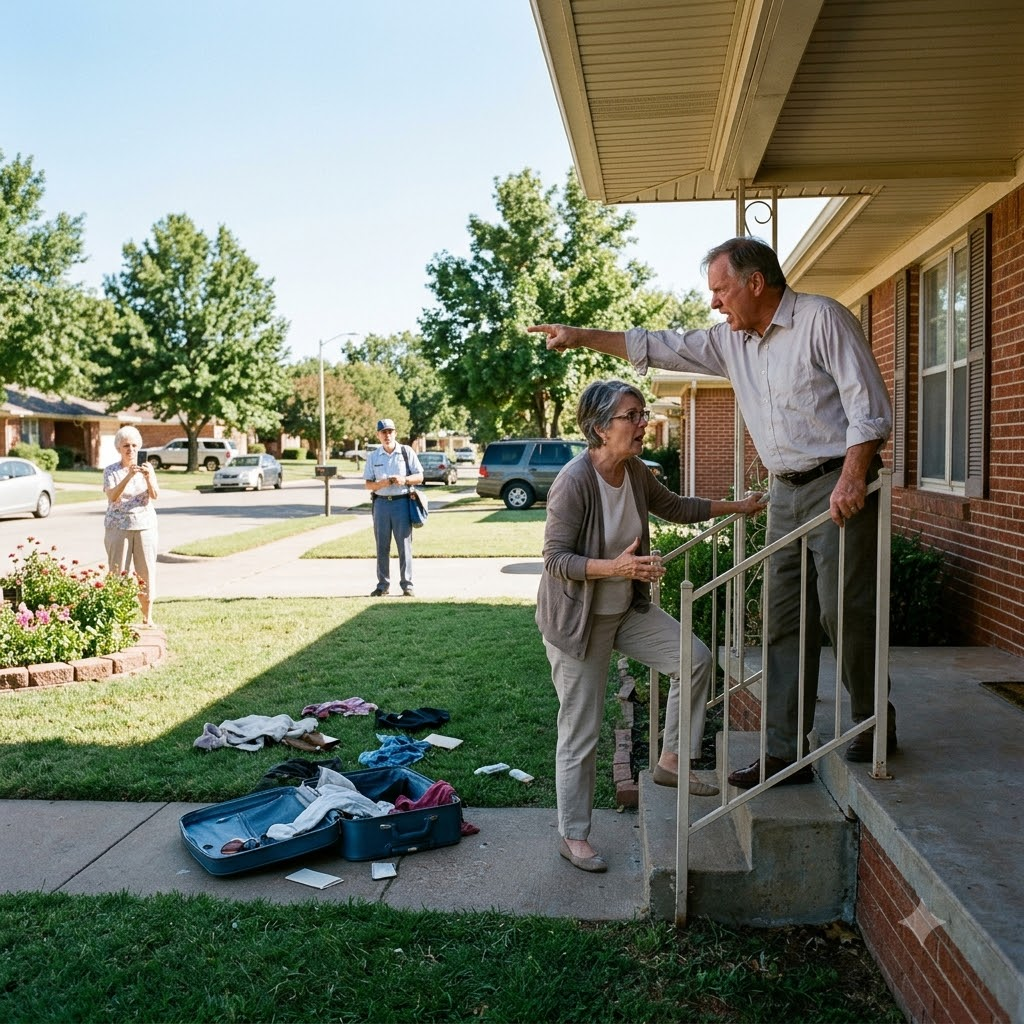
"Get off my porch, you useless woman!" Grant shouted as he hurled my suitcase onto the concrete walkway.
My husband stood above me with a mineral deed in his hand.
On the second page, beneath the words "Mineral Deed and Assignment," was a number he had tried to hide.
Three hundred thousand dollars wasn't the real price.
I didn't understand that yet.
All I knew was that my right wrist felt as though someone had driven a nail through it, my palms were bleeding, and the man I had loved for thirty-eight years was pointing toward the street as if I were a stray dog he wanted off his property.
"Grant," I whispered, struggling to get my feet beneath me. "Please. The neighbors can hear you."
"Good!" he roared. "Let them hear! Maybe somebody will finally understand what I've been putting up with!"
My suitcase lay open on the walkway.
A blue sweater I had knitted during my mother's final winter had landed in the grass. My reading glasses had slipped halfway down my nose. Two envelopes containing old photographs were scattered near the flower bed.
I stared at those photographs.
One showed Grant and me on our wedding day in 1988.
I was twenty-five, wearing a borrowed ivory dress and smiling as if nothing bad could ever happen to a woman who married her best friend.
Grant was twenty-eight, handsome and confident, with thick brown hair and the kind of smile that made strangers trust him.
I wondered what that young woman would have said if someone had shown her this afternoon.
Maybe she would have laughed.
Maybe she would have called the police.
Maybe she would have refused to believe it.
"Are you listening to me?" Grant shouted.
I looked up.
He was standing at the top of the three concrete steps leading to our front porch. His gray shirt was damp beneath the arms, and his face had turned a frightening shade of red.
"You're not taking another penny from me," he said.
I almost laughed.
For thirty-eight years, I had worked as a middle school Earth Science teacher in Edmond, Oklahoma.
I had paid our mortgage during the years his roofing company barely survived.
I had bought groceries when his customers were late paying invoices.
I had spent entire summers teaching science camps because he said we needed extra money.
And now he was accusing me of taking from him.
"Grant, I only said I wanted an attorney to look at the papers."
"Because you don't trust me!"
"Because I don't understand why a company wants mineral rights to land you keep calling worthless."
Something changed in his face.
It was brief.
A tightening around his eyes. A sudden stillness in his mouth.
Then the anger returned.
"You're a schoolteacher, Stella. Not a businesswoman. You don't know a damn thing about mineral rights."
I looked at him for a long moment.
"Actually," I said quietly, "I taught geology for thirty-one years."
He slammed his hand against the railing.
"Don't start lecturing me!"
Across the street, I noticed movement.
Doreen Platt stood beside her rosebushes, holding her phone in both hands.
She was seventy years old and had lived across from us for nearly twenty years.
Doreen was the kind of neighbor who remembered birthdays, brought casseroles after funerals, and knew exactly when everyone on the block put out their trash.
She was also recording us.
Grant hadn't noticed.
I was grateful.
Four hours earlier, none of this had seemed possible.
The reading of my grandfather's will had taken place at ten that morning in a quiet conference room in downtown Oklahoma City.
My grandfather, Walter Bennett, had died three weeks earlier at the age of ninety-four.
He had been a farmer his entire life.
Even after his hands became too stiff to button his own shirts, he could identify a field's soil quality by rubbing a pinch of dirt between his fingers.
When I was little, he used to take me walking through his wheat fields in Kingfisher County.
"People look at land and see what sits on top," he would tell me. "The smart ones ask what's underneath."
I thought he meant earthworms.
Grandpa would laugh and let me believe it.
My younger sister, Celeste, never liked visiting the farm.
She hated the dust, the insects, the lack of shopping malls, and the way Grandpa expected everyone to help with chores.
Celeste was four years younger than me, beautiful, ambitious, and determined to live somewhere more glamorous than Oklahoma.
She eventually moved to Los Angeles, married a wealthy real estate investor, divorced him, and became very good at making expensive things look effortless.
At the will reading, she arrived wearing a cream designer suit and carrying a handbag that probably cost more than my car.
Grant sat beside me.
He had been unusually attentive that morning.
He held my hand while we waited.
He offered to get me coffee.
He even kissed my cheek before the attorney entered.
I had mistaken his behavior for kindness.
Norah Pruitt, Grandpa's longtime private attorney, was unable to attend because of a medical appointment, so another attorney from her firm conducted the reading.
He was a narrow-faced man named Martin Ellis.
He opened a leather folder and began.
Celeste received Grandpa's penthouse in Los Angeles.
The property was valued at approximately five million dollars.
My sister pressed a hand to her chest.
"Oh, Grandpa," she whispered.
Then she smiled.
The attorney continued.
"To my granddaughter Stella Rutherford, I leave my eight-hundred-acre agricultural property in Kingfisher County, Oklahoma, including the farmhouse, improvements, and all associated rights and interests owned by my estate, subject to the provisions of the attached documents."
I blinked.
The farm.
Grandpa had left me the farm.
Celeste laughed.
Not a polite laugh.
A sharp, delighted burst that made the attorney look up.
"I'm sorry," she said, though she didn't sound sorry. "It's just so Grandpa. I get the penthouse, and Stella gets the dust bowl."
I felt my cheeks grow warm.
Grant didn't laugh.
His hand tightened around mine.
"Eight hundred acres?" he asked.
"Correct," Martin replied.
"What's it worth?"
"The estate's agricultural appraisal is included in the documentation."
"How much?"
Martin glanced at the papers.
"That valuation is subject to certain limitations and exclusions."
Grant leaned forward.
"What exclusions?"
The attorney closed the folder.
"Mrs. Rutherford should discuss the attached property documents with Ms. Pruitt before making any decisions."
I remembered that sentence later.
At the time, I barely noticed it.
I was thinking about Grandpa.
About the smell of fresh-cut wheat.
About the old porch swing where he taught me to identify constellations.
About the day he let me steer his tractor across an empty field when I was eleven.
I would have traded every penthouse in California for one more afternoon with him.
Grant barely spoke during the drive home.
At first, I assumed he was disappointed.
He had been struggling financially for months.
His roofing company, Rutherford Roofing and Restoration, was facing several lawsuits involving defective installations and unpaid subcontractors.
He insisted everything was under control.
But I had seen the collection notices.
I had heard the phone calls he took in the garage.
I knew he had stopped sleeping through the night.
When we pulled into our driveway, he turned off the engine and sat gripping the steering wheel.
"Three hundred thousand," he said.
I looked at him.
"What?"
"That's what I can get you for the farm."
I frowned.
"Already?"
He finally turned toward me.
"I've been talking to somebody."
"About Grandpa's farm?"
"About opportunities."
"Grant, Grandpa was buried three weeks ago."
He sighed.
"Stella, don't make this emotional. We have debts."
"We?"
"My company is our livelihood."
I didn't answer.
Inside the house, he went straight to the kitchen drawer where we kept important papers.
He removed a thick envelope.
The logo on the front read:
PRAIRIE LINE MINERALS.
He placed the documents on the kitchen table.
"Sign these."
I sat down slowly.
"What are they?"
"A sale agreement."
"For the farm?"
"Yes."
"All eight hundred acres?"
He shifted his weight.
"Essentially."
I opened the packet.
The first page contained familiar legal language about consideration, ownership, and conveyance.
The second page was different.
I read the heading twice.
MINERAL DEED AND ASSIGNMENT.
I looked up.
"Grant, this isn't just a sale of farmland."
"It's all part of the same transaction."
"It transfers mineral interests."
"That's what buyers want."
"Why?"
He gave me a look I had seen hundreds of times.
The look that meant he thought I was being difficult.
"Because that's how land deals work."
I continued reading.
The document contained broad language covering oil, gas, hydrocarbons, royalties, and associated subsurface rights.
There was also a clause addressing existing and future lease payments.
My stomach tightened.
"Why would a company called Prairie Line Minerals pay three hundred thousand dollars for land you say nobody wants?"
"Because they're investors."
"Then why aren't they buying the surface?"
Grant's expression hardened.
"Just sign it."
"I want to call Norah Pruitt first."
"No."
The word came too quickly.
I stared at him.
"What do you mean, no?"
"I mean we don't need to waste money on another lawyer."
"She was Grandpa's attorney."
"And now he's dead."
The cruelty of that sentence stunned me.
I closed the packet.
"I'm not signing anything today."
Grant stood.
"Stella."
"No."
"Don't do this."
"I said no."
He reached across the table and seized my right wrist.
At first, I thought he was trying to take the papers.
Then his fingers tightened.
Pain shot up my arm.
"Grant, you're hurting me."
"Do you have any idea how much money I owe?"
"Let go."
"Do you understand what happens if those lawsuits go against me?"
"Grant!"
I pulled away.
The movement knocked a chair sideways.
For one second, we stared at each other.
Then he said something I had never heard him say before.
"I should have married your sister."
I stopped breathing.
He looked almost surprised by his own words.
But he didn't apologize.
Instead, he grabbed the document packet and pointed toward the hallway.
"Pack your things."
I thought he was bluffing.
I had thought that about so many things during our marriage.
I thought he was bluffing when he threatened to cancel our vacation because I bought new tires without asking him.
I thought he was bluffing when he said my retirement savings belonged to both of us but his business accounts were none of my concern.
I thought he was bluffing when he told me that if I ever left, nobody would want a sixty-three-year-old woman with a teacher's pension.
I had become very good at believing threats were just words.
That afternoon, I learned otherwise.
He pulled my suitcase from the bedroom closet.
He stuffed clothing inside without folding it.
He threw my shoes on top.
When I tried to retrieve my mother's jewelry box, he blocked the doorway.
"You're not taking anything valuable."
"Those earrings belonged to my mother."
"Then you should've thought about that before you decided to ruin me."
I reached for the jewelry box anyway.
He shoved past me.
The next few minutes blurred together.
The front door.
The suitcase.
My feet stumbling on the porch steps.
His hand against my back.
The hard impact of concrete beneath my palms.
And his voice.
"Get off my porch!"
Now I stood beside the scattered contents of my suitcase, trying not to cry in front of the neighbors.
Grant had gone back inside.
Through the open doorway, I heard him speaking on the phone.
"Yes, I want her removed from the joint credit card accounts," he said. "Immediately."
I closed my eyes.
Thirty-eight years.
I had cooked his meals.
Raised our daughter with him.
Cared for his mother through two years of dementia.
Stayed awake beside his hospital bed after his heart attack.
And he was canceling my credit cards before I had even left the driveway.
I bent down and began gathering my clothes.
My wrist throbbed.
A shadow fell across the walkway.
I looked up.
Doreen stood beside me.
She had crossed the street without my noticing.
"Stella," she whispered.
I tried to smile.
"I'm all right."
"No, honey. You're not."
She glanced toward the porch.
"I recorded it."
I stared at her.
"All of it?"
"From when he came outside with your suitcase."
I swallowed.
"Please don't post it anywhere."
"I won't."
She placed a gentle hand on my shoulder.
"But I'm keeping it safe."
I nodded.
For some reason, that small kindness almost broke me.
Doreen helped fold my clothes.
She offered to let me stay in her guest room.
I thanked her, but I knew Grant would come looking for me there.
I also knew exactly where I needed to go.
Grandpa's farm.
I still had the old brass key he had given me years earlier.
I had carried it on my key ring long after he stopped living at the farmhouse.
"Are you sure you should drive?" Doreen asked.
"I'll manage."
"Your wrist—"
"I know."
She looked at me for a long moment.
Then she squeezed my left hand.
"Call me when you get somewhere safe."
I promised I would.
I loaded the suitcase into my twelve-year-old Toyota Camry.
My purse contained two hundred dollars in cash, my driver's license, a debit card connected to a small personal checking account, and my phone.
I still had my teacher's pension.
I still had my car.
And somewhere northwest of Edmond, I had eight hundred acres of land that everyone seemed to think was worthless.
Grant appeared in the doorway as I started the engine.
He held his phone in one hand.
"Don't come crawling back!" he shouted.
I looked at him through the windshield.
For the first time in thirty-eight years, I didn't answer.
I put the car in reverse.
Then I drove away.
The road toward Kingfisher County was familiar.
I had traveled it dozens of times as a child, sitting in the passenger seat of Grandpa's old pickup truck.
Back then, the fields seemed endless.
Now, with darkness approaching, they felt lonely.
I stopped once at a gas station.
The cashier noticed my scraped hands.
"Rough day?" she asked.
"You could say that."
I bought a bottle of water, a packet of crackers, and a small bag of ice.
I wrapped the ice in a paper towel and held it against my wrist while sitting in the parked car.
My phone buzzed.
A text from Grant.
You have until tomorrow morning to come to your senses.
A second message followed.
The offer won't last forever.
I stared at the screen.
Not once had he asked whether I was hurt.
Not once had he apologized.
He only cared about the papers.
I opened my contacts and found Norah Pruitt's number.
It was after business hours.
I left a voicemail.
"Ms. Pruitt, this is Stella Rutherford. Walter Bennett's granddaughter. I need to speak with you about the farm. My husband tried to make me sign something called a Mineral Deed and Assignment. I didn't sign it. Please call me."
I hesitated.
Then I added, "I think something is wrong."
I ended the call.
A few minutes later, I turned onto the county road leading to Grandpa's property.
The pavement gave way to gravel.
My headlights swept across dry grass, weathered fence posts, and a mailbox leaning slightly to one side.
The farmhouse appeared at the end of the long driveway.
It looked worse than I remembered.
The front porch sagged.
Paint peeled from the window frames.
The old barn stood dark against the horizon.
I parked near the front steps.
For a moment, I simply sat there.
The house had been empty for years.
At least, that was what everyone believed.
I stepped out of the car.
The night air smelled of dust and cut grass.
I carried my suitcase toward the porch.
One board creaked beneath my foot.
Another shifted slightly.
"Wonderful," I muttered. "I've inherited a death trap."
The brass key resisted when I inserted it into the lock.
I twisted carefully.
Nothing.
I tried again.
The mechanism finally turned with a stiff click.
I pushed the door open.
And stopped.
A lamp switched on in the living room.
I stared.
The room was immaculate.
Fresh oak floors gleamed beneath warm light.
The walls had been repainted.
The old stained curtains were gone.
A new sofa stood beside a polished wooden coffee table.
The kitchen beyond had modern cabinets, stainless-steel appliances, and clean white countertops.
The air smelled faintly of lemon oil.
I stepped inside.
"Grandpa?"
The word escaped before I could stop it.
Of course, nobody answered.
I set down my suitcase.
My heart was pounding.
Someone had renovated the entire house.
Someone had installed electricity, furniture, and automatic lighting.
Someone had prepared it to be lived in.
I walked into the kitchen.
A stainless-steel refrigerator stood against the far wall.
Across its upper door, written in thick black marker, were words in handwriting I recognized instantly.
Grandpa's handwriting.
Large.
Straight.
Unmistakable.
STELLA, IF GRANT COMES, DO NOT OPEN THIS DOOR.
I stared at the warning.
My injured wrist began throbbing again.
Grandpa had known.
Somehow, before he died, he had known something about Grant.
I reached for my phone.
Before I could dial, two bright headlights swept across the kitchen wall.
A vehicle had turned off the county road.
I hurried to the front window.
A dark pickup truck was moving slowly up the gravel driveway.
Its tires crunched over the stones.
I stepped back.
The truck stopped directly in front of the porch.
The engine went silent.
Then someone climbed out.
I couldn't see the driver's face.
But I could hear heavy footsteps approaching the front door.
A fist struck the wood three times.
And a man's voice called through the darkness.
"Stella Rutherford? Your grandfather told me you'd come. I need to show you what your husband was really trying to buy."






Comments 0