"My daughter?"
I stared at the signature on the document Daniel Mercer held beneath the porch light.
Emily Rutherford.
My only child.
The little girl I had taught to ride a bicycle on our driveway.
The teenager who cried when she didn't make the school volleyball team.
The woman who had stood between Grant and me at her wedding, smiling while we posed for photographs.
Her name was printed beneath a signature on a document intended to transfer my grandfather's farm.
I felt my knees weaken.
Lucas caught my elbow.
"Aunt Stella?"
I barely heard him.
"Why would Emily sign this?"
Daniel looked at the document.
"Mrs. Rutherford, we don't know that she did."
I looked up.
"What?"
"This appears to be an unrecorded draft. The signature hasn't been authenticated."
I stared at him.
"But her name is there."
"Yes."
"Why?"
"That's what we're investigating."
The wind whipped rain across the porch.
Behind me, Celeste stood trembling in a borrowed sweater.
Somewhere beyond the equipment shed, deputies were searching for Victor Harlan.
And I was looking at another document that seemed to implicate someone I loved.
I wanted to scream.
Instead, I reached for my phone.
"I'm calling Emily."
She answered on the fourth ring.
"Mom?"
Her voice sounded sleepy.
For a moment, I couldn't speak.
"Mom? Is everything okay?"
I looked at Daniel.
He nodded for me to continue.
"Emily, where are you?"
"At home. Why?"
"Is Jason there?"
"He's asleep. Mom, what's happening?"
I closed my eyes.
My daughter lived in Tulsa with her husband and two children.
I had deliberately kept her away from the worst of the conflict.
She knew Grant and I were separating.
She knew he had thrown me out.
But she didn't know about every forged document, every threat, or every secret surrounding the farm.
I had wanted to protect her.
Now I wondered whether that had been another mistake.
"Emily, did your father ask you to sign anything about Grandpa's property?"
Silence.
Then she said, "What?"
"Please answer me."
"No."
I gripped the phone.
"Are you certain?"
"Mom, of course I'm certain."
I looked down at the document.
"There's a deed with your name on it."
"What deed?"
"One that appears to authorize a transfer of the farm."
Her voice sharpened.
"That's impossible."
I swallowed.
"Emily—"
"Mom, I haven't signed anything about your farm. Dad asked me about it last week, but I told him it wasn't my business."
My heart pounded.
"What did he ask?"
"He wanted to know whether Grandpa had ever promised me part of the property."
I stared into the darkness.
"And what did you say?"
"I said no."
She paused.
"Mom, why would he ask that?"
I looked toward Daniel.
"Because someone is trying to use your name to take the land."
Emily was silent.
Then she whispered, "Dad wouldn't do that."
The words hurt more than I expected.
I had said them myself.
For years.
Grant wouldn't lie about money.
Grant wouldn't threaten me.
Grant wouldn't hurt me.
Until he did.
"Emily," I said softly, "I need you to listen."
And for the next ten minutes, I told my daughter the truth.
Not every family secret.
Not everything about Celeste and Lucas.
But enough.
The forged mineral deed.
The security footage.
The secret payment.
The assault Doreen had recorded.
When I finished, Emily was crying.
"Mom, why didn't you tell me?"
I closed my eyes.
"Because I didn't want you to feel like you had to choose between us."
She took a shaky breath.
"You should have told me."
"I know."
There was a long silence.
Then she said, "I'm coming tomorrow."
"Emily, you don't have to—"
"Yes, I do."
Her voice became firm.
"He's my father. But you're my mother. And I need to know what's happening."
I swallowed.
"All right."
Then she said something that made me press my hand against my chest.
"Mom, I believe you."
By morning, Victor Harlan was still missing.
Deputies had searched the surrounding property, but the storm had made tracking him difficult.
His SUV had been found abandoned near a county road.
The man who accompanied him had been identified and questioned.
Raymond Cole had given a statement about how Celeste came to be at the farmhouse.
According to Raymond, Victor had contacted him claiming Celeste needed help and that the original agreement could resolve the dispute. Raymond admitted he had agreed to meet them but said he hadn't known Victor intended to use Celeste as leverage.
Daniel wasn't accepting that explanation without investigation.
Neither was I.
But I had something more immediate to face.
At ten o'clock, Thomas Keene called.
"Stella, we have a hearing scheduled."
My stomach tightened.
"When?"
"Tomorrow morning."
"So soon?"
"The court agreed to consider emergency relief concerning the disputed mineral deed and preservation of the property records."
I sat down.
"Will Grant be there?"
"His attorney has been notified."
"And Victor?"
"The entities claiming interests through the disputed documents have been served through counsel where possible."
I rubbed my forehead.
"Thomas, I'm scared."
His voice softened.
"That's understandable."
"What if the judge believes Grant?"
"Then we'll present the evidence. The court will evaluate it."
I looked at Grandpa's photograph.
"What if I lose the farm?"
"Tomorrow's hearing isn't a final trial of every ownership issue. We're asking the court to protect the property while those questions are resolved."
I took a breath.
"All right."
"Stella?"
"Yes?"
"Bring the original letters and the recordings. We'll make sure the evidence is properly presented."
I nodded.
"I will."
Emily arrived that afternoon.
I watched her car pull into the driveway.
She stepped out wearing jeans, a gray sweater, and the worried expression I remembered from childhood.
For a moment, I saw the little girl who used to run toward me after school.
Then she crossed the porch and threw her arms around me.
"Mom."
I held her tightly.
She began crying.
"I'm so sorry."
I pulled back.
"For what?"
"For not knowing."
I touched her cheek.
"You couldn't have known what I didn't tell you."
She looked at my wrist brace.
Her face changed.
"Did Dad do that?"
I nodded.
She closed her eyes.
For several seconds, neither of us spoke.
Then she whispered, "I never thought he'd hurt you."
"Neither did I."
She looked toward the farmhouse.
"Can I see the video?"
I hesitated.
"Emily—"
"Please."
I studied her face.
Then I nodded.
Inside, Lucas helped us open the recording.
Emily watched silently.
She saw Grant grab my wrist.
She saw him shove me.
She heard him call me useless.
When the video ended, she sat perfectly still.
Then she began crying.
I reached for her.
She shook her head.
"Mom, he told me you left because you wanted to punish him."
My stomach tightened.
"What?"
"He said Grandpa's inheritance made you selfish. That you were trying to take money from the business."
I stared at her.
"He told you that?"
She nodded.
"He said you were having some kind of breakdown."
I closed my eyes.
Of course.
Grant had been telling everyone I was unstable.
He needed them to believe I was unreasonable.
Because if they believed me, they might start asking questions.
Emily wiped her face.
"I believed him at first."
The admission hurt.
But I appreciated her honesty.
"Then I saw how frightened you were when we talked."
She looked at me.
"And I realized I hadn't asked you what happened."
I squeezed her hand.
"You're asking now."
She nodded.
"Yes."
The next morning, I stood outside the Kingfisher County courthouse.
I wore a navy dress, low heels, and a light jacket.
My wrist brace was still visible.
Norah stood beside me.
Thomas carried a briefcase filled with documents.
Lucas and Emily waited near the entrance.
Margaret had arrived earlier.
Doreen had traveled from Edmond with her son to support me and, if needed, authenticate her recording.
I looked at the courthouse steps.
I had spent thirty-one years standing in front of classrooms.
I had spoken at school board meetings.
I had testified about science curriculum standards.
But I had never been this frightened.
Thomas approached.
"Ready?"
I looked at him.
"No."
He smiled faintly.
"That's all right."
I took a breath.
"Let's go."
The courtroom was smaller than I expected.
Wooden benches.
A raised judge's bench.
An American flag in the corner.
Grant sat at the opposing table beside Bradley Voss.
He wore a dark suit.
His hair was neatly combed.
He looked respectable.
He looked like the man who had attended church with me every Sunday for years.
Then he turned.
Our eyes met.
For a moment, I saw surprise.
Then anger.
Then something else.
Fear.
He looked away first.
I sat beside Thomas.
The judge entered shortly afterward.
Everyone stood.
The hearing began.
Thomas explained that I disputed the mineral deed and the separate authorization allegedly appointing Grant to act on my behalf.
He described the notary's denial.
The suspicious signatures.
The electronic recording records.
The security footage.
The proposed transfer documents found near the farm.
He asked the court to prevent further transfers or reliance on the disputed instruments while the case proceeded.
Bradley Voss stood.
He argued that the documents were part of a family business arrangement and that the parties disagreed about authorization.
I stared at Grant.
Family business arrangement.
That was what he called stealing my inheritance.
The judge asked several questions.
Then Thomas requested permission to present testimony.
I was called first.
I walked to the witness stand.
My legs felt weak.
I raised my right hand as carefully as I could.
After taking the oath, I sat.
Thomas approached.
"Mrs. Rutherford, how long were you married to Grant Rutherford?"
"Thirty-eight years."
"Did you inherit property from your grandfather?"
"Yes. Eight hundred acres of farmland in Kingfisher County."
"Did you authorize your husband to transfer the mineral interests?"
"No."
"Did you sign the mineral deed presented to you?"
"No."
"Did you appear before Evelyn Price to have that deed notarized?"
"No."
Thomas nodded.
"Did your husband pressure you to sign documents concerning the property?"
"Yes."
"How?"
I looked toward Grant.
He was staring at the table.
"He told me the farm was worthless. He said we needed the money. He told me I didn't understand business."
I swallowed.
"When I refused to sign, he became angry."
Thomas waited.
"What happened next?"
"He grabbed my wrist."
My voice trembled.
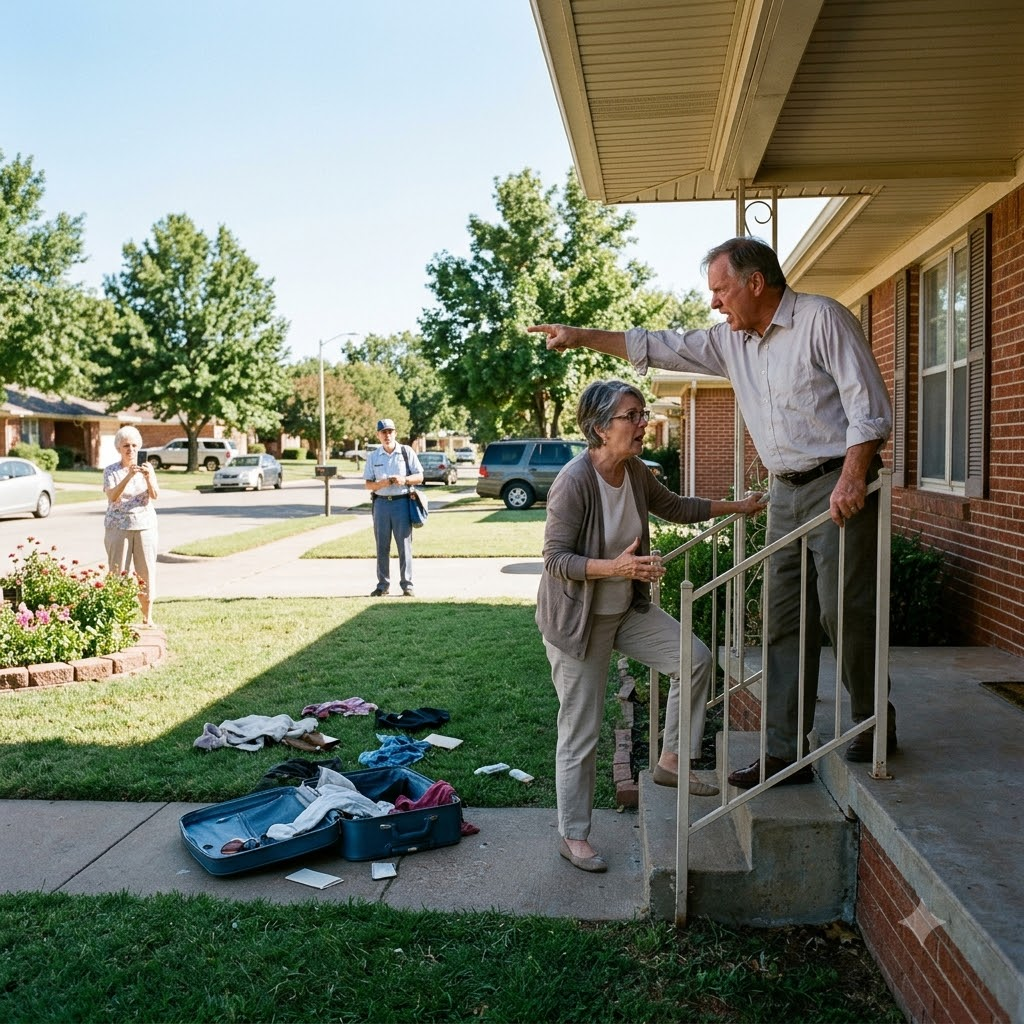
"He shoved me down the porch steps. Then he threw my suitcase outside and told me to leave."
The courtroom became quiet.
Thomas asked, "Was the incident recorded?"
"Yes."
The video was played.
I watched the judge's expression.
Then I watched Grant.
He kept his eyes on the table.
When his voice came through the speakers calling me useless, Emily began crying behind me.
I wanted to turn around.
But I kept my eyes forward.
The recording ended.
Thomas asked, "Mrs. Rutherford, did you ever voluntarily agree to sell your mineral interests to Prairie Line Minerals?"
"No."
"Why not?"
"Because I wanted an independent lawyer to review the documents and explain what I was giving up."
Thomas nodded.
"Thank you."
Then Bradley Voss stood.
His questions were careful.
He asked whether Grant and I had discussed selling the mineral interests.
"Yes."
"Whether I understood the roofing business was struggling."
"Yes."
"Whether I knew my husband had financial obligations."
"Not all of them."
He paused.
"Mrs. Rutherford, isn't it true that you and your husband historically made financial decisions together?"
I looked at him.
"No."
He blinked.
"No?"
"Grant made most of the decisions. I was usually informed afterward."
Voss shifted.
"But you benefited from the business income?"
"I also contributed my salary and retirement savings to our household."
He nodded.
"Did you ever tell your husband he could negotiate with mineral buyers?"
"No."
"Did you ever discuss the possibility?"
"Discussing something isn't the same as authorizing it."
The judge looked toward me.
Voss paused.
Then he asked, "Isn't it possible you misunderstood the nature of the documents?"
I felt my chest tighten.
For thirty-eight years, Grant had told me I misunderstood things.
I misunderstood money.
I misunderstood business.
I misunderstood his anger.
I looked directly at Voss.
"I taught Earth Science for thirty-one years. I know the difference between a discussion and a signature. I also know when someone is trying to make me believe I agreed to something I never agreed to."
The courtroom was silent.
Voss looked down at his notes.
"No further questions."
Evelyn Price testified remotely.
She confirmed that she had not notarized my mineral deed or authorization.
She explained that her notarial information appeared to have been misused.
She also described an earlier encounter with a woman who identified herself as Celeste Bennett and brought paperwork connected to a mineral transaction.
She was careful to distinguish what she personally remembered from what she had later learned.
Thomas then presented the electronic recording records linking the submission account to Harlan Administrative Services.
Margaret testified about the original geological report and why an independent valuation was necessary.
She did not claim that two million dollars was guaranteed.
Instead, she explained that the available data supported a potentially substantial value and that a three-hundred-thousand-dollar offer should not be treated as proof of fair market value.
I watched the judge take notes.
For the first time, the people who had dismissed my concerns were being required to answer specific questions.
Dates.
Documents.
Signatures.
Payments.
Facts.
Not insults.
Not threats.
Facts.
Then Thomas called Grant Rutherford.
My husband walked to the witness stand.
He looked confident at first.
He adjusted his tie.
Took the oath.
Sat down.
Thomas began with simple questions.
"Mr. Rutherford, did you ask your wife to sign a mineral deed?"
"Yes."
"Did she refuse?"
"She was confused."
"Did she refuse?"
Grant hesitated.
"Yes."
"Did you later tell her she had to leave your marital residence?"
Grant shifted.
"We had an argument."
"Did you physically push her?"
"I was trying to get her to calm down."
Thomas paused.
"Mr. Rutherford, the video shows you pushing her."
Grant looked toward the judge.
"It was an accident."
I felt my stomach tighten.
An accident.
Thirty-eight years.
And he still couldn't admit what he had done.
Thomas continued.
"Did you receive a payment of one hundred and fifty thousand dollars connected to the Bennett acquisition project?"
Grant's face changed.
Bradley Voss stood.
"Your Honor, relevance?"
Thomas explained the connection to the disputed transaction.
The judge allowed a limited question.
Grant swallowed.
"I received consulting compensation."
"For what services?"
"Business introductions."
"Did those introductions involve your wife's inherited mineral interests?"
Grant hesitated.
"Possibly."
Thomas placed a document on the screen.
"Is this the payment schedule?"
Grant stared at it.
"I'd need to review it."
Thomas waited.
Grant's attorney approached the bench.
After a brief discussion, the questioning continued.
Thomas asked whether Grant had entered the farmhouse after midnight without my permission.
Grant looked toward me.
"I was checking on her."
"At 2:17 in the morning?"
"Yes."
"Did you photograph confidential documents?"
Grant hesitated.
"I may have."
"Did you remove an envelope?"
Silence.
"Mr. Rutherford?"
Grant swallowed.
"I don't remember."
Thomas played the security footage.
The courtroom watched Grant take the envelope from Grandpa's desk.
Then hand it to someone outside the back door.
When the video ended, Thomas asked one final question.
"Mr. Rutherford, who was waiting outside?"
Grant looked toward Bradley Voss.
His attorney's face had gone pale.
Then Grant whispered, "Victor Harlan."
The judge recessed the hearing briefly.
When we returned, she announced that the evidence supported temporary measures to preserve the disputed property interests and prevent further transfers under the challenged instruments while the litigation continued.
She emphasized that the court was not making a final determination about every allegation or ownership question.
But the disputed deed could not simply be treated as uncontested authority to take my mineral interests.
I sat perfectly still.
Norah squeezed my hand.
"Stella."
I looked at her.
"We protected the farm for now."
My eyes filled.
For now.
Those two words mattered.
I wasn't finished.
But I hadn't lost.
Not today.
Outside the courtroom, Emily approached me.
She wrapped her arms around my shoulders.
"I'm proud of you, Mom."
I held her tightly.
Then I saw Grant standing near the hallway.
He was speaking with Bradley Voss.
His face was pale.
When he noticed us, he started toward me.
Emily stepped between us.
"Dad."
Grant stopped.
"Emily, sweetheart."
She shook her head.
"Don't."
His expression changed.
"Your mother has filled your head with lies."
Emily looked at him.
"I saw the video."
He froze.
"I heard you testify."
He looked away.
She continued.
"You lied to me about why Mom left."
Grant's jaw tightened.
"That's between your mother and me."
"No," Emily said. "You made it my business when you used my name on a deed."
His face went white.
I stared at him.
"Grant."
He looked at me.
"Did you know Emily's name was on that document?"
He didn't answer.
Then Bradley Voss stepped forward.
"Grant, don't say anything else."
Grant turned toward him.
"Bradley, I didn't—"
"Stop."
I looked at my husband.
For the first time, I saw genuine panic in his eyes.
Not anger.
Not pride.
Panic.
Then Norah's phone rang.
She answered.
Her expression changed immediately.
"Thomas," she said, "you need to hear this."
Thomas stepped closer.
Norah listened.
Then looked at me.
"Stella, Daniel Mercer just called."
My heart pounded.
"What happened?"
She swallowed.
"They found Victor Harlan."
I stared at her.
"Where?"
"At a private airfield outside Oklahoma City."
My stomach tightened.
"Was he arrested?"
Norah nodded.
"He's being detained while investigators sort through the allegations and evidence."
I closed my eyes.
Relief washed through me.
Then Norah said, "There's something else."
I opened my eyes.
"What?"
"Investigators recovered a briefcase from his vehicle."
My heart began pounding.
"What was inside?"
She looked at Thomas.
"Documents."
"What documents?"
Norah took a breath.
"The original 1998 agreement."
I stared at her.
The agreement Grandpa had warned me about.
The agreement Grant had witnessed.
The agreement Victor had used to threaten Celeste.
Norah continued.
"And a separate document showing who altered it."
My stomach tightened.
"Who?"
She hesitated.
Then said, "The document identifies someone who authorized the changes."
I gripped her arm.
"Norah, tell me."
She looked toward Grant.
He was standing several feet away.
Watching us.
His face had gone completely white.
Then Norah whispered, "Stella, the authorization was signed by someone who was in that courtroom today."
I turned.
And saw Grant reaching for his phone.
He looked at the screen.
Then toward the exit.
And started running.






Comments 0