"Mrs. Rutherford, I'm here on behalf of the person who actually owns the mineral rights beneath your farm."
The woman on my porch spoke with the confidence of someone who expected her words to change my life.
A month earlier, they might have.
A month earlier, I would have opened the door, invited her inside, and apologized for making her wait.
But I wasn't that woman anymore.
I stood beside Lucas, watching the security monitor.
"Who are you?" I asked through the intercom.
"My name is Rebecca Sloan. I'm an attorney."
"Who do you represent?"
She glanced at the young man beside her.
"An individual with a beneficial interest arising from a 1998 agreement."
My stomach tightened.
The agreement.
Again.
Even after the forged signatures, the courthouse hearing, and Victor Harlan's arrest, that document had found another way to reach my front door.
"Then contact my attorney," I said.
Rebecca nodded.
"I intend to. But my client requested an opportunity to speak with you personally."
I looked at the young man.
He appeared to be in his early thirties, with sandy hair and a nervous expression.
"What's his name?"
"Andrew Harlan."
My heart stopped.
Harlan.
The name that had haunted my family for nearly thirty years.
Lucas looked at me.
"Don't let them in until Norah gets here."
I nodded.
Then I pressed the intercom again.
"Ms. Sloan, my attorney will contact you. Until then, please leave the property."
Rebecca studied the camera.
For a moment, I expected an argument.
Instead, she nodded.
"Very well."
She handed a business card to the young man.
He placed it beneath a small stone beside the porch steps.
Then they returned to their car.
I watched them drive away.
Only after their vehicle disappeared did I realize how hard my heart was pounding.
Lucas turned toward me.
"Are you okay?"
I looked at the empty driveway.
"Yes."
And to my surprise, I meant it.
I was frightened.
But I wasn't helpless.
There was a difference.
Norah and Thomas arrived that afternoon.
I told them everything.
Rebecca Sloan.
Andrew Harlan.
The claim that someone else owned my mineral rights.
Thomas examined the business card.
Then he opened the original 1998 agreement.
"I think I know what they're referring to."
I sat down.
"Please tell me this doesn't mean Grandpa gave away the farm."
Thomas shook his head.
"No. The original agreement didn't convey ownership of your mineral estate to Richard Harlan."
I exhaled.
"Then what is this about?"
He pointed to a paragraph near the end.
"The agreement contained a contingent beneficiary provision. If the limited option expired without being exercised, certain unused funds held under the arrangement were to be returned or distributed to a named beneficiary."
I frowned.
"Funds?"
"Money held under the original arrangement. Not the land itself."
I stared at him.
"Then why did that woman say someone else owned the mineral rights?"
"Because she's asserting a broader interpretation. We need to determine whether she has any evidence supporting it."
Norah leaned forward.
"Stella, the original language distinguishes between the mineral option and the financial obligation. The option expired in 1999. The surviving provision concerns an accounting and possible payment."
I looked down at the page.
"Who is the beneficiary?"
Thomas turned the document toward me.
The name was printed clearly.
Andrew Richard Harlan.
I swallowed.
"Richard's son?"
"Yes."
I leaned back.
For weeks, I had believed every member of the Harlan family wanted to steal my inheritance.
Now another one had appeared.
But I wasn't going to assume he was guilty because of his last name.
"Does he have a legitimate claim to money?"
"Possibly," Thomas said. "We'll examine the records and determine what, if anything, remains payable."
"And the farm?"
He looked directly at me.
"Nothing we've reviewed establishes that Andrew owns your mineral interests."
I closed my eyes.
For the first time that day, I could breathe.
The following week, Rebecca Sloan met with Thomas and Norah.
Andrew attended.
So did I.
We met in a conference room in Oklahoma City.
I wore a simple blue blouse and the pearl earrings Grandpa had given me for my sixtieth birthday.
Andrew stood when I entered.
"Mrs. Rutherford."
"Stella is fine."
He looked surprised.
Then he smiled nervously.
"I'm sorry about what happened at your house."
I sat across from him.
"Your attorney made a rather dramatic announcement."
Rebecca looked uncomfortable.
"I apologize for the wording. My client had received information suggesting the mineral interests were subject to an outstanding claim."
"From whom?" Thomas asked.
Andrew lowered his eyes.
"Victor."
The room became quiet.
He continued.
"My cousin told me that my father had secured a permanent interest in the Bennett property. He said the family had been cheated out of something valuable."
I studied him.
"Did you believe him?"
"At first."
"And now?"
Andrew looked at the documents on the table.
"Now I think he lied to me."
Rebecca opened her folder.
"After reviewing the original agreement and the materials Mr. Keene provided, we no longer maintain that Andrew holds title to the mineral interests."
I stared at her.
Just like that.
The terrifying claim that had arrived at my door was being withdrawn.
Thomas nodded.
"Then we can address the remaining financial provision separately."
Andrew looked at me.
"Mrs. Rutherford, I never wanted to take your farm."
I studied his face.
He seemed genuinely ashamed.
"My father was involved in a lot of things I didn't understand," he continued. "After he died, Victor handled most of the family business records. I trusted him."
I thought about Celeste.
Raymond.
Even myself.
All the people who had trusted someone because they seemed to know what they were doing.
I nodded.
"Trust can be expensive."
Andrew gave a sad smile.
"I'm learning that."
Over the following weeks, the attorneys reviewed the accounting records. They determined that the surviving financial provision concerned a modest, separately funded obligation, not a claim against the farm itself. Andrew received the remaining amount through the appropriate settlement process, and his attorney formally withdrew the mineral ownership claim.
No one had to surrender the land.
No one had to sign away the future.
For once, a disagreement ended with documents, patience, and a fair resolution instead of threats.
The criminal investigations took longer.
There were interviews.
Subpoenas.
Financial records.
Handwriting comparisons.
And more paperwork than I had ever seen outside a school district accreditation review.
But eventually, the truth emerged.
Victor Harlan had used several related companies to pursue mineral interests across Oklahoma.
Some transactions were legitimate.
Others were not.
His organization had identified my grandfather's property as a valuable acquisition target because of confidential geological information obtained years earlier.
Richard Harlan had originally gained limited access to that information through the 1998 agreement.
Grant had helped arrange the introduction.
He had also supplied Richard with a copy of geological records taken from Grandpa's office without permission.
When the original mineral option expired, the Harlan companies lost the opportunity it provided.
But Victor had later relied on altered versions of the agreement to suggest that his family still possessed rights they did not have.
The original report Grandpa hid in the storm cellar helped expose those alterations.
So did the correspondence recovered from Victor's briefcase.
And the financial records showed that Grant had assisted the acquisition effort while receiving payments connected to it.
I remembered something Thomas told me after the investigation.
"Your grandfather's greatest protection wasn't a clever legal trick," he said.
"What was it?"
"He kept the originals."
I smiled.
Of course he did.
Grandpa saved everything.
Receipts from twenty years earlier.
Instruction manuals for appliances he no longer owned.
Birthday cards from when I was a little girl.
He believed that important things should never be thrown away simply because someone said they were no longer useful.
That belief had saved his farm.
And perhaps me.
Grant eventually admitted that he had knowingly helped circulate altered mineral documents and had participated in the attempt to obtain my signature.
He also admitted entering the farmhouse without my permission.
He could no longer pretend the security footage was a misunderstanding.
The recording from Doreen's porch established what he had done to me.
The messages from Doreen's phone showed how he had tried to frighten me into surrendering documents.
And the records connected him to the unauthorized mineral transaction.
He faced criminal charges arising from the fraud and related conduct.
After negotiations with prosecutors, he entered guilty pleas to several charges and received a sentence that included incarceration, financial penalties, and restitution obligations.
Victor faced more extensive charges connected to the document scheme, threats, and unlawful conduct at the farm. His case ended in convictions and a substantial prison sentence.
I didn't attend every proceeding.
At first, I thought I had to.
I believed I needed to hear every admission.
Every explanation.
Every excuse.
Then one morning, I woke up and realized something.
I already knew enough.
I didn't need Grant to explain why he had hurt me before I was allowed to heal.
The divorce became final the following spring.
I sat in a quiet courtroom beside my attorney.
Grant wasn't present in person.
The proceedings were brief.
The judge reviewed the settlement and entered the decree.
After thirty-eight years, our marriage was legally over.
I expected to cry.
Instead, I felt strangely calm.
Outside the courthouse, Emily waited with two paper cups of coffee.
She handed me one.
"How does it feel?"
I thought about the question.
Then I smiled.
"Like I can finally hear myself think."
Emily laughed.
Then she hugged me.
"I'm proud of you, Mom."
I held her tightly.
The divorce settlement resolved our marital assets and debts as far as the court could determine. My inherited farm remained mine, and the disputed mineral interests were protected from Grant's claims. His business liabilities were addressed through the legal proceedings rather than simply being pushed onto me.
I didn't walk away with everything I had once imagined a marriage would provide.
But I walked away with something better.
My own life.
Celeste and I needed more time.
Forgiveness wasn't something I could give her in a single conversation.
She had concealed Lucas's existence for twenty-eight years.
She had helped Grant gain access to Grandpa's office.
She had allowed Victor to manipulate her with promises of financial relief.
And she had kept silent while I struggled to understand what was happening.
But she had also been frightened.
And ashamed.
And trapped by secrets that had grown larger than she knew how to manage.
We began meeting every Sunday.
Sometimes at the farmhouse.
Sometimes at a small diner in Kingfisher.
At first, our conversations were awkward.
We talked about the weather.
Emily's children.
The price of groceries.
Anything except the past.
Then one afternoon, Celeste looked at me across the kitchen table.
"Do you hate me?"
I put down my coffee.
"No."
She began crying.
"I wouldn't blame you."
I took a breath.
"I'm angry about what happened."
She nodded.
"I know."
"And I can't pretend it didn't hurt."
"I know."
I reached across the table.
"But you're still my sister."
She covered my hand with hers.
For a long time, neither of us spoke.
Then she whispered, "I missed you."
I smiled sadly.
"I missed you too."
Her penthouse eventually sold.
After paying the mortgage and other obligations, she had far less money than the five-million-dollar inheritance once suggested.
But she was no longer pretending to be wealthy.
She rented a comfortable apartment in Oklahoma City and began rebuilding her finances with professional help.
For the first time in years, she seemed relieved not to maintain an expensive illusion.
Lucas visited her often.
And he visited me even more.
My nephew became one of the greatest surprises of my life.
He was twenty-eight years old.
Intelligent.
Patient.
A little stubborn.
Just like Grandpa.
He helped me organize the farm records.
He repaired the old porch steps.
He taught me how to use the security system without accidentally triggering the alarm every time I opened a window.
One afternoon, we sat beside the creek.
He looked at me.
"Do you ever wish Grandpa had told you about me sooner?"
I thought about it.
"Yes."
He nodded.
"Me too."
I smiled.
"But I'm glad I know you now."
He looked down at the water.
"Grandpa said you'd like me."
I laughed.
"He was right."
Lucas grinned.
"He also said you'd try to feed me every time I visited."
I looked offended.
"That's called hospitality."
He laughed.
Then he put an arm around my shoulders.
For a moment, I imagined Grandpa sitting beside us.
Smiling.
Listening.
Finally free of the secrets he had carried for so long.
Raymond Cole's involvement was resolved through the investigation.
He had accepted consulting payments from a Harlan-related business and failed to disclose important information promptly.
Investigators found that he had shared confidential material he should have protected, but they did not establish that he had participated in the forged deeds or Victor's threats.
His role as a reviewer under Grandpa's codicil was formally terminated because of the conflict of interest.
Norah and an independent professional completed the remaining estate review.
Raymond came to the farmhouse once more.
He stood on the porch, holding his hat.
"Stella, I owe you an apology."
I looked at him.
"Yes, you do."
He nodded.
"I should have told you everything from the beginning."
"Yes."
He gave a sad smile.
"Walter always said you were stronger than people realized."
I looked toward the wheat fields.
"Then I wish more people had listened to him."
Raymond nodded.
He didn't ask me to trust him again.
And I didn't promise that I would.
We parted respectfully.
Sometimes that was enough.
The mineral rights took longer to resolve than anyone expected.
There were title examinations.
Independent geological reviews.
Negotiations with legitimate energy companies.
And months of careful financial analysis.
Margaret remained involved as an independent adviser.
She never promised me a fortune.
She reminded me that geological potential wasn't the same as guaranteed production.
I appreciated that.
After everything I had been through, I wanted facts.
Not fantasies.
Eventually, an established operator made an offer for a mineral lease.
Unlike Prairie Line's proposal, it did not require me to permanently sell all my mineral interests.
It included an upfront bonus, continuing royalty rights, and terms negotiated with independent legal advice.
The bonus alone was enough to pay for the farmhouse improvements, establish a substantial emergency fund, and give me financial security I had never known during my marriage.
Later, successful development of the northern formation began generating royalty income.
The exact amounts varied.
Some months were better than others.
But over time, the combined value of the lease benefits and royalty payments approached the two-million-dollar scenario Margaret had once shown me.
I never forgot her warning.
The number had been an estimate.
Not a promise.
And I was fortunate that the development proved successful.
But when the first substantial royalty payment arrived, I sat at Grandpa's kitchen table and stared at the statement.
Then I began laughing.
I laughed until tears rolled down my cheeks.
Not because I had become rich.
Because Grant had called the farm worthless.
He had called me worthless.
And now the land he tried to steal was helping me build a future he could no longer control.
I didn't sell the farm.
Not one acre.
Instead, I hired a local farm manager to help oversee the agricultural operations.
We continued growing wheat.
We improved the soil conservation practices.
We repaired the fences.
And we restored the old barn.
I also established a small educational program for local students.
Every spring, I invited school groups to visit the property and learn about geology, agriculture, and the history of the land.
I called it the Walter Bennett Land and Science Program.
The first group arrived on a bright April morning.
Twenty-four middle school students stepped off a yellow bus.
Their teacher looked exhausted.
I smiled.
I remembered that expression.
I had worn it for thirty-one years.
We walked through the fields.
I showed them soil layers.
Explained how sedimentary formations developed.
Talked about the difference between scientific evidence and speculation.
Then one little girl raised her hand.
"Mrs. Bennett?"
I smiled.
"Yes?"
"Is it true there's oil under your farm?"
I laughed.
"Yes, there is."
Her eyes widened.
"Are you a millionaire?"
The other children giggled.
I thought about the question.
Then I knelt beside her.
"I have enough to live comfortably."
She frowned.
"Isn't that the same thing?"
I smiled.
"Not exactly."
She looked confused.
I pointed toward the farmhouse.
"See that house?"
She nodded.
"My grandfather left it to me. And for a long time, I thought I needed someone else's permission to decide what to do with my life."
The little girl tilted her head.
"Why?"
I smiled sadly.
"Because sometimes adults forget how important their own choices are."
She thought about that.
Then nodded.
"My mom says I should make good choices."
I laughed.
"Your mom is right."
That summer, Emily brought her children to stay for two weeks.
The farmhouse filled with noise.
Laughter.
Running footsteps.
The smell of pancakes.
Her daughter, Sophie, loved the old barn.
Her son, Noah, insisted on helping Lucas repair a fence.
Every evening, we ate dinner on the porch.
Celeste joined us whenever she could.
Lucas brought his girlfriend, Hannah, a kind young woman who worked as a nurse in Oklahoma City.
Doreen visited for a weekend.
She stood in the kitchen, looking around.
"Well, Stella, you've done something wonderful with this place."
I smiled.
"I had help."
She laughed.
"That's what people say when they don't want to take credit."
I hugged her.
"Thank you for recording what happened."
Her expression softened.
"Honey, I'd do it again."
I held her tightly.
Doreen had been the first person to show me that I wasn't imagining what Grant had done.
She had witnessed it.
She had believed me.
And she had refused to be frightened into silence.
I would never forget that.
One evening, Emily and I sat on the porch after the children had gone to bed.
The sun was setting over the wheat fields.
The air was warm.
Crickets sang in the grass.
Emily leaned against the railing.
"Mom?"
"Yes?"
"Are you happy?"
I looked at her.
It was such a simple question.
And for most of my marriage, I would have answered automatically.
Of course.
Because that was what wives were supposed to say.
Because admitting unhappiness felt like failure.
Because I didn't want anyone to worry.
But now I thought carefully.
I looked at the farmhouse.
The fields.
The barn.
The place Grandpa had prepared for me.
Then I smiled.
"Yes."
Emily studied my face.
"Really?"
I nodded.
"Really."
She smiled.
"I'm glad."
I took her hand.
"So am I."
On the first anniversary of Grandpa's death, our family gathered at the farmhouse.
Celeste brought flowers.
Lucas brought a framed photograph of Grandpa standing beside his tractor.
Emily baked his favorite apple pie.
We placed the photograph on the mantel.
Then we shared stories.
Funny stories.
Embarrassing stories.
Stories about his stubbornness.
His kindness.
His terrible jokes.
At one point, Lucas laughed.
"Grandpa used to tell me the land had a way of revealing people's true character."
I smiled.
"He told me that too."
Celeste wiped her eyes.
"He was right."
I looked at my sister.
She smiled through tears.
For the first time in years, we weren't hiding anything important from each other.
We were simply a family.
Imperfect.
Wounded.
But together.
After everyone went home, I remained in the living room.
I stood before Grandpa's photograph.
"Well," I whispered, "you were right."
The house was quiet.
Outside, the wind moved through the wheat.
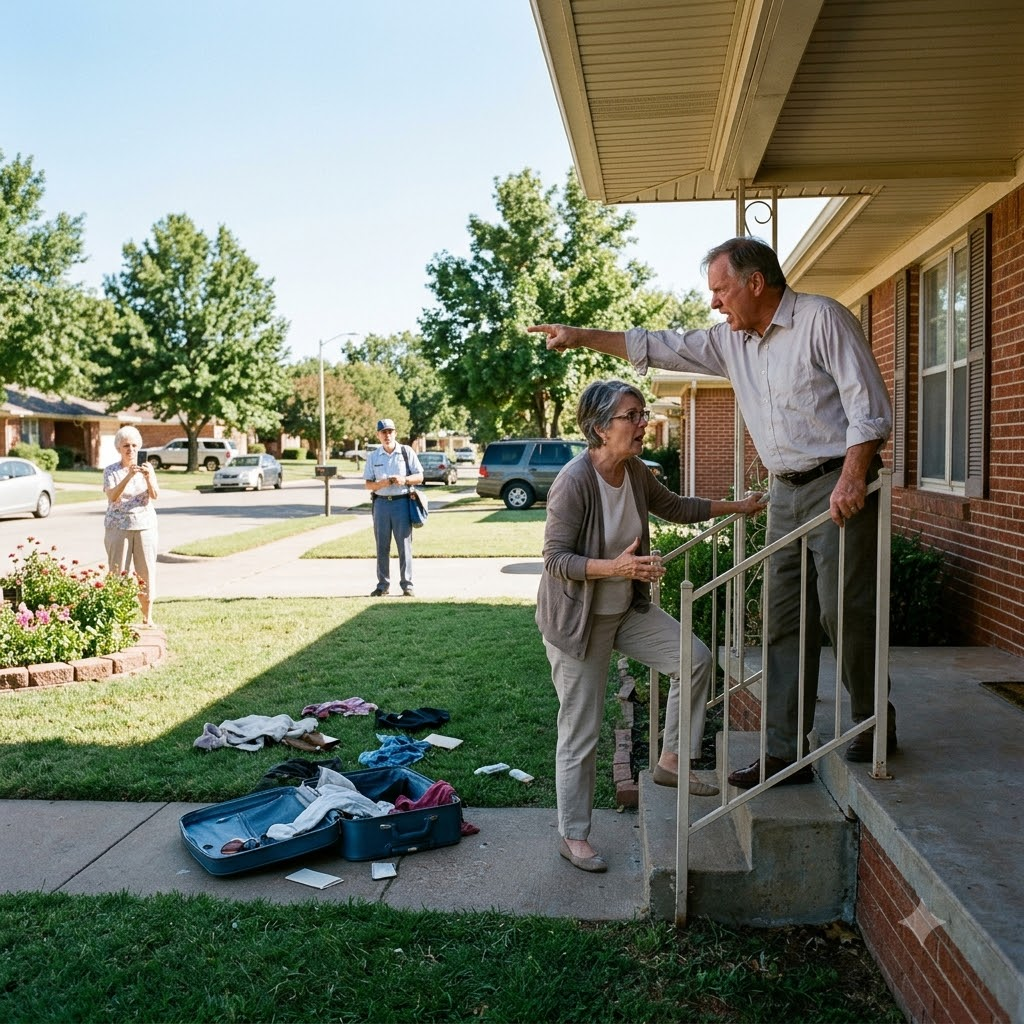
I thought about the day Grant threw me out.
The suitcase landing on the lawn.
The pain in my wrist.
The humiliation.
The fear.
I remembered driving toward the farmhouse with two hundred dollars in cash and no idea what would happen next.
I had believed my life was over.
But it hadn't been over.
It had been waiting.
Waiting for me to stop apologizing.
Waiting for me to stop asking permission.
Waiting for me to understand that love should never require surrendering my dignity.
I touched Grandpa's photograph.
"Thank you for giving me somewhere to go."
Then I smiled.
"And thank you for believing I could make it my home."
A year later, I stood in the North Forty at sunrise.
The wheat was nearly ready for harvest.
The sky glowed pink above the horizon.
I wore jeans, comfortable boots, and Grandpa's old denim jacket.
In my pocket was the small brass key stamped with the number four.
I kept it there sometimes.
Not because I still needed to open the shed drawer.
But because it reminded me of the first mystery I had solved.
And the first decision I had made for myself.
I looked across the fields.
The land stretched farther than I could see.
Eight hundred acres.
A farmhouse.
A barn.
A creek.
A history of hard work and stubborn hope.
And beneath it, mineral interests that had helped give me financial independence.
But the greatest thing Grandpa left me wasn't the land.
It was the chance to discover who I was without Grant Rutherford telling me who I had to be.
I was sixty-four now.
Divorced.
A grandmother.
A sister.
An aunt.
A retired teacher who had somehow become a farmer, a businesswoman, and a woman who could stand in a courtroom without lowering her eyes.
I had lost a marriage.
But I had found a family I didn't know was complete.
I had lost the house where I raised my daughter.
But I had found a home where I felt safe.
I had lost the future I once imagined.
But I had gained one I could choose.
I took out my phone and opened a photograph Emily had sent the night before.
Sophie and Noah stood beside the restored barn, grinning beneath the summer sun.
Behind them was a wooden sign.
THE WALTER BENNETT FAMILY FARM.
I smiled.
Then I slipped the phone back into my pocket.
The morning breeze moved through the wheat.
Somewhere in the distance, a tractor engine started.
Another harvest was beginning.
I stood there for a long time, breathing in the cool air.
For thirty-eight years, I had believed my worth depended on being someone's wife.
Then my husband threw me away because he thought I had nothing valuable to offer.
He never understood what my grandfather had buried beneath the farm.
And he never understood what Grandpa had planted inside me.
The courage to begin again.
I turned toward the farmhouse.
Sunlight filled its windows.
Coffee was waiting in the kitchen.
Emily and the children would arrive that afternoon.
Celeste and Lucas were coming for dinner.
And I had a whole ordinary, beautiful day ahead of me.
For the first time in my adult life, I wasn't waiting for someone to tell me what came next.
I already knew.
I was going home.






Comments 0