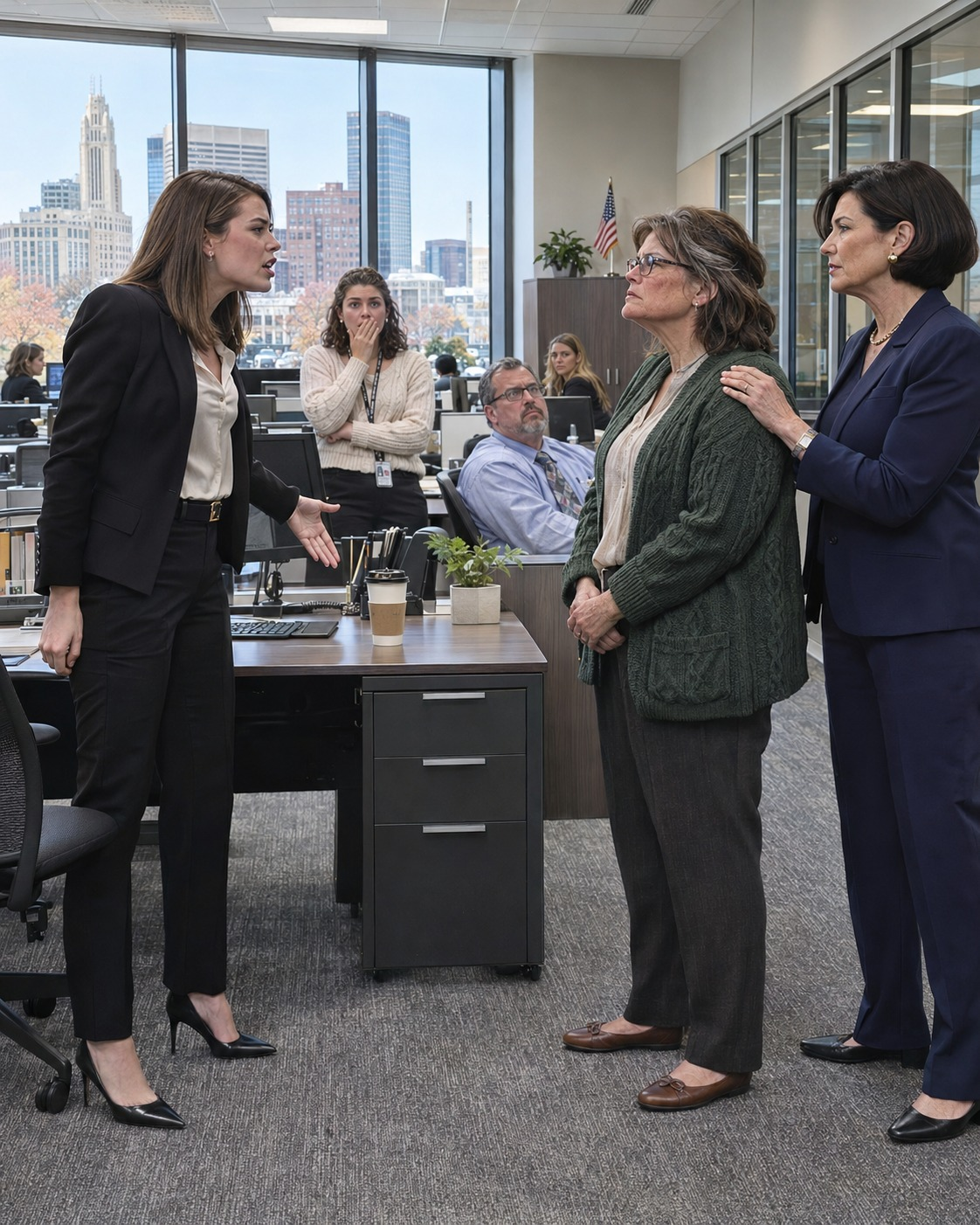
The woman standing in the conference room doorway was holding a folder with my husband's name on it.
I hadn't seen her in more than twenty years.
"Regina?" she whispered.
I stood so quickly that my chair moved backward.
"Patricia?"
Her eyes filled with tears.
"I'm sorry it took me so long."
Theodora looked between us.
"Do you two know each other?"
I couldn't take my eyes off the woman.
Patricia Wells had been our company's original outside accountant. She had worked with Mitchell and me during the first five years of our business, helping us prepare financial statements and organize our tax records.
She had left Columbus shortly before Mitchell became ill.
I remembered her as a practical woman who never signed anything without reading it twice.
Now she was standing in front of me holding a folder that appeared to contain documents from our earliest years.
"Patricia, what are you doing here?"
She looked toward Harold.
"Harold contacted me."
I turned.
"Why?"
Patricia placed the folder on the conference table.
"Because he told me someone had started asking questions about Mitchell's old financial account."
I felt my stomach tighten.
"What account?"
Harold adjusted his glasses.
"I believe Patricia can explain that better than I can."
Martin pulled out a chair.
"Let's all sit down."
Nobody moved immediately.
Then Theodora closed the conference room door.
Patricia sat beside me.
She opened the folder carefully.
Inside were copies of bank statements, old company resolutions, and several documents bearing Mitchell's signature.
I recognized his handwriting immediately.
The same handwriting he had used on birthday cards.
The same handwriting that appeared on the original contract for our first office.
For a moment, I couldn't concentrate on the documents.
I was remembering the man who had sat beside me at our kitchen table twenty-three years earlier, calculating whether we could afford to start a medical billing business.
He had believed in the idea before I did.
He had told me that hospitals and small medical practices needed reliable billing support.
He believed we could build a company that treated people fairly while helping medical professionals focus on their patients.
We had invested $6,800 of our savings.
It had been nearly everything we could comfortably afford.
Now his name was appearing in financial records connected to questionable payments.
And a woman from our earliest business days was sitting beside me with an explanation nobody had thought to give me.
Patricia opened the first document.
"Mitchell created this account during the company's second year."
I looked at the heading.
"Reserve Management Agreement."
She nodded.
"It was established as a contingency reserve."
"For what?"
"Unexpected operating expenses, payroll disruptions, and emergencies that could threaten the company's stability."
I looked at Mitchell's signature.
"Why wasn't I told?"
Patricia paused.
"You were involved in the original discussions."
I frowned.
"I don't remember this account."
She turned another page.
"You approved the original resolution."
She showed me a document dated twenty-one years earlier.
My signature appeared beneath Mitchell's.
I stared at it.
The handwriting was unmistakably mine.
But the details were unfamiliar.
Patricia explained that Mitchell had proposed a separate reserve account to protect the company during periods of financial instability.
At the time, our business was still small.
We had fewer than twenty employees.
A delayed client payment could create serious payroll problems.
The reserve account had been designed to provide stability without requiring the company to borrow money at unfavorable rates.
"How much was in it?" I asked.
"Initially, very little. You and Mitchell contributed gradually as the company grew."
"Where was it held?"
"At a separate financial institution."
I looked toward Harold.
"Did you manage it?"
He shook his head.
"Not initially."
Patricia answered.
"I maintained the records during my time with the company. When I left, I transferred the account documentation to Harold as part of the financial transition."
"And the account remained active?"
"Yes."
I looked at the documents again.
There were statements covering several years.
The balances had grown.
Some deposits were small.
Others were considerably larger.
I recognized several references to company distributions and reserve contributions.
"Why wasn't this included in the ordinary financial reports?"
Patricia folded her hands.
"It was included in the restricted reserve schedule. It wasn't part of the regular operating cash balance."
"Who had access?"
"Originally, you and Mitchell."
"And after Mitchell died?"
She looked toward Harold.
"That was when the access arrangements changed."
I turned to him.
"Explain."
Harold cleared his throat.
"After Mitchell passed, the company was undergoing a difficult transition. We had several outstanding obligations, and I was responsible for making sure the reserve account remained available."
"That doesn't answer my question."
He looked uncomfortable.
"The account had an administrative access arrangement."
"What kind?"
"Limited authorization."
"Under whose authority?"
He glanced at Martin.
"I'd prefer to review the records before answering."
Martin leaned forward.
"Mr. Whitmore, we're reviewing the records now. If you know who had access, please answer."
Harold adjusted his glasses.
"Originally, Mitchell and Regina were the primary authorized parties. After Mitchell's death, I was assigned administrative responsibility."
I looked at Patricia.
"Did I approve that?"
She turned through the folder.
"I have a copy of the transition paperwork."
She found a document and placed it in front of me.
I read the first paragraph.
It stated that Harold would maintain the reserve account's administrative records.
It did not state that he could independently transfer funds.
I looked at him.
"You were responsible for maintaining records, not authorizing payments."
Harold shifted in his chair.
"That was my understanding."
"Then why was Mitchell's old credential used?"
He didn't answer.
Martin intervened.
"We need to distinguish the account's administrative access from its transaction authorization history. The records will establish what actually happened."
I nodded.
Patricia opened another section of the folder.
"There is something else."
She removed a statement dated several years after Mitchell's death.
The account balance was significantly higher than I expected.
I examined the transaction history.
Several deposits had been made.
Then I noticed a withdrawal.
Twenty-four thousand dollars.
The same amount Martin had identified earlier.
I looked up.
"This is the payment connected to Bright Path."
Patricia nodded.
"That's what I noticed when Harold contacted me."
I stared at the statement.
"Why was a company reserve account paying a staffing agency?"
Patricia looked toward Harold.
"I don't know."
Harold shook his head.
"The payment may have been part of an approved operational transfer."
"Approved by whom?"
"I would need to review the supporting documents."
Martin wrote something down.
"That review will be part of the investigation."
I turned back toward Patricia.
"Why did you leave the company?"
She looked surprised by the question.
"That's a long time ago."
"I know. But I want to understand why you transferred these responsibilities to Harold."
Patricia lowered her eyes.
"Because I was moving out of state. I believed the transition had been completed properly."
"Did you have any concerns?"
She hesitated.
Then she looked directly at me.
"Yes."
Theodora leaned forward.
"What concerns?"
Patricia took a breath.
"Before I left, I noticed that Harold had begun requesting additional access to the reserve account."
I felt my shoulders tighten.
"Why?"
"He said the company needed a more efficient financial process. He wanted to consolidate several reporting responsibilities."
"Did Mitchell agree?"
"Not that I knew."
"Did I?"
Patricia shook her head.
"You were dealing with family matters at the time. I remember asking Mitchell whether he had approved the changes."
"What did he say?"
She paused.
"He told me he wanted to discuss it with you first."
I stared at her.
"Did that discussion happen?"
"I don't know."
The room became quiet.
I remembered the final months of Mitchell's life.
Hospital appointments.
Medication schedules.
Long nights.
Phone calls from doctors.
I remembered trying to keep the company running while pretending I wasn't frightened.
There were weeks when I barely understood what day it was.
It was entirely possible that Mitchell had intended to discuss the account with me and never found the opportunity.
But that didn't explain what happened afterward.
"Patricia, why are you telling me this now?"
She looked at the folder.
"Because I recently received a letter."
"From whom?"
"Harold."
I turned toward him.
He looked down.
Patricia continued.
"He asked whether I still had copies of the original reserve agreement and the account authorization documents."
"Why?"
"He said there was a historical audit issue."
I looked at Martin.
"Did you know about this?"
He shook his head.
Patricia opened her handbag and removed a folded letter.
"I brought it with me."
Martin accepted it.
He read it silently.
Then he placed it on the table.
The letter was dated three weeks earlier.
Harold had asked Patricia to confirm that the reserve account's administrative arrangements had been properly transferred following Mitchell's death.
There was nothing inherently suspicious about asking for historical records.
But the final paragraph caught my attention.
Harold had specifically requested confirmation that Mitchell's original authorization credentials were no longer active.
I read it again.
Then I looked at Harold.
"Why did you need that confirmation?"
He rubbed his forehead.
"Because I was reviewing the old system."
"At the same time we began examining Bright Path?"
"I don't remember the exact dates."
Patricia checked the letter.
"It was sent three weeks ago."
I looked toward Theodora.
Three weeks.
The same period when Selena had arrived at the office and begun demanding coffee.
The same period when Clare's questions had resurfaced through Caitlyn.
The same period when I had started reviewing the staffing invoices.
I felt a chill move through me.
"Harold, did you know I was reviewing the vendor records?"
He hesitated.
"I heard something."
"From whom?"
"I don't remember."
Martin interrupted.
"Mr. Whitmore, please don't speculate. If you have relevant information, provide it through the formal review."
Harold nodded.
The meeting continued.
Patricia explained that the reserve account had originally been designed to protect payroll and essential operating expenses.
Mitchell had wanted the money kept separate from ordinary operating funds.
He had also insisted on dual authorization for withdrawals above a specified threshold.
I found the original clause.
Two authorized approvals were required for any transfer exceeding ten thousand dollars.
I read the sentence twice.
Then I looked at the twenty-four-thousand-dollar withdrawal.
"Who were the two approvers?"
Patricia pointed to the authorization schedule.
"Originally, you and Mitchell."
"And after Mitchell died?"
"The arrangement should have been updated."
"Was it?"
She shook her head.
"I don't have a completed amendment."
I turned toward Harold.
"Did you submit one?"
He looked uncomfortable.
"I believe the account administrator may have processed a temporary change."
"Who approved it?"
"I don't remember."
Martin closed his notebook.
"That is enough for today. We need to obtain the bank's original authorization records."
Theodora agreed.
The meeting ended with a formal request for the historical account statements, transaction records, and access logs.
Patricia remained seated after everyone else began gathering their papers.
I waited.
She looked at me.
"Regina, can we speak for a moment?"
Martin started to object.
Patricia immediately added:
"With everyone present. I don't have anything to hide."
Theodora nodded.
"Go ahead."
Patricia folded her hands.
"I should have contacted you years ago."
I stared at her.
"Why?"
"Because I noticed something after Mitchell died."
"What?"
She looked toward Harold.
Then back at me.
"An account activity notification."
I felt my pulse quicken.
"What kind of notification?"
"A change to the reserve account's authorized contact information."
"Who requested it?"
"Harold."
"Did you approve it?"
"No."
"Did Mitchell?"
"Mitchell was already gone."
The room became silent.
Patricia continued.
"I questioned the change because the original account required dual authorization. Harold told me the bank had accepted the transition paperwork."
"Did you verify that?"
She shook her head.
"I should have."
I leaned forward.
"Patricia, what happened after that?"
She opened the folder again.
"There was a second account."
I stared at her.
"What?"
"Not the reserve account. A separate administrative account linked to it."
Theodora looked at Martin.
Martin sat straighter.
"Do you have documentation?"
Patricia nodded.
She removed another statement.
It showed an account number, several transfers, and a series of small administrative payments.
I examined the first page.
The account had been opened shortly after Mitchell's death.
The listed administrative contact was Harold Whitmore.
But there was another name.
A name I recognized from the current executive team.
I looked up.
"Who authorized this account?"
Patricia pointed to the bottom of the page.
I read the signature.
Owen Dunore.
Theodora's face hardened.
"How old was Owen when this account was opened?"
Patricia checked the date.
"He wasn't working here yet."
I frowned.
"Then how could he have signed?"
Patricia looked at the document.
"That's what I never understood."
Martin took the page.
He examined the signature and the date.
Then he turned it over.
There was a second page attached.
It contained the account's original authorization instructions.
Martin read them carefully.
His expression changed.
"What is it?" Theodora asked.
He didn't answer immediately.
He placed the page on the table.
The account had been established under a temporary financial arrangement.
Its stated purpose was to receive administrative reimbursements and process vendor setup payments.
But the final clause was different.
It authorized a named representative to request transfers from the reserve account after receiving confirmation from the designated financial controller.
The representative's name was not Harold Whitmore.
It was Owen Dunore.
I looked at Patricia.
"How could Owen have been involved before he joined the company?"
She shook her head.
"I don't know."
Theodora turned toward Harold.
"Do you?"
He didn't respond.
Martin picked up the authorization page.
"Mr. Whitmore, I need you to look at this carefully."
Harold finally raised his eyes.
Martin placed the document in front of him.
"Is this your signature?"
Harold stared at the page.
His face had lost its color.
Then he whispered:
"That isn't the original agreement."
Theodora leaned forward.
"What do you mean?"
Harold looked toward the conference room door.
Then he turned back to us.
"The original agreement named someone else."
Martin's voice became firm.
"Who?"
Harold swallowed.
He looked directly at me.
And then he said the one name I had never expected to hear connected to Mitchell's account.
"Regina Halverson."
I stopped breathing.
Because the signature beneath that name was mine.






Comments 0