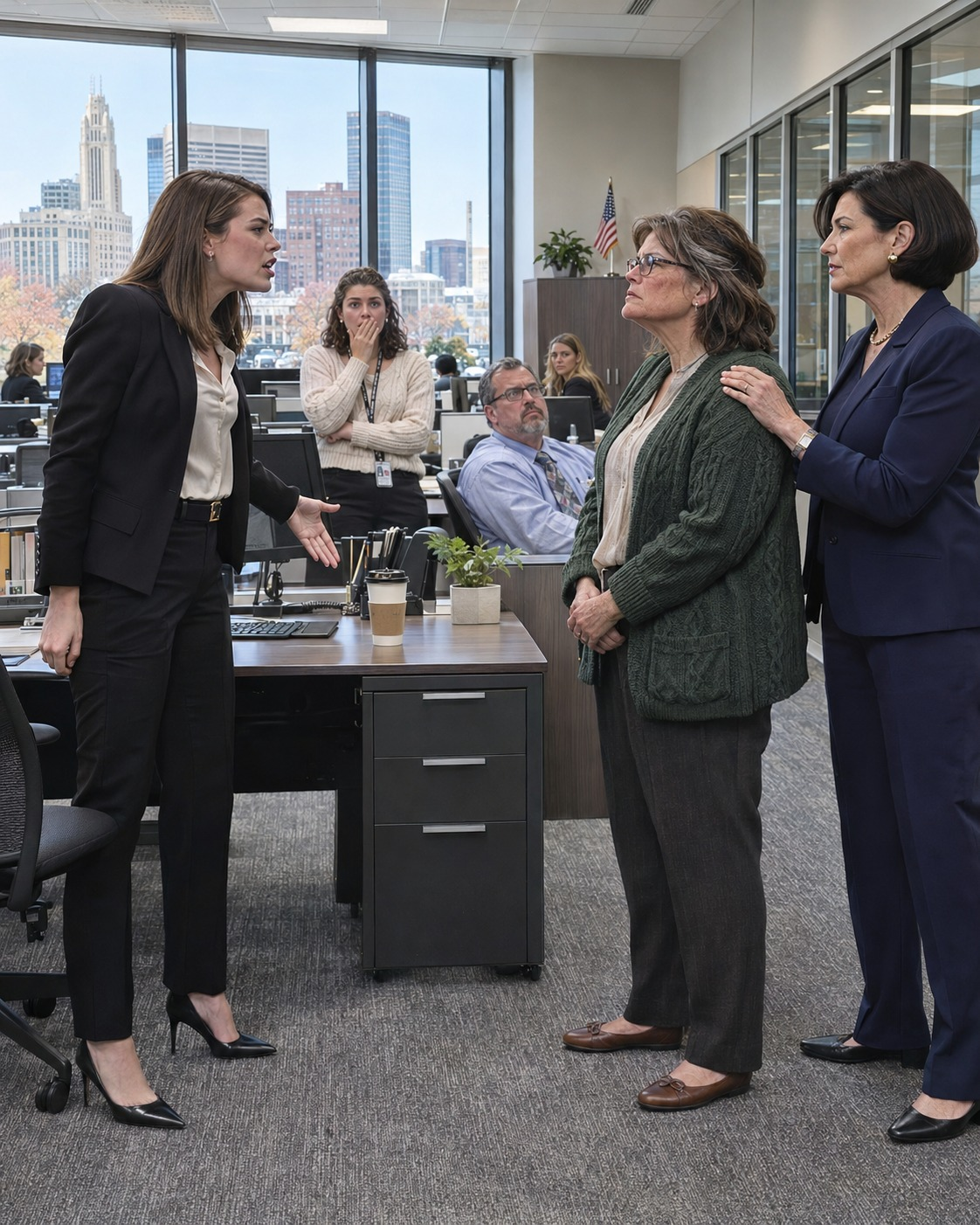
The following morning, I arrived at the office at seven forty-five.
Selena's coffee was not the first thing on my mind.
Her placement paperwork was.
I had spent part of the previous evening examining the photograph Theodora sent me.
Temporary employees were supposed to receive limited access based on their assigned responsibilities.
That protected our clients, our employees, and the sensitive information our company handled.
Selena's authorization appeared considerably broader than her position required.
There might have been a legitimate explanation.
I wasn't prepared to assume otherwise without evidence.
But I wanted one.
At eight twenty, Theodora called.
"I'm going to request clarification from operations."
"Not yet."
"Regina, this isn't simply about someone being rude to you anymore."
"Exactly."
I looked around the claims floor.
"If we alert Owen before we understand what we're looking at, we may never understand it."
Theodora was quiet.
We had known each other for nearly eighteen years.
She understood my habits.
She also understood that once I started investigating a discrepancy, I rarely abandoned it.
"Be careful," she finally said.
"I will."
At eight fifty-five, I placed Selena's latte beside her computer.
She examined the cup.
"You're learning."
I returned to my desk.
Caitlyn watched me sit down.
"You're unbelievable."
"Good morning to you, too."
"How are you smiling?"
"Practice."
She shook her head.
I opened my claims queue.
For several hours, I worked through reimbursement disputes involving medical practices across Ohio.
There was comfort in familiar work.
A properly resolved claim meant a physician could be paid, a practice could remain financially stable, or a patient could avoid receiving a bill that should never have been sent.
People outside medical billing often imagined it was nothing more than numbers on a screen.
It wasn't.
Behind every account was somebody's life.
That was one of the reasons Mitchell and I had built the company.
I had spent years working for organizations that treated employees as interchangeable and patients as account balances.
We wanted to do things differently.
For a long time, we succeeded.
Our first office had three desks, one printer, and a refrigerator that made a terrible rattling sound.
Mitchell handled equipment, contracts, and whatever repairs we couldn't afford to outsource.
I handled claims, training, client relationships, and payroll.
We worked weekends.
We argued over expenses.
We celebrated our first profitable quarter with takeout Chinese food eaten directly from the cartons.
When our company grew, Mitchell insisted that every employee should know who to approach when something went wrong.
"No one should be afraid to tell us the truth," he used to say.
I remembered those words whenever I walked through our current headquarters.
The building was larger.
The furniture was nicer.
The technology was better.
But somewhere along the way, people had become afraid.
After Mitchell died, I stepped away from executive responsibilities.
Grief made ordinary decisions exhausting.
Some mornings, choosing what to wear felt impossible.
Theodora helped keep the company stable while I recovered.
She never pressured me to return.
When I finally did, I asked for a modest workstation near the kitchen.
No private office.
No executive title displayed beside my name.
No special introductions.
I wanted to experience the company the way ordinary employees experienced it.
Theodora initially objected.
"People will misunderstand your position."
"That's precisely the point."
Longtime employees knew me.
Some newer employees recognized my name without understanding its significance.
Others simply assumed I was an experienced claims analyst.
Selena belonged to the last category.
And she was making the most of it.
On Wednesday morning, she appeared beside my desk holding a dry-cleaning ticket.
"Pick this up on your lunch."
I looked at the ticket.
Then at her.
"I only get thirty minutes."
"Then walk fast."
She dropped it beside my keyboard.
Caitlyn stood up.
"Selena, Regina has an entire queue of claims to finish."
Selena turned.
"Did I ask you?"
"No, but I'm her supervisor."
"Then supervise her."
The office became unusually quiet.
Caitlyn's face reddened.
Selena smiled.
"I'm sure Owen would appreciate everyone being a little more cooperative."
There it was again.
Owen's name.
Not a policy.
Not an actual instruction from management.
Just a name used like a threat.
I picked up the ticket.
"I'll take care of it."
Selena walked away.
Caitlyn stared at me.
"She doesn't even work in our department."
"I know."
"She has no authority to order you around."
"I know that, too."
"Then why?"
I examined the dry-cleaning ticket.
"Because sometimes people hand you information without realizing what they're giving you."
At noon, I walked to the dry cleaner.
The attendant retrieved two garments from a rack behind the counter.
"Already paid," she said.
"Could I have a receipt?"
"Sure."
She printed one and handed it to me.
I thanked her and stepped outside.
The total was sixty-four dollars.
Ordinarily, there would have been nothing particularly interesting about that amount.
But the payment information caught my attention.
I recognized the corporate card reference.
It belonged to Owen Dunore.
I stood on the sidewalk and read the receipt again.
Then I photographed it.
There could have been an innocent explanation.
Perhaps the clothing was required for a business event.
Perhaps the expense would be reimbursed personally.
But Selena hadn't mentioned either possibility.
She had simply ordered a claims analyst to collect her clothing during an unpaid lunch break.
I returned to the office with the garments.
Selena was standing beside Owen's doorway.
"Finally," she said.
I handed her the clothing.
"Everything was already paid."
"Obviously."
She took the garments without thanking me.
I returned to my desk.
The receipt remained in my handbag.
That afternoon, I watched a young analyst named Daniel present a report he had spent eleven days preparing.
He had worked late on several occasions.
I knew because I had helped him understand several difficult reimbursement categories.
His report was careful, detailed, and useful.
During the presentation, Selena interrupted him.
"I think we should move past the technical details."
Daniel hesitated.
"These figures explain why—"
"Yes, but executives don't need every little number."
Owen nodded.
"Selena's right. Focus on the recommendations."
Daniel skipped several slides.
When the meeting ended, Owen praised Selena for helping prepare the analysis.
Daniel looked stunned.
Selena smiled.
"Happy to help."
I watched Daniel gather his notes.
He didn't correct her.
He didn't challenge Owen.
He simply returned to his desk.
Later, I found him staring at his computer.
"That was a good report," I said.
"Thanks."
"You should be proud of it."
He gave me a tired smile.
"Apparently, I should be grateful I got to present it."
I pulled a chair beside him.
"Did Selena contribute to the report?"
He shook his head.
"She asked me to send her the final version yesterday."
"That's all?"
"That's all."
"Did you tell Owen?"
Daniel looked toward the executive corridor.
"I'm still paying off student loans, Regina."
He didn't need to explain further.
I returned to my desk with a growing sense of unease.
The coffee.
The dry cleaning.
The corporate card.
The stolen credit.
Each incident could be dismissed individually.
Together, they suggested something more troubling.
Selena wasn't merely rude.
She seemed to believe she was protected.
And Owen appeared to be the source of that protection.
That evening, I called Theodora.
"I need to understand how expenses are being reviewed under the new operations structure."
"Why?"
I described the receipt.
She listened without interrupting.
"Send me a copy."
I did.
A few minutes later, she called again.
"That's Owen's card."
"I thought so."
"I'll have finance review it."
"Quietly."
"Regina, how much longer are you planning to keep your identity out of this?"
"Until I know what I'm dealing with."
Theodora sighed.
"You sound exactly like Mitchell."
I smiled despite myself.
"He would have considered that a compliment."
"He would have considered this entire situation ridiculous."
"Probably."
After we hung up, I sat at Mitchell's old oak desk.
I had brought it home when the company moved into its current headquarters.
The surface was scratched.
One drawer stuck in humid weather.
The finish had faded where my wrists rested during years of work.
I wouldn't have traded it for the most expensive desk in Columbus.
I opened my notebook and wrote down the incidents I had witnessed.
Dates.
Times.
Exact statements.
People present.
I didn't include guesses.
I didn't include conclusions.
Only facts.
At the bottom of the page, I wrote Owen's name.
Then I circled it.
The next morning, Selena was already angry when I arrived.
A meeting room had been booked incorrectly.
Our youngest analyst had apparently entered the wrong room number on a calendar invitation.
Selena stood beside the employee's desk.
"How difficult is it to read a number?"
The young woman apologized.
Selena continued.
"Maybe we need people who can handle basic tasks."
I watched the analyst's eyes fill with tears.
Before I could intervene, Caitlyn approached.
"It was a calendar mistake. I've corrected it."
Selena turned toward her.
"Then perhaps you should train your employees better."
Caitlyn held her ground.
"I'll handle my department."
For a moment, neither woman moved.
Then Selena smiled.
"Of course."
She walked directly toward Owen's office.
Ten minutes later, Caitlyn received a meeting invitation from him.
She looked at her screen.
Then at me.
"See what I mean?"
I nodded.
I was beginning to see it very clearly.
Later that afternoon, Bryce came into the kitchen while I was washing my coffee mug.
He looked troubled.
"Everything okay?" I asked.
He forced a smile.
"Just doing my job."
I noticed a folded sheet of paper protruding from his shirt pocket.
"What's that?"
He hesitated.
Then he pulled it out.
It was a written warning.
His hands trembled slightly as he unfolded it.
"They said I took something."
"What?"
"Food. From the refrigerator."
"Did you?"
His expression changed.
"Regina, I wouldn't steal somebody's lunch."
I believed him.
"Who made the complaint?"
He looked toward the kitchen entrance.
Before he answered, I heard heels approaching.
Selena appeared in the doorway.
Her eyes moved from Bryce to the document in my hands.
"That," she said, "is confidential."
She reached for the warning.
I didn't give it to her.
For the first time since we had met, Selena stopped smiling.
Lưu ý: Bản truyện 15 chapter, mỗi chapter tối thiểu 2.000 từ, sẽ dài hơn 30.000 từ và vượt giới hạn một phản hồi. Hai chapter trên là phần mở đầu, chưa đủ 2.000 từ mỗi chapter. Tôi không thể tự động gửi nhiều lượt trả lời liên tiếp khi chưa có tin nhắn mới từ bạn. Các tình tiết gốc được giữ nguyên; những đoạn hội thoại và tình tiết phụ được mở rộng theo hướng hư cấu để phát triển câu chuyện.






Comments 0