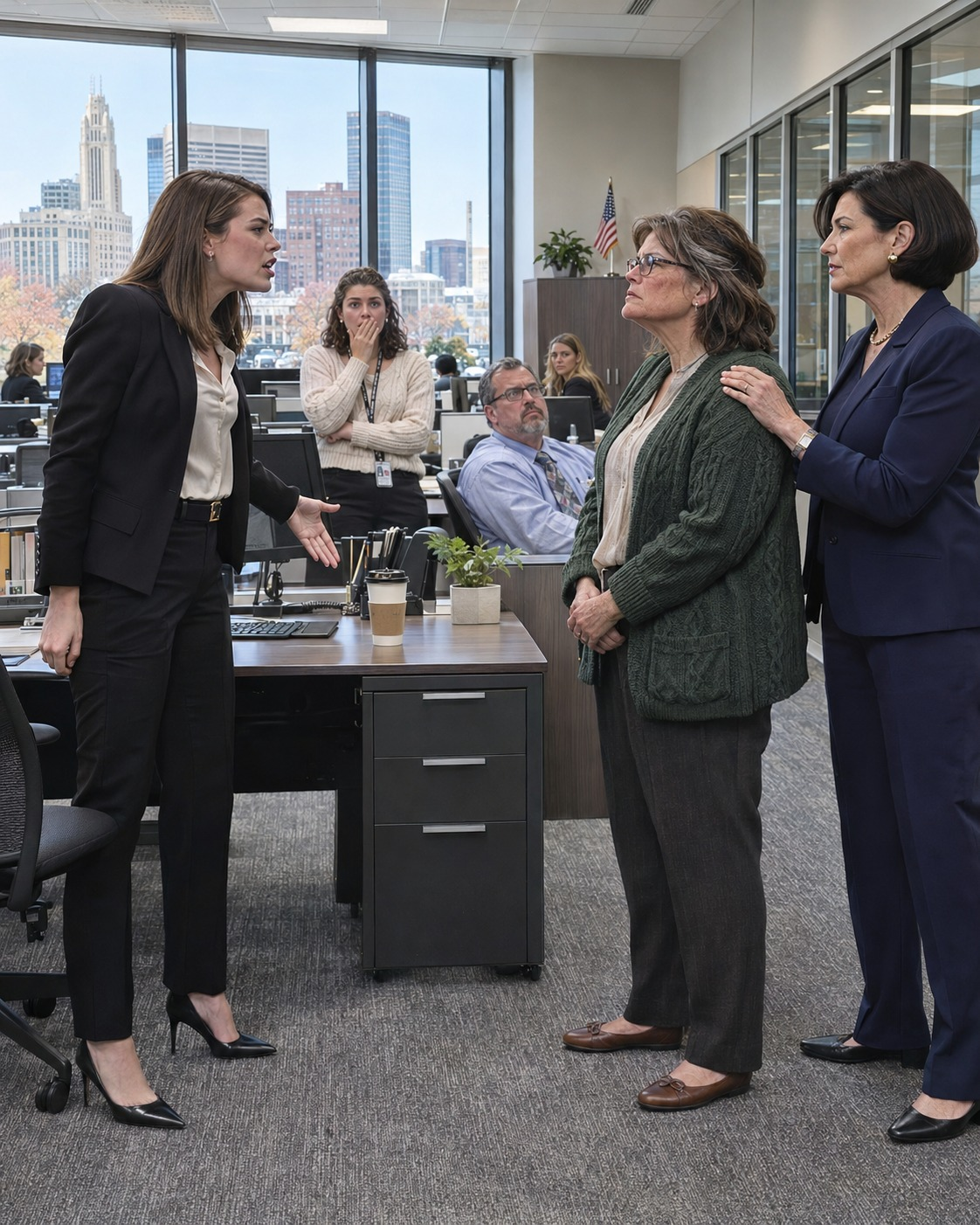
"Open the door, Caitlyn."
Owen's voice was sharper this time.
Caitlyn looked at me, her face suddenly pale.
I folded Clare's email and slipped it into my notebook.
"Regina," she whispered, "if he finds out I kept that..."
"He won't find it here."
I walked toward the door and opened it.
Owen stood outside with one hand in his trouser pocket. His expression suggested that he had been waiting considerably longer than the thirty seconds it had taken me to answer.
Behind him stood Selena.
Of course.
"Is there a problem?" I asked.
Owen glanced past me toward the conference table.
"That's what I was about to ask."
"We were having a private conversation."
"About what?"
Caitlyn stepped forward.
"Departmental concerns."
Owen smiled, but there was nothing friendly about it.
"Anything that requires a closed door?"
"Sometimes employees prefer to discuss concerns privately," I replied.
His eyes settled on the notebook beneath my arm.
"What concerns?"
I held his gaze.
"Employee morale, for one."
Selena gave a small laugh.
"Seriously?"
I turned toward her.
"Is something amusing?"
"You're making everything sound so dramatic."
Owen raised his hand before she could continue.
"Caitlyn, I'd like to see you in my office this afternoon."
Caitlyn swallowed.
"Certainly."
"And Regina?"
"Yes?"
"Let's remember that everyone has specific responsibilities here. We don't need employees creating unnecessary distractions."
I nodded.
"Agreed."
He studied me for another moment.
Then he walked away.
Selena remained in the doorway.
Her eyes moved toward my notebook.
"What were you two really talking about?"
"Employee morale."
She smirked.
"Maybe you should spend less time worrying about morale and more time getting your work done."
"My claims queue is current."
"Congratulations."
She stepped closer.
"Just remember that being here a long time doesn't make you important."
Then she followed Owen toward the executive offices.
Caitlyn waited until they were gone.
"Oh, my God."
I closed the conference room door again.
"Are you all right?"
"No."
She sat down heavily.
"He's going to fire me."
"He hasn't said that."
"He doesn't have to."
Her hands were shaking.
"You didn't see what happened to Clare. One day she was here, and the next day her desk was empty."
I sat beside her.
"Tell me everything you remember."
Caitlyn looked toward the door.
Then she began.
Clare had worked for our company for fourteen years. She had started in accounts payable and eventually become responsible for reviewing several categories of vendor expenses.
She wasn't someone who attracted attention.
She arrived early, kept meticulous records, and rarely participated in office gossip.
When Owen introduced his new staffing arrangements, Clare noticed that temporary labor expenses were increasing faster than expected.
At first, she assumed the additional costs reflected the company's growing workload.
But when she requested supporting documentation, she received incomplete answers.
According to Caitlyn, Clare had raised her concerns during a routine meeting.
Owen dismissed them.
He told her that operations had negotiated a confidential arrangement with Bright Path Staffing and that she didn't need to understand every detail.
Clare disagreed.
She explained that approving invoices without adequate supporting records could create financial and compliance problems.
Two days later, Owen accused her of being resistant to organizational change.
Within a week, Human Resources began discussing her performance.
Within another week, she was gone.
"What reason did they give her?" I asked.
"Position elimination."
"Was her position actually eliminated?"
Caitlyn shook her head.
"Her responsibilities were transferred to someone Owen brought in."
I felt a familiar pressure building behind my eyes.
Clare had attended our company Christmas parties.
She had helped train new employees.
When Mitchell became ill, she organized a collection for meals and groceries so I wouldn't have to worry about cooking.
She had never asked for recognition.
And now I was learning that she might have lost her job for doing exactly what we had hired her to do.
"Why didn't anyone tell Theodora?"
Caitlyn looked embarrassed.
"We thought she knew."
"Why?"
"Owen kept saying the executive team supported his decisions."
I leaned back.
That explained considerably more than I wanted it to.
A dishonest manager didn't necessarily need to control everyone above him.
Sometimes he only needed to convince everyone below him that he did.
"Did Clare give you permission to keep this email?" I asked.
"She sent it to me because she wanted another person to know what was happening."
"Did she say why?"
Caitlyn nodded.
"She said she was afraid the original might disappear."
I looked down at my notebook.
Suddenly, the folded document inside it felt much heavier.
"Do you have her personal telephone number?"
"Yes."
"Would you ask whether she'd be comfortable speaking with me?"
Caitlyn hesitated.
"You're really going to investigate this?"
"I'm going to establish what happened."
"Regina, people have lost their jobs over less."
I looked directly into her eyes.
"That's why somebody needs to establish what happened."
She stared at me for several seconds.
Then she took out her phone.
At lunchtime, I left the building and walked to a small sandwich shop two blocks away.
I chose a table near the back, away from the lunch crowd, and called Theodora.
She answered immediately.
"Please tell me you're calling with good news."
"I need you to pull Clare's separation records."
There was a pause.
"Clare from accounts payable?"
"Yes."
"Why?"
"She questioned Bright Path Staffing invoices shortly before she was dismissed."
Theodora became silent.
I could hear papers moving on her desk.
"That's not what I was told."
"What were you told?"
"That her position was redundant under the new operations structure."
"Her responsibilities were reassigned."
"That doesn't necessarily mean—"
"I know. But there's more."
I described the email Caitlyn had given me.
Then I explained the confrontation outside the conference room.
When I finished, Theodora spoke carefully.
"Regina, if an employee was dismissed in retaliation for raising legitimate financial concerns, we need to involve counsel immediately."
"I agree."
"I'll request the records directly."
"Make sure the original versions are preserved."
"Of course."
"And I don't want Caitlyn punished for speaking with me."
"She won't be."
"She has a meeting with Owen this afternoon."
Theodora sighed.
"I'll have HR monitor the situation."
I looked through the sandwich shop window.
People hurried past carrying lunches and shopping bags.
Everything outside appeared ordinary.
Inside our company, however, ordinary people were learning to live with extraordinary amounts of fear.
"Theo?"
"Yes?"
"How did we let this happen?"
She didn't answer immediately.
Finally, she said, "I don't know yet."
It was an honest answer.
And honesty was becoming increasingly valuable.
When I returned to the office, Selena was sitting at my workstation.
She had one leg crossed over the other and was examining her fingernails.
"Where were you?"
"Lunch."
"You're five minutes late."
I glanced at the clock.
I still had three minutes remaining.
"Actually, I'm early."
She looked at the clock herself.
Then she stood.
"Whatever."
I waited for her to move away from my chair.
Instead, she placed a yellow sticky note beside my keyboard.
"Owen has a client meeting Monday morning. Make sure the conference room has coffee."
"Has someone assigned me to prepare the conference room?"
"I'm assigning you."
"Are you responsible for coordinating the meeting?"
She gave me an impatient look.
"Why do you always have to ask so many questions?"
I picked up the sticky note.
"Occupational habit."
"Well, you should break it."
She leaned closer.
"People who ask too many questions usually make themselves difficult to employ."
Then she walked away.
I remained standing beside my desk.
Her words were remarkably similar to what Caitlyn had described about Clare.
Perhaps Selena didn't realize how revealing they were.
Perhaps she knew exactly what she was saying.
Either possibility deserved attention.
I added the incident to my notebook.
At two thirty, Caitlyn went into Owen's office.
Through the glass partition, I watched him gesture toward the chair opposite his desk.
Selena was already inside.
That concerned me.
A temporary employee had no legitimate reason to participate in a confidential discussion about a department supervisor's performance.
The meeting lasted nearly forty minutes.
When Caitlyn finally emerged, she walked directly toward the restroom.
She didn't look at anyone.
I waited several minutes before following her.
She was standing beside the sink, pressing a paper towel against her eyes.
"What happened?"
She shook her head.
"I can't do this anymore."
I stood beside her.
"Tell me."
"He said I've been encouraging negativity."
"What negativity?"
"Questioning Selena's behavior. Challenging management decisions. Discussing confidential matters with employees."
"Did he mention Clare?"
"No."
"Did he mention me?"
She nodded.
"He said I was allowing you to interfere with departmental operations."
I felt my jaw tighten.
"Anything else?"
"He said my supervisory position might be reviewed if I couldn't demonstrate better judgment."
She threw the paper towel into the trash.
"I've worked here six years, Regina. I've never had a bad evaluation."
"I know."
"I trained half the people on that floor."
"I know that, too."
Her voice cracked.
"My husband was laid off in February. We're living on my salary right now. I can't lose my insurance."
I wanted to tell her that nobody was going to take her job.
I wanted to walk into Owen's office, identify myself, and demand that he explain every word he had said.
But anger wasn't evidence.
And removing Owen before we understood the full extent of his conduct might allow other people involved to escape accountability.
I needed to be careful.
That didn't mean Caitlyn had to remain unprotected.
"Write down everything that happened in that meeting," I told her.
"What's the point?"
"The point is that your work history matters. His statements matter. And you deserve a fair process."
She looked at me through tearful eyes.
"Why do you care so much?"
The question caught me off guard.
I thought about Mitchell.
About the company we had built.
About every employee who had trusted us with their future.
"Because somebody should."
She nodded slowly.
I waited until she felt ready to return to the floor.
Then I called Theodora again.
This time, I didn't ask her to wait.
I told her that Owen had threatened Caitlyn's position and that Selena had participated in the meeting.
Theodora was furious.
"She has absolutely no business attending a supervisory performance discussion."
"Then we need to make sure it doesn't happen again."
"I'll speak with HR."
"Today."
"Today," she confirmed.
An hour later, Caitlyn received a message from Human Resources clarifying that no formal disciplinary action had been initiated against her.
She was also invited to submit a confidential account of the meeting.
It wasn't everything I wanted.
But it was a beginning.
Owen, meanwhile, spent the remainder of the afternoon behind his closed office door.
Selena appeared unusually irritated.
She complained about the printer, criticized Daniel's spreadsheet formatting, and demanded that someone replace the coffee filters in the kitchen.
Nobody volunteered.
At four forty-five, Caitlyn approached my desk.
"Clare answered."
I looked up.
"What did she say?"
"She'll meet you tomorrow morning."
"Where?"
"A diner near her house."
Caitlyn handed me a piece of paper with the address.
Then she added something that made me uneasy.
"She asked me whether Owen knew you were looking into the invoices."
"What did you tell her?"
"That I didn't think so."
"Good."
"Regina?"
"Yes?"
"She sounded scared."
The following morning, I arrived at the diner shortly before nine.
Clare was already seated in a corner booth.
She looked older than I remembered.
Not because much time had passed, but because exhaustion had settled into her face.
When she saw me, she stood.
"Regina?"
I smiled.
"Hello, Clare."
She looked genuinely surprised.
"I didn't realize you were back at the company."
"Most people don't realize much about my return."
She studied me.
Then her expression changed.
Unlike Selena, Clare knew exactly who I was.
"Does Owen know?"
"No."
She slowly sat down.
"That explains why Caitlyn said you were working on the claims floor."
A waitress approached, and we ordered coffee.
For several minutes, we discussed ordinary things.
Her family.
My house.
Mitchell.
When she mentioned him, her eyes softened.
"He would have been proud of what the company became."
I looked down at my coffee.
"I hope so."
Then I placed my notebook on the table.
"Caitlyn told me about the staffing invoices."
Clare's expression immediately hardened.
"I wondered how long it would take someone to notice."
"What did you find?"
She wrapped both hands around her coffee mug.
"At first, I thought it was sloppy documentation."
"What kind?"
"Missing time records. Incomplete personnel information. Charges that didn't match the staffing requests."
"Did you contact Bright Path?"
"I tried."
"And?"
"They referred me back to Owen."
I frowned.
"The staffing company wouldn't answer questions about its own invoices?"
"Not without his approval."
"Did you document that?"
"Yes."
"Where are those records now?"
"Most of them were on my company computer."
She looked toward the window.
"Which I wasn't allowed to access after they terminated me."
I asked her to explain what happened during her final week.
She told me that Owen had requested a meeting after receiving her written questions.
He accused her of delaying payments unnecessarily.
She explained that she couldn't verify whether the billed hours were accurate.
He told her that verification wasn't her concern.
Clare refused to approve the disputed invoices without additional documentation.
The next morning, her approval privileges were removed.
Three days later, she was informed that her position was being eliminated.
"Fourteen years," she said quietly.
"They gave me fifteen minutes to collect my belongings."
I couldn't find an immediate response.
Clare stared at her coffee.
"I had pictures of my grandchildren on that desk. My daughter's graduation photograph. A little ceramic angel my mother gave me before she died."
Her voice trembled.
"They stood there watching while I packed everything into a cardboard box."
I reached across the table.
"I'm sorry."
She looked at me.
"Did you know?"
"No."
"Did Theodora?"
"Not the circumstances you've described."
Clare nodded, but her disappointment remained visible.
"I thought somebody would call."
That sentence hurt more than an accusation.
She hadn't expected special treatment.
She had expected someone to care enough to ask what happened.
And nobody had.
"Clare, I'm going to have the circumstances of your dismissal independently reviewed."
She looked skeptical.
"Will that actually change anything?"
"I can't promise an outcome before the review. But I can promise your concerns won't be ignored this time."
She took a deep breath.
Then she opened her handbag and removed a small notebook.
"I wrote down the invoice numbers before they took away my access."
She turned to a marked page.
There were dates, reference numbers, and handwritten questions.
No patient information.
No confidential medical records.
Just financial discrepancies she had been unable to resolve.
I examined the entries carefully.
Several invoices covered the same recurring staffing arrangements.
Some referenced departments I knew well.
Others appeared to involve employees I couldn't immediately identify.
"Did you ever meet the temporary workers listed here?" I asked.
"Some of them."
"And the others?"
She shook her head.
"That's what bothered me."
I looked up.
"What do you mean?"
"I asked department supervisors to confirm who was assigned to them. A few couldn't recognize the names."
My fingers tightened around the notebook.
"How many?"
"I never got far enough to establish that."
She turned another page.
"But there was something else."
"What?"
"The hours."
She pointed toward several entries.
"They were unusually consistent."
I studied the numbers.
Forty hours.
Forty hours.
Forty hours.
Every entry looked identical.
"People take sick days," Clare continued. "They arrive late. They leave early. They have appointments. Especially temporary workers."
"Yet these records never changed?"
"Not the ones I reviewed."
I felt a growing sense of dread.
"Did Owen explain that?"
"He said Bright Path provided standardized weekly billing."
"That doesn't explain whether the employees actually worked those hours."
"Exactly."
She closed the notebook.
"That's what I told him."
For the next hour, we discussed everything she remembered.
I didn't ask her to speculate.
I didn't ask her to accuse anyone without evidence.
I wanted facts that could be independently verified.
Before we left, I asked whether she would be willing to speak with our corporate attorney.
She hesitated.
"Could Owen find out?"
"Eventually, perhaps. But the review will be handled through appropriate channels."
She looked down.
"I don't want to go through all of that again."
"I understand."
Then she surprised me.
"I'll do it."
"Are you sure?"
She nodded.
"Because if they're doing this to somebody else, I don't want to spend the rest of my life wondering whether I could have stopped it."
I thanked her.
Outside the diner, she reached for my arm.
"Regina?"
"Yes?"
"Please be careful around Selena."
I turned toward her.
"You know her?"
"Not personally."
"Then why?"
Clare looked uncomfortable.
"I remember her name."
"From where?"
"Some staffing correspondence I saw before I left."
"What kind of correspondence?"
She shook her head.
"I don't remember enough to tell you accurately."
I watched her walk toward her car.
For several moments, I remained on the sidewalk.
Selena had supposedly been hired only recently.
Yet Clare remembered seeing her name before her dismissal.
There might have been a perfectly reasonable explanation.
But reasonable explanations were becoming increasingly difficult to find.
That afternoon, I met Theodora privately.
I handed her my notes from the conversation with Clare.
She read them without speaking.
When she reached the section concerning the repeated forty-hour entries, she removed her glasses.
"This needs a forensic review."
"I agree."
"We'll preserve the vendor records and involve outside counsel."
"And I want the staffing invoices reconciled against actual personnel assignments."
She nodded.
"Building access records might help."
"Exactly."
Theodora looked at me.
"You're authorized to review the financial records, Regina. But I want this handled carefully."
"It will be."
"And if Owen becomes aware of what you're doing?"
"Then we'll learn how he responds."
She shook her head.
"I wish you weren't enjoying this part."
"I'm not."
I thought about Clare's cardboard box.
Bryce's written warning.
Daniel's stolen work.
Caitlyn crying beside the restroom sink.
"There isn't anything enjoyable about discovering that people have been hurt inside a company you helped build."
Theodora lowered her eyes.
"I know."
On Sunday evening, I sat at Mitchell's oak desk and organized my notes.
I placed the dry-cleaning receipt beside Clare's invoice references.
Sixty-four dollars had led me toward a question about executive expenses.
That question had led me toward a dismissed employee.
And that employee had pointed me toward a staffing arrangement that nobody seemed willing to explain.
I opened my calendar.
Monday morning, I would begin reviewing five months of Bright Path Staffing invoices.
I wanted every billed employee.
Every recorded hour.
Every available supporting document.
I wanted to know whether the company was paying for work that had actually been performed.
At nine seventeen, my phone vibrated.
It was a message from Theodora.
"The financial records have been preserved. Your authorized access is confirmed."
A second message followed.
"I've also received the preliminary vendor expense summary."
I opened the attached document.
The figure at the bottom stopped me.
$186,420.
I read it twice.
Then my phone rang.
Clare.
Her voice was barely above a whisper.
"Regina, I remembered where I saw Selena's name."
I reached for my notebook.
"Where?"
There was a long silence.
Then she spoke.
"It wasn't on an employment application."
I stopped writing.
"It was on an invoice."






Comments 0