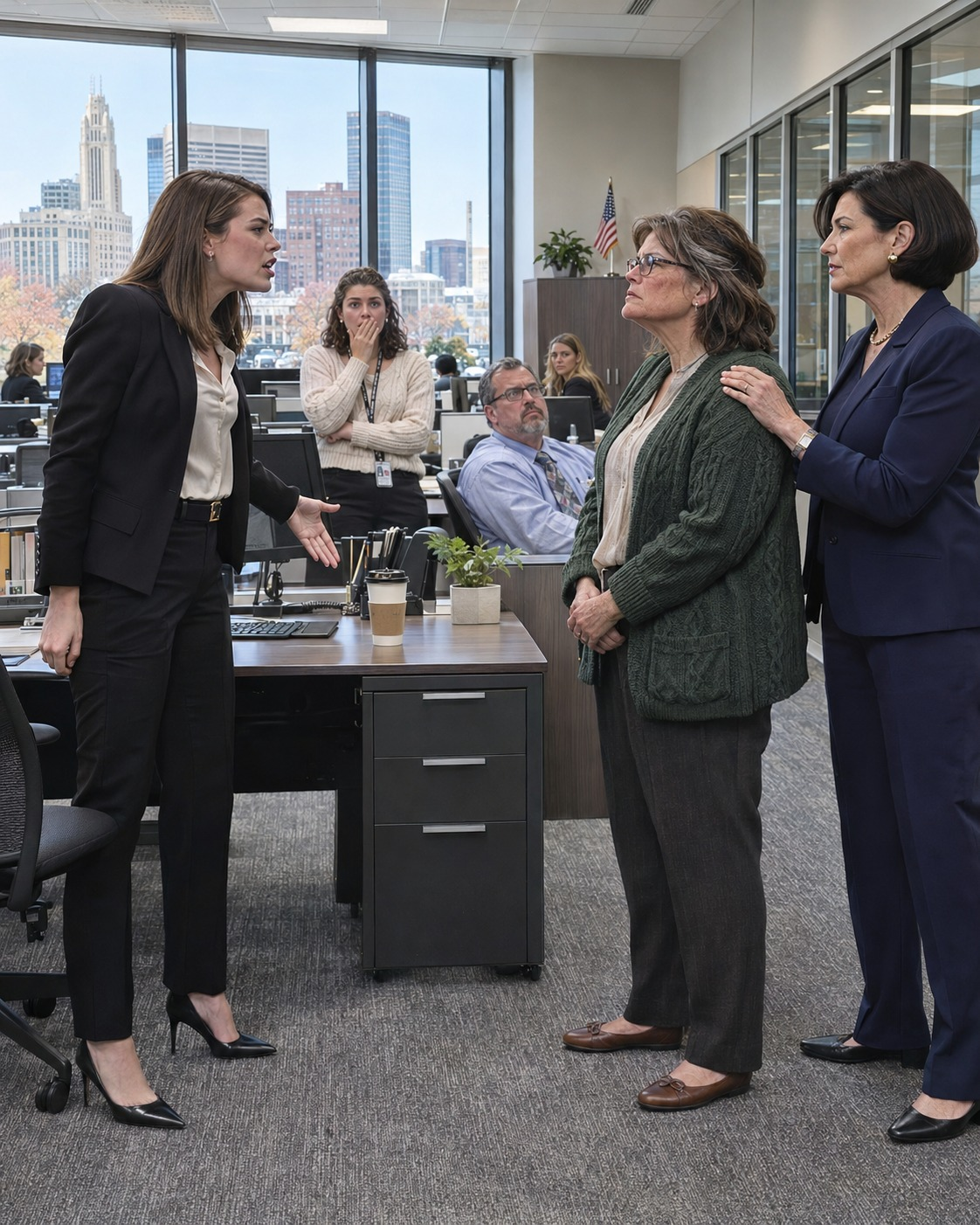
Selena slammed an empty coffee cup beside my keyboard.
"Make yourself useful, Regina."
Twenty minutes later, our CEO, Theodora Pratt, received a photograph of that cup.
Three words accompanied the photograph.
"Not yet, Theo."
Selena had chosen the wrong woman.
She just didn't know it.
At fifty-four, I had learned that people revealed considerably more about themselves when they believed you had nothing to offer them.
Selena Vale apparently believed I had nothing to offer except coffee.
She stood beside my desk that Monday morning wearing a fitted black blazer that probably cost more than my entire outfit. Her chestnut-brown hair fell neatly around her shoulders, and her manicured fingers tapped impatiently against the edge of my workstation.
I looked at the empty cup.
Then I looked at the medical claims waiting on my computer.
"Did you need something?" I asked.
She sighed as though explaining something obvious to a particularly slow child.
"Oat milk latte. Two pumps of vanilla. Not three."
I glanced toward the office kitchen.
"There's a coffee machine over there."
"I know where it is."
She leaned closer.
"That's why I'm asking you."
Across the aisle, a young claims supervisor named Caitlyn stopped typing.
Selena noticed her watching.
Instead of lowering her voice, she raised it.
"Women your age either learn to be useful or they get replaced. I'm doing you a favor."
There were moments in my life when I had experienced genuine cruelty.
I had sat beside my husband's hospital bed while a physician explained that there was nothing more they could do.
I had signed documents with trembling hands after Mitchell died.
I had returned to an empty house and discovered that silence could be louder than any argument.
Selena's little performance was nothing compared with those experiences.
But something about her words bothered me.
Not because she had insulted me.
Because she had said them so comfortably.
People rarely became that comfortable humiliating others without having been allowed to do it before.
I smiled politely.
"Two pumps?"
"Exactly."
She turned and walked toward the executive offices.
Caitlyn immediately rolled her chair toward my desk.
"Regina, what the hell was that?"
"Apparently, a coffee order."
"She can't talk to you like that."
"I heard her."
"Then why aren't you saying anything?"
I picked up the cup.
"Because I'd like to understand something first."
"What?"
I looked toward the corridor where Selena had disappeared.
"How she became so comfortable doing it."
Caitlyn stared at me.
She was thirty-one, hardworking, and considerably more qualified than several people who occupied offices with doors that closed.
She had joined the company six years earlier and worked her way from entry-level claims processing to supervisor.
She knew how to handle complicated insurance disputes, angry clients, exhausted employees, and impossible deadlines.
What she didn't know was why I had returned to the company.
Almost nobody did.
That was intentional.
I walked into the kitchen and prepared Selena's coffee.
The machine hissed as it heated the oat milk. I measured the vanilla carefully, secured the lid, and carried the cup to her workstation.
She didn't look up when I placed it beside her keyboard.
"Finally."
"Anything else?"
"Tomorrow, have it here before nine."
I nodded.
Then I returned to my desk, opened my phone, and made a dated note of her exact words.
I photographed the empty cup she had left beside my paperwork.
And I sent Theodora a message.
Her response arrived less than a minute later.
"Regina, I can handle this immediately."
I typed back.
"Don't tell anyone who I am. Not yet."
Three dots appeared.
Disappeared.
Appeared again.
"Are you certain?"
"Absolutely."
I put my phone away.
For the remainder of the morning, I processed claims.
That was the work I understood better than almost anything else.
Thirty-two years in medical billing had taught me how to recognize a coding error, identify an incorrect reimbursement, and spot an insurance denial that deserved a second review.
It had also taught me something less technical.
Small inconsistencies often led to much larger problems.
A missing signature.
An unexplained payment.
A duplicate invoice.
An employee who behaved as though the ordinary rules didn't apply to her.
Selena was becoming an inconsistency I couldn't ignore.
At lunchtime, I carried my sandwich into the break room.
Bryce, our sixty-three-year-old cleaner, was sitting alone near the window.
He wore a faded gray work shirt and carried a lunch bag that his granddaughter had decorated with colorful stickers.
"Morning treating you all right, Regina?" he asked.
"Interesting morning."
He chuckled.
"That's one way to describe this place lately."
I sat across from him.
"What do you mean?"
He hesitated.
Then he glanced toward the doorway.
"Things changed when the new operations guy arrived."
"Owen?"
Bryce nodded.
"People seem nervous. Everybody's watching what they say."
"Has something happened to you?"
He shook his head too quickly.
"Nothing worth mentioning."
I recognized that answer.
It was the answer people gave when something was worth mentioning but they were afraid of the consequences.
Before I could ask another question, Selena entered the kitchen.
Bryce immediately stood.
His sandwich was only half finished.
"I'd better get back."
Selena opened the refrigerator, inspected its contents, and frowned.
"Who keeps putting all this junk in here?"
Nobody answered.
She turned toward me.
"Regina, did you remember the vanilla this morning?"
"Two pumps."
"Good. At least you can follow simple instructions."
Bryce looked down.
I watched him leave.
Selena took a yogurt from the refrigerator and walked out without another word.
I remained at the table.
My sandwich suddenly didn't taste like anything.
When Mitchell and I started the company twenty-three years earlier, we couldn't afford a proper office.
We had $6,800 in savings, a secondhand Dell computer, a spare bedroom, and an oak desk Mitchell built himself.
He had sanded that desk in our garage until nearly midnight.
I remembered standing in the doorway, watching sawdust settle on his shoulders.
"You're making it too big," I had told him.
He smiled.
"You're going to need the room."
"For what?"
"Everything you're going to build."
I laughed at him then.
We had one client.
One computer.
And a mortgage payment that frightened me every month.
But Mitchell believed in me.
When we hired our first employee, I made coffee every morning because I couldn't afford to pay her what I believed she deserved.
When we hired our fifth employee, Mitchell bought a larger coffee machine.
When we moved into our first commercial office, I continued making coffee.
Not because anyone ordered me to.
Because kindness had been part of the company before profit ever was.
I wondered what Mitchell would have thought of Selena.
Probably the same thing I did.
That the problem wasn't the coffee.
It was the belief that another person's dignity could be purchased with a job title.
That afternoon, I watched Selena walk into Owen Dunore's office without knocking.
Owen was our recently appointed vice president of operations.
He was polished, articulate, and exceptionally good at presenting attractive numbers during executive meetings.
Theodora had initially supported his appointment.
His résumé was impressive.
His references were strong.
His proposals promised greater efficiency and reduced operating expenses.
But numbers could be arranged to tell almost any story.
People were harder to disguise.
Through the glass partition, I saw Selena sit comfortably in the chair opposite Owen's desk.
He laughed at something she said.
She leaned forward, showed him something on her phone, and laughed with him.
Their familiarity struck me as unusual.
Selena was a temporary employee.
She had been with us for only three weeks.
Most temporary employees barely knew where the executive offices were.
Selena behaved as though she belonged inside them.
At three that afternoon, Caitlyn brought me a stack of disputed claims.
"Can you take a look at these?"
"Of course."
She remained beside my desk.
"You're really not going to report her?"
"I haven't decided what I'm going to do."
"She's been doing this to other people."
I looked up.
"What people?"
Caitlyn glanced toward Owen's office.
"Forget it."
"Caitlyn."
She lowered her voice.
"People who complain don't seem to stay very long anymore."
That sentence remained with me for the rest of the afternoon.
At five, employees began gathering their belongings.
Selena walked past my desk carrying an expensive handbag.
"Tomorrow. Before nine."
"I remember."
She smiled.
"Good girl."
Caitlyn heard her.
Her face tightened.
I gently shook my head before she could respond.
Selena stepped into the elevator.
The doors closed.
Caitlyn turned toward me.
"I don't understand how you can stand there and take that."
I removed my glasses.
"Sometimes, when somebody thinks they're winning, they stop being careful."
She frowned.
"Winning what?"
"That's what I'm trying to find out."
I packed my belongings and left the office.
Outside, the streets of Columbus were filled with people heading home.
I sat in my car for several minutes before starting the engine.
My phone displayed a missed call from Theodora.
I called her back.
"Tell me you're not seriously making coffee for a temporary employee," she said.
"I made one latte."
"Regina."
"Theo."
She sighed.
"You know I can put an end to this."
"I know."
"Then why are we having this conversation?"
"Because I didn't return to that office to be treated differently from everyone else."
There was a long silence.
Finally, she spoke.
"Mitchell would have hated this."
"Mitchell would have wanted to know why it was happening."
She didn't argue.
I looked through my windshield at the building.
"How much do you know about Selena Vale?"
"She's from Bright Path Staffing. Owen requested additional temporary personnel."
"Did he request her specifically?"
"I'd have to check."
"Please do."
"Is there something you're not telling me?"
"Not yet."
After ending the call, I drove home.
Mitchell's photograph stood on the table near the entrance.
He was smiling in it, wearing the blue shirt I had bought him for our twentieth wedding anniversary.
I touched the wooden frame.
"You wouldn't believe what happened today."
The house remained quiet.
I made dinner, reviewed a few personal documents, and prepared for bed.
At 10:47 that evening, my phone vibrated.
It was Theodora.
"I checked Selena's placement paperwork."
A second message appeared.
"Owen approved her assignment personally."
That didn't surprise me.
The third message did.
"Regina, there is something unusual about the authorization."
I sat upright.
Before I could respond, she sent a photograph of the document.
At the bottom was Owen's signature.
Directly above it was a provision I had never authorized.
Selena Vale had been granted privileges that no temporary employee was supposed to possess.
And someone had approved them before she ever entered our building.






Comments 0