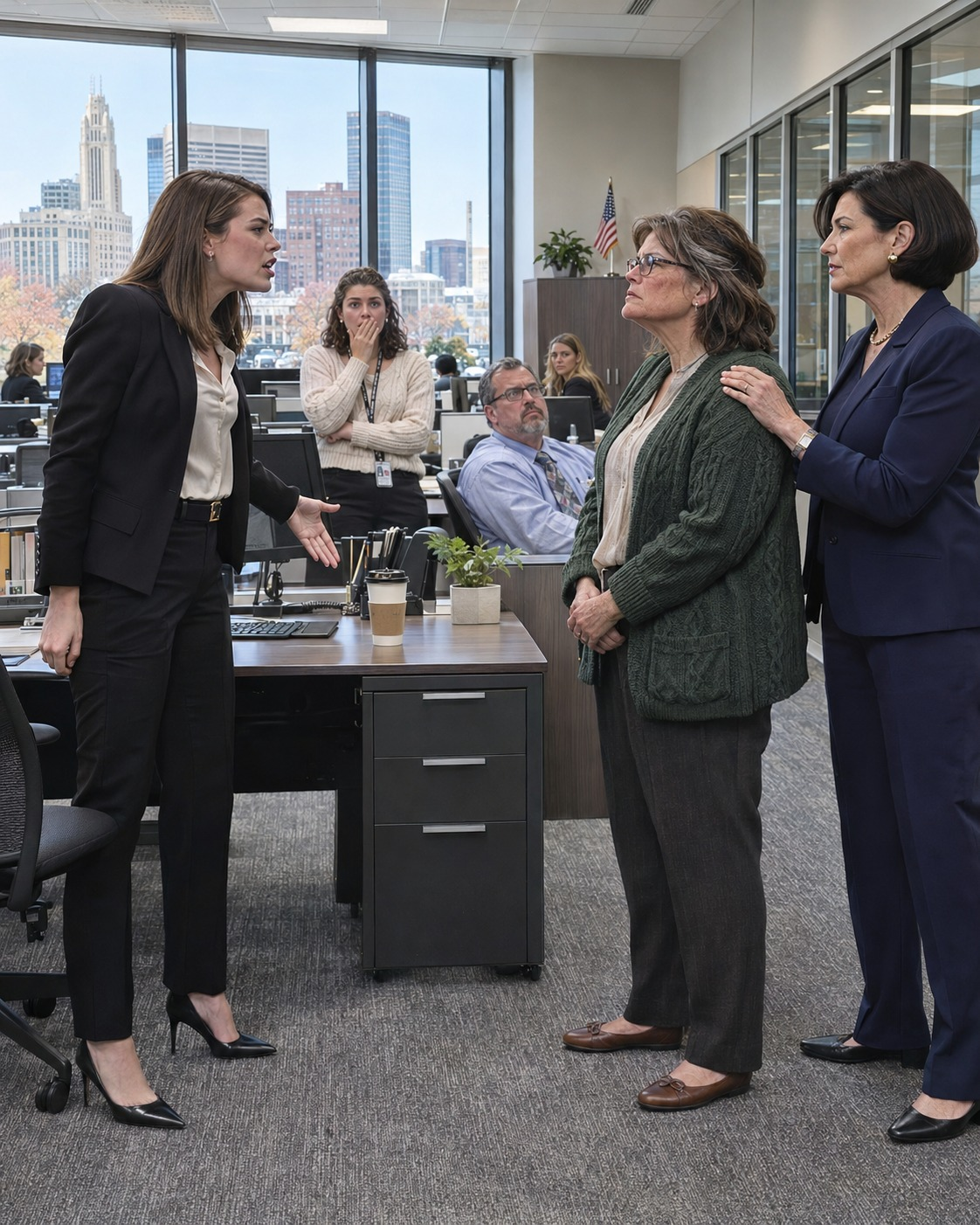
"Because the second agreement was never supposed to exist."
Patricia's words hung in the doorway.
I looked at her, then at the message on my phone.
"Come inside," I said quietly. "We're finishing this today."
Patricia entered the conference room and closed the door.
Martin Ellison was already on his way upstairs. I called Theodora and asked her to join us. Nobody would be discussing another financial document behind closed doors without witnesses again.
When Martin arrived, Patricia placed a small leather folder on the table.
"I've carried this for more than twenty years," she said. "I should have brought it to you a long time ago."
She opened it.
Inside was a document bearing Mitchell's signature, dated six weeks before his death.
The heading read:
SECONDARY RESERVE ACCOUNT – CONTINGENCY AGREEMENT.
I examined the first page.
"This is different from the agreement we found behind the wall."
"Yes," Patricia replied. "Mitchell prepared it after discovering that someone had attempted to change the original authorization."
Martin carefully examined the document.
"Why was there a second agreement?"
Patricia took a breath.
"Because Mitchell wanted a way to protect the company if the original reserve account was compromised. He created a secondary arrangement that required independent verification from two people who were not involved in daily financial operations."
"Who were they?" I asked.
"Mitchell and you."
I looked at the signatures.
Mine was there.
But beneath them was a clause I hadn't seen before.
It stated that the secondary agreement would become effective only if the original account's authorization structure was altered without my written consent.
I read it twice.
"So this agreement was designed to protect the original one."
Patricia nodded.
"Exactly."
"Why didn't I know about it?"
"Mitchell intended to explain everything after the next quarterly review. He wanted to confirm that the account had been secured before involving you."
I looked down.
"He never got that chance."
Patricia wiped her eyes.
"No."
Martin turned another page.
There was a list of conditions.
If the original authorization was changed improperly, the secondary agreement would preserve my authority and require an independent audit of all transactions.
But one paragraph was particularly important.
It stated that no external representative could receive ownership, control, or independent transfer authority over the reserve account.
I looked at Patricia.
"Who was the second original?"
She pointed to a separate attachment.
It was a duplicate of the original reserve agreement, signed by Mitchell and me.
But unlike the document recovered from the wall, this version included an additional handwritten note.
"Original held by Patricia Wells. Release only to Regina Halverson or her authorized legal representative."
I stared at it.
"Mitchell gave you this?"
"Yes."
"Why?"
"Because he believed the first agreement might be altered or removed."
Martin examined the signature.
"This is significant. We'll need to authenticate the document and compare it with the bank's archived records."
Patricia nodded.
"I understand."
I looked directly at her.
"Why did you keep it hidden for so long?"
She lowered her head.
"Because I made a terrible decision."
She explained that after Mitchell died, Harold had approached her with the revised authorization documents.
He told her the company needed immediate administrative continuity.
She had signed the limited transition document, believing that it would preserve the existing financial controls.
Later, she discovered that the version submitted to the bank contained additional provisions.
She questioned Harold.
He told her the changes had been approved by Mitchell before his death.
She didn't believe him.
But when she tried to obtain the original bank records, she discovered that her access had been removed.
She had been frightened.
She had also been ashamed of signing the original transition document without insisting on direct confirmation from me.
So she kept Mitchell's second agreement.
She hoped that one day she would have the courage to bring it forward.
I listened without interrupting.
When she finished, I remained quiet for several seconds.
"Patricia, you should have told me."
"I know."
"You should have trusted me enough to let me decide what to do."
"I know."
I looked at the document.
"But you brought it here now."
She nodded.
"I couldn't let Mitchell's work disappear."
I took her hand.
"I can't promise that everything is forgiven immediately. But I am glad you finally told the truth."
She began crying.
For the first time in years, I felt that we were finally looking at the same facts.
The meeting with Victor Lang took place that afternoon.
He arrived with his attorney.
He was in his late sixties, with thinning gray hair and a carefully pressed suit.
He recognized me immediately.
"Regina Halverson."
"Victor."
He offered his hand.
I didn't take it.
"Please sit down."
Martin explained the purpose of the meeting.
Victor was asked to address the reserve account, the administrative modifications, and his connection to Bright Path Staffing.
At first, he insisted that he had only provided financial consulting services.
He claimed that Harold had been responsible for the company's internal approvals.
He also denied knowing that Owen's name had been added to the authorization structure.
Martin placed the bank records on the table.
"Mr. Lang, your credentials were used to submit a new authorization request yesterday."
Victor adjusted his glasses.
"I did not personally submit that request."
"Who did?"
"I don't know."
Martin showed him the transaction metadata.
Victor examined it.
His expression changed.
Then Evelyn presented the historical records.
The first Bright Path payment.
The reserve account transfers.
The altered staffing reports.
The administrative account opened before Owen officially joined the company.
Victor remained silent.
I leaned forward.
"You introduced Harold to Mitchell."
"Yes."
"You recommended him as a financial administrator."
"Yes."
"Did you also arrange for Owen to receive access to the reserve account?"
Victor looked at his attorney.
Then he sighed.
"Yes."
The room became silent.
He admitted that he had helped establish the administrative structure after Mitchell became ill.
He claimed the arrangement was intended to simplify vendor payments and protect the company from operational delays.
But when Mitchell questioned the changes, Victor had continued advising Harold.
He knew the original dual-authorization requirements had not been properly preserved.
He also knew the revised documents contained provisions that had never been approved by me.
"Why?" I asked.
Victor looked down.
"Because Harold and I believed the company needed a different financial structure."
"That doesn't answer my question."
He took a breath.
"We thought we could control the reserve account more efficiently."
"Without my permission?"
He didn't respond.
I continued.
"Did you know Mitchell had discovered the modifications?"
"Yes."
"Did you know he had prepared a second agreement?"
Victor looked up sharply.
"Yes."
My heart tightened.
"Then why did you allow the original envelope to be intercepted?"
Victor glanced toward his attorney.
"I didn't collect the envelope."
"Who did?"
"Harold."
"And you knew he never delivered it to me?"
Victor was silent.
Martin placed the collection record on the table.
Victor looked at it.
Then he nodded.
"Yes."
I felt anger rise, but I kept my voice steady.
"My husband trusted you."
"I know."
"He introduced you to our business."
"I know."
"He believed you would protect what we built."
Victor lowered his eyes.
"I made a serious mistake."
"No. You made several decisions. Each one gave someone else more control over something that wasn't yours to give."
He said nothing.
Martin continued the questioning.
Victor eventually acknowledged that he had helped create the administrative account used to process vendor payments.
He also confirmed that Bright Path had been selected through a process that bypassed the company's normal independent review.
The forensic records supported his admission.
The arrangement had allowed payments to be routed through administrative accounts before being reconciled against staffing invoices.
Not every payment was fraudulent, but several had no supporting evidence of legitimate services.
Victor admitted that he had received consulting fees from Bright Path.
He claimed he believed those fees were properly disclosed.
The bank records suggested otherwise.
By the end of the meeting, Martin had enough information to refer the findings to the appropriate authorities and pursue recovery of the disputed funds.
Victor signed a statement acknowledging his role.
As he prepared to leave, he turned toward me.
"Regina, I hope you understand that I never intended Mitchell to suffer because of this."
I looked at him.
"Mitchell suffered because he trusted people who didn't deserve his trust."
Victor lowered his head.
Then he left.
I didn't feel victorious.
I felt tired.
But for the first time, the truth was no longer hidden behind missing paperwork and carefully prepared explanations.
The investigation continued for several weeks.
The bank authenticated Mitchell's original agreement.
The secondary reserve agreement was also verified.
The forensic accountant completed a detailed reconciliation of the disputed transactions.
The findings established that more than $186,420 had been billed through Bright Path for staffing services that could not be adequately verified.
Additional reserve account transfers were identified.
Some money had been moved between accounts.
Other payments had been directed toward unauthorized expenses.
The company worked with its attorneys and the appropriate authorities to recover the funds and pursue the people responsible.
Harold was formally dismissed after the investigation established that he had participated in unauthorized financial modifications and failed to disclose material information.
Owen was removed from his position while the findings were referred for further review.
Victor faced separate legal and financial consequences for his role in the arrangement.
Selena's involvement was also examined.
She had altered staffing reports, submitted inaccurate documentation, and participated in efforts to misrepresent employee assignments.
However, her cooperation and the records she provided helped establish how the reporting process had been manipulated.
She was dismissed from the company after the review.
Theodora made sure that every personnel decision followed the proper process.
Nobody was punished merely because they had been named in a rumor.
Evidence determined what happened.
That mattered to me.
I had spent months watching people use accusations to frighten employees into silence.
I didn't want the company to become the same kind of place under different management.
Meanwhile, the recovered funds were returned to the company's financial structure as the recovery process progressed.
The reserve account was restored under the original dual-authorization agreement.
I was formally reinstated as its primary authorized representative.
The new controls required independent verification for every major transfer.
No executive, consultant, or administrator could change the structure without documented approval.
Theodora also commissioned an independent review of the company's vendor contracts.
Every staffing agreement was examined.
Every invoice was matched against actual work records.
And every department received a clear reporting procedure for raising concerns without fear of retaliation.
It took time.
But the company was finally becoming the place Mitchell and I had intended it to be.
One Monday morning, Theodora called an all-staff meeting.
I entered the conference room and found approximately thirty employees waiting.
Daniel sat near the front.
Caitlyn was beside him.
Bryce stood near the back, looking slightly uncomfortable in his clean blue shirt.
I smiled when I saw him.
Theodora stepped toward the microphone.
"Thank you for being here. I want to address the recent investigation and the changes we're making."
She explained that the company had identified serious weaknesses in its financial controls and employee reporting procedures.
She acknowledged that some employees had been treated unfairly.
She also announced that the company would review previous disciplinary actions connected to the investigation.
Then she turned toward me.
"There is someone I would like to recognize."
I felt uncomfortable.
I hadn't expected that.
Theodora continued.
"Regina Halverson invested in this company more than two decades ago with her late husband, Mitchell. She helped build it from a spare bedroom into the organization we are today."
Several employees turned toward me.
"After Mitchell passed away, Regina chose to step away from executive responsibilities. She returned to the claims floor because she wanted to understand how our employees experienced the company every day."
The room became quiet.
"During the recent investigation, she refused to accept convenient explanations when the records didn't support them. She also insisted that we examine the way employees were being treated, not just the financial irregularities."
Theodora paused.
"Regina, I would like you to say a few words."
I stood.
For a moment, I looked at the people in front of me.
Daniel.
Caitlyn.
Bryce.
The claims analysts.
The administrative staff.
People who had worked through difficult deadlines and demanding clients without ever appearing in an executive presentation.
I walked toward the microphone.
"When Mitchell and I started this company, we had $6,800 in savings and one secondhand computer."
A few people smiled.
"We didn't have impressive offices. We didn't have a large financial department. We didn't even have enough money to buy proper furniture."
I paused.
"But we had one belief. If someone trusted us with their livelihood, we had a responsibility to treat that person with dignity."
I looked toward Bryce.
"That responsibility doesn't disappear because someone has a different job title."
Then I looked at Daniel and Caitlyn.
"It doesn't disappear because someone is young, inexperienced, or afraid to challenge a decision."
I took a breath.
"During the past few months, some people were humiliated. Some were blamed for things they didn't do. Others were encouraged to remain silent."
I let the words settle.
"That should never have happened."
Nobody moved.
"I also want to say something about the person who started this company with me. Mitchell believed that a good business wasn't measured only by its revenue. It was measured by whether people could trust it."
My voice softened.
"I hope we can make this company worthy of that trust again."
The room broke into applause.
I wasn't expecting it.
Bryce was the first to stand.
Then Caitlyn.
Then Daniel.
Soon, the entire room was on its feet.
I looked toward the ceiling for a moment.
Mitchell would have liked that.
Three months later, the company announced a new employee protection and financial transparency program.
The initiative included independent reporting channels, stronger vendor verification, and annual reviews of management practices.
Theodora also invited employees from every department to participate in quarterly discussions.
Not just executives.
Not just supervisors.
Everyone.
I accepted a new position as senior adviser for corporate integrity and employee experience.
I didn't return to the executive suite full-time.
Instead, I kept a desk near the claims department.
It was a deliberate decision.
I wanted to remain close to the people whose work kept the business running.
Daniel was promoted to claims reporting supervisor after completing additional training.
Caitlyn became the department's employee development coordinator.
Bryce received a formal apology from HR, and his written warning was removed from his personnel record.
The company also introduced a policy ensuring that cleaning and facilities employees were included in appropriate staff communications and workplace recognition programs.
One Friday afternoon, Bryce approached me with a small paper cup.
"Coffee?"
I smiled.
"Is that for me?"
He nodded.
"Just thought you might want one."
I accepted it.
"Thank you, Bryce."
He grinned.
"You're welcome."
It was an ordinary moment.
But it meant more to me than any expensive office celebration.
Patricia visited me the following week.
She brought the original leather folder containing Mitchell's secondary agreement.
The documents had been authenticated and added to the company's permanent legal archive.
She sat across from me.
"I've been thinking about what you said."
"Which part?"
"That I should have trusted you enough to tell you the truth."
I nodded.
She looked down.
"I can't change what happened."
"No."
"But I can make sure I don't repeat it."
I smiled slightly.
"That's a good place to start."
She reached into her handbag.
"I also found something else."
She placed a small photograph on my desk.
It showed Mitchell and me standing outside our first office.
We were young.
Tired.
And smiling as though we had just won the lottery.
I laughed softly.
"I remember that day."
"Mitchell gave me a copy before I moved away."
I turned it over.
There was a handwritten message on the back.
"To Patricia. Thank you for believing in us when all we had was a desk, a computer, and a plan."
I felt tears gather in my eyes.
Patricia smiled sadly.
"He really believed in people."
"Yes," I whispered. "He did."
We sat together for a while, remembering the early days.
Before the executive offices.
Before the staffing contracts.
Before the investigations.
There had been a small room, an old computer, and two people trying to build something worthwhile.
I was grateful that we had finally recovered the documents Mitchell had wanted me to see.
But I was even more grateful that we had recovered the company's original purpose.
On the anniversary of Mitchell's death, I took the afternoon off.
I drove to the cemetery with a small bouquet of white lilies.
The sky was bright.
The air was warm.
I placed the flowers beside his name and sat quietly.
For a long time, I didn't speak.
Then I smiled.
"We found it, Mitchell."
I told him about the original agreement.
About Patricia.
About the reserve account.
About the money that had been recovered.
I told him Daniel was doing well.
I told him Bryce was finally being treated with the respect he deserved.
And I told him that the company had changed.
I even told him about Selena's coffee orders.
I laughed when I remembered the little yellow sticky note on my monitor.
"Oat milk. Two pumps. Don't forget."
I shook my head.
"You wouldn't believe some of the things people tried to get away with."
Then my voice softened.
"But we fixed it."
I placed my hand on the headstone.
"I kept our promise."
A few minutes later, my phone vibrated.
It was a message from Theodora.
The company's annual employee satisfaction results had been released.
The numbers showed substantial improvement across departments.
Employee confidence in management had increased.
Complaints about workplace treatment had decreased.
And the claims department had recorded its strongest retention rate in years.
I smiled.
Then another message arrived.
It was from Daniel.
He had sent a photograph of the oak desk Mitchell built in our garage.
The company had restored it and placed it in a small meeting room named after Mitchell.
Underneath the photograph, Daniel had written:
"We wanted everyone to know where this company began."
I looked at the picture.
For the first time in a long while, I felt completely at peace.
On Monday morning, I arrived at the office at 8:15.
The claims floor was busy.
Caitlyn was helping a new employee.
Daniel was reviewing reports.
Bryce was pushing his cleaning cart toward the kitchen.
I walked to my desk and placed my handbag beside the chair.
There was a cup of coffee waiting for me.
A small note was attached.
It read:
"For Regina. Thank you for reminding us that every person matters."
I smiled.
Then I looked toward the executive offices.
Theodora was standing in the doorway.
She raised her hand.
"Morning, Regina."
"Good morning."
She walked toward me.
"Ready for the quarterly review?"
I picked up my notebook.
"Absolutely."
As we walked toward the conference room, I glanced once more at the claims floor.
Thirty-two years in medical billing had taught me many things.
How to read an insurance denial.
How to find a missing payment.
How to identify an error buried in thousands of records.
But the most important lesson had never been about numbers.
It was about people.
Mitchell and I had started our company with $6,800, a secondhand computer, and a belief that honest work deserved respect.
People had tried to take advantage of that belief.
They had hidden documents, altered records, misused authority, and treated employees as though their dignity depended on their job titles.
But they had failed to destroy what mattered most.
The company was still standing.
The people were still there.
And the truth had finally been heard.
I thought about Mitchell's oak desk.
I thought about the letter behind the wall.
And I thought about the woman who had once been told she needed to make herself useful.
I didn't need to prove my worth by bringing anyone coffee.
I had already spent more than three decades building something that mattered.
And now, every morning, I walked into an office where people were treated with the respect they deserved.
That was the company Mitchell and I had dreamed of.
That was the legacy I intended to protect.






Comments 0