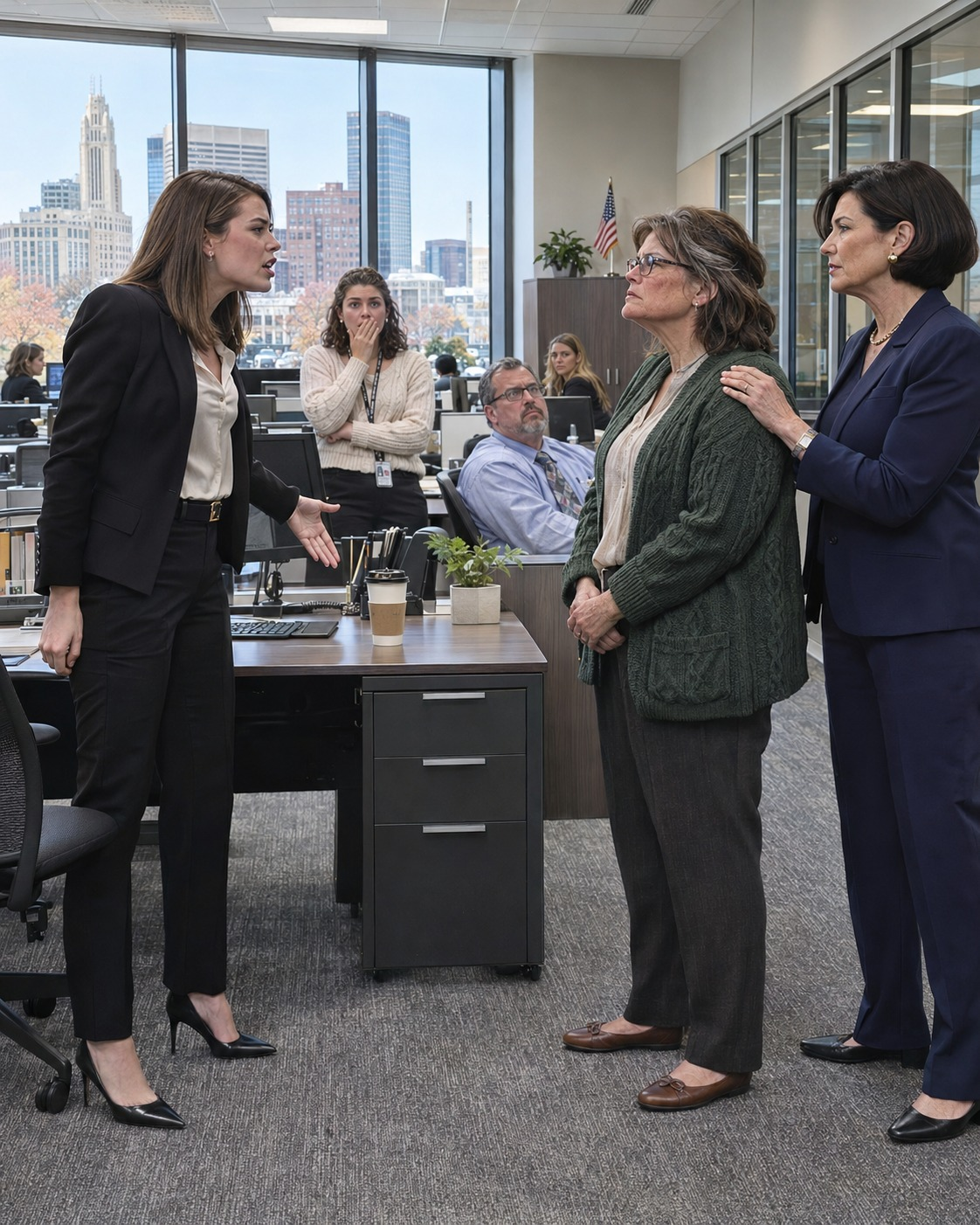
"That's my signature?"
I stared at the document.
My name appeared beneath the authorization clause, written in the familiar handwriting I had used for decades.
But something was wrong.
I leaned closer.
The signature looked like mine.
Almost exactly.
Theodora sat beside me, her expression frozen.
Martin Ellison carefully examined the document without touching the ink.
"Ms. Halverson, do you recognize this authorization?"
"No."
Harold Whitmore shifted in his chair.
"Regina, you need to understand that this was an administrative arrangement."
I turned toward him.
"An arrangement made in my name?"
He swallowed.
"The account was established to protect the company."
"Then why was my signature used without my knowledge?"
Nobody answered.
Patricia Wells opened her folder again.
"There is something else you should examine."
She removed a photocopy of the original authorization.
"This is the version I retained before leaving the company."
Martin placed the two documents side by side.
The differences were immediately noticeable.
The original document named Regina Halverson as the primary authorized representative.
The second document contained the same name but included an additional clause allowing another representative to request transfers.
That additional representative was Owen Dunore.
I read the clause twice.
"Who added this?"
Harold looked down.
"I don't remember."
Martin's voice became firmer.
"Mr. Whitmore, these documents are materially different."
"I understand."
"Do you have an explanation?"
Harold rubbed his forehead.
"I would need to examine the original records."
Theodora leaned forward.
"You signed the original agreement. You were responsible for maintaining the financial controls. You were also responsible for the transition after Mitchell's death."
Harold nodded.
"Yes."
"Then you should know how this authorization changed."
He remained silent.
I looked at Patricia.
"Did you ever approve the revised version?"
"No."
"Did you send it to the bank?"
"No. I never saw it before today."
Martin carefully gathered the documents.
"Both versions will be submitted for independent examination. We will also obtain the bank's original records."
Theodora looked at Harold.
"Until this is resolved, you are not to access the reserve account or related financial records."
Harold appeared stunned.
"You're suspending my responsibilities?"
"Temporarily, yes."
"I've worked here eleven years."
"And this company deserves an explanation."
Harold stood.
His hands were trembling slightly.
"You're making a serious mistake."
Theodora didn't move.
"Then help us establish the truth."
He looked at me one final time.
There was something in his expression I couldn't identify.
Fear, perhaps.
Or regret.
Then he left the conference room.
I remained seated.
The signature on the second document was still in front of me.
My name.
My handwriting.
My authority.
Used to approve something I had never knowingly authorized.
Martin broke the silence.
"Regina, I recommend that you provide several original signature samples for comparison."
"How many?"
"At least ten, preferably from different years."
I nodded.
"I can arrange that."
Patricia touched my arm.
"I'm sorry."
I looked at her.
"For what?"
"For not investigating this when I first noticed the access changes."
I shook my head.
"You weren't responsible for what happened after you left."
"But I could have asked more questions."
"So could many people."
She lowered her eyes.
Theodora closed the folder.
"We'll continue this review tomorrow."
I stood.
Before leaving, I looked at Mitchell's name on the reserve account statement.
For years, I had believed that the account was simply another piece of our company's financial history.
Now it seemed to be connected to something much larger.
And I intended to understand every part of it.
That evening, I went home and searched through the filing cabinet in our study.
Mitchell had kept nearly everything.
Tax returns.
Insurance policies.
Business registrations.
Old client agreements.
Even the receipt for the secondhand Dell computer we had purchased when we started the company.
I found several documents bearing my signature.
Some were dated more than twenty years earlier.
Others were from the years after Mitchell's death.
I placed them in chronological order.
Then I compared the signatures.
The first authorization document looked like mine.
The second looked like mine.
But the signature on the disputed account modification was slightly different.
The capital R was unusually narrow.
The final stroke of my surname extended farther than I normally wrote it.
It was a subtle difference.
Someone unfamiliar with my handwriting might never notice.
But I had signed thousands of documents.
I knew my own signature.
I photographed the documents and sent them to Martin.
Then I opened a small wooden box in the bottom drawer.
Inside were several personal items Mitchell had kept.
A fountain pen.
An old business card.
A photograph of us standing outside our first office.
And a folded piece of paper.
I recognized Mitchell's handwriting.
It was dated six months before his death.
The note contained a list of financial matters he wanted to discuss with me.
One sentence caught my attention.
"Ask Harold why the reserve account has a second authorization request."
I read it again.
Then again.
My hands became cold.
Mitchell had known about the second authorization request.
He had written it down.
But I had never seen the note before.
I sat down at the desk.
For several minutes, I couldn't move.
Had Mitchell discovered something?
Had he intended to confront Harold?
And why had nobody mentioned this document during the financial transition?
I photographed the note and sent it to Martin.
His response arrived almost immediately.
"Please preserve the original. Do not write on it or alter it. This may be important."
I placed it carefully inside a clear document sleeve.
Then I called Theodora.
She answered while I was still holding the note.
"What happened?"
"I found something Mitchell wrote before he died."
I read the sentence aloud.
She became silent.
"Does it mention Harold?"
"Yes."
"Send me a copy."
"I already sent it to Martin."
"Good."
I looked at the note.
"Theo, I think Mitchell knew something was wrong."
"Possibly."
"And nobody told me."
"We don't know that yet."
I appreciated her caution.
But I couldn't ignore what was written in front of me.
"Can you check whether Mitchell's old emails were preserved?"
"I'll ask IT."
"I want the original mailbox archive, not a reconstructed summary."
"Understood."
After we ended the call, I remained at Mitchell's desk.
I remembered the last months of his life.
He had become quieter.
He often worked late, even when I asked him to rest.
Sometimes I would find him sitting at the computer with several spreadsheets open.
When I asked what he was doing, he would say he was checking something.
I had assumed he was handling ordinary company business.
Now I wondered whether those late nights had been connected to the reserve account.
I closed the wooden box.
The next morning, I arrived at the office at seven forty-five.
Theodora had arranged a meeting with Martin and Evelyn Shaw, the forensic accountant.
Patricia was also present.
The original authorization documents were spread across the conference table.
Evelyn began with the transaction history.
"Based on the records we've received so far, the reserve account remained active after Mitchell's death."
I nodded.
"How active?"
"There were several deposits and withdrawals. Most were consistent with ordinary reserve activity."
"And the disputed transfers?"
"Those require further examination."
She displayed a spreadsheet.
Three payments had been made to accounts associated with Bright Path Staffing.
The first was the $24,000 setup payment.
The second was $18,500.
The third was $31,200.
I stared at the figures.
"That's more than seventy thousand dollars."
"Correct."
"Are these included in the $186,420?"
"Partially. The reserve transfers appear to be separate from some of the regular operating invoices."
I leaned forward.
"How much was paid in total?"
"We're still reconciling the transactions. Some payments may represent transfers between company accounts rather than external disbursements."
"Can you establish the final amount received by Bright Path?"
"Not yet."
Theodora looked concerned.
"How long?"
"Several days, assuming the bank provides the historical records promptly."
Evelyn displayed another document.
"This is the most important issue at the moment."
It was a transaction authorization.
The approval field contained Mitchell's old credential.
The request field contained Selena's employee identification.
And the administrative confirmation field contained Harold's initials.
I stared at the screen.
"Selena requested this transfer?"
"According to the metadata, yes."
"How much?"
"Thirty-one thousand two hundred dollars."
"Did she have authority to request transfers?"
"No."
"Then why was the transaction accepted?"
Evelyn explained that the system had recognized the legacy authorization credential and processed the request through the administrative arrangement.
The transaction had passed through a secondary review process that appeared to have been bypassed.
I felt my jaw tighten.
"Who bypassed it?"
"That's still being investigated."
Theodora turned toward Martin.
"Can we suspend all transfers connected to this account?"
"Yes. I've already instructed the bank to place a temporary hold pending verification of the authorization history."
I nodded.
"Good."
Evelyn closed the spreadsheet.
"There is another pattern worth mentioning."
"What?"
"The three transfers were requested shortly before the corresponding staffing invoices were approved."
I looked at the dates.
The timing was close.
Very close.
"Who approved the invoices?"
"Owen."
"And the transfers?"
"Harold's administrative credentials were used."
I looked at Theodora.
"This is no longer just a problem with one person."
She nodded.
"Agreed."
Martin made a note.
"We need to determine whether these transactions were coordinated, whether the authorizations were valid, and whether any funds were improperly diverted. We should not assume intent until we have the complete evidence."
Nobody disagreed.
But the pattern was becoming difficult to ignore.
At ten thirty, I returned to the claims floor.
Caitlyn was waiting beside my desk.
"Regina, can we talk?"
I put down my handbag.
"Of course."
She led me toward the small meeting room.
Once the door was closed, she looked at me.
"Selena has been asking questions."
"About what?"
"About the staffing invoices."
I felt my attention sharpen.
"What kind of questions?"
"She asked whether Daniel had given you his original report."
"Why?"
"I don't know. But she seemed upset when I said I hadn't seen it."
I studied her face.
"Did you tell her anything else?"
"No."
"Good."
Caitlyn hesitated.
"There's something I need to tell you."
"What?"
"Yesterday, I received an email from Owen."
She took out her phone.
The message was short.
It asked her to confirm whether she had discussed Bright Path Staffing concerns with me.
I read it.
Then I looked at her.
"What did you respond?"
"Nothing."
"Good."
She shook her head.
"Regina, I'm tired of being afraid every time my phone rings."
I understood.
"I know."
"I've worked here six years. I shouldn't have to worry about losing my job because I answered a question."
"You shouldn't."
She looked toward the window.
"Do you think Theodora knows how bad things have become?"
"She knows enough to take the investigation seriously."
"But does she know how people feel?"
I thought about that.
"Then we should make sure she hears it."
Caitlyn nodded.
I suggested that she document her concerns through the appropriate employee relations process.
She agreed.
Before leaving, she showed me another message.
This one had come from Daniel.
It read:
"I found another version of the staffing report. I think Selena changed it after the original was submitted."
I looked up.
"When did he find it?"
"Last night."
I immediately called Daniel.
He answered.
"Regina?"
"Can you come to the meeting room?"
"Right now?"
"Yes."
Five minutes later, he arrived carrying a USB drive and a printed document.
He looked nervous.
"I found the revision history."
He opened his laptop.
The original report had been prepared on a Monday.
The revised version had been modified two days later.
The changes were extensive.
Several temporary employees had been assigned additional hours.
Two names had been moved to different departments.
One employee's placement date had been changed.
And Selena's name appeared in the document properties.
"Did you authorize these changes?" I asked.
"No."
"Did you send the original report to Owen?"
"Yes."
"Do you have the email?"
He opened it.
The original attachment was still there.
I examined the timestamp.
Then I looked at the revised version.
The changes had been made after Owen received Daniel's original report.
"Who sent the revised version?"
"Selena."
"To whom?"
"Owen and Harold."
I looked at Caitlyn.
She was standing beside the table.
Neither of us spoke.
Daniel opened another email.
"This is the part I don't understand."
The message was from Harold.
It instructed Selena to ensure that the staffing totals matched the approved vendor schedule before the next reporting period.
I read it carefully.
It didn't explicitly instruct her to falsify records.
But it raised an important question.
Why was a temporary employee being asked to reconcile financial staffing records?
And why was the request coming from the senior financial controls adviser?
"Daniel, please preserve everything exactly as it is."
"I will."
"Don't edit the files."
"I won't."
I contacted Martin and informed him that additional documentation had been located.
He arranged to collect the records through the approved process.
When I returned to my desk, I noticed Selena watching me.
She quickly turned toward her computer.
At eleven forty-five, Owen emerged from his office.
He approached my workstation.
"Regina, I need to speak with you."
I looked up.
"About what?"
"Your ongoing involvement in matters outside your assigned responsibilities."
I closed the document on my screen.
"My assigned work is current."
"This isn't a discussion about your claims queue."
"Then perhaps we should have HR present."
His jaw tightened.
"That's not necessary."
"I would prefer it."
He looked toward the corridor.
Then he lowered his voice.
"You're making this situation more difficult than it needs to be."
I remained calm.
"Then let's make it easier. Please put your concerns in writing."
He stared at me.
For a moment, I thought he might say something else.
Instead, he turned and walked away.
I documented the interaction and sent it to Martin.
At two fifteen, Theodora called me upstairs.
When I entered her office, she was standing beside the window.
Martin sat at the conference table.
Evelyn had several documents open on her laptop.
"What's happened?" I asked.
Theodora pointed toward the chair.
"We received the bank's first response."
I sat down.
Evelyn turned her screen toward me.
The document showed the original reserve account authorization history.
The account had been modified after Mitchell's death.
A new administrative representative had been added.
The change was processed using the old authorization credentials.
But the request had not come from me.
It had come from an external terminal.
Martin pointed toward the transaction details.
"We've traced the terminal identification to a workstation that was registered to the company's former accounting department."
I stared at the screen.
"Harold's office?"
"Yes."
Theodora folded her arms.
"That establishes where the request originated. It doesn't establish who physically entered it."
I nodded.
"Understood."
Evelyn opened another record.
"There's also an account access log from the same period."
The first entry showed Harold's credentials.
The second showed a transfer request.
The third showed an approval using Mitchell's old authorization.
Then came another entry.
A change to the account's contact information.
I read the name.
It was not Harold's.
It was not mine.
It belonged to Owen.
I looked up.
"Was he employed here at the time?"
Theodora shook her head.
"No."
Martin examined the date.
"That's what makes this particularly important."
I looked at the screen again.
Owen's name appeared in a record created before his official employment with our company.
Theodora sat down.
"Someone may have been arranging his access before he joined us."
"Who?" I asked.
Nobody answered.
Evelyn opened the final attachment.
It was a scanned authorization letter.
The signature appeared beneath a statement confirming that Owen Dunore could act as an administrative representative for the reserve account.
I recognized the handwriting immediately.
It was mine.
But this time, I noticed something else.
The document carried a date.
A date when I had been in another state attending a medical appointment with Mitchell.
I remembered that week clearly.
I had been away from Columbus for four days.
And I had never signed any company paperwork during that trip.
I looked at Martin.
"Who submitted this document?"
He examined the metadata.
"The archived file indicates it was uploaded by Harold Whitmore."
Theodora closed her eyes.
Then she opened them.
"Martin, I want every record connected to this authorization preserved."
"Already arranged."
I stared at the signature.
Someone had used my name to grant Owen access to Mitchell's reserve account before Owen officially joined the company.
And suddenly, I understood why the disputed paperwork had been so carefully hidden.
But before I could say anything, Evelyn opened one final page.
It was a bank notification sent to the original account holder.
The recipient field contained my name.
The date was several years earlier.
And beside the notification status was a single word:
DELIVERED.
I looked at the address listed beneath it.
It wasn't my home.
It wasn't the office.
It was an address I had never seen before.
Martin enlarged the document.
Then he turned toward me.
"Regina, do you recognize this address?"
I stared at the screen.
Because the address belonged to a private mailbox registered under my husband's name.






Comments 0