The kitchen floor disappeared beneath Caleb's feet.
"Elias!"
Rebecca Whitcomb's scream cut through the thunder of breaking timber.
Elias Vance lunged forward.
The boy dropped as the boards split apart, his mother's brass lantern flying from his hand.
For one terrible second, Elias saw nothing but darkness beneath his son.
Then Caleb caught the edge of a broken floor joist.
His small fingers clung to the wood.
"Papa!"
Elias threw himself onto the remaining boards.
His injured ankle struck the floor.
Pain shot up his leg.
He barely felt it.
"Hold on, Caleb!"
The boy's face appeared through the dust.
His eyes were wide with terror.
Below him, black water rushed through the ruined lower passage.
The current struck the stone walls with enough force to shake the farmhouse.
Elias stretched his arm into the opening.
"Give me your hand!"
Caleb tried.
His fingers slipped.
A broken board fell into the water.
The boy cried out.
"Elias, move!" Walter Briggs shouted.
The older rancher dropped beside him.
Daniel Mercer seized Elias's belt from behind.
Thomas Hale grabbed Walter's coat.
Together, the men formed a human chain across the damaged floor.
Elias reached farther.
His fingertips brushed Caleb's sleeve.
"Look at me, son!"
Caleb lifted his frightened face.
"Don't look down. Look at me."
The boy nodded.
"Remember what I taught you about the cattle?"
Caleb struggled to breathe.
"When they're frightened, what do we do?"
"Stay... stay calm."
"That's right."
The floor groaned.
Dust fell from the ceiling.
Elias stretched until his shoulder burned.
"Now give me your hand."
Caleb released one hand from the broken joist.
For a moment, his body swung over the rushing water.
Then Elias caught his wrist.
"I've got you!"
Daniel pulled backward.
Walter seized Caleb's coat.
Thomas braced his boots against the wall.
Together, they dragged the boy upward.
Caleb tumbled onto the floor.
Elias wrapped both arms around him.
The boy buried his face against his father's chest.
"I thought I was going to die."
Elias held him so tightly that Caleb could barely move.
"Not today."
Another violent tremor shook the house.
Walter shouted, "We have to get out!"
Elias lifted Caleb.
"Everybody outside! North side of the yard!"
The farmhouse became a storm of movement.
Sheriff Reed rushed through the doorway, his revolver still in his hand.
"Move away from the kitchen!"
Anna gathered her child.
Thomas helped Rebecca to her feet.
Daniel guided the rescued travelers toward the front entrance.
Walter grabbed the emergency blankets.
Elias carried Caleb through the hallway.
Behind them, the kitchen floor continued to break apart.
The old stone foundation had been undermined by the floodwater.
The lower passage was no longer holding.
But the upper walls of the farmhouse remained standing.
For now.
They reached the porch.
The blizzard struck them immediately.
Snow swept across the yard.
The wind tore at their coats.
Elias lowered Caleb beside the fence.
"Stay with Walter."
The boy grabbed his arm.
"Papa, don't go back!"
Elias knelt.
"I'm not going back inside."
"Promise?"
Elias looked into his son's eyes.
"Promise."
Then he turned toward Sheriff Reed.
"Where's Pike?"
The sheriff's face was grim.
"Behind the stone wall. I saw him fall when the ground shifted."
"And the other man?"
"Still near the southern passage."
Elias looked toward the ridge.
A lantern lay broken in the snow.
Beside it, a dark figure struggled to stand.
The man's coat was torn.
His hat had disappeared.
Elias recognized him.
Otto Reinholdt's younger brother, Frederick.
He had worked at the lumber mill for years.
Elias had seen him loading wagons.
He had never suspected him of anything more serious than helping his brother keep the business running.
Now Frederick was standing beside the opened emergency passage.
And water was pouring through the broken stonework.
Sheriff Reed raised his voice.
"Frederick! Hands where I can see them!"
The man froze.
Then slowly lifted both arms.
Daniel moved toward him with the sheriff.
Walter stayed beside Caleb and the others.
Elias watched as Reed took Frederick into custody.
The man did not resist.
He looked toward the ruined farmhouse.
Then began shaking.
"I didn't know it would do that," he whispered.
The sheriff stared.
"Do what?"
Frederick swallowed.
"Samuel said it was only a door."
Elias felt anger rise.
"A door?"
Frederick looked at him.
"He said there were papers inside. Papers that could ruin his family."
"And you opened the passage?"
Frederick nodded.
"Samuel promised me money."
Elias stared at the man.
Behind them, the farmhouse groaned.
A section of the kitchen wall collapsed inward.
Frederick flinched.
"I didn't know the water was behind it."
Elias looked toward the ridge.
The floodwater was spreading across the lower pasture.
The old drainage system had finally failed.
And his home had paid the price.
Sheriff Reed secured Frederick to a fence post with a length of rope.
Then he turned toward the ridge.
"We need Pike."
Walter shook his head.
"Not if the ground's still moving."
The sheriff studied the slope.
Snow had collapsed around the southern passage.
A narrow trench had opened where the old drainage channel ran beneath the earth.
The ground was unstable.
Elias remembered every warning in Whitcomb's notebook.
He looked toward Reed.
"Don't go near the lower passage."
The sheriff nodded.
"Then we approach from the high ground."
They followed the stone fence around the northern side of the ridge.
Elias stayed back with Walter.
His ankle was badly swollen.
He could barely stand.
But he could see the sheriff and Daniel moving carefully through the snow.
They found Samuel Pike near the old cottonwood stump.
He was conscious.
His rifle lay several feet away.
One leg was trapped beneath a fallen branch.
Sheriff Reed ordered him to remain still.
Daniel removed the branch.
Pike cried out.
The sheriff secured his hands.
Then helped him onto higher ground.
When Pike saw Elias, his face twisted with hatred.
"You ruined everything."
Elias stared at him.
"No, Samuel."
He looked toward the broken farmhouse.
The flooded pasture.
The ruined barn.
The frightened people gathered beside the fence.
"You did."
Pike lowered his eyes.
For once, he had nothing to say.
The storm began weakening shortly before dawn.
Not suddenly.
Not mercifully.
But slowly, as though the valley had finally exhausted the sky.
The wind dropped.
The snow thinned.
The first gray light appeared beyond the eastern hills.
Elias stood beside the damaged farmhouse.
Caleb held his hand.
The boy's lantern lay somewhere beneath the broken kitchen floor.
Elias knew he could not retrieve it yet.
The house was unsafe.
The lower passage remained flooded.
The cattle were cold.
The people they had rescued were exhausted.
And the ranch looked as though a giant hand had torn it apart.
But everyone who had been inside the farmhouse was alive.
That mattered more than anything else.
Sheriff Reed approached.
"Samuel and Frederick are secured. Daniel's taking them to the county office as soon as the road opens."
Elias nodded.
"What about the people from the eastern road?"
"Walter and Thomas are organizing a search. The wind's finally light enough to travel."
Elias looked toward the pasture.
His eleven cattle stood together near the temporary windbreak.
Mercy.
Daisy.
Martha.
June.
Hazel.
And the six others.
All alive.
He counted them twice.
Eleven.
Then he looked toward Walter.
"What about your eight?"
The older man lowered his head.
Elias felt his stomach tighten.
"Walter?"
The rancher swallowed.
"I went back with Daniel before sunrise."
Elias waited.
Walter looked up.
"All eight are alive."
Elias closed his eyes.
The relief was almost unbearable.
"They're cold," Walter continued. "One's limping. But they're alive."
Elias gripped his shoulder.
"Thank God."
Walter nodded.
Then looked toward the ruined barn.
"We're going to need a better shelter."
Elias followed his gaze.
The red doors were gone.
The roof had collapsed.
The lower chamber was flooded.
The ground around the entrance had shifted.
The structure he had built was beyond saving.
He knew it.
Walter knew it.
And for the first time, Elias did not feel compelled to argue.
"Yes," he said.
"We are."
By midday, neighbors began arriving.
Some came on horseback.
Others brought wagons.
A few walked through the snow carrying blankets and food.
News had spread through the valley.
The bridge was damaged.
Several barns had collapsed.
The eastern road had trapped travelers.
But the storm was finally passing.
And people were searching for one another.
Daniel returned with Thomas's grandfather.
The old man had survived beneath the remaining section of his roof, wrapped in quilts beside a small stove.
Thomas embraced him so tightly that the old man laughed through his tears.
Anna's husband was found with two other travelers beside an overturned wagon.
They had sheltered behind a rocky embankment.
When Anna saw him coming through the snow, she ran across the yard with her child in her arms.
The family fell together in the snow.
Elias watched from the porch.
He felt something loosen inside his chest.
For days, he had feared the valley would become a place of loss.
Now he watched people return to one another.
Not everyone had escaped without injury.
Several families had lost livestock.
Homes had been damaged.
Food stores had been ruined.
But the neighbors were alive.
And they had begun helping one another.
The sheriff returned two days later.
He brought a county surveyor, two experienced builders, and a magistrate's representative.
They examined the ruined ridge.
The damaged farmhouse.
The old drainage system.
And the surviving upper storage chamber.
The surveyor studied Whitcomb's notebook for hours.
Then he called Elias aside.
"Your original idea wasn't wrong."
Elias looked at him.
"The barn?"
The man nodded.
"An earth-sheltered livestock building can work very well here."
Elias glanced toward the collapsed entrance.
"Mine didn't."
"Because the lower water system was disturbed."
The surveyor pointed toward the drawings.
"Whitcomb understood the separation between the shelter and the drainage channel. His upper chamber was built on stable ground. The dangerous section was the lower passage."
Elias nodded.
"I know that now."
The surveyor looked toward the southern slope.
"There is another location farther east. Higher ground. Solid rock beneath the surface. No underground water channel."
Elias followed his gaze.
The slope was less dramatic.
Less sheltered.
But safer.
The surveyor continued.
"If you build there, with proper foundations, drainage, ventilation, and structural supports, you could have the barn you wanted."
Elias stared at the hillside.
For weeks, he had been obsessed with the warmest part of the ridge.
He had believed the answer lay in digging deeper.
Now he understood that warmth was useless without safety.
He looked toward the surveyor.
"Then that's where we'll build."
The original land agreement was found three days later.
Not beneath the flooded lower passage.
Not behind the damaged kitchen floor.
But inside the dry upper storage chamber.
The builders entered through the safely inspected southern access after the water had receded and the stonework had been secured.
They found the western wall marked in Margaret's drawing.
Behind a loose stone lay a small iron box.
Inside were folded documents wrapped in oilcloth.
The original land agreement.
Whitcomb's construction records.
And several letters describing the dispute over the spring.
Sheriff Reed examined the papers.
The magistrate's representative compared the signatures with the county records.
The documents confirmed what Rebecca had told them.
The spring belonged to the Vance property, subject to longstanding shared-use rights for neighboring farms.
The Pike family had no exclusive claim.
And the records showed that Jonah Whitcomb had repeatedly warned county officials about attempts to block the lower drainage outlet.
The discovery changed everything.
Samuel Pike's fraudulent livestock contract was no longer an isolated attempt to steal cattle.
It was part of a broader effort to force Elias from his land.
The forged documents.
The diverted lumber.
The pressure to sell.
The deliberate interference with the old drainage mechanism.
All of it pointed toward the same purpose.
Pike had wanted the ranch.
And he had been willing to destroy it to get what he wanted.
The legal proceedings took several weeks.
Samuel Pike was convicted of fraud, conspiracy, and the deliberate destruction of property.
Frederick Reinholdt testified about the attempt to open the southern passage.
Otto Reinholdt admitted his role in the fraudulent lumber transaction and cooperated with the investigation.
His testimony helped establish Pike's plan.
The court ordered restitution.
Pike's assets were used to compensate Elias and other victims.
Otto lost control of the mill pending the settlement of his debts.
The stolen lumber was legally confirmed as Elias's property.
And the fraudulent bill of sale for the eleven cattle was declared void.
Elias stood outside the courthouse when the final decision was announced.
Walter stood beside him.
Caleb held his father's hand.
For a long moment, Elias said nothing.
Then Walter asked, "How does it feel?"
Elias looked toward the distant mountains.
"Like I can finally breathe."
Walter smiled.
"That's a good start."
The rebuilding began in early spring.
The valley had survived the winter, but the damage remained visible everywhere.
Broken fences.
Collapsed sheds.
Flooded fields.
Scarred roads.
Elias had lost much of his farmhouse.
The underground barn was gone.
The old drainage passage had been permanently secured under the supervision of the county surveyor.
But the ranch itself remained his.
And this time, he would not rebuild alone.
Walter arrived with timber.
Daniel brought stone.
Thomas brought tools.
The county builders helped lay the foundations.
Neighbors who had sheltered at the Vance farmhouse during the storm came with wagons, food, and willing hands.
Some worked for wages.
Others refused payment.
One woman brought bread every morning.
Another repaired the damaged fences.
A blacksmith donated hinges for the new barn doors.
A carpenter offered to build the feeding troughs.
Elias watched the work begin.
He felt humbled.
He had once believed that being a good father meant carrying every burden himself.
Now he understood that strength could also mean accepting help.
The new barn was different.
It was built into the stable eastern slope.
Not deep underground.
Not near the old drainage channel.
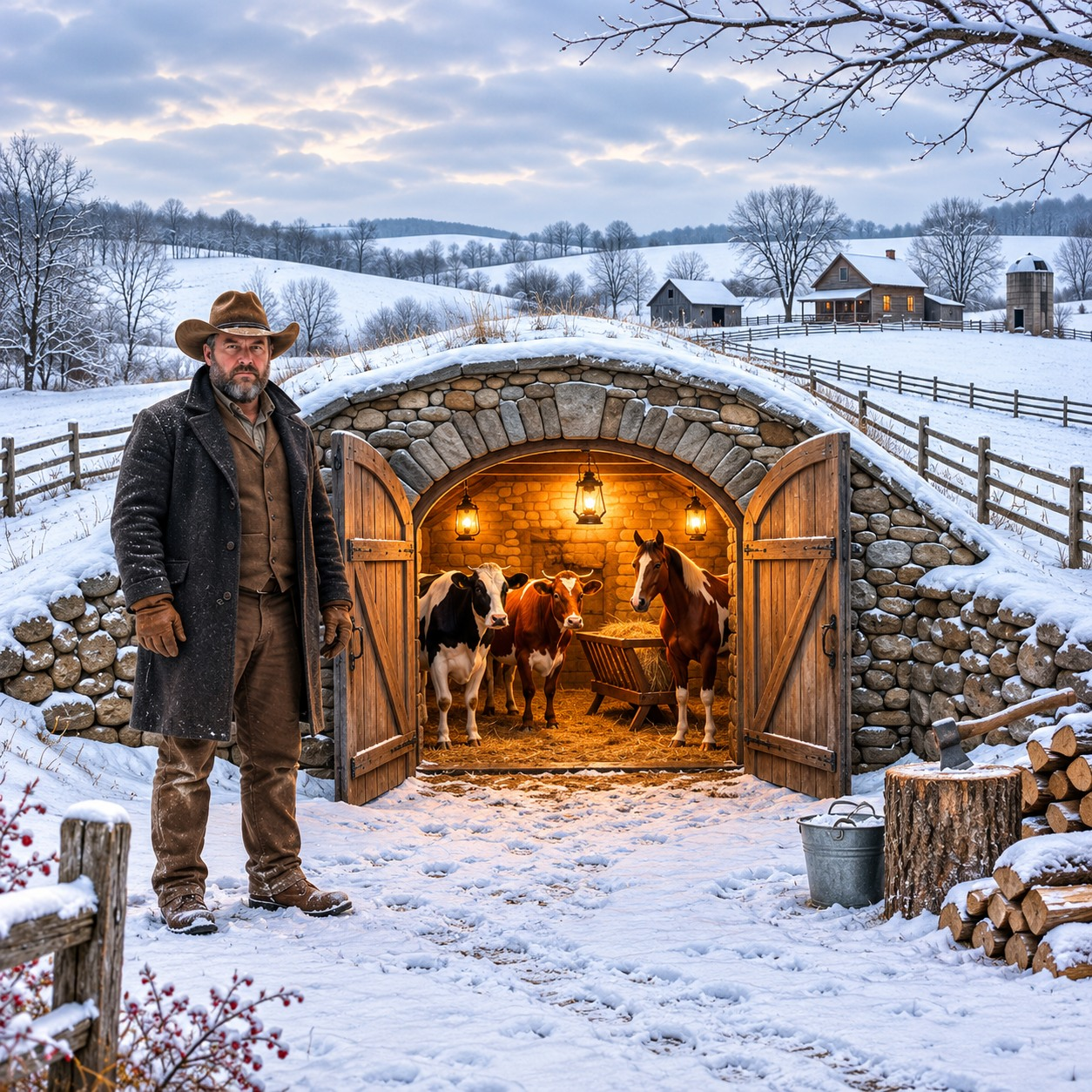
Its stone walls were thick.
Its foundation rested on solid ground.
The floor was raised and drained.
Heavy timber beams supported the roof.
Ventilation openings allowed fresh air to circulate.
The earth-covered rear wall provided insulation.
And the southern entrance faced the winter sun.
The builders followed the county surveyor's recommendations.
They checked every support.
Every joint.
Every drainage channel.
Elias refused to rush.
When the weather turned wet, they stopped.
When the ground needed time to settle, they waited.
When a beam showed a flaw, they replaced it.
Caleb watched everything.
He helped measure boards.
Carried nails.
Sorted tools.
And recorded the progress in a small notebook.
One afternoon, he stood beside his father and looked at the rising walls.
"Papa?"
Elias smiled.
"Yes?"
"Is this the barn Mama wanted?"
Elias looked toward the structure.
Then toward the old drawing he kept folded in his pocket.
"I think so."
Caleb considered that.
"She wanted red doors."
Elias laughed softly.
"Then red doors it is."
By late summer, the barn was finished.
It was not the grandest building in the valley.
It did not have the tallest roof.
Or the finest windows.
But it was strong.
Dry.
Warm in winter.
Cool in summer.
And large enough for all eleven cattle.
The doors were painted a deep, bright red.
Above them, Caleb helped carve a wooden sign.
MARGARET'S BARN
Elias stood beneath the sign for a long time.
He traced the letters with his fingers.
Then closed his eyes.
He remembered Margaret's laughter.
Her hands covered in flour.
The way she stood beside the pasture fence at sunset.
The plans she had drawn.
The future she had wanted for their son.
He wished she could have seen it.
But perhaps, in some way, she already had.
Her drawing had guided the design.
Her letter had helped him understand the dangers.
Her hidden records had protected the land.
And her love had remained present through every difficult decision.
Caleb stepped beside him.
"Papa?"
Elias looked down.
"Yes?"
"Can we bring the cows in now?"
Elias smiled.
"Let's do it."
Mercy entered first.
She sniffed the fresh straw.
Then walked calmly toward the feeding trough.
Daisy followed.
Then Martha.
The old cow had recovered slowly after the winter storm.
Her legs were stiff.
She moved carefully.
But she was alive.
And when she stepped into the new barn, Caleb laughed with delight.
"Look, Papa! She likes it!"
Elias watched Martha settle beside the others.
June and Hazel entered next.
The remaining cattle followed.
One by one.
Until all eleven stood beneath the strong timber roof.
Elias counted them.
Once.
Then again.
Eleven.
Every one of them.
Caleb stood beside him.
"Did we do it?"
Elias looked around.
The stone walls.
The dry floor.
The wide feeding troughs.
The ventilation openings.
The heavy beams.
The red doors.
Then he looked at his son.
"Yes."
His voice trembled.
"We did."
The following winter came quietly.
Snow fell across the valley.
The mountains turned white.
The creek froze along its edges.
But the new barn stood firm.
Inside, the cattle remained dry and sheltered.
The air was cool but comfortable for the animals.
The ventilation worked.
The drainage remained clear.
And the roof carried the weight of the snow without complaint.
Elias checked the barn every morning.
Not because he expected disaster.
But because he had learned that caring for something meant paying attention long after the work was finished.
Walter visited often.
Sometimes he brought coffee.
Sometimes he brought stories.
Sometimes he simply stood beside Elias and watched the cattle.
One cold afternoon, he looked toward the red doors.
"Remember when I told you that you were digging graves?"
Elias smiled faintly.
"I remember."
Walter shook his head.
"I've never been so glad to be wrong."
Elias looked toward the barn.
"You weren't wrong about everything."
Walter raised an eyebrow.
Elias continued.
"I needed to be more careful. I needed help. And I needed to listen."
Walter nodded.
Then smiled.
"Well, you finally learned."
Elias laughed.
"So did you."
The farmhouse was rebuilt before Christmas.
The kitchen stood on a new, properly inspected foundation.
The old flooded passages beneath it had been isolated and sealed.
The upper storage chamber remained accessible through a reinforced entrance, but it was no longer connected to the dangerous lower water system.
The county surveyor certified the repairs.
The house was safe again.
And in the center of the kitchen, beside the stove, stood Margaret's brass lantern.
It had been recovered from the debris after the flood.
The glass was broken.
The handle was bent.
But the brass frame had survived.
Elias repaired it himself.
He replaced the glass.
Straightened the handle.
Polished the base.
Then placed Margaret's letter inside a small wooden box beside it.
Caleb helped him.
The boy read the letter often.
Not because it made him sad.
But because it reminded him that his mother had loved him enough to think about his future even when she knew she might not be there to see it.
One evening, Caleb sat beside the stove.
"Papa?"
Elias looked up from his book.
"Yes?"
"Do you think Mama would be proud of us?"
Elias closed the book.
He looked toward the lantern.
Then toward the window, where the red barn doors glowed faintly in the evening light.
"I know she would."
Caleb smiled.
Then leaned against his father's shoulder.
On Christmas morning, the valley gathered at the Vance ranch.
Walter came with Mary.
Daniel brought his family.
Thomas arrived with his parents and grandfather.
Rebecca Whitcomb traveled from town.
Sheriff Reed joined them after completing his morning rounds.
Anna came with her husband and child.
The people who had survived the storm stood together inside the new barn.
They brought food.
Music.
Stories.
And laughter.
The children ran between the stalls.
The adults gathered near the entrance.
Walter stood beside Elias.
He looked around at the crowd.
"Quite a place you've built."
Elias smiled.
"Quite a few people helped."
Walter nodded.
Then raised his voice.
"Everybody!"
The conversations quieted.
Walter stepped forward.
"I want to say something."
Elias frowned.
"Walter—"
The older man ignored him.
"A year ago, I stood on this ranch and laughed at a man who was digging a barn into a hillside."
Several neighbors smiled.
Walter continued.
"I called it a grave."
His voice grew quieter.
"I told him he'd lose every animal he owned."
He looked toward Elias.
"But when the worst storm of our lives came, and my own barn collapsed, I came here begging him to open his doors."
The crowd fell silent.
Walter swallowed.
"He did."
Elias looked down.
Walter continued.
"He didn't ask whether I'd mocked him. He didn't remind me of the things I'd said. He just helped."
The older man's eyes filled.
"And when the valley needed shelter, he opened his home to strangers."
He looked around.
"Some of us are standing here today because Elias Vance refused to close his door."
For a moment, nobody spoke.
Then Daniel began clapping.
Thomas joined him.
Soon the entire barn was filled with applause.
Elias stood motionless.
He had never wanted a speech.
He had never wanted praise.
He had only wanted to keep his cattle alive.
To protect his son.
To honor his wife's dream.
But as he looked around at the people gathered beneath the strong roof, he understood that the barn had become something larger than he had imagined.
Not a monument to his stubbornness.
Not proof that he had been right about everything.
A place built through patience, knowledge, and the kindness of people who had learned to trust one another.
Caleb slipped his hand into his father's.
Elias looked down.
The boy smiled.
"You did good, Papa."
Elias knelt.
He pulled Caleb into his arms.
"No, son."
He looked around the barn.
"We did."
That evening, after the guests had gone, Elias and Caleb made one final visit to the barn.
Snow fell gently outside.
The red doors stood beneath the winter sky.
Inside, the eleven cattle rested quietly.
Mercy lay near the feeding trough.
Daisy stood beside her.
Martha had settled into the deepest straw.
The younger animals breathed softly in the warm, sheltered air.
Caleb walked slowly between the stalls.
He touched Mercy's neck.
Then Daisy's.
Then Martha's.
Elias watched him.
The boy had grown taller.
Stronger.
More confident.
The fear that had once lived in his eyes had softened.
He still remembered the collapses.
The flood.
The terrible nights.
But those memories no longer defined him.
He had seen his father make mistakes.
He had seen him admit them.
He had seen neighbors become friends.
And he had learned that courage did not mean never being afraid.
It meant doing what was right while respecting the dangers around you.
Caleb returned to his father.
"Papa?"
"Yes?"
"Do you think we'll ever have another storm like that?"
Elias looked toward the snow.
"Maybe."
The boy considered that.
"Will the barn be ready?"
Elias looked around.
He checked the beams.
The stone walls.
The drainage.
The ventilation.
The heavy red doors.
Then he smiled.
"Yes."
Caleb nodded.
"Good."
They stood together for a moment.
Then Elias reached for the lantern hanging beside the entrance.
Margaret's lantern.
Its brass frame gleamed in the warm light.
He lifted it carefully.
Caleb looked up.
"Can I carry it?"
Elias smiled.
"Of course."
He handed the lantern to his son.
The boy held it with both hands.
Then they walked toward the doors.
Elias paused at the threshold.
He looked back one final time.
Eleven cattle.
Safe.
Warm.
Alive.
The barn was finished.
The ranch was secure.
The people he loved were safe.
And the dream Margaret had left behind had finally become real.
Caleb stepped into the snow.
"Come on, Papa."
Elias smiled.
"I'm coming."
He closed the red doors.
The latch settled firmly into place.
Then he took his son's hand.
Together, they walked toward the farmhouse.
Warm light glowed in the windows.
Smoke rose from the chimney.
Fresh snow covered the fields.
And above the barn entrance, the carved wooden sign stood beneath the winter stars.
MARGARET'S BARN
The wind moved softly across the valley.
Inside the barn, the cattle slept.
Inside the farmhouse, the fire waited.
And for the first time in a long while, Elias Vance did not fear what winter might bring.
He had kept his promise.
To Margaret.
To Caleb.
And to the eleven animals that had been all he had left.
He opened the farmhouse door.
Caleb stepped inside.
The boy placed his mother's lantern beside the stove.
Then turned toward his father.
"Good night, Papa."
Elias smiled.
"Good night, son."
Caleb disappeared into his bedroom.
Elias stood alone for a moment.
He looked at Margaret's letter.
Then at the lantern.
Then toward the window, where the red barn doors were barely visible through the falling snow.
He spoke softly.
"We did it, Margaret."
The fire crackled.
The house was warm.
And outside, beneath the quiet winter sky, the barn stood strong.






Comments 0