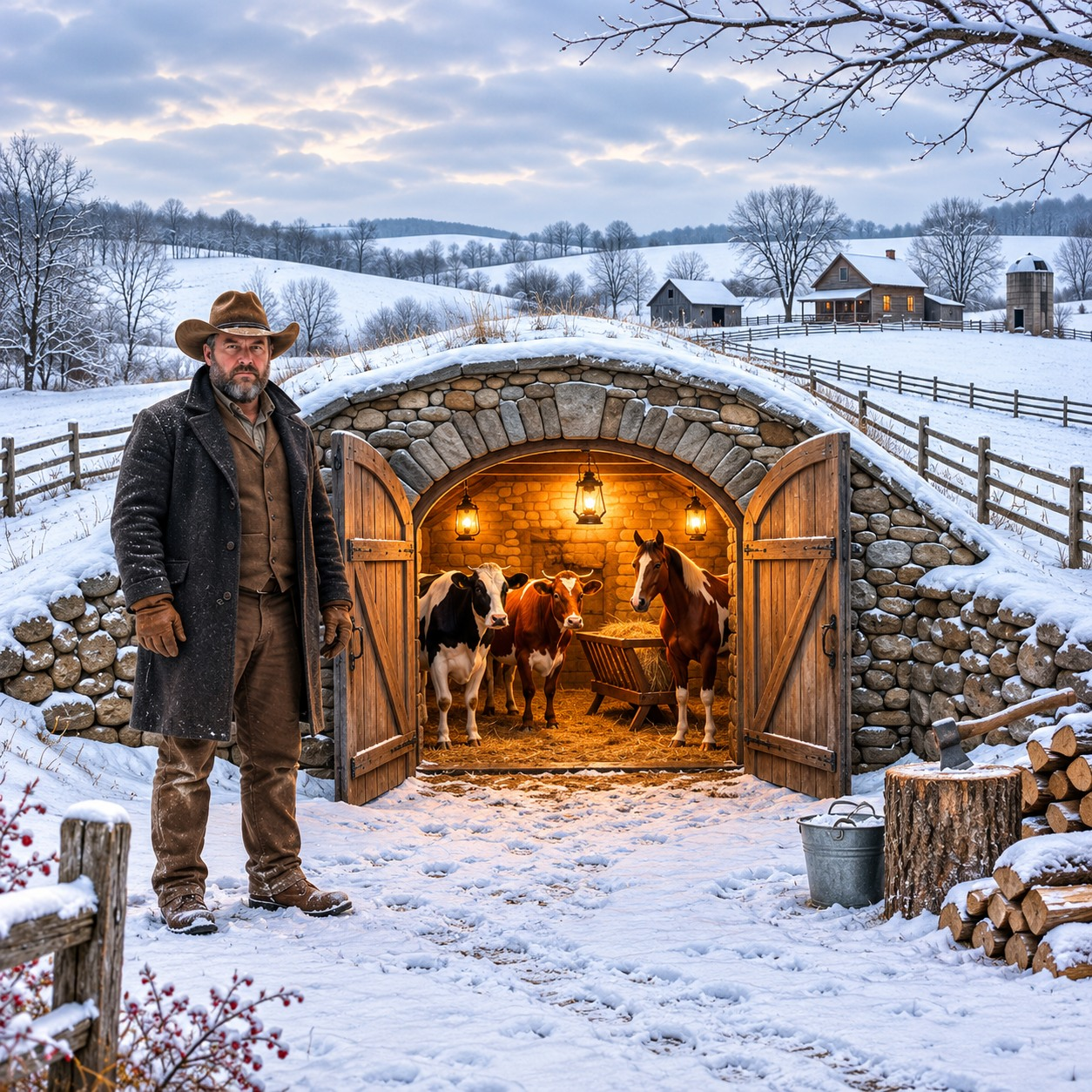
"Elias Vance."
The whisper came from the other side of the iron-bound door.
Elias stood motionless at the bottom of the hidden staircase.
Above him, Caleb held his mother's brass lantern, its trembling light spilling across the old wooden steps.
"Papa?" the boy called.
Elias raised one hand.
"Stay where you are."
The whisper came again.
"Elias."
This time, it sounded thinner.
Almost like the wind passing through a narrow crack.
Elias tightened his grip on the door handle.
"Who's there?"
No answer.
He waited.
Then came three slow knocks.
The same three knocks he had heard beneath the frozen ridge.
The same sounds that had preceded the collapse of his first excavation.
His heart began pounding.
He turned the handle.
The iron mechanism resisted.
Then moved.
Elias pulled.
The door opened an inch.
A cold draft rushed past his face.
The lantern flame flickered.
He pulled harder.
The hinges groaned.
Beyond the doorway lay a narrow stone chamber.
A wooden desk stood against the far wall.
Shelves lined one side.
Old papers lay scattered across the floor.
And directly ahead, a rusted iron pipe protruded from the stonework.
The pipe trembled.
Then it made three hollow knocks.
Elias stared.
A faint scraping sound followed.
Wind moved through the pipe, carrying a strange, broken echo.
He let out a breath.
There was no stranger waiting behind the door.
No hidden intruder.
Only an old chamber connected to the air passages beneath the ridge.
But that did not explain why the sound had seemed to speak his name.
Elias stepped closer.
A loose metal plate hung beside the pipe.
As the draft shifted, it scraped against the stone.
The noise rose and fell.
A thin, wavering sound.
Almost human.
Almost a voice.
Then Caleb called again.
"Papa, please come back."
Elias turned.
His son stood at the top of the staircase, frightened and pale.
Elias looked once more into the chamber.
Then he stepped backward.
"I'm coming."
He closed the door.
And climbed toward the light.
Caleb did not speak until his father reached the kitchen.
Then he threw his arms around Elias's waist.
"I heard somebody."
"I know."
"Was there a man?"
"No."
"Then who said your name?"
Elias hesitated.
He could not honestly explain the sound.
He had heard it clearly.
Or believed he had.
But the old pipe and loose metal plate could have made a strange echo.
He had been tired.
Frightened.
And expecting danger.
"There's an old air passage down there," he said. "The wind makes sounds through it."
Caleb looked unconvinced.
"It sounded like Mama calling you."
Elias went still.
Margaret.
For one terrible moment, the kitchen seemed to lose its warmth.
He remembered her voice.
The way she called him from the porch when supper was ready.
The way she laughed when Caleb spilled flour across the table.
The quiet way she said his name during the final days of her illness.
Elias knelt.
"Caleb, your mother isn't down there."
"I know."
The boy's eyes filled.
"I just wish she was."
Elias pulled him close.
"So do I."
They remained together beside the stove while the wind moved through the walls of the old farmhouse.
Eventually, Caleb stepped back.
"Are you going to open that door again?"
Elias looked toward the hidden staircase.
"Yes."
The boy stiffened.
"But not alone," Elias added. "And not tonight."
By morning, Elias had made a decision.
He would not enter the underground chamber without help.
The first excavation had nearly killed him.
The second had nearly killed Caleb.
Whatever lay beneath the farmhouse would be approached differently.
He sent Caleb to Walter Briggs's ranch with a written message.
The boy rode a small, steady pony named Button, following the packed road between the properties.
Elias watched him disappear beyond the fence.
Then he returned to the kitchen.
The square trapdoor remained closed.
He had placed a heavy chair over it.
The old survey lay on the table.
He studied the line connecting the farmhouse to the buried stone chamber.
It was not a straight passage.
It curved around the northern side of the property before joining the drainage system beneath the ridge.
The line was faint.
Almost invisible.
But now Elias understood something important.
The underground structure was larger than he had imagined.
It was not merely a chamber for livestock.
It was a network.
Air passages.
Water channels.
Storage rooms.
Perhaps even a service tunnel.
Someone had spent years constructing it.
Someone who understood the land far better than Elias did.
And somewhere inside those old walls might be the notebook Jonah Whitcomb had left behind.
Walter arrived before noon.
Daniel Mercer came with him.
Thomas Hale followed shortly afterward.
Elias showed them the hidden staircase.
Walter stared at the open floor.
"Well, I'll be damned."
Daniel crouched beside the trapdoor.
"How long's this been here?"
"Longer than I've owned the house."
Thomas leaned closer.
"Did you go down?"
"Only to the doorway."
Walter looked at him sharply.
"Alone?"
Elias nodded.
The older man sighed.
"Elias."
"I didn't enter the chamber."
"That's something."
Daniel examined the staircase.
"The wood looks old."
"It is."
"Could be rotten."
"That's why I asked you here."
Walter gave a small nod.
"Good."
They began by testing the stairs from above.
Daniel used a long pole to press against each step.
Several creaked.
One near the bottom cracked under pressure.
They marked it and avoided putting weight on it.
Thomas fetched rope.
Walter opened the windows to allow fresh air into the kitchen.
Elias watched carefully.
He remembered the damp smell rising from below.
Old enclosed spaces could hold dangerous air.
The men agreed not to descend until they had checked the chamber as safely as possible.
They lowered a lantern on a rope.
Its flame remained steady.
But Daniel warned that a burning lantern could not prove the air was safe.
They waited while air circulated through the opened trapdoor.
Then they lowered a second lantern and examined the room from the stairs.
No movement.
No falling stones.
No visible water.
The chamber appeared stable.
Still, Elias insisted they work slowly.
Walter looked at him.
"You're learning."
Elias gave a tired smile.
"Pain's a good teacher."
They entered one at a time.
Daniel went first.
Walter followed.
Elias came third, using his cane carefully.
Thomas remained above with Caleb.
The chamber was smaller than Elias had expected.
Perhaps twelve feet long and eight feet wide.
Its walls were built from fitted stone.
Heavy timber beams supported the ceiling.
A narrow iron pipe ran along one wall.
Several wooden shelves had collapsed.
Dust covered everything.
The desk stood beneath a small ventilation opening.
Daniel examined the roof.
"Whoever built this knew his trade."
Walter ran a hand along the stonework.
"Look at these joints."
Elias approached the desk.
A leather-bound book lay beneath a pile of papers.
He lifted it carefully.
The cover was stiff.
The pages had yellowed.
On the first page, written in faded black ink, were the words:
Jonah Whitcomb — Winter Works and Drainage Records.
Elias felt his breath catch.
He had found it.
The notebook.
The one Thomas's grandfather remembered.
The one that might explain the strange warmth beneath the ridge.
He opened it.
The first pages contained measurements.
Stone thickness.
Timber spacing.
Drainage depths.
Then came sketches of the hillside.
A chamber.
A water channel.
A ventilation shaft.
And a wide entrance facing south.
Elias stared.
The drawing was almost identical to the shelter he had been trying to build.
Except Whitcomb's version was far more detailed.
And far more carefully supported.
Walter leaned beside him.
"What's that?"
Elias pointed.
"The original livestock chamber."
Daniel looked over his shoulder.
"That's a barn."
Elias nodded.
"An underground one."
For several seconds, nobody spoke.
Then Walter said quietly, "So you weren't the first fool in this valley."
Elias laughed.
It was the first genuine laugh he had managed in days.
"No."
He turned another page.
"And maybe the first one knew how to make it work."
They carried the notebook upstairs.
Caleb stood beside the table while Elias opened it.
The boy's eyes widened at the drawings.
"Papa, that's our barn."
Elias nodded.
"Almost."
Caleb leaned closer.
"Did Mr. Whitcomb have cows?"
"Looks like he did."
"How many?"
Elias turned a page.
A list appeared beneath a drawing of the chamber.
Fourteen cattle.
Two horses.
Six sheep.
Caleb stared.
"That's more than us."
"Yes."
"And they all fit?"
"Apparently."
The boy smiled.
"Then ours can too."
Elias looked at him.
The simple faith in his voice was almost painful.
Caleb had seen two collapses.
He had watched his father dragged from falling earth.
He had heard neighbors call the shelter a grave.
Yet he still believed it could work.
Elias placed a hand on his shoulder.
"We're going to study these plans before we do anything else."
Caleb nodded.
"Because Mama would want it safe."
"Exactly."
For the next several hours, the men examined Whitcomb's notebook.
They discovered that the original chamber had been built into the ridge more than thirty years earlier.
Whitcomb had chosen the site because the earth remained relatively warm during winter.
But the warmth did not come from a mysterious underground fire.
It came from the ground's stable temperature, the protection of the hillside, and air moving through deep passages where it was less exposed to freezing wind.
The watercourse beneath the ridge also influenced the temperature.
Whitcomb had designed stone channels to carry that water away from the livestock floor.
He had built a raised platform for the animals.
Heavy beams supported the roof.
Ventilation shafts allowed damp air to escape.
And a thick outer wall separated the barn from the lower drainage passage.
Elias studied the drawings.
He saw mistakes he had made.
His first excavation had cut too close to the water channel.
His second had placed too much weight on a poorly supported entrance.
The split roof beam had been salvaged timber with a hidden weakness.
He had built too quickly.
Trusted too much.
And measured too little.
Whitcomb's notebook made the failures painfully clear.
Walter watched him.
"You're quiet."
Elias looked up.
"I was wrong about a lot of things."
Walter nodded.
"That happens."
"I nearly got Caleb killed."
The older man said nothing.
Elias looked toward the boy.
Caleb was helping Thomas sort the drawings.
"I thought if I worked hard enough, I could force the barn into existence."
Walter sat beside him.
"Hard work matters."
"I know."
"But knowing when to stop matters too."
Elias nodded slowly.
Walter tapped the notebook.
"Now you've got something better than a guess."
Elias looked down.
A plan.
A tested design.
And a warning from a man who had already learned the dangers of the ridge.
Near the back of the notebook, Elias found a page marked with a thick black line.
The handwriting was darker.
More hurried.
He read aloud.
"The lower passage must remain sealed during severe frost. Ice can block the outlet and force water backward into the chamber."
Daniel leaned closer.
"That's what happened to you."
Elias nodded.
He continued reading.
"The upper ventilation shafts may remain open, but the drainage gate must not be disturbed until spring thaw."
Walter frowned.
"Drainage gate?"
Elias turned the page.
A drawing showed a heavy iron mechanism beneath the ridge.
It controlled the flow of water through a narrow stone channel.
The gate could be raised or lowered.
But Whitcomb had written a warning beside it.
Never open the gate when the lower outlet is frozen.
Elias stared.
The iron latch he had seen moving beneath the snow.
The metallic scraping.
The sudden rush of water.
He had assumed the old door led only into a chamber.
Now he wondered whether part of the structure had been connected to the drainage mechanism.
If the gate had shifted during the storm, it might explain the pressure that damaged the hillside.
Daniel studied the drawing.
"That could be trouble."
Walter nodded.
"Especially if ice is blocking the outlet."
Elias looked toward the window.
The snow outside had begun to fall again.
Not heavily.
But steadily.
Winter was tightening its grip on the valley.
And the old drainage system beneath his land was still active.
That evening, Sheriff Reed arrived with unexpected news.
He brought a wagon.
Behind it were two more wagons loaded with lumber.
Elias stepped onto the porch.
For a moment, he could only stare.
The sheriff climbed down.
"The magistrate signed an emergency release."
Elias looked at the wagons.
"That's my timber?"
"Most of it."
Walter came outside.
Daniel followed.
The sheriff handed Elias a document.
"The county has confirmed your purchase. Samuel Pike's claim to these boards has been rejected pending the fraud proceedings."
Elias stared at the paper.
He had imagined this moment so many times.
The lumber arriving.
The barn finally becoming possible.
Margaret's dream taking shape.
But now, standing in the snow, he felt something different from triumph.
Relief.
Deep, exhausting relief.
"Thank you," he said.
Sheriff Reed nodded.
"Don't thank me yet. Reinholdt's still missing, and Pike hasn't told us everything."
Elias looked up.
"What do you mean?"
The sheriff hesitated.
"We found letters between them. It appears they expected you to sell the herd before winter."
Walter's expression darkened.
"Why?"
"Because they believed you couldn't shelter the animals."
Elias looked toward the ridge.
The unfinished entrance.
The collapsed roof.
The dark earth beneath the snow.
For weeks, the men had been right about one thing.
He had not been ready.
But they had mistaken his desperation for surrender.
The sheriff continued.
"Pike may have planned to use the forged livestock contract if you refused to sell."
Elias felt anger rise.
"Then he never intended to bargain honestly."
"No."
Caleb appeared in the doorway.
He had heard enough.
"Are they going to take our cows?"
Elias turned.
"No."
The boy looked toward the wagons.
"Then we can build the barn?"
Elias looked at the lumber.
Then at Whitcomb's notebook on the kitchen table.
"Yes," he said quietly. "Now we can build it properly."
The next morning, work began.
Not with shovels.
With measurements.
Elias, Walter, Daniel, and Thomas spent hours examining the ridge.
They compared Whitcomb's drawings with the existing ground.
They identified the stable southern slope.
They marked the old drainage channel.
They established a safe distance from the unstable passage.
They chose a new entrance location.
Farther east.
Higher above the water.
And well away from the collapsed sections.
The men agreed on one rule.
Nobody would enter unsupported ground.
Every section would be reinforced before the excavation continued.
The old drainage gate would remain untouched.
And the new shelter would have its own drainage system.
Caleb watched the men work.
At one point, he approached his father.
"Papa?"
Elias looked up.
"Yes?"
"Can I help?"
Elias smiled.
"You can help measure."
The boy brightened.
"Really?"
"Really."
Elias handed him the end of a measuring tape.
Caleb held it carefully while his father marked the distance between the support posts.
For the first time, the boy was not merely carrying stones.
He was helping build something he understood.
Something planned.
Something safe.
Over the next several days, the shelter began to take shape.
The men worked from sunrise until darkness.
They dug carefully.
Set heavy beams.
Built stone walls.
Raised the floor.
Installed drainage channels.
And left the old underground passage undisturbed.
Elias's ankle slowly improved.
He still limped.
But he could work longer each day.
Walter checked every support.
Daniel handled the heaviest stonework.
Thomas built the ventilation shafts.
Caleb kept the tools organized and recorded measurements in his father's notebook.
The work was slow.
But steady.
And each evening, the shelter looked more like a real barn.
The walls rose.
The roof strengthened.
The entrance widened.
The floor dried.
The air inside remained noticeably less cold than the air outside.
Not because of any miracle.
Because the hillside blocked the wind.
Because the earth insulated the chamber.
Because the structure had finally been built with the land instead of against it.
One afternoon, Walter stood inside the nearly completed shelter.
He removed his gloves.
Then looked around.
"Well, Elias."
Elias glanced at him.
"What?"
The older rancher smiled faintly.
"I owe you an apology."
Elias raised an eyebrow.
"For what?"
"For calling this a grave."
Elias looked toward the stone walls.
The heavy beams.
The dry floor.
The ventilation openings.
Then he shook his head.
"You weren't wrong to worry."
Walter nodded.
"But I was wrong to laugh."
Elias extended his hand.
Walter shook it.
Neither man said anything more.
They did not need to.
By the end of the week, the shelter was nearly ready.
The men had installed wide wooden doors.
Caleb insisted they be painted red.
Elias agreed.
Margaret had wanted red doors.
So Caleb spent an entire afternoon helping Thomas apply the paint.
By sunset, the entrance stood beneath the ridge like something out of a dream.
Two wide red doors.
Strong stone walls.
A heavy timber roof.
And a dry, sheltered chamber large enough for eleven cattle.
Elias stood beside Caleb.
The boy looked up.
"Mama would love it."
Elias swallowed.
"Yes."
Caleb reached for his hand.
"Do you think she can see it?"
Elias looked toward the sky.
He did not know how to answer.
So he said the only thing he could.
"I hope so."
The next morning, they began bringing the cattle home.
Walter returned Martha and the younger animals.
Daniel brought the two heifers he had sheltered.
Thomas delivered the last animal.
By noon, all eleven stood together in the pasture.
Elias counted them.
Once.
Then again.
Eleven.
Caleb smiled.
"They're all home."
Elias nodded.
"All home."
They opened the red doors.
Mercy entered first.
Then Daisy.
Then Martha.
The others followed slowly.
The animals sniffed the straw.
Examined the feeding trough.
Shifted into their new stalls.
Elias watched every movement.
The chamber was quiet.
The floor was dry.
The roof supports stood firm.
The ventilation shafts carried damp air upward.
And the temperature inside remained more stable than the freezing pasture outside.
Caleb stood beside him.
"Papa?"
"Yes?"
"Did we do it?"
Elias looked around.
For the first time, he allowed himself to smile.
"I think we did."
That evening, the first true blizzard of winter began.
The wind rose suddenly.
Snow swept across the valley.
The sky darkened.
Within an hour, the fences disappeared beneath drifting white.
Elias closed the red doors.
Inside, the cattle stood quietly.
The air was cool but sheltered.
The straw remained dry.
The roof was silent.
Caleb carried his mother's lantern along the feeding trough.
He stopped beside Mercy.
Then looked toward his father.
"Papa, they're not scared."
Elias smiled.
"No."
Outside, the wind howled.
Inside, the animals breathed steadily.
For a moment, Elias felt something he had not felt since Margaret's death.
Peace.
Not complete.
Not permanent.
But real.
Then a heavy gust struck the doors.
The hinges rattled.
Elias checked the latch.
Secure.
He turned toward Caleb.
"Let's go inside."
The boy nodded.
They crossed the yard toward the farmhouse.
Snow swirled around their boots.
The lantern swung between them.
Behind them, the red doors remained closed.
Near midnight, Elias woke to a strange sound.
Not the wind.
Not the cattle.
A distant bell.
He sat upright.
Listened.
There it was again.
A faint metallic ringing.
From somewhere beyond the pasture.
He dressed quickly.
Caleb appeared in the doorway.
"Papa?"
Elias turned.
"Go back to bed."
The boy shook his head.
"I heard it too."
The bell rang again.
Three times.
Elias felt his stomach tighten.
He took the lantern.
Opened the farmhouse door.
And stepped into the storm.
The wind struck him like a wall.
Snow whipped across his face.
He could barely see the fence.
Then the bell rang again.
Closer.
Elias raised the lantern.
A dark shape moved beyond the pasture gate.
A horse.
No.
Two horses.
Pulling a wagon.
The animals stumbled through the snow.
The wagon tilted dangerously.
Someone was standing beside it, waving both arms.
Elias narrowed his eyes.
The figure shouted something.
The wind swallowed the words.
Then the person stumbled forward.
Elias recognized the coat.
The hat.
The familiar shape of the shoulders.
Walter Briggs.
The older rancher was staggering through the blizzard.
His face was white with frost.
His beard was covered in ice.
He reached the fence and collapsed against it.
Elias ran toward him.
"Walter!"
The old man grabbed his coat.
His eyes were wild.
"Elias!"
"What happened?"
Walter struggled to breathe.
"My barn—"
He coughed violently.
Elias caught him.
"What about your barn?"
Walter looked toward the darkness behind him.
"The roof came down."
Elias felt his blood turn cold.
"Mary?"
Walter shook his head.
"She's safe. At Daniel's."
"The animals?"
Walter's voice broke.
"Trapped."
Elias looked toward the storm.
Walter gripped his arm harder.
"Please."
The old man was crying.
The same man who had laughed at the underground barn.
The same man who had called it a grave.
The same man who had warned Elias that all eleven cattle would die.
Now he stood in the snow, begging for help.
"Please, Elias. Open your doors."
Elias looked toward the ridge.
The red doors stood beneath a thick layer of snow.
Behind them, his eleven cattle were safe.
But Walter had more animals.
And the shelter was already near its planned capacity.
Elias knew the danger of overcrowding.
He knew the importance of ventilation.
He knew the limits of the structure.
Yet he also knew what would happen to Walter's livestock if they remained exposed in the blizzard.
He looked at the old man.
Then toward the dark road.
"How many?"
Walter swallowed.
"Eight."
Elias felt his heart sink.
Eight more animals.
Nineteen in total.
The shelter had been built for eleven.
He could not simply force eight additional cattle inside.
Not without risking every animal.
He looked toward the farmhouse.
Caleb stood in the doorway, holding Margaret's lantern.
The boy had heard everything.
Elias turned back to Walter.
"We'll find a way."
Walter stared at him.
"Elias—"
"Get inside. Warm yourself. I'll gather the men."
But before Walter could answer, a terrible sound rose from the darkness beyond the fence.
A deep, rolling crash.
The ground trembled.
The horses screamed.
Elias turned toward the ridge.
A section of snow above the old stone chamber suddenly collapsed inward.
The earth shifted.
The red barn doors shuddered.
Then a narrow crack appeared between them.
Elias stared.
The doors were still locked.
The cattle were still inside.
But something beneath the shelter was moving.
Walter grabbed his arm.
"Elias, look!"
A thin stream of dark water began flowing from beneath the red doors.
Then another.
And another.
Caleb screamed from the porch.
"Papa! The barn!"
Elias ran toward the ridge.
He reached the doors.
Grabbed the iron latch.
And pulled.
The doors opened a few inches.
Warm, damp air rushed into his face.
He raised the lantern.
Inside, the cattle were crowded together.
Mercy stood near the entrance.
Daisy was beside her.
Martha was farther back.
All eleven were still standing.
But the floor beneath the rear stalls was wet.
Water was seeping through the stone joints.
Elias felt his stomach tighten.
He looked toward the old drainage channel.
The warning returned to him.
Never open the gate when the lower outlet is frozen.
Then he heard it.
Three heavy knocks.
From beneath the floor.
The same sound that had preceded every collapse.
Elias stepped backward.
The water rose another inch.
Walter stood behind him.
Caleb was running across the yard.
And from deep beneath the frozen ridge came a metallic groan.
Elias looked toward the rear wall.
The stones began to shift.
A narrow seam opened between them.
Then the iron drainage gate, sealed for decades, suddenly started to rise.
And behind it, something enormous was waiting to break through...






Comments 0