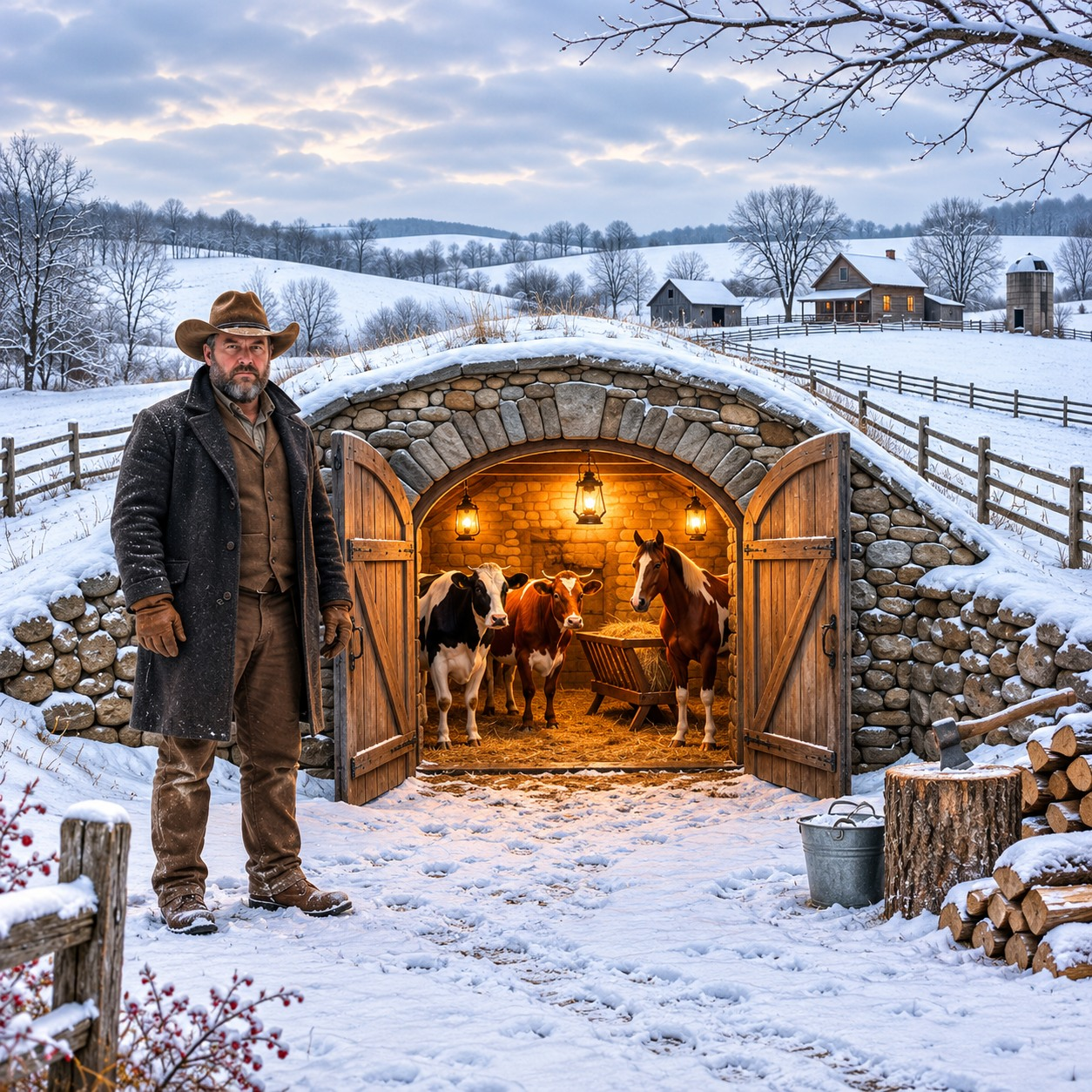
"Open the door, Samuel!" Sheriff Reed shouted, striking the wooden frame with his fist.
Inside the farmhouse, something heavy scraped across the floor.
Then came a woman's frightened voice.
"Samuel, please! They already know!"
Elias Vance stood on the porch with his injured ankle throbbing beneath him.
Walter Briggs was beside the steps.
Neither man spoke.
A moment earlier, Elias had seen a document bearing his forged signature.
Four words were written beneath it.
TRANSFER OF ALL LIVESTOCK.
Now Samuel Pike had locked himself inside a farmhouse beside a newly built barn that appeared to contain the lumber Elias had purchased months earlier.
And someone inside was desperately trying to hide another contract.
Sheriff Reed stepped back.
"Samuel, this is your last warning."
Silence.
Then a bolt slid.
The door opened.
Samuel Pike stood in the doorway, his face flushed and his collar crooked.
Behind him was a woman in a dark wool dress.
She looked to be in her forties.
Her hands trembled.
Samuel forced a smile.
"Sheriff, there's been a misunderstanding."
Reed looked past him.
"Then I suggest you explain it."
Samuel glanced at Elias.
For a fraction of a second, his expression changed.
The friendly livestock buyer was gone.
In his place stood a man who had just discovered that a carefully arranged lie was beginning to collapse.
"Mr. Vance," Samuel said. "I didn't expect to see you."
Elias looked toward the red barn doors.
"No," he answered quietly. "I imagine you didn't."
Sheriff Reed entered the farmhouse first.
He instructed Samuel to remain in the sitting room while he questioned the woman.
Her name was Ruth Pike.
She was Samuel's younger sister.
She had been keeping the house since his wife died several years earlier.
Ruth sat near the stove, twisting a handkerchief between her fingers.
The sheriff placed the delivery ledger on the table.
"Mrs. Pike, did a wagon bring lumber to this property on September third?"
Ruth looked toward her brother.
Samuel shook his head almost imperceptibly.
Reed noticed.
"Samuel, look at me."
Samuel stiffened.
"I'm asking your sister."
Ruth swallowed.
"Yes."
The room became quiet.
Elias felt Walter shift beside him.
"How much lumber?" Reed asked.
"Three wagonloads."
"Who delivered it?"
"Men from Reinholdt's mill."
"Who signed for it?"
Ruth's eyes filled with tears.
Samuel stood.
"She doesn't know anything about business arrangements."
"Sit down," Reed ordered.
Samuel hesitated.
Then obeyed.
Ruth looked at Elias.
"I'm sorry, Mr. Vance."
Elias said nothing.
She continued.
"I didn't know it was yours."
Samuel's face hardened.
"Ruth."
She flinched.
The sheriff turned toward him.
"One more interruption, and I'll have you wait outside under guard."
Samuel leaned back.
Ruth took a trembling breath.
"The wagons arrived just after sunrise. Samuel told me the lumber had been purchased from a man who couldn't pay the remaining balance."
Elias stared at her.
"I paid my deposit in full."
"I know that now."
"What happened to the rest of the money?"
Ruth shook her head.
"I don't know."
Sheriff Reed opened the ledger.
"Did Samuel tell you who owned the timber?"
"No."
"Did he mention Elias Vance?"
Ruth hesitated.
Then nodded.
"He said Mr. Vance was having trouble with his ranch."
Elias felt a cold pressure settle in his chest.
"What kind of trouble?"
Ruth looked toward her brother again.
Samuel's jaw tightened.
"He said you couldn't afford to keep your cattle through winter."
Walter muttered something beneath his breath.
Elias remained still.
Ruth continued.
"He said you'd eventually have to sell them."
The sheriff leaned forward.
"And the contract we saw in Samuel's hand?"
Ruth lowered her eyes.
"He wanted me to witness a signature."
Elias's fingers tightened around his cane.
"Whose signature?"
"Yours."
Samuel suddenly stood.
"That's enough!"
Reed rose immediately.
"Sit down."
Samuel did not move.
For several seconds, the two men stared at each other.
Then Samuel slowly lowered himself into the chair.
Ruth began crying.
"I told him it was wrong."
Elias looked at her.
"Where's the other contract?"
She wiped her face.
"In the desk."
Samuel's expression changed.
"Ruth, don't."
But she had already pointed toward the next room.
The sheriff found three documents inside the desk.
The first was a copy of Elias's lumber agreement.
The second was a false delivery confirmation.
The third was a bill of sale transferring ownership of eleven cattle from Elias Vance to Samuel Pike.
All three carried signatures resembling Elias's handwriting.
None had been signed by Elias.
The final document contained a date.
December 1.
Elias stared at it.
That date was still more than a week away.
"Why would you prepare a bill of sale for cattle I haven't sold?"
Samuel looked away.
Reed placed the paper on the table.
"Answer him."
Samuel rubbed his forehead.
"It was only a draft."
"With a forged signature?" Reed asked.
"I didn't forge anything."
"Then who did?"
Samuel said nothing.
Elias studied the document.
The description of the cattle was unusually detailed.
Eleven head.
Mixed dairy and beef stock.
Including one aged cow and three young heifers.
The numbers were correct.
Even the age categories were correct.
Whoever prepared the document knew his herd.
And knew it well.
Elias looked up.
"You came to my ranch two days ago."
Samuel remained silent.
"You offered less than half what my cattle were worth."
"That was a fair winter price."
"You told my son they'd be dead by January."
Samuel shifted.
Elias leaned forward.
"And all that time, you already had this paper waiting."
Walter stepped closer.
"Samuel, what in God's name were you planning?"
Samuel's eyes moved from one man to another.
Finally, he spoke.
"Reinholdt owed me money."
The sheriff frowned.
"How much?"
"More than he could pay."
"So you took lumber belonging to another customer?"
Samuel shook his head.
"He offered it as settlement."
"Did you know it belonged to Elias?"
Samuel hesitated.
That was enough.
Elias felt his anger sharpen into something colder.
"You knew."
Samuel looked toward the window.
"You weren't going to finish that barn anyway."
The words landed heavily.
Walter stared at him.
"What?"
Samuel's voice grew defensive.
"Everyone knew Vance was struggling. He had no workers, no money, and no proper equipment. By the time the snow came, he'd have been forced to sell."
Elias remained motionless.
Samuel continued.
"I figured I'd buy the cattle and settle the lumber matter afterward."
"By forging my name?"
"I said I didn't forge it."
Sheriff Reed closed the folder.
"Then you can explain that to the magistrate."
Samuel stood abruptly.
"You're arresting me?"
"I'm detaining you while we investigate suspected fraud and forgery."
Samuel's face drained.
"You can't prove I wrote those signatures."
"Perhaps not yet."
The sheriff looked toward the red barn.
"But I can prove where the lumber went."
By late afternoon, Samuel Pike was riding toward town under the sheriff's supervision.
Ruth remained at the farmhouse.
She had agreed to provide a written statement.
The disputed lumber would be inventoried and held until the county determined ownership.
Elias watched the sheriff's wagon disappear.
He should have felt victorious.
Instead, he felt exhausted.
His ankle ached.
His hands were numb.
And somewhere fourteen miles away, eleven cattle were standing in a pasture without adequate shelter.
Walter stood beside him.
"At least we know what happened."
Elias looked toward the timber.
"Knowing doesn't put a roof over my animals."
Walter nodded.
"No."
"How long before the county releases those boards?"
"Could be days."
"Could be weeks."
Walter said nothing.
Elias looked toward the sky.
Heavy clouds were gathering beyond the hills.
The wind had shifted north.
He had lived on the plains long enough to recognize the warning.
A serious storm was coming.
And he could not wait for a magistrate to finish reading paperwork.
Walter seemed to understand.
"I'll ask around for more spare beams."
Elias turned.
"You've already done enough."
"Maybe."
Walter placed a hand on his shoulder.
"But I'm not finished helping."
They reached the Vance ranch shortly after sunset.
Caleb was waiting on the porch.
He ran toward the wagon as soon as he saw his father.
"Papa!"
Elias climbed down carefully.
The boy noticed his expression.
"Did you find the lumber?"
"We found some of it."
"Can we bring it home?"
"Not yet."
Caleb's shoulders fell.
"Why?"
Elias glanced at Walter.
Then back at his son.
"Because someone took it who shouldn't have."
Caleb frowned.
"Who?"
"A man named Samuel Pike."
The boy stared.
"The man who wanted our cows?"
"Yes."
Caleb looked toward the pasture.
"Was he going to take them too?"
Elias hesitated.
"He was trying."
The boy's expression changed.
"But you stopped him?"
"The sheriff is handling it."
Caleb nodded slowly.
Then he asked something Elias had not expected.
"Does that mean we can still build Mama's barn?"
Elias looked toward the northern ridge.
The excavation was barely visible in the fading light.
A dark wound in the snowy hillside.
He thought about the collapse.
The rushing water.
The frightened cow.
The false contracts.
The missing lumber.
And the storm gathering beyond the horizon.
"We're going to try," he said.
Caleb reached for his hand.
"Then I'll help."
That night, Elias could not sleep.
He lay awake listening to the wind.
Every gust seemed stronger than the last.
The farmhouse creaked.
Snow brushed against the windows.
Sometime after midnight, he rose and dressed.
He moved quietly so he would not wake Caleb.
Then he took the brass lantern from the kitchen table.
Margaret's lantern.
Its polished handle had worn smooth where her fingers once held it.
Elias lit the wick.
The small flame brightened.
He stepped outside.
The cold was immediate.
He crossed the yard slowly, leaning on his cane.
The cattle stood together near the temporary windbreak.
He counted them.
Eleven.
Daisy was resting beside Mercy.
Martha stood near the feeding trough.
All were alive.
All were still his.
Elias looked toward the ridge.
A thin ribbon of vapor rose from the snow near the collapsed excavation.
He stopped.
The air was colder than it had been the previous night.
Yet the vapor appeared stronger.
He moved closer.
The snow around the narrow seam had partially melted.
Dark earth showed beneath the white crust.
Elias crouched.
He held the lantern near the opening.
Warm, damp air brushed his face.
He felt it clearly.
Not hot.
Not enough to burn.
But noticeably warmer than the bitter air around him.
He remembered the sound of water rushing through the cavity.
He remembered the hollow rumble beneath the ground.
And he remembered something Walter had said.
Your biggest problem isn't warmth. It's strength.
Elias stared at the ridge.
Perhaps he had been thinking about the shelter incorrectly.
He had imagined digging a large chamber into the hillside and using the earth as insulation.
But what if the ridge already contained natural spaces through which air and water moved?
What if those spaces could help maintain a more stable temperature?
He did not need to understand every geological detail to recognize an opportunity.
But he did need to understand the danger.
The collapse had proved that.
He moved along the slope, examining the ground.
Several yards east of the excavation, he found another narrow seam.
Snow had melted around it.
He placed his hand near the opening.
Warm air again.
Then another.
Farther uphill.
The same faint current.
Elias straightened.
Three separate openings.
All within a short distance.
He looked toward the farmhouse.
Then back at the ridge.
For the first time, he began to suspect that the strange warmth was not coming from a single isolated pocket.
It might be moving through a network of natural cracks beneath the hillside.
If he could locate the stable ground between them, he might build a shelter that benefited from the earth's insulation without disturbing the underground water.
He needed to test the idea.
Carefully.
And without another collapse.
At sunrise, Elias began measuring.
He drove wooden stakes into the ground above the ridge.
He marked the warm seams.
The collapsed excavation.
The areas where the snow melted first.
Then he studied the slope.
The southern face remained protected from the prevailing wind.
The soil farther east appeared firmer.
And the ground there was slightly higher than the wet section where Daisy had fallen.
That mattered.
A raised floor would reduce the risk of flooding.
He could cut a shallow drainage ditch along the outside.
He could build the main chamber farther from the unstable cavity.
He could reinforce the walls with stone.
And if the warm air continued to rise through the natural seams, he might use a carefully controlled passage to allow some of that air into the shelter.
But there was a problem.
He did not know whether the warmth would last.
It might disappear when the underground water cooled.
It might be caused by temporary conditions.
Or it might carry too much moisture into the shelter.
He could not rely on it alone.
The earth would provide insulation.
The cattle's own body heat would contribute warmth.
Dry straw would help.
Proper ventilation would be essential.
The shelter would still need strong beams and careful construction.
Elias wrote everything in his notebook.
Then he drew a new plan.
The third plan in less than a week.
This one was different.
Smaller.
Safer.
More deliberate.
He would abandon the collapsed rear section completely.
The new chamber would extend into firmer ground.
The roof would be supported by a series of heavy timber beams.
The walls would be lined with fieldstone.
The entrance would face south.
A raised feeding area would keep hay away from damp ground.
And a narrow ventilation shaft would allow stale air to escape.
He stared at the drawing.
It was possible.
Not easy.
Not guaranteed.
But possible.
Caleb found him beside the ridge shortly after breakfast.
"Papa?"
Elias looked up.
"Morning."
The boy carried two pieces of bread wrapped in cloth.
He handed one to his father.
Then he examined the stakes.
"Are you building another barn?"
"The same barn. A better way."
Caleb looked toward the collapsed excavation.
"Are you going back in there?"
"No."
The boy visibly relaxed.
Elias pointed toward the new markings.
"We're moving the entrance."
"Why?"
"Because that ground is stronger."
Caleb studied the hillside.
Then he noticed the melted snow.
"Papa, look."
Elias followed his gaze.
A narrow strip of dark soil ran between two stones.
Caleb crouched.
"There's no ice here."
"I know."
"Why?"
Elias sat beside him.
"Something beneath the ground is keeping it warmer."
"Like a stove?"
"Not exactly."
"Like Mama's root cellar?"
Elias paused.
Margaret had once dug a small storage pit beside the farmhouse.
It kept potatoes from freezing during ordinary cold weather.
In summer, it stayed cool.
In winter, it stayed relatively warm.
"Something like that," Elias said.
Caleb looked thoughtful.
"Then maybe the hill is already a barn."
Elias stared at him.
The boy continued.
"Maybe you just have to make a door."
For a moment, Elias could not speak.
It was such a simple observation.
A child's way of seeing what adults complicated.
The hill was not a building.
It could not replace every wall, beam, and drainage channel.
But it could provide something no lumber dealer could sell.
A massive layer of natural insulation.
Elias smiled faintly.
"That's a good way to think about it."
Caleb looked pleased.
"Can we call it Mama's barn?"
Elias glanced toward the farmhouse.
"Maybe when it's finished."
By noon, Walter Briggs returned with two neighbors.
One was a broad-shouldered farmer named Daniel Mercer.
The other was a younger man named Thomas Hale.
Both had heard about Samuel Pike's arrest.
Both had heard about the missing lumber.
And both had come carrying tools.
Daniel climbed down from his wagon.
"Where do you want the beams?"
Elias stared.
"What beams?"
Daniel pointed toward the wagon.
Four heavy timbers lay beneath a canvas cover.
"Pulled them out of an old shed."
Thomas lifted a shovel.
"And I've got two days before I need to finish my own fencing."
Elias looked at Walter.
The older rancher shrugged.
"I mentioned you could use some help."
Elias swallowed.
"I can't pay you."
Daniel laughed.
"Nobody asked."
Thomas looked toward the excavation.
"Besides, I want to see whether this crazy idea works."
Walter gave him a sharp look.
Thomas raised both hands.
"No offense."
Elias studied the men.
For weeks, he had heard whispers.
Warnings.
Laughter.
Predictions of failure.
Now three neighbors stood in his yard offering their labor.
He did not know what to say.
Walter stepped closer.
"Don't make a speech, Elias. Just tell us where to start."
They worked until sunset.
The men cleared loose earth from the new entrance.
They hauled stones.
They set the first timber supports.
They reinforced the lower walls.
Elias supervised from a safe position, using his cane and measuring tape.
Whenever he tried to lift something heavy, Walter ordered him to sit down.
Caleb carried tools and sorted stones.
The cattle watched from the pasture.
By evening, the new entrance had begun to take shape.
It was not yet a barn.
But it no longer looked like a grave.
A broad opening faced the southern pasture.
Two stone walls supported the entrance.
Heavy timbers formed the first section of the roof.
Beyond them, the chamber extended into the hillside.
The men had deliberately left the unstable cavity untouched.
Elias inspected every support.
He checked the joints.
The stones.
The drainage.
He refused to rush.
Daniel wiped sweat from his forehead despite the cold.
"Well, I'll be."
Thomas stepped back.
"That might actually stand."
Walter looked toward Elias.
"Don't let that go to your head."
Elias smiled.
"I'll try not to."
That evening, the men gathered near the farmhouse for coffee.
Caleb sat beside the stove, listening to their conversation.
Daniel spoke about a winter twenty years earlier when snow had buried fences.
Thomas described losing two calves during a late spring freeze.
Walter remembered a storm that had trapped a wagon train for four days.
Elias listened.
Then he asked a question.
"Have any of you ever seen ground stay warm when everything around it freezes?"
Daniel frowned.
"Warm how?"
"Enough to melt snow."
Thomas shrugged.
"Sometimes near a spring."
Walter nodded.
"Or where water runs underground."
Elias explained what he had found.
The seams.
The vapor.
The strange air movement.
Daniel leaned forward.
"Could be a natural drainage channel."
"That's what I think."
"Could be dangerous."
"I know."
Thomas looked toward the ridge.
"Have you checked where the water comes out?"
Elias shook his head.
"Not yet."
Walter rubbed his chin.
"You should."
Elias nodded.
"I intend to."
Daniel looked thoughtful.
"If the water's moving beneath the ridge, there may be a lower outlet somewhere downhill."
"And if there is?" Elias asked.
"Then you'll know where the wet ground is. Might help you keep the barn dry."
Elias considered that.
The collapsed section had filled with water.
But the new excavation stood higher.
If he could identify the natural drainage path, he could avoid it.
He could also make sure the shelter's drainage channel led away from the entrance rather than into the chamber.
It was practical advice.
The kind he needed.
The next morning, Elias and Caleb walked along the lower slope.
Elias moved slowly.
His ankle was improving, but it remained sore.
Caleb carried the notebook.
They followed the line of the ridge toward the spring.
The ground dipped gently.
Snow lay thick in the hollows.
Near a cluster of bare shrubs, Caleb stopped.
"Papa!"
Elias turned.
The boy pointed toward a patch of dark stones.
Water was trickling between them.
Not much.
Just a narrow stream.
But it was flowing.
And the stones around it were free of ice.
Elias crouched.
He touched the water.
It was cool, not hot, but warmer than the surrounding air.
He followed the stream with his eyes.
It disappeared beneath a thin sheet of ice farther downhill.
He looked back toward the ridge.
The location aligned roughly with the warm seams above.
A natural drainage path.
Perhaps water moving through deeper ground before emerging near the spring.
Elias took out his pencil.
He marked the outlet.
Then he drew a line toward the hillside.
Caleb watched.
"Does that mean the hill is safe?"
"It means we know a little more about it."
"Is that good?"
"Very good."
Elias stood carefully.
Then he noticed something unusual.
The snow near the outlet had melted in a broad patch.
But one narrow strip remained completely dry.
It ran uphill toward the new excavation.
He followed it.
The ground felt firm beneath his boots.
He pressed the end of his cane into the soil.
Hard.
Stable.
He moved farther uphill.
The dry strip continued.
Then it disappeared beneath a large flat stone.
Elias stopped.
The stone was nearly four feet wide.
Its surface was smooth.
Too smooth to be ordinary fieldstone.
He brushed away the snow.
Caleb knelt beside him.
"What is it?"
Elias examined the edges.
The stone appeared to have been shaped.
Not perfectly.
But deliberately.
He looked toward the ridge.
Then back at the stone.
It might have been part of an old foundation.
Or a natural slab fractured along unusually straight lines.
He could not tell.
He brushed away more snow.
A shallow groove appeared along one edge.
Then another.
Caleb leaned closer.
"Papa?"
Elias said nothing.
The grooves formed a narrow channel.
A channel that appeared to direct water away from the hillside.
He stared.
Someone might have worked this ground before him.
Long before he purchased the ranch.
Perhaps an earlier settler had discovered the same underground drainage.
Perhaps the stone had once been part of a springhouse or a water diversion.
He did not know.
But the possibility was enough to make him uneasy.
Because if someone had already tried to control the water beneath the ridge, there might be more hidden structures.
And some might no longer be stable.
Elias returned to the farmhouse with the notebook full of measurements.
He spread the pages across the kitchen table.
Caleb watched as his father compared the locations.
The warm seams.
The collapsed excavation.
The spring outlet.
The flat stone.
The new shelter entrance.
Elias drew connecting lines.
Then stopped.
The pattern was becoming clearer.
The wet ground followed one side of the ridge.
The firmer ground followed another.
The shelter needed to remain entirely within the stable section.
He could not afford another mistake.
Not with the storm approaching.
Not with eleven cattle depending on him.
Not with Caleb watching every decision.
He closed the notebook.
Then he heard a wagon approaching.
Walter Briggs arrived just before dusk.
He was not alone.
Sheriff Reed sat beside him.
Elias stepped onto the porch.
The sheriff climbed down.
"Mr. Vance."
"Sheriff."
"I've got news about the lumber."
Elias felt his pulse quicken.
"Good news?"
Reed hesitated.
"Some of it."
Walter looked troubled.
The sheriff removed a folded document from his coat.
"The county has confirmed that the lumber delivered to Pike's property matches your purchase order."
Elias exhaled.
"Then I can have it?"
"Not immediately."
His hope faltered.
"Why not?"
"Because Reinholdt's creditors are disputing ownership of the remaining stock."
Elias stared.
"But it's mine."
"I believe that. The records support your claim."
"Then what's stopping you?"
"The magistrate has to authorize the release."
Elias looked toward the ridge.
The new entrance was barely visible through the falling snow.
"How long?"
"A few days, if we're fortunate."
Elias closed his eyes.
A few days.
The weather might not give him a few days.
The sheriff seemed to understand.
"I'll do what I can."
Elias nodded.
Then Reed continued.
"There's something else."
Walter shifted beside him.
Elias looked up.
"What?"
The sheriff unfolded a second paper.
"We found another record in Reinholdt's office."
Elias felt his stomach tighten.
"Another forged contract?"
"Not exactly."
Reed handed him the document.
It was an old property survey.
The paper had yellowed.
The ink was faded.
At the top was the name of the original land grant.
Elias recognized the boundaries.
His ranch.
The northern ridge.
The spring.
The pasture.
But near the hillside, someone had drawn a small symbol.
A dark square.
Beside it were three handwritten words.
Elias brought the paper closer to the lantern.
The words were difficult to read.
He tilted the page.
Then the letters became clear.
OLD STONE CHAMBER.
Elias looked up.
"Where did this come from?"
The sheriff frowned.
"That's what I wanted to ask you."
Elias stared at the map.
He had owned the land for three years.
He had walked the ridge in every season.
He had never seen a stone chamber.
Walter leaned closer.
"Could be an old root cellar."
"Or a springhouse," Reed suggested.
Elias looked toward the dark hillside.
The strange warmth.
The hollow sounds.
The moving water.
The shaped stone.
Suddenly, the pieces seemed connected.
But one question remained.
If there had once been a chamber beneath the ridge, why had nobody mentioned it when he bought the property?
And why was it marked on a survey that had been kept among Otto Reinholdt's business papers?
Elias turned the document over.
There was writing on the back.
A date.
A name.
And a warning.
The ink had faded, but one sentence remained legible.
DO NOT OPEN THE LOWER PASSAGE DURING WINTER.
Elias felt the cold settle into his bones.
He looked toward the ridge.
A faint ribbon of vapor rose from the snow.
Then another.
And another.
For the first time, he noticed that the vapor was no longer drifting steadily upward.
It was pulsing.
As though something beneath the earth were forcing air through the cracks.
Walter followed his gaze.
"Elias?"
The rancher did not answer.
A low rumble traveled through the frozen ground.
The porch boards trembled beneath their boots.
Sheriff Reed turned toward the hillside.
"What was that?"
Elias stared at the snow-covered ridge.
The warm seams were widening.
A thin crack appeared across the frozen slope.
Then, from deep beneath the earth, came three heavy knocks.
The same knocks Elias had heard before the first collapse.
Only this time, they were followed by something else.
A slow metallic scraping.
Elias grabbed the lantern.
Walter caught his arm.
"Don't go near it."
But Elias was already staring at the old survey.
He looked from the warning to the dark hillside.
Then he whispered, "There's a door down there."
At that exact moment, the snow above the ridge began to sink.
A rectangular outline appeared beneath the white surface.
The ground shifted.
A buried wooden frame rose slightly from the earth.
And somewhere below, an ancient iron latch suddenly clicked...






Comments 0