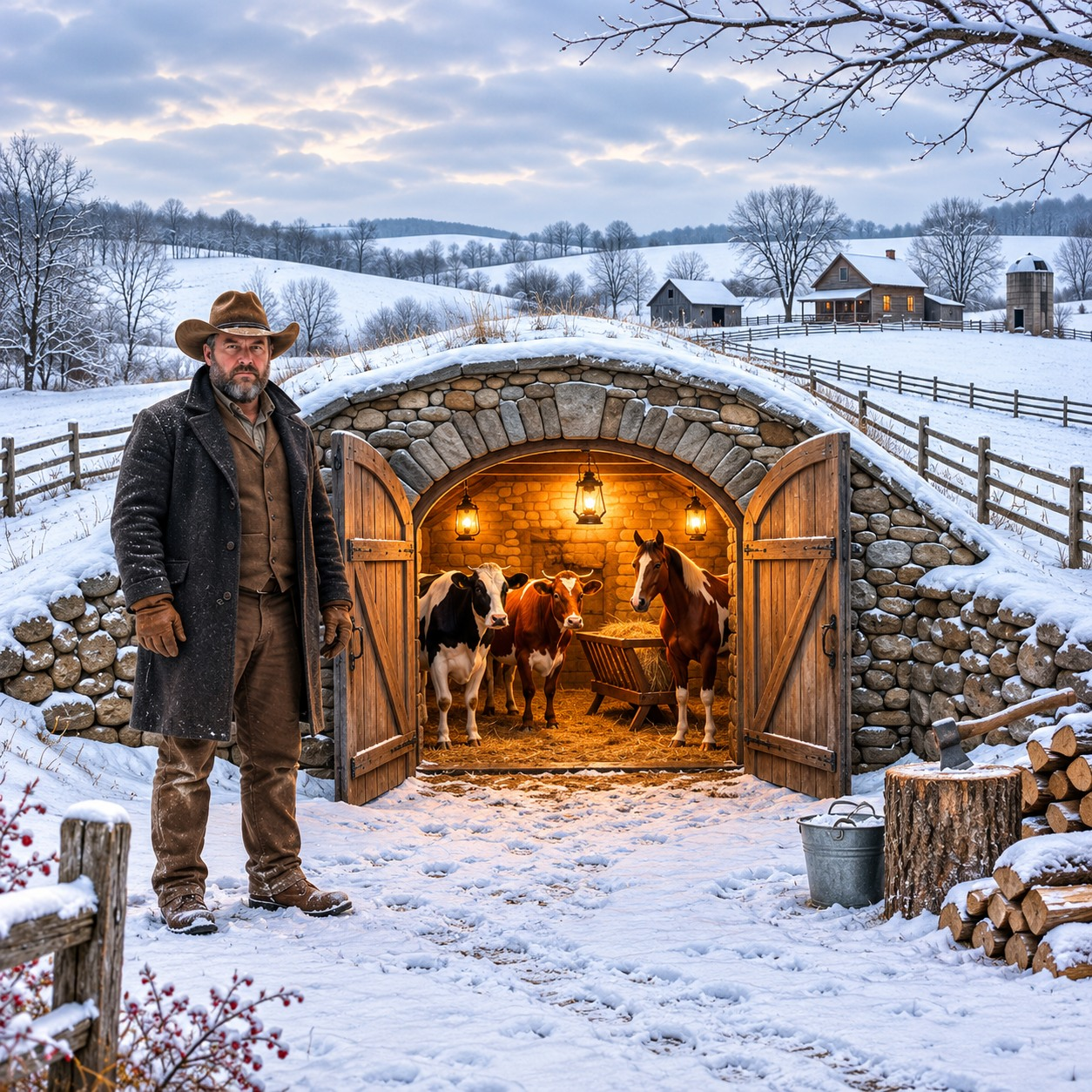
"Papa! The whole hill is moving!"
Caleb's scream cut through the frozen morning as Elias Vance stood trapped at the bottom of the excavation.
The ground beneath his boots trembled.
A deep, grinding sound came from inside the ridge.
Then the dark opening behind the collapsed wall widened, and a surge of muddy water burst through the stones.
Elias staggered backward.
The lantern fell from his hand.
Its glass shattered against a rock.
The flame died instantly.
For one terrible second, everything disappeared into darkness.
"Papa!"
"I'm here!"
"Climb out!"
Elias reached for the rope hanging from the fence post above.
But another sound stopped him.
A frightened bellow.
Daisy.
The reddish-brown cow was still trapped inside the narrow cavity.
Elias turned toward the sound.
He could barely see her now.
Only a dark shape struggling against the wet earth.
Water was spreading across the bottom of the excavation.
And the wooden brace above him had begun to crack.
He had seconds to decide.
Save himself.
Or try to save one of the eleven animals that represented everything he and Margaret had worked for.
Elias wrapped the rope around his waist.
Then he shouted, "Caleb! Tie the other end to the wagon!"
The boy hesitated.
"Papa, the hill—"
"Now!"
Caleb ran.
Elias dropped to his knees beside the opening.
He reached into the darkness.
His fingers found Daisy's halter.
"Easy, girl. I've got you."
The cow struggled.
A loose stone struck Elias's shoulder.
Pain shot down his arm.
He gritted his teeth.
"Easy."
He pulled the halter toward him.
Daisy moved a few inches.
Then stopped.
Something was holding her hindquarters against the collapsed earth.
Elias reached farther inside.
His sleeve soaked through.
The water was cold enough to make his fingers ache.
He felt along the cow's side.
A thick root had caught beneath her belly.
He pushed it.
Nothing.
He grabbed the pry bar lying beside the opening.
Wedged it beneath the root.
And leaned with all his strength.
The root snapped.
Daisy lurched forward.
At the same instant, a heavy timber overhead split with a sound like a rifle shot.
"Papa!"
Elias grabbed the halter.
"Come on!"
The cow scrambled.
Her front hooves struck the edge of the opening.
Mud sprayed across Elias's face.
He pulled again.
Daisy stumbled into the trench.
But the roof was falling.
Elias looked up.
A section of earth broke loose.
He threw himself against the cow's shoulder, forcing her toward the open end of the excavation.
The first stones came down behind them.
Then the timber brace collapsed.
The impact shook the ground.
Elias felt the rope tighten around his waist.
Caleb had reached the wagon.
The boy was pulling from above.
"Papa! Hurry!"
Elias pushed Daisy toward the sloping entrance.
The frightened cow climbed over the loose earth.
Then she broke free and scrambled into the pasture.
Elias tried to follow.
His boot slipped.
He fell hard against a stone.
Pain exploded through his left ankle.
He grabbed the rope.
Above him, Caleb screamed again.
The hillside gave one final shudder.
Elias pulled himself toward the surface.
A large stone struck the ground where his head had been moments earlier.
He reached the edge.
Caleb caught his coat.
Together, they dragged him onto solid ground.
Behind them, the rear section of the excavation collapsed completely.
A cloud of dust and frozen soil rose into the air.
Then silence returned.
Elias lay on his back, staring at the pale November sky.
Caleb knelt beside him.
"Papa?"
Elias tried to answer.
His chest hurt.
His shoulder throbbed.
His ankle burned.
But he was alive.
He turned his head.
Daisy stood near the fence, trembling.
Mud covered her legs.
Her breathing was fast.
But she was standing.
Elias closed his eyes.
"Eleven," he whispered.
Caleb began to cry.
They did not return to the excavation that morning.
Elias could barely walk.
Caleb helped him into the farmhouse, where he sat beside the stove and removed his boot.
His ankle had swollen.
A purple bruise was spreading beneath the skin.
He could move his toes.
That was something.
But putting weight on the foot sent sharp pain up his leg.
Caleb brought a basin of cold water.
Then a clean cloth.
He worked quietly, with the solemn concentration of a child who had suddenly been forced to act older than his years.
Elias watched him.
"You're doing fine."
Caleb said nothing.
He wrapped the cloth around his father's ankle.
Then he sat back.
"Why did you go after her?"
Elias frowned.
"Who?"
"Daisy."
Elias looked toward the window.
The cow was visible beyond the fence.
"She was trapped."
"But you could've died."
The words came out harder than Caleb intended.
Elias looked at his son.
The boy's face was pale.
His hands were shaking.
"Caleb—"
"You could've died like Mama!"
The room went silent.
Elias felt the accusation more deeply than any injury.
Caleb stood abruptly.
"You promised you'd stay!"
Elias reached toward him.
But the boy stepped back.
"You promised!"
Then Caleb ran into his bedroom and slammed the door.
Elias remained seated.
He could hear his son's muffled crying through the wall.
For a long time, he did not move.
He had thought only of saving Daisy.
He had not considered what Caleb would see from above.
A father disappearing beneath a collapsing hillside.
A rope pulled tight.
A moment when the boy might have believed he was about to lose the only parent he had left.
Elias lowered his head.
He had saved one cow.
But he had frightened his son more than any winter storm ever could.
By afternoon, the snow had stopped.
Elias managed to stand with the help of a wooden cane.
He moved slowly toward Caleb's bedroom.
He knocked.
No answer.
"Caleb?"
Silence.
"Can I come in?"
A long pause.
Then a small voice.
"Yes."
Elias opened the door.
Caleb sat on his bed, holding the folded drawing Margaret had made of their imagined barn.
His eyes were red.
Elias lowered himself into the chair beside the bed.
For a moment, neither spoke.
Then Elias said, "You were right."
Caleb looked up.
"About what?"
"I shouldn't have gone back into that hole without knowing whether it was safe."
The boy stared at him.
"I thought you were dead."
"I know."
"I couldn't see you."
Elias swallowed.
"I'm sorry."
Caleb looked down at the drawing.
"Mama went away, and she never came back."
Elias felt his throat tighten.
"I remember."
"I don't want you to go away too."
Elias leaned forward.
"Listen carefully. I can't promise nothing bad will ever happen. Nobody can promise that."
Caleb's eyes filled again.
"But I can promise you something else."
"What?"
"I won't take a risk like that again without thinking about you first."
The boy looked uncertain.
Elias continued.
"You're more important than the cattle. More important than the ranch. More important than anything we own."
Caleb's voice was barely audible.
"Even the barn?"
"Especially the barn."
The boy slowly moved closer.
Elias opened his arms.
Caleb pressed his face against his father's chest.
They sat together until the afternoon light began to fade.
The next morning brought another problem.
Elias's ankle had stiffened overnight.
He could walk, but only with difficulty.
Every step across the frozen yard was painful.
The excavation was ruined.
The rear wall had collapsed.
The drainage channel had filled with mud.
Several salvaged timbers were buried beneath fallen earth.
And the first serious winter storm was expected within days.
Elias stood at the kitchen window, studying the ridge.
He needed help.
That realization troubled him more than he wanted to admit.
For three years, he had tried to build the ranch with his own hands.
Margaret had helped when she was alive.
After her death, Caleb had done what a child could.
But the heaviest work had always belonged to Elias.
Now his body was telling him something his pride did not want to hear.
He could not finish the shelter alone.
Not in time.
Not with an injured ankle.
And not without enough timber to reinforce the roof properly.
He opened the drawer beneath the kitchen table.
Inside lay the lumber agreement he had signed with Otto Reinholdt.
The paper was creased and stained.
Elias unfolded it.
The terms were simple.
A deposit paid in June.
Delivery promised before the end of August.
The remaining balance due upon arrival.
Otto's signature stood at the bottom.
Elias stared at the name.
He had trusted the man.
Not because Otto had seemed particularly honest.
But because Elias had been desperate to believe that one straightforward business arrangement could solve his problem.
He remembered the mill.
The smell of freshly cut pine.
The stacks of boards.
The workers loading wagons.
Everything had looked legitimate.
Otto had smiled as he accepted the money.
"You're doing the right thing, Mr. Vance. A good barn is worth every dollar."
Elias had believed him.
Now that same money was gone.
And the missing timber had nearly cost him his life.
Shortly before noon, Walter Briggs arrived.
He found Elias sitting on the porch with his injured foot resting on a wooden crate.
Walter stopped beside the steps.
"I heard about the collapse."
Elias looked up.
"News travels fast."
"Caleb came to my place yesterday evening."
Elias frowned.
"He did?"
Walter nodded.
"He wanted to know whether I had any spare roof beams."
Elias looked toward the farmhouse.
Caleb was inside.
The boy had said nothing about visiting Walter.
"He told me what happened," Walter continued. "About the cow. About the water."
Elias looked down.
Walter removed his gloves.
"You nearly got yourself killed."
"I know."
"And your boy nearly watched it happen."
Elias's jaw tightened.
"I know that too."
Walter studied him.
Then his expression softened.
"I'm not here to lecture you."
"That's a change."
The older rancher almost smiled.
"I brought something."
He walked to his wagon.
Elias watched as Walter lifted a heavy timber from the back.
Then another.
Both were old but solid.
Walter carried them toward the porch.
"These came out of my old hay shed."
Elias stared.
"They're good beams."
"They are."
"What do you want for them?"
"Nothing."
Elias frowned.
"Walter—"
"Don't start."
"I can't take your lumber for free."
Walter set down the second beam.
"You can help me repair a fence next spring."
Elias looked at the timbers.
They were exactly the kind he needed.
Strong.
Straight.
Dry.
He could not remember the last time a gift had made him feel so grateful and so ashamed at once.
Walter seemed to understand.
"Your wife helped my Mary through a fever two winters ago," he said quietly.
Elias looked up.
"I remember."
"Mary never forgot it."
Walter paused.
"Neither did I."
For a moment, the two men stood without speaking.
Then Walter looked toward the ridge.
"I still think that hole is dangerous."
"It is."
"Good. At least we agree on something."
Elias gave a tired laugh.
Walter continued.
"But if you're determined to finish it, you need to stop digging like a man chasing a buried treasure."
Elias looked toward the collapsed earth.
"I've changed the plan."
"Then show me."
They spent the next hour studying Elias's drawings.
Walter listened more carefully than Elias expected.
He examined the proposed roof supports.
The drainage channel.
The entrance.
The reinforced stone walls.
He asked practical questions.
How much earth would cover the beams?
Where would water go during a thaw?
How would fresh air enter?
What would prevent the cattle from crowding the doorway?
Elias answered what he could.
When he did not know, he admitted it.
Walter pointed toward the unstable section.
"You're leaving that part alone?"
"Yes."
"Good."
"The warm air comes from somewhere behind it."
Walter frowned.
"Warm air?"
Elias explained what he had discovered.
The thin vapor.
The unusual frost.
The faint current rising from the stones.
Walter listened.
Then he shook his head.
"Could be underground water."
"That's what I think."
"Could also be a pocket of air moving through the ridge."
"Maybe."
"Either way, don't trust it until you know where it goes."
Elias nodded.
Walter studied the drawing again.
"Your biggest problem isn't warmth."
"What is it?"
"Strength."
He tapped the roof.
"Earth is heavy. Wet earth is heavier. And snow adds more weight. If you don't support this properly, it'll come down on your cattle."
Elias knew he was right.
He had been thinking the same thing since the collapse.
Walter leaned back.
"How many good beams have you got?"
"Six, counting the two you brought."
"You need more."
"I know."
Walter looked toward the road.
Then he said something unexpected.
"Maybe Reinholdt still has your lumber."
Elias stared at him.
"What?"
"The mill."
"Otto's gone."
"Otto's gone. That doesn't mean every board disappeared with him."
Elias sat forward.
Walter continued.
"I heard something in town yesterday. A wagon driver said the mill property is being held until the county sorts out the debts."
Elias felt a sudden surge of hope.
"Is there timber there?"
"I don't know."
"Who would?"
"The county clerk. Maybe the sheriff."
Elias looked toward his injured ankle.
The nearest town was nearly fourteen miles away.
He could not ride comfortably.
But if the lumber still existed—
If even part of his order remained—
He might be able to finish the shelter before the worst weather arrived.
Walter seemed to read his thoughts.
"Don't get your hopes too high."
Elias looked at him.
"Too late."
The following morning, Walter returned with his wagon.
Caleb helped Elias climb aboard.
The boy had insisted on coming.
Elias refused.
"The cattle need someone to check them."
Caleb frowned.
"I can come with you."
"I know. But Mercy needs feeding, and Martha needs watching."
The boy looked toward the pasture.
Then he nodded.
Elias placed a hand on his shoulder.
"Count them twice."
Caleb gave a small smile.
"Always."
Walter clicked his tongue.
The horses started forward.
The wagon rolled along the frozen road.
For the first several miles, neither man spoke.
The landscape stretched around them in pale, empty fields.
Snow gathered in the wagon tracks.
The wind pushed against their coats.
Elias watched the neighboring farms pass.
Every one had a barn.
Some were large.
Some were small.
Some were barely standing.
But each had walls and a roof.
And every time Elias saw one, he felt the same bitter thought.
That should have been mine.
They reached town shortly before noon.
The county clerk's office stood beside a general store and a small blacksmith shop.
Inside, a thin man named Henry Bell sat behind a desk covered with papers.
He looked up when Elias entered.
"Mr. Vance."
"Mr. Bell."
Henry noticed the cane.
"Trouble?"
"Some."
Walter remained near the door.
Elias placed the lumber agreement on the desk.
"I need to know what's happening with Reinholdt's mill."
Henry sighed.
"You're not the first man to ask."
"Is there timber left?"
"Some."
Elias felt his pulse quicken.
"Enough to fill my order?"
"I don't know."
"Can I inspect it?"
Henry hesitated.
"The property is under county supervision."
"I paid for those boards."
"So did several other men."
Elias leaned forward.
"My cattle are standing in the snow. I've got a nine-year-old boy at home. I need that lumber."
Henry looked uncomfortable.
"I understand."
"Then help me."
The clerk opened a drawer.
He removed a thick folder.
Inside were several documents.
Receipts.
Claims.
Statements.
Elias recognized Otto's handwriting on one page.
Henry examined the papers.
Then he frowned.
"That's strange."
Elias stiffened.
"What?"
Henry pulled out another document.
It was a delivery ledger.
Several names were listed beside dates and quantities.
Henry ran his finger down the page.
Then stopped.
"Your order is here."
Elias leaned closer.
"Does it say where the lumber went?"
Henry did not answer immediately.
He turned the ledger toward Elias.
Beside the name ELIAS VANCE, someone had written a delivery date.
September 3.
Elias stared at it.
"That's impossible."
Henry looked up.
"Why?"
"Because nothing was delivered."
Walter stepped forward.
"Are you certain?"
Elias turned sharply.
"Of course I'm certain!"
Henry studied the entry.
"There's a signature."
Elias looked down.
A name appeared beside the delivery confirmation.
His name.
Written in dark ink.
Elias felt the room grow strangely quiet.
"That's not my signature."
Henry frowned.
"You're sure?"
Elias pulled the original agreement from his coat.
He placed it beside the ledger.
The signatures were similar.
But not identical.
One had a sharp downward stroke on the final letter.
The other did not.
Elias pointed.
"Look."
Henry leaned closer.
Walter examined both documents.
For several seconds, nobody spoke.
Then Henry slowly closed the ledger.
"This changes things."
Elias stared at him.
"What does?"
"If someone signed for your lumber without your permission, this may be more than an unpaid debt."
Walter's expression darkened.
"Forgery?"
Henry nodded.
"Possibly."
Elias felt anger rising in his chest.
All those weeks.
All those unanswered letters.
All the nights he had worried about the cattle.
The money had not simply disappeared.
Someone had recorded a delivery that never happened.
And someone had written his name to make it appear legitimate.
Henry sent for the sheriff.
Sheriff Thomas Reed arrived twenty minutes later.
He was a broad man with a graying mustache and a habit of speaking only after he had listened carefully.
Elias explained everything.
The agreement.
The missing wagons.
The false signature.
The ruined excavation.
The sheriff studied the ledger.
Then he asked one question.
"Did anyone see timber delivered to your ranch on September third?"
"No."
"Anyone who could confirm that?"
"My son. My neighbors. Anyone who passed the road."
Walter nodded.
"I was hauling hay that week. I'd have noticed a lumber wagon."
The sheriff closed the book.
"Then we'll investigate."
Elias leaned forward.
"How long will that take?"
"Can't say."
"Days?"
"Maybe."
"Weeks?"
"Possibly."
Elias shook his head.
"I don't have weeks."
The sheriff looked at him.
"I understand."
"No, Sheriff. You don't."
Elias's voice rose for the first time.
"My cattle are standing in an open field. My barn is half a hole in the ground. The money I paid that man was everything I had saved. And now you're telling me someone signed my name and took the lumber I bought."
The room fell silent.
Elias took a breath.
Then lowered his voice.
"I'm not asking for charity. I'm asking for what belongs to me."
Sheriff Reed studied him.
Then he stood.
"Come with me."
They rode to the mill in Walter's wagon.
The property stood beside a narrow creek.
The main building was locked.
Several empty wagons rested beneath a shed.
Stacks of timber remained in the yard.
Elias felt his heart pounding.
There was lumber.
Real lumber.
Enough to build several barns.
But whether any of it belonged to him was another matter.
The sheriff unlocked the office.
Inside, dust covered the desk.
A calendar still hung on the wall.
A half-empty bottle sat beside a stack of invoices.
Sheriff Reed began searching the drawers.
Henry examined a cabinet.
Walter walked outside to inspect the timber.
Elias remained near the doorway.
His ankle throbbed.
But he barely noticed.
Then Henry called from the back room.
"Sheriff?"
Reed looked up.
"What is it?"
"I found something."
Elias followed them.
Henry stood beside a wooden filing cabinet.
In his hand was a folded sheet of paper.
He opened it.
The document listed several lumber shipments.
One entry had been marked with a red pencil.
ELIAS VANCE — 3 SEPTEMBER.
Beside it was a wagon number.
And beneath that, a destination.
Not Elias's ranch.
Not even the same road.
The lumber had been sent somewhere else.
Elias stared at the address.
Walter leaned closer.
His expression changed.
"That can't be right."
The sheriff looked at him.
"Why not?"
Walter swallowed.
"Because I know that property."
Elias turned.
"Whose is it?"
Walter did not answer.
The sheriff took the paper.
He read the destination aloud.
Then he looked toward Elias.
The room became silent.
Elias felt a terrible suspicion forming.
"Tell me," he said.
Walter lowered his eyes.
The sheriff folded the document.
Then he said, "Mr. Vance, I think you need to see something."
They returned to the wagon.
The sheriff gave directions.
Walter drove.
Elias sat beside him, gripping the edge of the seat.
The road led away from town.
Past the blacksmith.
Past the church.
Past a line of frozen fields.
Elias recognized the route.
He had traveled it many times.
His stomach tightened.
"Where are we going?"
Walter kept his eyes on the road.
The sheriff sat behind them.
"To the property listed on the delivery record."
Elias looked toward the distant hills.
The wagon turned onto a narrow lane.
A large wooden barn appeared beyond the trees.
Its walls were new.
Its roof was freshly shingled.
And its wide doors had been painted a deep, unmistakable red.
Elias stared.
The color struck him like a blow.
Margaret had wanted red doors.
He had promised Caleb they would paint their barn red if there was enough money left.
Now he was looking at a barn that seemed to have been built with the lumber he had purchased.
Walter pulled the horses to a stop.
Nobody moved.
Then Elias noticed something else.
A stack of unused boards lay beside the barn.
Each board carried a small black mill stamp.
R.
The mark of Otto Reinholdt's lumber company.
Elias climbed down from the wagon.
Pain shot through his ankle.
He ignored it.
He walked toward the stack.
The sheriff followed.
Elias picked up one board.
Then another.
The dimensions matched his order.
The wood was the same grade he had purchased.
He turned toward Walter.
"Whose barn is this?"
Walter's face had gone pale.
"Elias—"
"Whose?"
The old rancher looked toward the house beyond the fence.
Then he whispered a name.
Elias stopped breathing.
Because the name belonged to someone he had trusted.
Someone who had stood on his land.
Someone who had warned him that his cattle would die.
Someone who had offered to buy those same cattle for less than half their value.
Elias slowly turned toward the farmhouse.
A curtain moved behind the front window.
Someone was watching them.
The sheriff stepped forward.
"Stay here."
He walked toward the door.
Raised his hand.
And knocked.
For several seconds, nothing happened.
Then a lock clicked.
The door opened a few inches.
A man's voice came from inside.
"What do you want?"
The sheriff held up the delivery record.
"We need to talk about the lumber that was brought here on September third."
The door began to close.
The sheriff caught it with his boot.
"Don't."
Elias stepped closer.
Through the narrow opening, he saw a familiar face.
And in the man's hand was a second document bearing Elias Vance's forged signature.
But this time, beneath the signature, someone had written four words.
TRANSFER OF ALL LIVESTOCK.
Elias stared at the paper.
Then he heard the sheriff say, "Mr. Pike, open that door."
Samuel Pike's face disappeared into the darkness.
A heavy bolt slid into place.
And from somewhere inside the house, a frightened voice suddenly cried out—
"Don't let them find the other contract!"






Comments 0