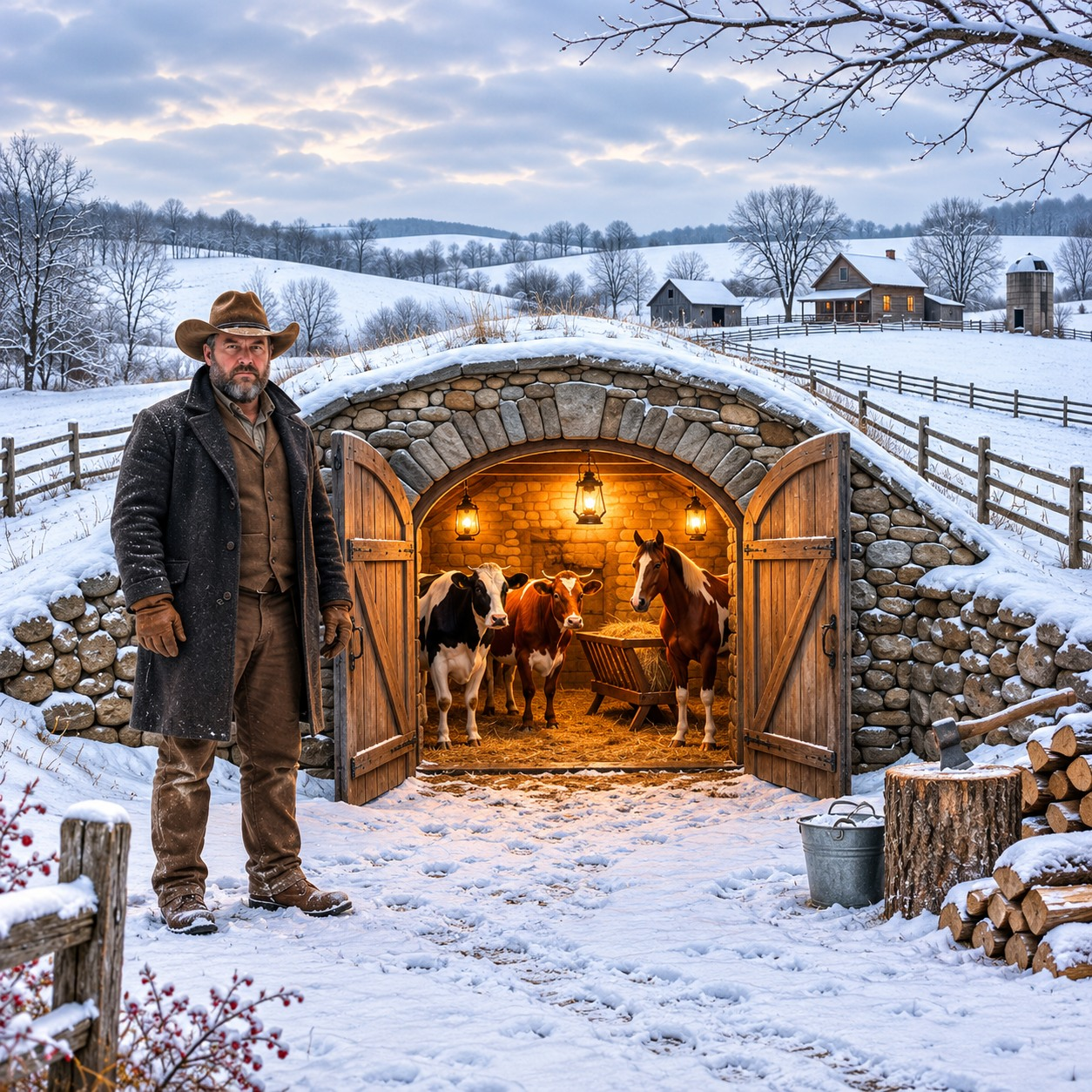
"You're digging graves for those animals, Elias!" the old rancher shouted, slamming his gloved hand against the wooden gate.
Elias Vance stood knee-deep in a trench beside the frozen hillside, holding a shovel whose handle had been worn smooth by years of hard labor.
The visiting rancher, Walter Briggs, had brought a folded lumber receipt from the county office.
On the back, someone had written three words in red pencil.
PAYMENT NOT RECOVERABLE.
Elias looked at the receipt.
Then he looked at the eleven cattle standing beyond the fence.
He understood something Walter did not.
The missing lumber was no longer his greatest problem.
"Did you hear what I said?" Walter demanded.
Elias drove his shovel into the dirt.
"I heard you."
"Then explain yourself."
"There's nothing to explain yet."
Walter stared at the hole.
It was nearly six feet deep in places, with a rough entrance cut into the southern face of a low ridge. Piles of earth lay beneath a thin crust of November snow. Fieldstones had been stacked beside the excavation. Several heavy timbers rested on sawhorses nearby.
It looked less like a building project than the beginning of a burial ground.
Walter removed his hat.
"Lord Almighty, Elias. You've got a boy to raise."
Elias stopped digging.
That was the first thing Walter had said all morning that mattered.
"My boy is why I'm doing this."
"Then you ought to be building something that stands above the ground."
Elias glanced toward the distant farmhouse.
A small figure stood on the porch.
Caleb.
Nine years old, wearing his mother's old knitted scarf wrapped twice around his neck.
The boy had been watching his father since sunrise.
Elias knew what Caleb was waiting for.
An answer.
An explanation.
Some assurance that the eleven cattle they owned would not freeze when the temperature fell below anything a living creature should have to endure.
Elias had given him the same answer for weeks.
They would be fine.
But the truth was more complicated.
Because Elias Vance was running out of time.
And the winter had already begun.
Three years earlier, Elias had arrived in the valley with a wagon, a young wife, a six-year-old son, and enough savings to purchase a modest stretch of land.
His wife, Margaret, had loved the place immediately.
She loved the rolling fields.
She loved the small spring that ran clear even during the driest months.
She loved the line of bare cottonwood trees beside the northern ridge.
Most of all, she loved the silence.
"There's room to breathe here," she had told him.
Elias had laughed.
"There's also room to starve."
"Then we'd better work hard."
And they had.
Their first summer had been merciless.
The second had been better.
By their third spring, they owned eleven cattle, a horse, a wagon, a few tools, and a farmhouse that no longer leaked whenever the clouds gathered.
They had begun talking about building a proper barn.
Margaret wanted red doors.
Caleb wanted a loft where he could sleep during the summer.
Elias wanted four solid walls and a roof that would keep his livestock alive through the winter.
It was not an unreasonable dream.
Then Margaret fell ill.
The fever came in September.
At first, it seemed like the ordinary sickness that passed through frontier settlements whenever the seasons changed.
She complained of a headache.
Then chills.
Then a weakness that made it difficult to stand.
Elias rode fourteen miles through the rain to fetch a doctor.
By the time the doctor arrived, Margaret was barely conscious.
She died three days later.
Caleb had been sitting beside her bed when she stopped breathing.
Elias remembered the boy asking a question he would never forget.
"Is Mama sleeping?"
He had not known how to answer.
For a long time afterward, neither father nor son spoke much.
They worked.
They ate.
They slept.
They woke before sunrise.
And when the house became too quiet, Elias went outside and found something that needed repairing.
A fence.
A wagon wheel.
A broken hinge.
Anything that could be fixed with his hands.
Because there was one thing he could not fix.
By the following spring, Elias had decided the barn could wait no longer.
The cattle were growing.
The winters were becoming harder.
He had survived one season by building temporary windbreaks and keeping the animals near the southern side of the farmhouse.
But he knew that arrangement would not survive another severe winter.
He needed lumber.
He needed a roof.
And he needed money.
For months, Elias saved every dollar he could.
He sold two wagonloads of hay.
He repaired equipment for neighboring farmers.
He took odd jobs in town.
He even sold Margaret's old sewing machine, though he kept the small wooden box containing her needles and thread.
When Caleb asked why the machine was gone, Elias told him the truth.
"We need a barn."
Caleb looked toward the empty place beside the house.
"Mama wanted red doors."
"I remember."
"Can we still paint them red?"
Elias had smiled for the first time in weeks.
"If we've got enough money left for paint."
By June, he had saved enough to order the lumber.
The dealer was a man named Otto Reinholdt.
His mill stood two counties east.
Otto was known for offering lower prices than most of his competitors, and Elias had heard that several farms in the region had purchased timber from him.
The arrangement seemed simple.
Elias would pay a deposit.
Otto would prepare the lumber.
The wagons would arrive before the end of August.
That would give Elias enough time to build before the first frost.
The agreement was written on a single sheet of paper.
Elias signed it.
Otto shook his hand.
"Your timber will be there before harvest."
Elias believed him.
That was his mistake.
August came.
The wagons did not.
Elias wrote a letter.
No answer.
He rode to the mill.
Otto was absent.
A worker told him the owner had traveled east to settle business.
Elias returned home.
September came.
Still no lumber.
The mill sent a message claiming the delivery had been delayed by a broken wagon axle.
Elias waited another week.
Then another.
By October, the truth had become impossible to ignore.
The money was gone.
The timber was not coming.
And Otto Reinholdt had disappeared.
The county clerk could offer little comfort.
Other men had lost money too.
Some had paid larger deposits.
Some had ordered lumber for houses.
One family had purchased enough timber to replace a storm-damaged roof.
Nobody knew where Otto had gone.
The receipt Walter brought to the ranch confirmed what Elias had already suspected.
There would be no refund before winter.
Possibly no refund at all.
Walter watched Elias read the paper.
"Now do you understand why I'm worried?"
Elias folded it carefully.
"I understood before you came."
"Then stop this foolishness."
Elias placed the receipt inside his coat.
Walter gestured toward the trench.
"You think digging a hole is going to save your cattle?"
"I think standing here talking won't."
The old rancher frowned.
"Elias, I've been working this land forty years."
"I know."
"I've seen winters that killed horses inside barns. I've seen cattle freeze standing up. I've seen men lose everything because they thought they knew better than the weather."
Elias listened without interrupting.
Walter lowered his voice.
"I'm not trying to insult you."
"I know that too."
"Then listen to me. Sell half your herd. Use the money to buy enough lumber for a smaller barn."
Elias looked toward the cattle.
Eleven animals.
Eleven living investments.
Eleven reasons Caleb might have a future on that land.
Selling half would provide some money.
But not enough to build a proper structure before the snow became too deep.
And even if it did, the remaining cattle would struggle to produce enough income to keep the ranch operating.
Walter's suggestion was reasonable.
That made it harder to reject.
"I've made my decision," Elias said.
Walter studied him.
Then he shook his head.
"Pride is a dangerous thing in winter."
Elias said nothing.
Walter climbed onto his wagon.
Before leaving, he turned once more.
"When January comes, remember I tried to warn you."
The wagon wheels creaked along the frozen road.
Elias watched until they disappeared.
Then he returned to his shovel.
Caleb came down from the farmhouse shortly before noon.
He carried a tin cup of coffee in one hand and a piece of bread wrapped in cloth in the other.
"Papa?"
Elias looked up.
"You're supposed to be inside."
"I brought you something."
The boy handed him the cup.
The coffee was weak and barely warm.
Elias drank it anyway.
"Thank you."
Caleb looked into the excavation.
"Mr. Briggs said the cows are going to die."
Elias stopped chewing.
"When did he tell you that?"
"I heard him."
Elias sighed.
"Mr. Briggs worries about things."
"Is he right?"
The question hung between them.
Elias could have lied.
He could have promised that everything would work.
He could have told his son that grown men always knew what they were doing.
Instead, he climbed out of the trench and sat beside Caleb on a flat stone.
"I don't know exactly how bad this winter will be."
Caleb looked down.
"But I know something about that hill."
"What?"
Elias pointed toward the ridge.
"Remember last February, when the snow was so deep we couldn't get the wagon out?"
Caleb nodded.
"Remember where the snow melted first?"
The boy thought.
"Near the old cottonwood?"
"That's right."
"And remember how the wind blew across the north pasture?"
"It knocked over the water barrel."
"Yes. But it didn't hit this side of the ridge nearly as hard."
Caleb looked at the hillside.
"Because the hill blocked it?"
"Partly."
Elias picked up a handful of dark soil.
"Earth holds warmth differently than air. Deep enough underground, the temperature doesn't change as quickly when the weather turns."
Caleb frowned.
"So the cows would be warmer under the hill?"
"That's what I'm hoping."
The boy looked toward the trench again.
"Has anybody ever built a barn like that?"
Elias considered the question.
"I've heard of people making shelters in hillsides. Root cellars. Dugouts. Places that stay cooler in summer and warmer in winter."
"But not for cows?"
"Not around here."
Caleb was silent for a moment.
Then he asked the question Elias had been avoiding.
"What if it doesn't work?"
Elias looked at his son.
The boy had Margaret's eyes.
That made some moments almost unbearable.
"Then I'll do everything I can to make it work."
Caleb nodded slowly.
It was not the answer he wanted.
But it was honest.
That afternoon, Elias returned to the excavation.
The work was harder than he had expected.
The upper soil was packed with stones.
Beneath it lay dense clay.
Every few feet, his shovel struck another buried rock.
Some were small enough to lift.
Others required a pry bar and hours of effort.
He had already worn through one pair of gloves.
His shoulders ached.
His hands were blistered.
At night, his fingers stiffened so badly he sometimes struggled to button his shirt.
Still, he dug.
He had marked the entrance where the southern slope offered the best protection from the prevailing wind.
The interior would extend into the ridge.
He planned to reinforce the chamber with timber supports salvaged from an abandoned corral and line the lower walls with fieldstone.
The roof would be supported by heavy beams beneath a thick layer of earth.
Drainage would be essential.
So would ventilation.
He had spent evenings studying the hillside, testing the soil, and watching how rainwater moved after storms.
The design was not perfect.
But it was the only design he could afford.
He had one advantage.
The ridge itself.
And something strange about it.
Elias had first noticed the unusual ground the previous winter.
He had been searching for a missing calf after a night of heavy snow.
The animal had wandered toward the northern ridge.
Elias followed its tracks through the drifts.
Near a shallow depression, he noticed something that made him stop.
The snow was thinner.
Not gone.
Just thinner than it should have been.
At first, he assumed the wind had swept it away.
But the ground was damp.
And when he knelt, he felt something unexpected.
Warmth.
Not enough to heat his hand.
Not enough to melt the entire hillside.
But enough to make the soil feel different from the frozen earth around it.
He returned the next morning.
A faint mist hovered near a narrow seam between two rocks.
It vanished almost immediately in the wind.
Elias thought about it for days.
Perhaps water moved beneath the ridge.
Perhaps the earth was insulated by an unusual layer of stone.
Perhaps the warm air came from a deeper cavity.
He did not know.
He only knew that the frost behaved differently there.
And that the ground seemed to offer something the open pasture could not.
Protection.
By late afternoon, the sky had darkened.
The wind shifted.
Elias was lifting another stone when he heard Caleb calling from above.
"Papa!"
He looked up.
The boy stood near the edge of the excavation.
"There's something over here!"
Elias climbed the slope.
Caleb was pointing toward a patch of earth beside the ridge.
"What is it?"
"Look."
At first, Elias saw nothing.
Then he noticed a thin ribbon of vapor rising between two stones.
It was almost invisible.
The wind carried it away before it rose more than a few inches.
Elias crouched.
He removed one glove.
Slowly, he placed his fingers near the opening.
The air felt noticeably less cold.
He moved his hand closer.
A faint current brushed his skin.
Caleb leaned forward.
"Is it smoke?"
"No."
"Then what is it?"
Elias studied the seam.
He had seen the same phenomenon before, but never this clearly.
He picked up a small stone and dropped it into the opening.
A soft clicking sound came from below.
Then another.
Then silence.
The opening was deeper than it appeared.
Elias pressed his ear close to the ground.
For several seconds, he heard only the wind.
Then—
a faint trickling sound.
Water.
Somewhere beneath the ridge.
He sat back.
The ground might contain a narrow underground drainage channel.
Perhaps water from the spring moved through the stone before emerging farther downhill.
That could explain the unusual temperature.
It could also create a serious problem.
An underground chamber built too close to moving water might flood.
And if the soil became saturated, the roof could weaken.
Elias knew enough about excavation to understand the danger.
He would need to investigate before extending the shelter farther into the hill.
Caleb watched him carefully.
"Is it good?"
Elias looked at the vapor.
Then toward the trench.
"I don't know yet."
The boy's face fell.
Elias placed a hand on his shoulder.
"But it tells us there's more going on under this hill than we can see."
Caleb nodded.
They stood together as the first snowflakes began to fall.
That evening, Elias worked by lantern light.
He had promised Caleb he would come inside before dark.
But the discovery near the ridge had changed his plans.
He needed to understand the ground.
He returned to the excavation with a pry bar and a small iron hammer.
Near the rear wall, he found a narrow crack running between two large stones.
It appeared to angle toward the place where Caleb had noticed the vapor.
Elias struck the stone gently.
A hollow sound answered.
He frowned.
He struck it again.
The same sound.
Not solid earth.
Something else.
He set down the hammer.
Then he began clearing the soil around the crack.
The work was slow.
He removed one stone.
Then another.
Behind them lay a pocket of dark earth.
The air smelled damp.
He held the lantern closer.
A narrow gap extended into the ridge.
Elias stared at it.
His pulse quickened.
He had expected compact soil.
Instead, he had found an opening.
He leaned forward.
A faint current of air touched his face.
It was warmer than the wind outside.
Much warmer.
He withdrew the lantern.
For the first time in weeks, he felt something dangerously close to hope.
But hope was not proof.
He needed to know where the opening led.
He needed to know whether the ground was stable.
He needed to know whether he had found a useful natural cavity or the beginning of a collapse.
He reached for the pry bar.
Then stopped.
From somewhere inside the narrow opening came a sound.
Not water.
Not wind.
Three distinct knocks.
Elias held his breath.
He waited.
The hillside became silent.
Then the knocks came again.
This time, directly beneath his feet.
He raised the lantern toward the black opening.
A small stone shifted inside.
Then another.
And suddenly, something on the other side began pushing against the earth...






Comments 0