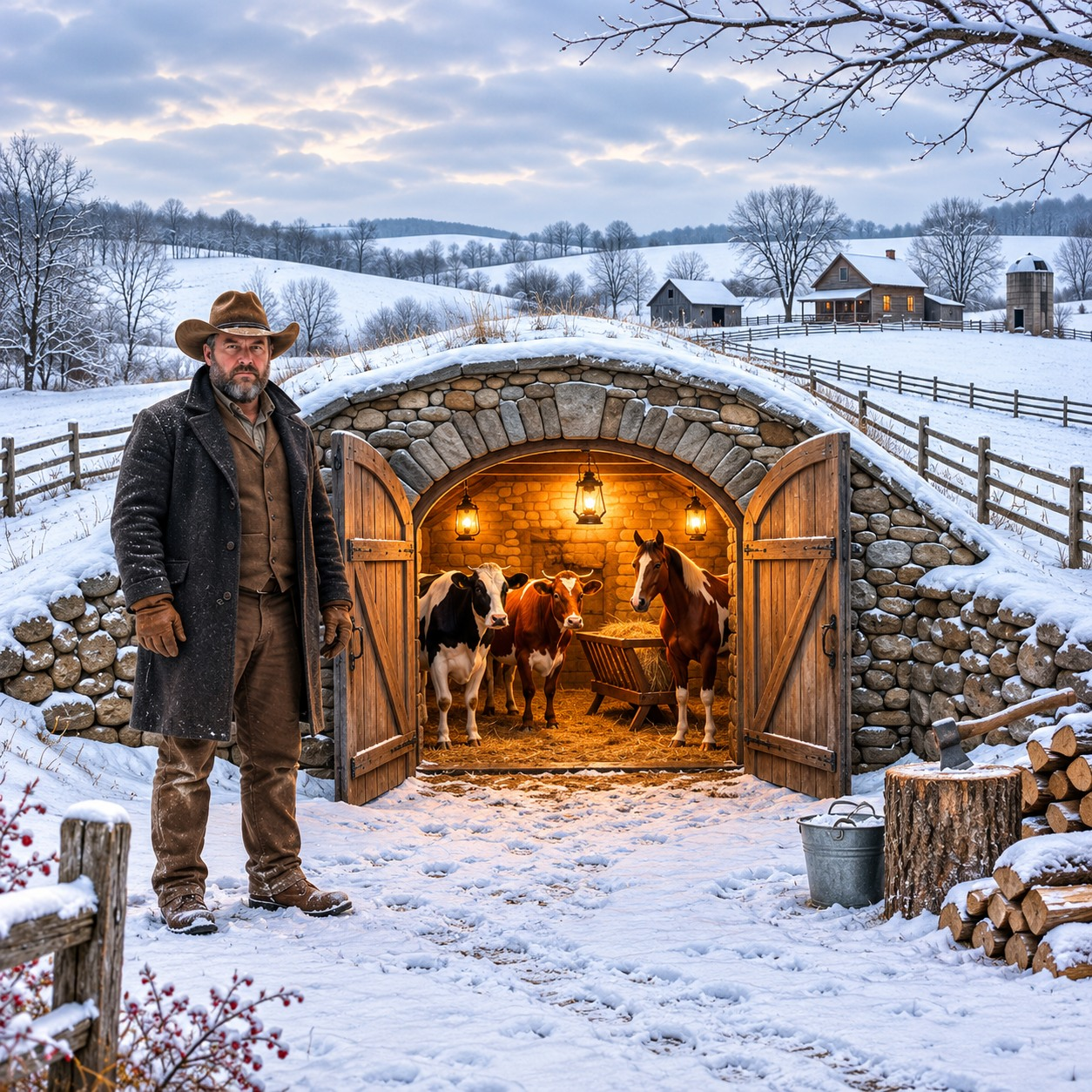
The first stone moved six inches.
Then the entire wall seemed to breathe.
Elias Vance stumbled backward, dragging his lantern away from the opening just as a fist-sized rock dropped into the trench.
It struck the ground beside his boot.
Another followed.
Then came a low, hollow rumble from somewhere deep inside the ridge.
Elias froze.
For one terrible second, he imagined the entire hillside collapsing over him.
He had spent weeks digging into that earth.
He had trusted its weight.
Trusted its shape.
Trusted the strange warmth that rose from beneath it.
Now the ground was answering him in a language he did not understand.
"Papa!"
Caleb's voice came from above.
Elias looked up.
His nine-year-old son stood at the edge of the excavation, holding the little brass lantern that had once belonged to his mother.
"Get back!" Elias shouted.
Caleb obeyed immediately.
Elias grabbed his shovel and scrambled toward the entrance.
Behind him, the rumbling continued.
A crack appeared in the exposed clay.
He reached the surface just as a heavy section of earth broke loose and crashed into the place where he had been standing.
Dust billowed from the opening.
The lantern flame flickered.
Then everything went still.
Caleb stared at the collapsed section of the wall.
"Papa?"
Elias bent forward, hands on his knees, struggling to catch his breath.
"I'm all right."
"You almost—"
"I know."
The boy looked at the trench.
A moment earlier, his father had been standing beneath several hundred pounds of loose earth.
Now that same place was buried.
Caleb's lower lip trembled.
Elias straightened.
"Come here."
The boy rushed into his arms.
Elias held him tightly.
For a moment, he forgot the cattle.
Forgot the missing lumber.
Forgot the approaching winter.
He remembered only that he had almost left his son without a father.
And Caleb had already lost enough.
They returned to the farmhouse without speaking.
Elias washed the dirt from his hands while Caleb placed the lantern on the kitchen table.
The room smelled of boiled potatoes and woodsmoke.
A small iron stove warmed one corner.
Margaret's blue curtains still hung over the windows.
Elias had never found the courage to replace them.
Caleb sat down.
"Are you going to stop digging?"
Elias dried his hands.
"For tonight."
"I mean forever."
The question was quiet.
That made it harder to answer.
Elias pulled out a chair.
"No."
Caleb stared at him.
"But the hill fell."
"Part of it did."
"It could happen again."
"Yes."
"Then why?"
Elias looked toward the window.
Beyond the glass, the pasture was disappearing beneath fresh snow.
The cattle stood together near the southern fence.
Their dark shapes moved slowly through the fading light.
Eleven animals.
Eleven lives.
And the last substantial investment Margaret had helped him build.
"Because those cattle need somewhere to go," Elias said.
Caleb lowered his eyes.
"Mr. Briggs said we should sell them."
"I know what he said."
"Would that be easier?"
Elias considered lying.
He could have told Caleb that selling the herd would be foolish.
That the animals were worth more than money.
That a rancher never surrendered his livestock.
But none of those answers would have been completely true.
"Yes," he said finally. "In some ways, it would."
Caleb looked surprised.
"Then why don't we?"
Elias leaned back.
"Because selling them now would mean accepting whatever price someone offered. Most people already have their winter feed figured out. Nobody wants eleven extra mouths to feed when the snow is coming."
"We could sell five."
"We could."
"Or six."
"We could do that too."
Caleb studied his father's face.
"But then we wouldn't have enough left?"
Elias nodded.
"Not enough to build the ranch the way your mother and I planned."
The boy was silent.
Outside, the wind struck the house.
The window rattled.
Caleb reached for the brass lantern.
"Mama said you could fix anything."
Elias felt something tighten in his chest.
"Your mother said a lot of generous things about me."
"She meant it."
Elias looked down at his hands.
The skin was cracked.
One knuckle had split open.
Dirt remained beneath his fingernails despite the washing.
"Some things can't be fixed, Caleb."
The boy understood.
His expression changed.
Neither of them spoke Margaret's name.
They did not need to.
The next morning, Elias returned to the ridge alone.
He had barely slept.
Every time he closed his eyes, he heard the stones falling.
He had replayed the collapse until he understood one thing clearly.
He had been digging too aggressively near the narrow opening.
The exposed stones had been holding back loose material.
When he removed them, he had disturbed the support beneath the clay.
The warm air might still be useful.
But the cavity was dangerous.
He could not simply carve a room into the hillside and hope the earth would remain above his head.
He needed proper supports.
Drainage.
A carefully reinforced entrance.
And a safer excavation plan.
He stood at the edge of the trench for nearly an hour.
The collapsed earth had filled the rear section.
The opening was no longer visible.
Yet something strange remained.
A thin ribbon of vapor rose from the disturbed soil.
Elias crouched.
He removed one glove and held his hand above the ground.
Warm air brushed his fingers.
The passage beneath the ridge had not disappeared.
Whatever lay below was still there.
He took out his notebook.
It was a small leather-bound book Margaret had given him on their first Christmas in the territory.
Most of its pages contained ordinary things.
Seed prices.
Fence measurements.
Calving dates.
Feed calculations.
Near the back, he began drawing the ridge.
He marked the entrance.
The collapsed wall.
The location of the warm seam.
Then he drew a new line.
Instead of extending the chamber directly toward the cavity, he would shift the excavation southward, leaving a thick barrier of undisturbed earth between the shelter and the unstable opening.
He would use the natural warmth only if he could find a safe way to let air circulate.
He would not gamble his cattle's lives on a mystery he did not understand.
Nor would he gamble Caleb's future.
For the first time since beginning the project, Elias felt the full weight of what he was attempting.
A conventional barn could be repaired if a wall failed.
An underground shelter could bury everything inside it.
He closed the notebook.
Then he went to inspect his cattle.
The first animal approached him before he reached the feeding trough.
She was a black-and-white cow named Mercy.
Margaret had named her after the animal survived a difficult birth during their first year on the ranch.
Mercy had a broad white face and a black patch around her left eye.
She was gentle with Caleb.
Stubborn with everyone else.
Elias scratched her forehead.
"Morning, old girl."
Mercy pushed her nose against his coat.
Behind her stood the rest of the herd.
There was Daisy, a reddish-brown cow with a white stripe down her forehead.
Martha, the oldest animal, whose joints had begun to stiffen during cold mornings.
Two younger cows named June and Hazel.
Three heifers that had not yet produced calves.
Two yearling steers.
And a pair of strong, dark-coated cows that had come from a neighboring farm the previous spring.
Eleven in all.
They were not impressive animals by the standards of wealthy ranchers.
They were not prizewinning cattle.
They did not represent some grand fortune.
But they were healthy.
They were productive.
And they were his.
Elias knew every animal's habits.
He knew which one preferred the left side of the feeding trough.
Which one pushed the others aside.
Which one became restless before a storm.
He knew the sound Mercy made when she wanted more hay.
He knew Daisy would follow Caleb almost anywhere if the boy carried an apple.
He knew Martha needed extra attention when the temperature dropped.
These were not merely numbers written in a ledger.
They were the difference between keeping the ranch and losing it.
He counted them.
Once.
Then again.
Eleven.
He always counted twice.
Margaret had taught him that.
"Never assume they're all there just because you can see a crowd," she used to say.
He had laughed at her the first time.
Then one spring morning, they discovered a calf missing from the pasture.
After searching for hours, Margaret found it trapped in a muddy ditch.
From that day forward, Elias counted every animal twice.
Even after she was gone.
By midday, Walter Briggs arrived again.
This time, he did not bring a receipt.
He brought another man.
His name was Samuel Pike.
Samuel was a livestock buyer who traveled between settlements purchasing cattle from struggling farms.
He wore a thick gray coat and rode a tired bay horse.
Elias saw them approaching from the pasture.
He knew immediately why they had come.
Walter dismounted first.
"Morning, Elias."
Elias continued spreading hay.
"Morning."
Samuel removed his hat.
"Mr. Vance."
"Mr. Pike."
Walter cleared his throat.
"I thought Samuel might be able to help."
Elias straightened.
"Help with what?"
Samuel looked toward the herd.
"Your cattle."
Elias said nothing.
Walter gestured toward the ridge.
"I told him about your situation."
"My situation?"
"The missing lumber. The shelter. The weather."
Elias rested his pitchfork against the fence.
"I didn't ask you to."
Walter's expression hardened.
"I'm trying to keep you from losing everything."
Samuel stepped forward.
"There's no need for an argument. I came to make an offer."
Elias looked at him.
"What kind of offer?"
"Cash."
"For how many?"
"All eleven."
Elias glanced toward the animals.
Mercy stood beside the trough.
Caleb was brushing straw from her back.
The boy had not yet noticed the visitors.
"How much?" Elias asked.
Samuel named a figure.
Elias stared at him.
Then he laughed once.
It was not a pleasant sound.
"That's less than half what they're worth."
Samuel shrugged.
"Under ordinary circumstances, I'd pay more."
"These aren't ordinary circumstances?"
"Not with winter coming."
Walter looked uncomfortable.
Samuel continued.
"You don't have a barn. Feed prices are rising. The roads could close before December. I'm taking a risk buying them at all."
Elias folded his arms.
"You'd be taking them to your winter pasture."
"That's right."
"Where you've already got shelter."
"Yes."
"And plenty of hay."
Samuel hesitated.
"Enough."
"Then the risk isn't quite what you're making it sound like."
Samuel's expression cooled.
"I'm offering you money today, Mr. Vance. You can take it or leave it."
Elias looked toward Caleb.
The boy had stopped brushing Mercy.
He was watching.
Elias lowered his voice.
"Not interested."
Walter stepped closer.
"Elias, think about your son."
Elias turned sharply.
"I think about him every minute."
"Then don't let pride make this decision."
Samuel reached into his coat.
He removed a folded document.
"I brought a bill of sale. We can settle it right now."
He held out the paper.
Elias did not take it.
Samuel waited.
Then he said something that made the entire conversation change.
"By January, those cattle won't be worth the cost of burying them."
Caleb heard him.
Elias saw the boy's face.
The color drained from it.
Something inside Elias went cold.
He stepped between Samuel and the fence.
"You can leave."
Samuel blinked.
"I beg your pardon?"
"You heard me."
Walter raised a hand.
"Now, Elias—"
"No."
Elias pointed toward the road.
"You brought a man onto my property to bargain over animals I haven't offered for sale. You've said what you came to say. Now go."
Samuel's jaw tightened.
"You're making a mistake."
"Maybe."
"You'll regret it."
"Maybe that too."
Samuel folded the document.
Then he mounted his horse.
Walter remained standing.
For a moment, the older rancher looked as though he wanted to say something.
Instead, he shook his head.
"I hope you know what you're doing."
Elias met his eyes.
"So do I."
Walter climbed into his wagon.
The two men left without another word.
Caleb waited until they were gone.
Then he approached his father.
"Are they going to die?"
Elias looked at him.
"Who?"
"The cows."
"No."
The answer came too quickly.
Caleb noticed.
"You don't know that."
Elias swallowed.
"No," he admitted. "I don't know it for certain."
The boy looked toward Mercy.
"Mr. Pike said—"
"I heard him."
"He said they'd all be dead."
Elias knelt.
"Listen to me. Mr. Pike wanted to buy our cattle cheaply. He said something cruel because he thought it might frighten me into selling."
"But what if he's right?"
Elias took a slow breath.
"Then we work harder to make sure he isn't."
Caleb looked at the ridge.
"Can I help?"
"You already do."
"I mean with the barn."
Elias hesitated.
He remembered the collapse.
The falling stones.
The moment he had nearly been buried.
"No digging inside," he said.
Caleb's shoulders fell.
"But you can help me carry small stones. Sort the good timbers. Keep the tools organized."
The boy brightened.
"And count the cows?"
Elias smiled faintly.
"Especially that."
Caleb held out his hand.
"Promise?"
Elias shook it.
"Promise."
That afternoon, father and son worked together.
Elias moved the heavy stones.
Caleb carried smaller ones in a wooden bucket.
They sorted the salvaged timbers into two piles.
Strong enough to support weight.
Too damaged to trust.
Elias showed Caleb how to identify rot.
He explained why a beam could look sound on the outside while weakening from within.
He demonstrated how to test a stone before placing it in a wall.
Caleb listened carefully.
Occasionally, he asked questions Elias could not answer.
"How much dirt can a beam hold?"
"Depends on the beam."
"How much snow can the hill hold?"
"More than we want to find out the hard way."
"How do you know if the roof is strong enough?"
Elias paused.
"By building it properly. And by checking it before we put anything beneath it."
Caleb nodded.
He seemed satisfied.
But Elias was not.
He had been doing calculations in his head all morning.
The chamber needed enough room for eleven cattle.
Enough space for a feeding trough.
A dry place for hay.
A separate area where the horse could stand without frightening the smaller animals.
And enough ventilation to prevent damp air from collecting beneath the roof.
That last problem worried him most.
A shelter could be warm and still be deadly.
Too little fresh air would make the animals sick.
Too much would let the winter wind strip away the heat.
He needed balance.
And he needed it before the ground froze solid.
Near sunset, Caleb found something beneath a pile of discarded boards.
"Papa?"
Elias looked up.
"What is it?"
The boy held a small wooden box.
Its lid was cracked.
Elias recognized it immediately.
Margaret's old tool box.
He had placed it in the shed after her death.
Inside were several small household tools, a measuring tape, a carpenter's pencil, and a folded piece of paper.
Caleb opened the paper.
"What's this?"
Elias took it.
It was a drawing.
Margaret had made it during their second summer.
A simple sketch of the barn she wanted.
Four walls.
A pitched roof.
Two wide doors.
And a little window near the loft.
Below the drawing, she had written:
For the animals, so they will always have a place out of the storm.
Elias stared at the words.
He remembered the afternoon she had drawn it.
They had been sitting beneath the cottonwood tree.
Caleb was playing with a wooden horse.
Margaret had been talking about where the barn should stand.
She wanted it close enough to the house that they could check the animals during a blizzard.
Elias had suggested building near the northern ridge.
She had laughed.
"Why not put it right inside the hill?"
He had laughed too.
At the time, it was only a joke.
Now he stood holding the drawing while the first serious snow of the season gathered around his boots.
Caleb looked up.
"Papa?"
Elias could barely speak.
"Yes?"
"Would Mama like our barn?"
He looked toward the excavation.
The piles of earth.
The unfinished entrance.
The rough stone walls.
The work that everyone called foolish.
"I think she'd want us to make it safe."
Caleb nodded.
Then he took the drawing back.
"Can I keep this?"
"Of course."
The boy folded it carefully and placed it inside his coat.
That night, the temperature fell sharply.
Elias woke shortly after midnight.
The house was quiet.
Caleb slept in the small bedroom beside the kitchen.
The stove had burned low.
Elias added another piece of wood.
Then he heard it.
A cow calling.
Not the ordinary low sound of an animal asking for feed.
A strained, restless bellow.
He stood still.
Another call followed.
Then another.
Elias grabbed his coat.
He took the lantern from the table and stepped outside.
The cold struck him immediately.
Snow blew across the yard.
The fences were barely visible.
He hurried toward the pasture.
The cattle had gathered near the southern side of the ridge.
Most stood close together.
But Martha, the oldest cow, was separated from the others.
She stood near the fence, shifting her weight.
Elias approached slowly.
"Easy, girl."
Martha turned her head.
Her breathing was heavy.
He examined her legs.
No obvious injury.
He checked her eyes.
Then her nose.
The old cow was shivering.
Not violently.
But enough to worry him.
Elias removed his glove and pressed his hand against her side.
Her body was warm.
Yet the wind was cutting through the pasture with frightening force.
He looked toward the unfinished shelter.
It was still too dangerous to use.
The roof supports were incomplete.
The rear wall had collapsed.
He could not bring the herd inside.
Not yet.
He led Martha toward the temporary windbreak beside the farmhouse.
Then he carried additional straw and piled it beneath her.
He stayed with her until her breathing settled.
By the time he returned to the house, his fingers were numb.
He sat beside the stove and stared at the dying fire.
Walter's warning returned to him.
I've seen cattle freeze standing up.
Elias closed his eyes.
He had spent the entire autumn trying to protect his animals from a winter that had not yet arrived.
Now winter was here.
And the shelter was still unfinished.
At dawn, Caleb found his father sitting at the kitchen table.
The notebook lay open.
Pages of measurements covered the wood.
Elias had drawn a new plan.
Smaller.
Stronger.
More practical.
The chamber would be divided into sections.
He would use the thickest salvaged beams for the roof.
He would reinforce the entrance with stone.
He would create a shallow drainage channel along the outer wall.
And he would leave the unstable cavity untouched until he understood it.
Caleb studied the drawing.
"Is that our barn?"
Elias nodded.
"That's what we're going to build."
"Will it be ready?"
Elias looked toward the window.
The snow had stopped.
For the moment.
"We're going to find out."
He closed the notebook.
Then he stood.
"Get your coat."
They spent the morning checking the herd.
Martha was better.
Mercy had eaten normally.
The younger animals were restless but healthy.
Elias counted them.
One.
Two.
Three.
Four.
Five.
Six.
Seven.
Eight.
Nine.
Ten.
He stopped.
He counted again.
Ten.
His stomach tightened.
"Caleb."
The boy looked up.
"What?"
"Where's Daisy?"
Caleb turned toward the pasture.
The reddish-brown cow with the white stripe was nowhere in sight.
Elias checked behind the feeding trough.
Nothing.
He followed the fence.
No sign of her.
Then he noticed tracks in the snow.
Fresh hoofprints.
They led toward the northern ridge.
Toward the unfinished excavation.
Elias began walking faster.
Caleb followed.
"Papa?"
"Stay behind me."
The tracks crossed a patch of frozen grass.
Then turned sharply toward the collapsed section of the hillside.
Elias stopped.
The snow near the excavation had been disturbed.
A narrow section of the temporary fence lay broken.
He saw deep hoofprints descending toward the trench.
And then—
nothing.
The tracks ended at the edge.
Caleb came up beside him.
"Where is she?"
Elias did not answer.
He moved toward the excavation.
A faint sound rose from below.
A low, frightened bellow.
Daisy.
She was alive.
But somewhere beneath the collapsed earth.
Elias grabbed the nearest rope.
He tied one end around a fence post.
Then he lowered himself carefully into the trench.
"Papa, don't!"
"Stay there!"
He reached the bottom.
The ground was damp.
The rear wall had shifted again.
A narrow opening had appeared where the clay had collapsed.
From inside came another frightened sound.
Elias held the lantern toward the gap.
He could see a reddish-brown shape moving in the darkness.
Daisy had fallen through a weakened section of earth into a lower pocket beneath the ridge.
She was trapped.
Elias moved closer.
"Easy, girl. Easy."
The cow struggled.
Loose stones fell from above.
Elias stepped back.
The opening was too narrow for him to enter safely.
He needed to widen it.
But the ground was unstable.
And every movement risked another collapse.
Caleb called from above.
"Can you get her?"
Elias looked at the frightened animal.
Then at the loose earth overhead.
"I need more rope!"
Caleb ran toward the shed.
Elias set down the lantern.
He examined the opening.
A large stone blocked the lower edge.
If he could move it, Daisy might have enough room to climb out.
He placed the pry bar beneath the stone.
Then pushed.
Nothing.
He adjusted his grip.
Pushed again.
The stone shifted slightly.
Daisy bellowed.
"Easy!"
Elias braced his boot against the ground.
He pushed with all his strength.
The stone moved.
Then the earth above it cracked.
A deep rumble traveled through the ridge.
Elias froze.
The same sound he had heard the night before.
Only louder.
Much louder.
Caleb returned with the rope.
"Papa!"
Elias looked up.
"Don't come down!"
The boy stopped.
Elias turned back toward Daisy.
Her frightened eyes reflected the lantern light.
He could not leave her.
He reached for the pry bar again.
Then he heard something that made his blood run cold.
A sharp cracking sound.
Directly overhead.
The timber brace beside the entrance had begun to split.
Elias looked toward the opening.
The roof was moving.
He grabbed the rope.
But before he could climb, Caleb screamed.
"Papa! Look behind you!"
Elias turned.
The collapsed wall had opened wider.
Dark water was rising through the stones.
And deep inside the ridge, something enormous had just begun to move...






Comments 0