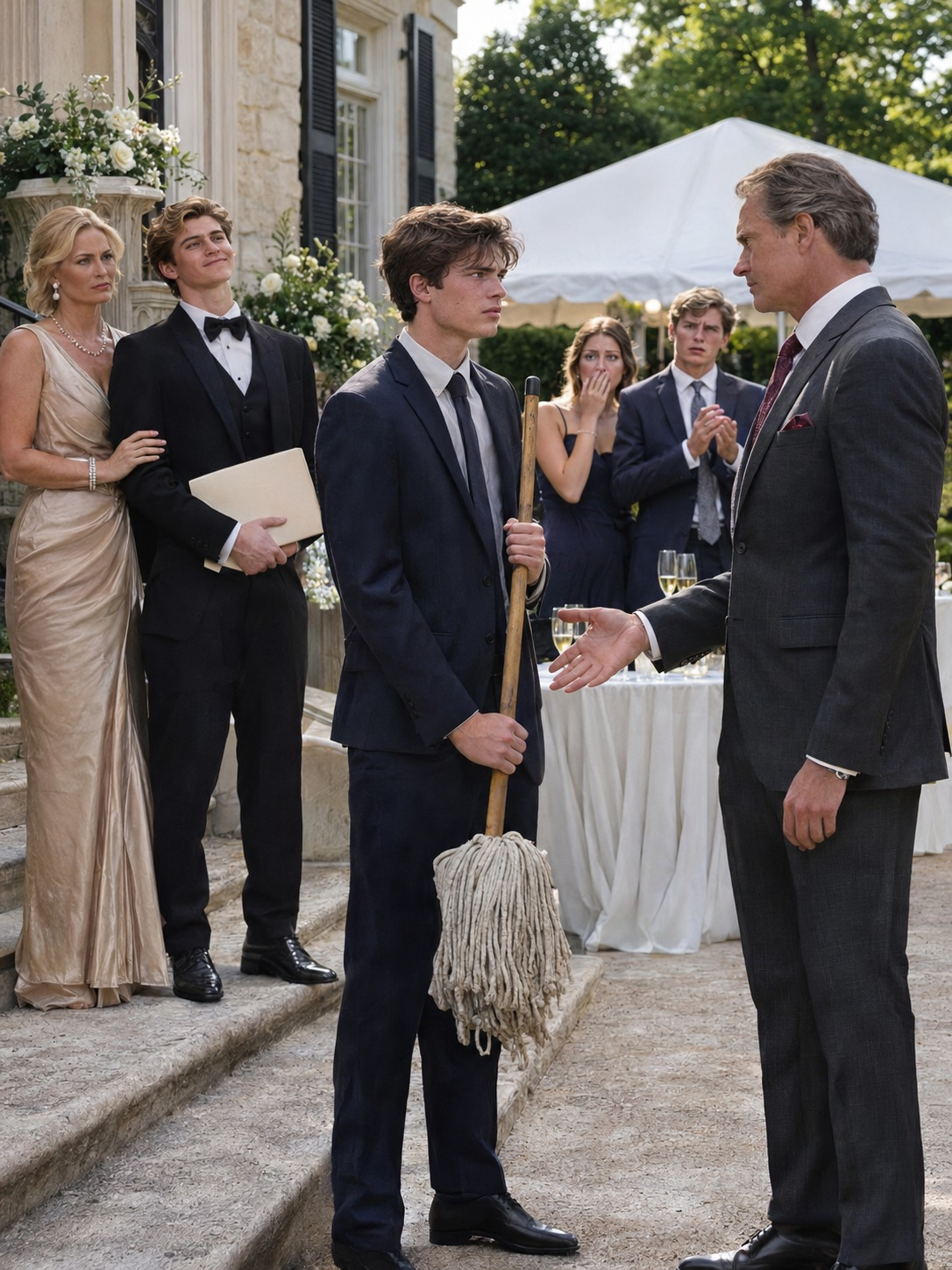
"Because if Ethan reads what's inside, he'll discover who actually owns Briarwood Hall."
My father's words hung in the air.
Rebecca immediately stepped between him and the desk.
"Richard, please step away from the documents."
Dad looked furious.
"Those papers are private property."
Patricia Wells calmly opened her folder.
"According to the estate inventory, this package was specifically designated for Ethan Mercer. We have already verified the authorization. You have no authority to prevent him from receiving it."
My father turned toward me.
"Ethan, listen to me. Whatever your grandfather wrote, it doesn't change the fact that this family built Briarwood Hall."
I looked at him.
"Then why are you afraid of a letter?"
He said nothing.
I turned toward the desk.
The sealed package was smaller than I expected. My name was written across the front in my grandfather's familiar handwriting. The edges had yellowed with age, but the seal remained intact.
I carefully opened it.
Inside was a formal legal document, several pages of handwritten notes, and a photograph.
The photograph showed my grandfather standing in front of Briarwood Hall.
Beside him was a much younger version of my father.
And behind them was a woman I recognized immediately.
My grandmother.
I turned the photograph over.
There was a handwritten message.
For Ethan. Remember that a person's worth is never measured by the position someone gives him.
I swallowed.
Then I began reading the legal document.
It was an ownership agreement.
According to the document, my grandfather had established Briarwood Hall as a family business but had placed the controlling ownership interest into a trust.
The trust had two beneficiaries.
My father had been appointed operational manager.
I had been named the future controlling beneficiary.
I read the paragraph again.
Then a third time.
I looked at Rebecca.
"What does this mean?"
She examined the document.
"It means your grandfather retained ownership through a family trust. Your father was appointed to operate the business, but he was not its sole owner."
I looked at my father.
His face had lost its color.
Rebecca continued.
"The agreement establishes that the controlling interest transfers to Ethan upon his eighteenth birthday, subject to the terms of the trust."
I felt my knees weaken.
I had turned eighteen only a few months earlier.
My grandfather had planned this years ago.
And my father had known.
"Is this legitimate?" I asked.
Patricia examined the attached certification.
"It appears to be an executed legal instrument. We'll need the estate attorney to verify the complete chain of documentation, but the signatures and registration references are consistent with the records we've reviewed."
I looked at the final page.
There was my grandfather's signature.
And beneath it, the signature of an attorney.
The document had been registered years before my grandfather died.
My father suddenly spoke.
"Your grandfather never intended you to run the venue."
I turned toward him.
"Then why did he name me?"
"He was emotional. He made decisions based on sentiment."
Rebecca closed the document.
"Richard, the agreement is legally binding unless a court determines otherwise."
Dad shook his head.
"This is absurd."
I looked at the ownership percentage.
The controlling interest belonged to me.
The venue where I had grown up.
The business my father had spent years presenting as his personal achievement.
The place where my brother had been treated like its natural heir.
It had never belonged to either of them in the way they believed.
My grandfather had left it to me.
Not because I was the perfect grandson.
Not because I had the highest grades.
But because he believed I would understand what the place was supposed to mean.
I looked at the photograph again.
Then I noticed the handwritten note attached to the legal agreement.
It was a letter.
I unfolded it.
And began reading.
Dear Ethan,
If you are reading this, you have probably reached an age when people will begin telling you what your future should look like.
Some will tell you that money makes a person important.
Others will tell you that a family name determines what you deserve.
I hope you never believe either of those things.
I built Briarwood Hall because I wanted a place where people could gather, celebrate, and feel welcome.
I did not build it so one person could stand above everyone else.
Your father has always been ambitious. I love him, but I worry that he sometimes confuses being respected with being obeyed.
Your brother is still young. He may one day discover that being handed an opportunity is not the same as earning the trust of others.
And you, Ethan, have always been willing to do the work nobody notices.
I remember the first computer you repaired. I remember how proud you were when you made it work again.
You didn't ask for applause.
You simply wanted to understand how something worked and make it useful.
That is the quality I hope you carry into adulthood.
I have placed the controlling interest of Briarwood Hall into a trust for you. Your father has been entrusted with managing the business, not owning your future.
When you turn eighteen, you will have the right to decide what happens next.
You may keep the venue.
You may sell it.
You may change the way it operates.
Or you may use it to help people who would otherwise never have the opportunity to walk through its doors.
Whatever you choose, make the decision because it is right, not because someone has made you feel guilty.
One final thing.
Never confuse kindness with weakness.
You can forgive someone without giving them permission to hurt you again.
I am proud of you, Ethan.
Not because of what you might inherit.
Because of who you already are.
Love,
Grandpa.
I lowered the letter.
For several seconds, nobody spoke.
My grandfather had been gone for six years.
Yet those words felt closer than anything my parents had said to me in eighteen.
I wiped my eyes.
I hadn't realized I was crying until Daniel quietly handed me a tissue.
My father walked toward the window.
"This changes nothing," he said.
Rebecca looked at him.
"It changes quite a lot, Richard."
The estate attorney arrived that afternoon.
His name was Michael Grant.
He had represented my grandfather for more than twenty years and had maintained the trust records after his death.
He examined the documents in the study.
Then he confirmed what Rebecca and Patricia had suspected.
The ownership agreement was valid.
The controlling interest had transferred to me when I turned eighteen.
My father retained responsibility for daily operations only under the management provisions of the trust.
He could not sell the venue, transfer its ownership, or use its assets for unrelated personal purposes without authorization.
I looked at Michael.
"Did my father know about this?"
Michael removed his glasses.
"Yes."
"How do you know?"
"Your father received annual trust statements. He also signed acknowledgments confirming that he understood the management arrangement."
I looked toward Dad.
He stared at the desk.
Michael continued.
"Your grandfather wanted to ensure that Briarwood Hall remained financially stable until you were old enough to make your own decisions."
I looked at the document.
"Why didn't anyone tell me?"
Michael hesitated.
"Your grandfather instructed me to deliver the original ownership package to you when you reached eighteen or requested it through the appropriate process."
"Did my father know?"
"Yes."
My father finally spoke.
"I never believed the arrangement would be interpreted this way."
Michael looked at him.
"Richard, the agreement is very clear."
Dad's jaw tightened.
Then he turned toward me.
"Ethan, we need to discuss this privately."
I shook my head.
"We've had enough private discussions."
He looked angry.
But he didn't argue.
The following weeks were difficult.
The grant review continued.
The Community Development Trust examined the fifty-thousand-dollar transfer, the expenditure reports, and the documents submitted under my name.
My parents were required to provide complete financial records.
The investigation established that the majority of the grant had not been spent on the approved program.
The report had included expenses without adequate supporting documentation.
The transfer to Harrison's personal account was also examined.
Harrison cooperated with the review and provided his bank statements.
He returned the remaining money and agreed to repay the portion he had used for personal expenses.
The Community Development Trust required Briarwood Hall to reimburse the improperly documented grant funds before becoming eligible for future funding.
My father was removed from his role as the venue's authorized grant administrator.
The municipal partnership application was withdrawn.
It was not a decision I celebrated.
I knew the financial consequences would be serious.
But the people who had donated money to support the program deserved to know where it had gone.
And the community deserved an honest explanation.
My parents eventually issued a written correction acknowledging that Harrison had not founded the mentorship initiative.
The council updated its records.
The official project documentation identified me as the original developer, with Daniel Brooks and the Ashford Community Technology Center recognized as essential partners.
For the first time, my name appeared where it should have been from the beginning.
A month later, I met with Michael, Rebecca, and Daniel to discuss Briarwood Hall.
The ownership transfer was complete.
I was now the controlling beneficiary and legal owner through the family trust.
My father was no longer the person making every decision.
I could have dismissed him immediately.
I could have sold the venue.
I could have changed everything simply because I finally had the power.
But I remembered my grandfather's letter.
The venue itself wasn't the problem.
The problem had been the way my father used it.
So I proposed something different.
Briarwood Hall would continue hosting weddings, corporate events, and private celebrations.
The business would remain financially independent.
But we would create a community education wing using part of the property.
The ballroom would host free educational events on selected weekends.
The computer rooms would be upgraded.
The gardens would be available for community gatherings.
And the mentorship program would operate as an independent nonprofit partnership with the technology center.
Daniel listened carefully.
"Are you sure you want to do this?"
I nodded.
"Grandpa built this place so people could come together. I think we should remember that."
Rebecca smiled.
"That's a meaningful direction."
Michael reviewed the proposal.
"Your grandfather would have approved."
I looked at the photograph I had brought from the study.
"I hope so."
Harrison changed more slowly than I expected.
He moved out of the family home and found a small apartment near downtown Ashford.
He stopped introducing himself as a startup founder.
Instead, he took a job with a local business development company.
At first, I barely heard from him.
Then one afternoon, he appeared at the technology center.
He was wearing jeans and a simple gray sweater.
He carried two boxes.
"What's that?" I asked.
"Refurbished computers."
I looked inside.
There were six laptops.
"Where did you get them?"
"I bought them."
"With what money?"
He gave a small, uncomfortable smile.
"My salary."
I nodded.
He placed the boxes on the table.
"I thought the students could use them."
I looked at him.
"Thank you."
He stood awkwardly.
Then he said, "I know buying computers doesn't fix anything."
"No, it doesn't."
"I also know I don't deserve to be treated like nothing happened."
I waited.
He looked down.
"I've been thinking about what you said. About earning trust."
I nodded.
"What do you want from me, Harrison?"
He seemed surprised by the question.
"Nothing."
I studied him.
"I just wanted to do something useful."
For the first time, I believed him.
We spent the next hour checking the computers.
He helped Caleb install educational software.
He carried equipment into the classroom.
He asked Margaret whether she needed help setting up her email.
He didn't ask anyone to take a photograph.
He didn't tell anyone he was in charge.
He simply helped.
When we finished, he stood beside me near the entrance.
"Maybe Grandpa was right about you," he said.
I looked at him.
"He was right about a lot of things."
Harrison nodded.
Then he added, "I'm sorry, Ethan."
This time, he didn't make excuses.
He didn't blame Dad.
He didn't mention the pressure of being the favorite.
He simply apologized.
I looked at him for a long moment.
"I appreciate that."
It wasn't complete forgiveness.
Not yet.
But it was a beginning.
My mother came to see me two weeks later.
She arrived at Briarwood Hall on a quiet Saturday morning.
I was in the garden reviewing the renovation plans.
She approached slowly.
"Can we talk?"
I put down the papers.
"Sure."
She sat on a nearby bench.
For several seconds, she looked at the fountain.
Then she said, "I've been thinking about graduation."
I remained quiet.
"I should never have allowed your father to give you that mop."
I looked at her.
"Yes."
"I should have stopped him."
"Yes."
She wiped her eyes.
"And I should never have sent that application."
I nodded.
She continued.
"I convinced myself I was helping Harrison. I thought he needed more support than you did."
I looked at her.
"Why?"
She took a breath.
"Because you always seemed capable of handling things yourself."
I considered that.
It was probably true.
I had learned to solve my own problems because asking for help rarely changed anything.
But that didn't mean I hadn't needed support.
"I needed you too, Mom."
She began crying.
"I know."
I looked toward the garden.
The workers were installing new benches near the fountain.
The same fountain where the graduation photographers had taken pictures of Harrison holding his check.
"I don't know if everything can go back to normal," I said.
She nodded.
"I understand."
"But I don't want to spend my life being angry."
She looked at me.
I continued.
"If we have a relationship again, it has to be different. No comparisons. No pretending Harrison's achievements belong to someone else. No expecting me to fix things just because I'm good at fixing them."
She nodded.
"I can try."
"Trying is a start."
She reached for my hand.
I let her hold it.
It wasn't a complete reconciliation.
But it was honest.
And honesty was more than we had shared in years.
Six months later, the new community education center opened inside Briarwood Hall.
The former administrative wing had been renovated.
There were twelve computers, a small classroom, a meeting room, and a quiet space where older residents could receive individual assistance.
The original mentorship program had grown beyond anything I imagined.
More than three hundred participants had registered.
Students from local high schools volunteered after class.
Retired residents taught practical skills in return.
Daniel became the program's official director.
I continued developing the software and managing the technical infrastructure.
Laura Bennett's nonprofit organization offered me a paid internship.
I accepted.
It gave me the opportunity to work on digital education projects across Ohio while continuing to support the Ashford program.
I also enrolled in a computer science program at a nearby university.
For the first time, my future felt like something I was building myself.
Not something my parents had assigned me.
Not something I had to earn through endless approval.
Something I genuinely wanted.
On the anniversary of my grandfather's birthday, we held a small celebration at Briarwood Hall.
There were no expensive decorations.
No business speeches.
No photographers hired to capture a perfect family image.
Just students, volunteers, residents, and people who had become part of the program.
Margaret stood near the entrance.
She was holding a tablet.
"Ethan!"
I turned.
"Yes?"
"Look!"
She showed me a photograph of her granddaughter.
They were smiling together during a video call.
"I can do this all by myself now," she said proudly.
I smiled.
"You always could. You just needed a little practice."
She laughed.
Across the room, Caleb was helping an older gentleman set up a new email account.
Daniel was talking with several volunteers.
Harrison was carrying chairs.
My mother was arranging refreshments.
My father wasn't there.
He had moved away from the daily operations of Briarwood Hall and was living separately.
Our relationship remained distant.
We exchanged occasional messages, but I wasn't ready to rebuild what he had broken.
And I had finally accepted that I didn't need to force forgiveness to prove I was a good person.
Some relationships needed time.
Some needed boundaries.
And some might never return to what they had been.
That was all right.
I had a life beyond them.
After the celebration, I returned to my grandfather's old study.
The room had been renovated, but I had kept his desk and photograph.
The wooden bird still sat beside the brass lamp.
I placed the handwritten letter inside a frame.
Then I looked at the photograph of us together.
I was twelve.
He was smiling.
And I was holding the little wooden bird.
I remembered the day he gave it to me.
He had told me that a person didn't need to be the loudest in the room to make a difference.
At the time, I hadn't understood.
Now I did.
My parents had spent years measuring success through appearances.
Money.
Cars.
Titles.
Applause.
But the most valuable thing I had built wasn't a business or a software platform.
It was a place where people felt welcome.
A place where students could discover their abilities.
A place where older residents could learn something new.
A place where nobody had to prove they deserved respect.
I looked at the framed letter one last time.
Then I switched off the desk lamp.
The following morning, I arrived early for the first class of the new semester.
The students were already gathering.
Caleb waved from the computer room.
Daniel stood near the entrance with a clipboard.
Margaret was showing a new participant how to use a tablet.
I walked toward the classroom.
On the wall was a framed photograph from graduation.
It wasn't the photograph of Harrison holding the fifty-thousand-dollar check.
It was a picture of the first mentorship class.
Twenty people sitting around a table.
Some were teenagers.
Some were grandparents.
All of them were smiling.
Underneath it was a small plaque.
THE ASHFORD COMMUNITY TECHNOLOGY PROGRAM
Built through patience, knowledge, and the belief that everyone deserves an opportunity.
I stood there for a moment.
Then Daniel approached.
"Ready?"
I smiled.
"Ready."
He handed me a marker.
The students were waiting.
I walked to the whiteboard and wrote the first lesson.
BUILD SOMETHING THAT HELPS SOMEONE.
For a second, I thought about the graduation reception.
The check.
The mop.
My father's laughter.
My mother's smile.
And the boy who had quietly packed his bags because he finally understood that staying would mean accepting a life someone else had chosen for him.
I didn't hate that boy anymore.
He had done the hardest thing.
He had walked away.
And because he did, he had finally found his way back to himself.
The first student raised his hand.
"Mr. Mercer, where do we start?"
I looked around the room.
At the people waiting to learn.
At the computers we had built together.
At the future that no longer belonged to anyone else's expectations.
I smiled.
"Right here."
And for the first time, the name Mercer didn't feel like a weight I had to carry.
It felt like a name I could give meaning to myself.






Comments 0