"There's a reason Dad was so sure you would never find out."
I looked at Harrison.
He was standing in the courtyard outside the technology center, holding a folder that seemed suddenly much heavier than paper should have been.
"What reason?"
He glanced toward the glass entrance.
Then he looked back at me.
"Because Dad knows how badly you wanted him to be proud of you."
I didn't answer.
Harrison continued.
"He thought you'd rather accept being overlooked than risk losing your place in the family."
I looked down at the handwritten note.
Use Ethan's work. He won't challenge his family.
My mother's signature appeared above it.
For several seconds, I couldn't move.
I had expected my father to favor Harrison.
I had expected my mother to defend him.
I had even expected them to dismiss my achievements.
But seeing those seven words was different.
They hadn't simply assumed I would remain silent.
They had planned around it.
I took a photograph of the page.
Then I looked at Harrison.
"Does Dad know you have this?"
"No."
"Does Mom?"
"I don't think so."
"Why did you take it?"
He rubbed the back of his neck.
"Because I started wondering what would happen if the council asked me questions I couldn't answer."
I studied his face.
For the first time, my brother looked like someone who had discovered that the life he had been handed came with obligations he had never considered.
"Did you read the entire application?"
"Most of it."
"And?"
He swallowed.
"There's another section about the funding."
"What does it say?"
"It describes the fifty thousand dollars as an investment made directly into the program."
I stared at him.
"But you received the money."
"I know."
"Did you use it for the program?"
He looked away.
"Not all of it."
"How much?"
He didn't answer immediately.
"Almost none."
I felt my stomach tighten.
"How much, Harrison?"
He finally looked at me.
"About four thousand went toward equipment. The rest went into my personal account."
I closed my eyes.
The number didn't surprise me as much as the fact that he had admitted it.
"Did Dad tell you to spend it?"
"He said it was mine."
"Then why did he put it in the application as program funding?"
"I don't know."
I looked at the folder.
"Did he tell you the council would see those records?"
"No."
For a moment, we stood without speaking.
Then I handed the folder back.
"You need to tell Rebecca exactly what you know."
Harrison nodded.
"Will you come with me?"
I shook my head.
"Not to tell your story."
His expression changed.
"Ethan—"
"You need to explain your own decisions. I can tell them what I know, but I won't speak for you."
He looked down.
Then he nodded again.
"Okay."
I turned toward the building.
Behind me, Harrison said my name.
I stopped.
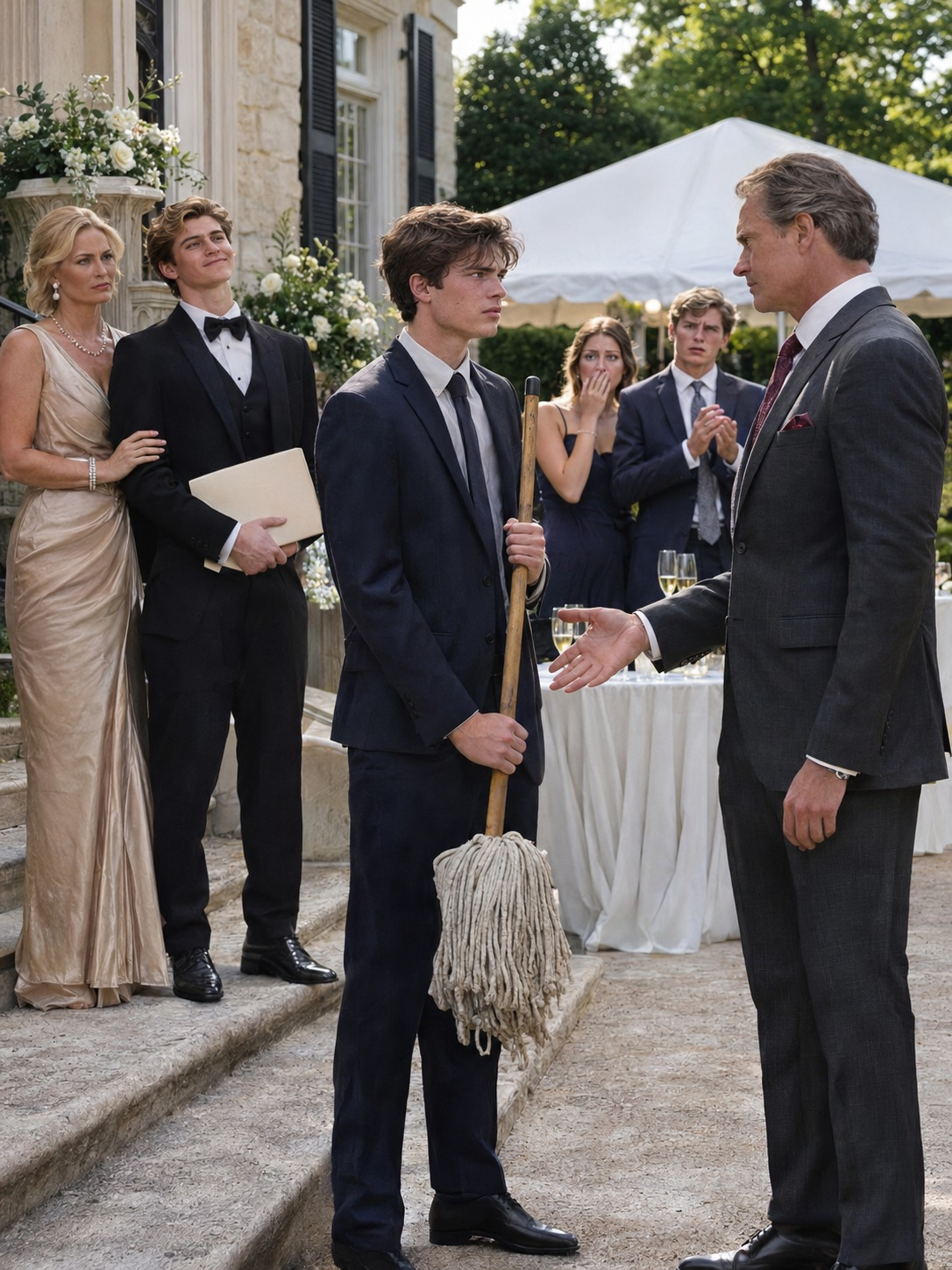
"I'm sorry about the mop."
I looked over my shoulder.
He seemed uncomfortable saying it.
But he had said it.
"That wasn't the only thing," I replied.
"I know."
I went inside.
For the first time, my brother had apologized.
But I wasn't ready to pretend that an apology could erase eighteen years.
Daniel was waiting in his office.
He looked up when I entered.
"Everything all right?"
I placed the photograph on his desk.
He read the handwritten note.
His expression changed.
"Where did you get this?"
"Harrison brought it."
Daniel read it again.
Then he looked at me.
"They wrote that about you?"
I nodded.
He leaned back.
For several seconds, he said nothing.
Then he asked, "How are you feeling?"
I considered the question.
"Honestly, I don't know."
"That's fair."
I sat down.
"I think I've spent my entire life trying to prove I wasn't the person they thought I was."
Daniel listened.
"And now I find out they knew exactly what I could do. They just didn't think I would ever stand up for myself."
Daniel folded his hands.
"People sometimes mistake patience for permission."
I looked at him.
"I don't want revenge."
"Then don't pursue revenge."
"I want the council to know what happened."
"That's reasonable."
"And I don't want the program damaged because of my family."
Daniel nodded.
"Then we keep the focus on the program."
I opened my laptop.
We saved the photograph, recorded where it came from, and prepared a message to Rebecca.
I explained that Harrison had voluntarily shown me the application page and that I had photographed it during our conversation.
I didn't claim to know who wrote the handwritten note.
I didn't speculate about why it had been included.
I simply provided the evidence.
Rebecca replied less than fifteen minutes later.
REBECCA: We have received the image. Please preserve the original document if possible. We would also like to speak directly with Harrison regarding the financial declaration and his role in the application.
I showed Daniel.
He nodded.
"That's appropriate."
I forwarded the message to Harrison.
His reply came almost immediately.
HARRISON: I'll contact her.
For once, he didn't ask me to fix anything.
At six that evening, the first call from my mother came.
I was helping Caleb troubleshoot a registration problem when my phone vibrated.
Mom.
I ignored it.
It rang again.
Then Dad.
I silenced the phone.
Caleb looked up.
"Everything okay?"
"Yeah. Just family stuff."
He returned to his screen.
A few minutes later, my phone began vibrating continuously.
I finally stepped into the hallway.
There were seven missed calls.
Four from Mom.
Three from Dad.
Then another message appeared.
MOM: Ethan, please call me. We need to talk before tomorrow.
I stared at it.
I had heard those words before.
Every time my parents wanted something, they described it as a family conversation.
I called her back.
She answered immediately.
"Ethan!"
"Hi, Mom."
"Where are you?"
"At the technology center."
"Are you alone?"
I glanced through the glass door.
"Yes."
"Your father and I need you to come home."
"For what?"
"There's been a misunderstanding."
I closed my eyes.
"About what?"
She hesitated.
"Your brother told us you've been speaking to people about the application."
"Yes."
"Why would you do that?"
"Because the council asked me for the original records."
"Couldn't you have spoken to us first?"
I looked at the wall.
"I tried."
She sighed.
"Your father is extremely upset."
"Why?"
"Because this could affect the future of Briarwood Hall."
I almost laughed.
"What about the future of the technology program?"
She didn't answer.
"Mom, did you write the note?"
"What note?"
"The one that said I wouldn't challenge the family."
Silence.
I could hear her breathing.
Then she said, "Where did you see that?"
"Harrison showed it to me."
Her voice became sharper.
"Your brother had no business taking documents from your father's office."
"That's not what I asked."
She didn't respond.
I waited.
Finally, she said, "Your father was trying to protect the family."
"From what?"
"From unnecessary conflict."
I stared at the phone.
"By using my work without telling me?"
"Nobody used your work."
"Then why did the application describe Harrison as the founder?"
"Because he was going to lead the project."
"He didn't build it."
"He's your brother."
I felt something tighten in my chest.
"That doesn't make him the founder."
She sighed again.
"Ethan, please. You're eighteen. You don't understand how complicated business can be."
I looked at the computer lab.
Caleb was now helping another student.
Margaret had arrived and was sitting near the entrance.
"Maybe I don't understand business," I said. "But I understand who wrote the code."
My mother lowered her voice.
"Your father wants to offer you a position."
"He already offered me one."
"This time it's different."
"How?"
"An actual management role. A salary. Benefits. We can help you get settled. You won't have to stay at that center."
I looked at the desk.
The same place where I had spent five months building the program.
"Mom, I don't need to leave the center."
"You could have a much better future at Briarwood Hall."
"Doing what?"
She paused.
"Managing the technology department."
I almost smiled.
"Would I be allowed to manage the program I created?"
"Of course."
"Would Harrison still be the founder?"
No answer.
"Would you correct the application?"
Silence.
I understood.
The offer wasn't an apology.
It was another attempt to make me cooperate.
"Mom, I need to go."
"Wait, Ethan."
I stopped.
"Please don't make your father angry."
I looked at the phone.
Then I ended the call.
At 7:12 p.m., my father called.
I answered because I wanted to hear what he had to say.
"Ethan."
"Dad."
"We need to resolve this."
"Then tell the council the truth."
He exhaled.
"You don't understand the situation."
"Explain it."
"Briarwood Hall has an opportunity to secure a major municipal contract."
"I know."
"And your behavior is putting that at risk."
"My behavior?"
"Your refusal to cooperate."
I leaned against the wall.
"Cooperate with what?"
"With the family."
I closed my eyes.
There it was again.
The word they used whenever they wanted me to sacrifice something.
"Did you submit a document with my signature?"
He didn't answer immediately.
Then he said, "The paperwork was handled through the office."
"Did I sign it?"
"You knew we were preparing the application."
"That isn't what I asked."
His voice hardened.
"Don't be disrespectful."
I felt my jaw tighten.
"Did I sign it?"
A long silence followed.
Then he said, "We were acting in everyone's best interests."
I stared at the floor.
"That's not an answer."
"You are making this much more difficult than it needs to be."
I almost laughed.
"How?"
"By refusing to understand what this family has done for you."
I said nothing.
He continued.
"We paid for your education. We gave you a home. You have had every advantage."
I looked toward the computer lab.
"And I gave you a program."
He went silent.
"Five months of work. Two hundred participants. A scheduling platform. Tutorials. Volunteers. Everything."
"Which is exactly why we're trying to build something bigger with it."
"Without asking me."
"You're part of this family."
"Then why did you give Harrison the credit?"
My father exhaled sharply.
"Because Harrison understands the business side."
"And I understand the program."
"Exactly."
I couldn't believe what I was hearing.
He was still using the same explanation.
The same division that had defined our childhood.
"Come home tomorrow morning," he said.
"No."
His voice dropped.
"Ethan."
"I'm not signing anything."
"You don't know what you're refusing."
"Then explain it."
He paused.
Then he said, "If you attend that gala tomorrow and challenge your brother in front of those people, don't expect things to go back to the way they were."
I looked at the photograph of the mop that was still saved on my phone.
"I don't expect them to."
I ended the call.
By eight o'clock, I had thirty-two missed calls.
Mom.
Dad.
Harrison.
Mom again.
Dad again.
Some were ordinary calls.
Others came through messaging applications.
My mother had sent six messages.
My father had sent three.
Harrison had sent one.
HARRISON: Dad knows I showed you the folder. He's furious.
I typed back.
ME: Did you tell him everything?
He replied.
HARRISON: No.
Then another message arrived.
HARRISON: He knows about the document.
I stared at the screen.
ME: Which document?
There was a pause.
Then:
HARRISON: The original funding agreement.
I sat upright.
I hadn't seen that agreement.
I had only seen the application and the disputed transfer document.
ME: Where is it?
Harrison took almost a minute to reply.
HARRISON: In Dad's office.
I waited.
Then he sent another message.
HARRISON: Ethan, there's something in it about the original source of the $50,000.
I looked toward Daniel's office.
He was speaking with a volunteer.
I typed:
ME: What source?
The typing indicator appeared.
Then disappeared.
Then Harrison sent a photograph.
It showed the first page of a formal agreement between Briarwood Hall and an outside organization.
The date was February 21.
The amount was fifty thousand dollars.
But the name at the top wasn't my father's.
It was the Ashford Community Technology Center.
I read the page again.
Then I zoomed in.
The agreement described the money as a restricted community development grant.
It was intended to support the mentorship initiative.
And beneath the description was a sentence that changed everything.
"Funds must be used exclusively for the development, operation, and expansion of the Ethan Mercer Mentorship Program."
I felt my hands go cold.
I called Harrison.
He answered immediately.
"Where did you get this?"
"In Dad's office."
"Did the center receive the money?"
"I don't know."
"Does Dad know I have this?"
"Yes."
I stood up.
"Why?"
Harrison's voice trembled.
"Because I think he knows the council is about to find out."
The next morning, Daniel arrived early.
I showed him the photograph.
He read the agreement carefully.
Then he looked at me.
"Where did this come from?"
"Harrison."
Daniel opened the center's financial archive.
We searched the grant records.
Nothing appeared.
No incoming payment.
No deposit.
No record of the fifty thousand dollars.
He searched the bank reconciliation files.
Still nothing.
Then he opened the correspondence archive.
The first message was dated February 21.
It came from an organization called the Ashford Community Development Trust.
The message explained that the trust had approved a fifty-thousand-dollar grant to support the mentorship initiative.
But the funds would be administered through a sponsoring organization.
The proposed sponsor was Briarwood Hall.
Daniel read the message twice.
"Your father may have been appointed as the financial administrator."
I leaned closer.
"Does that mean he received the money?"
"It means we need to find the disbursement records."
He opened the attachment.
It was a payment confirmation.
The grant had been transferred to a Briarwood Hall business account on February 24.
I stared at the date.
My father had received the money.
The community center had never received it.
And two weeks later, he had withdrawn his offer of a separate donation.
I felt sick.
Daniel immediately contacted Rebecca.
He explained what we had found and forwarded the original correspondence.
Rebecca responded within minutes.
She asked us to preserve the documents and confirmed that the council would review the grant's administration.
I looked at Daniel.
"Can they ask for the money back?"
"That depends on the grant agreement and what the records show."
I nodded.
Then I opened the original document again.
There was another page.
A page Harrison hadn't photographed.
I scrolled down.
At the bottom was a clause about the final report.
It required the sponsoring organization to submit a detailed account of how the money had been used.
I looked at the date.
The report had been submitted two days before graduation.
I opened it.
The first expense was software development.
The second was equipment procurement.
The third was volunteer administration.
The fourth was program expansion.
Every category described work I had already completed.
But there was something else.
The final page listed a payment recipient.
I leaned closer.
The money had been transferred to a personal account.
The account holder's name was Harrison Mercer.
I stared at the screen.
Daniel slowly turned toward me.
"Does Harrison know about this?"
I shook my head.
"I don't think so."
My phone vibrated.
A message from Harrison.
HARRISON: Ethan, Dad just told me something.
Another message appeared.
HARRISON: He says the $50,000 wasn't a gift. He says it was an advance against the municipal contract.
I read it twice.
Then the phone began ringing.
Mom.
I answered.
"Ethan!"
Her voice was shaking.
"Your father wants you to come home immediately."
I looked at the report.
"Why?"
She took a breath.
Then she said:
"Because the city council has just requested the original bank statements, and your father says you are the only person who can help us explain where the money went."
I sat completely still.
Three days earlier, I had walked away from Briarwood Hall carrying a backpack.
Now my family was asking me to explain fifty thousand dollars they had never told me existed.
And before I could answer, my mother whispered one more thing.
"Rebecca Sullivan is coming to Briarwood Hall today. She's bringing someone from the Community Development Trust."






Comments 0