"Because Dad just found out who Rebecca invited to sit at the main table."
I gripped my phone.
"Who?"
Harrison lowered his voice.
"Daniel Brooks."
I stared at the wall.
"And?"
"Margaret. Robert. Some of those students from the technology center."
I slowly leaned back in my chair.
"Why would that matter?"
Harrison let out an irritated breath.
"Because they're going to talk about the program. They know you built it."
I almost laughed.
For the first time, Harrison seemed to understand that the people who had actually worked with me might remember what happened.
"That's the point," I said.
"No, Ethan. You're not listening. Dad has spent weeks arranging this event. Important people are coming. The city council. Business owners. Potential clients. If those people start questioning the presentation, Briarwood Hall could lose the contract."
"Then maybe you should tell them the truth."
"You're unbelievable."
He ended the call.
I stared at my phone for several seconds.
Then I placed it beside my laptop.
Daniel had been standing near the computer lab entrance.
"Was that Harrison?"
"Yes."
"What did he want?"
I told him about Rebecca's invitation.
Daniel nodded slowly.
"That makes sense."
"Why?"
"Because the council needs people who can independently confirm how the program started. Your records establish the development history. The volunteers can confirm who organized the sessions. The participants can explain what the program actually did."
I looked at him.
"Do you think my parents understand that?"
Daniel gave a small, tired smile.
"I think they understand it better than they'd like to."
I turned toward the window.
Tomorrow evening, Harrison would stand in front of a room full of people and introduce himself as the founder of something he hadn't created.
My parents would sit proudly in the front row.
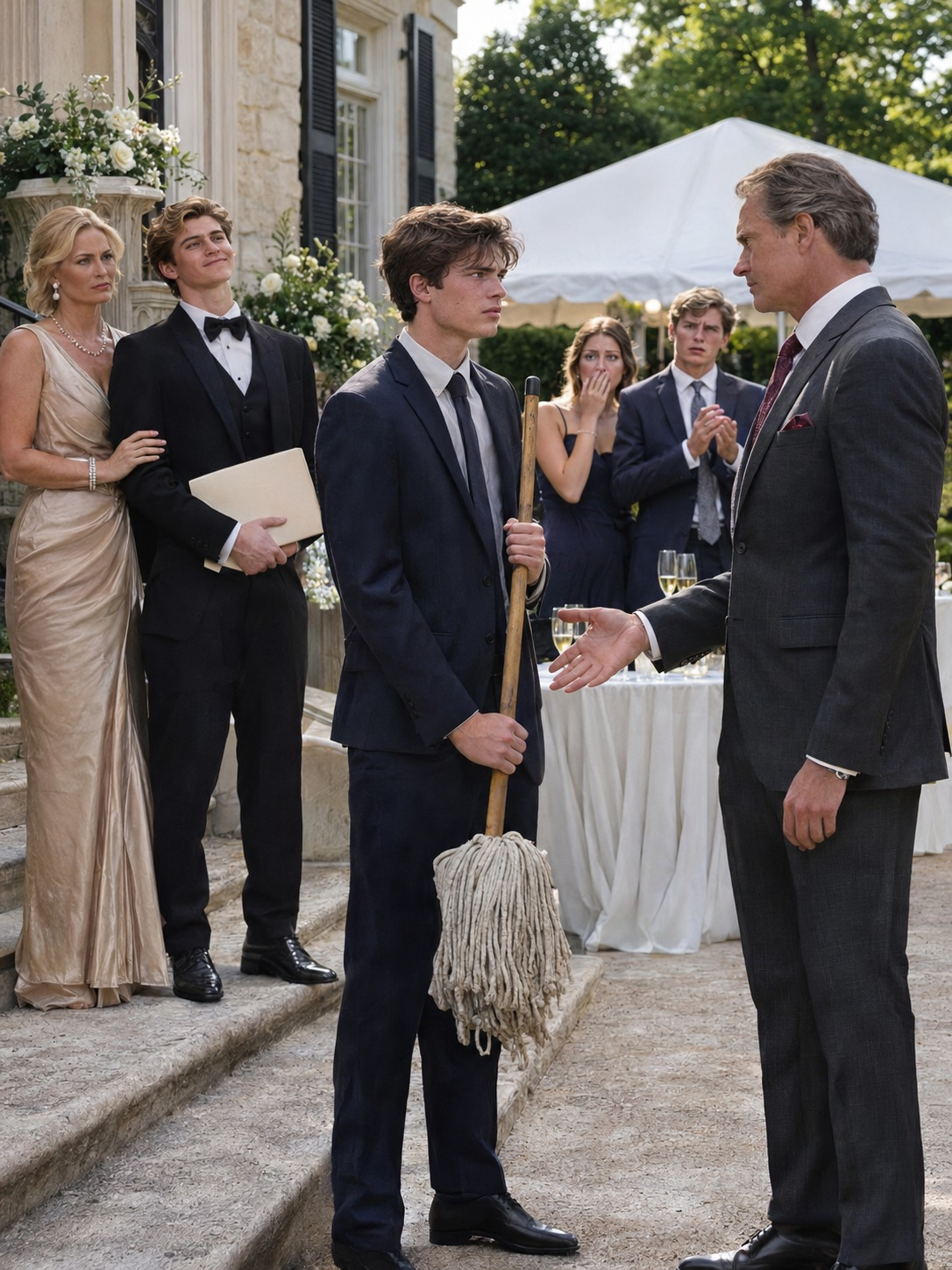
The same people who had watched my father hand me a mop would be there.
And this time, the people who knew the truth would also be in the room.
For the first time, I wasn't afraid of being ignored.
I was afraid of what my family might do when they realized they couldn't control the story anymore.
The next morning, Daniel received a call from Rebecca.
She wanted to confirm the attendance arrangements for the Community Voices Gala.
I sat at the staff desk while he spoke.
He asked several questions about the seating arrangement, the presentation schedule, and the council's review process.
When he finished, he put his phone down.
"She wants us there at six."
"Who is going?"
"You, me, and several representatives from the program."
I nodded.
"Margaret and Robert?"
"Both of them."
"And the students?"
"Caleb and two others volunteered to attend."
I looked toward the computer lab.
Caleb was sitting at a table, working on a small website.
He had no idea how much his presence might matter tomorrow.
I walked over.
"Hey, Caleb."
He looked up.
"What's up?"
"Daniel mentioned you might be attending the gala tomorrow."
"Yeah. Is that still happening?"
"Probably."
He smiled.
"Cool. I've never been to one of those fancy events."
I pulled out a chair.
"There's something you should understand."
His expression became more serious.
"Okay."
"The presentation tomorrow is about the mentorship program. Some people may ask questions about how it started and who developed it."
Caleb nodded.
"That's you."
"Yes, but I don't want you to feel like you have to defend me."
He frowned.
"Why wouldn't I?"
"Because that's not your responsibility."
He closed his laptop.
"Ethan, you helped me learn how to code. You helped me build my first website. You also helped my grandfather figure out his computer."
He paused.
"If somebody asks me who built the program, I'm going to tell them."
I looked at him.
There was something deeply reassuring about hearing that from a sixteen-year-old.
"Just tell them what you remember," I said.
"That's all I was planning to do."
At lunchtime, Margaret arrived carrying her usual notebook.
She had recently learned how to organize photographs into folders and was extremely proud of herself.
"Ethan, I have exciting news."
"What happened?"
"I sent my grandson the pictures from our last family gathering without asking him to help me."
I smiled.
"That's great."
"Do you know how long I struggled with that?"
"About three weeks?"
"Three weeks and two very frustrating phone calls."
We laughed.
Then she noticed Daniel standing near the office.
"Is something happening tomorrow?"
Daniel explained the invitation.
Margaret listened carefully.
When he finished, she looked at me.
"Will your parents be there?"
"Yes."
She frowned.
"I see."
I didn't want her to feel uncomfortable.
"You don't have to attend if you don't want to."
She gave me a look.
"Ethan, I am seventy-two years old. I have attended more uncomfortable dinners than you have had birthdays."
I laughed.
She placed her notebook on the desk.
"I'll be there."
A few minutes later, Robert arrived.
He had worked at a manufacturing plant for almost thirty years before retiring.
When I first met him, he had been nervous about using email.
He thought every unfamiliar button might delete something important.
Now he regularly helped other participants with basic computer problems.
Daniel told him about the gala.
Robert listened without interrupting.
Then he shook his head.
"That young man is going to stand there and take credit for your work?"
I shrugged.
"That's what the brochures say."
Robert looked toward me.
"Well, I'll be there."
"Robert, you don't have to."
"I know."
He pulled a chair closer.
"But I want to."
He looked at Daniel.
"Do you remember when we started the first computer class? Half the people couldn't even log into their accounts."
Daniel smiled.
"I remember."
"And Ethan stayed until almost ten at night helping us."
Robert turned back to me.
"That boy never asked for anything."
I lowered my eyes.
I didn't know what to say.
For years, I had wanted my parents to notice the hours I spent working.
Now people who had never owed me anything were volunteering to stand beside me.
It was difficult to explain how much that meant.
That afternoon, my mother called.
I almost let it go to voicemail.
But something made me answer.
"Ethan?"
"Hi, Mom."
Her voice sounded unusually gentle.
"How are you?"
"I'm fine."
"Where are you staying?"
"At the technology center for now."
She sighed.
"Your father is very upset about that."
I waited.
"He's worried people will start asking questions."
I looked at Daniel.
He was reviewing a volunteer schedule.
"What questions?"
"About the family."
I almost smiled.
"Mom, the council is reviewing the program."
"I know."
"Then why are you worried about people asking about the family?"
She paused.
"Because your father has worked very hard to build Briarwood Hall."
I said nothing.
"He has relationships with those people. He has spent years making sure the venue succeeds."
"I know."
"And Harrison has worked hard to prepare for this presentation."
I closed my eyes.
"Has he?"
"Ethan, please don't do this."
"Do what?"
"Make everything about who gets credit."
I looked at the computer screen.
The original scheduling platform was still open.
Two hundred participants.
Dozens of volunteers.
Hundreds of hours of work.
"Mom, the program has nothing to do with who gets credit for a family business. It belongs to the people who built it."
She sighed.
"Your father says you have become very difficult."
I almost laughed.
"That's interesting."
"What is?"
"Nobody called me difficult when I was fixing the computers downstairs."
Silence.
I continued.
"Nobody called me difficult when I was helping the accounting office. Nobody complained when I spent weekends helping the kitchen staff. Nobody had a problem with me working on the program until Harrison wanted to present it."
Her voice softened.
"You're taking this too personally."
I stared at the desk.
"Maybe I should have."
"Ethan—"
"I need to go, Mom."
She quickly interrupted.
"Wait. Your father wants to offer you something."
I stopped.
"What?"
"A position at Briarwood Hall."
I looked toward Daniel.
"What kind of position?"
"Technology manager. A proper salary. Your own office."
I almost couldn't believe what I was hearing.
For eighteen years, my father had told me I was better suited to practical work.
Now, after the council began asking questions, he was offering me a title.
"Why now?"
"Because he wants to make things right."
I leaned back.
"Does that include correcting the brochures?"
She didn't answer.
"Does it include telling the guests that Harrison didn't create the program?"
Another silence.
"Your brother has already prepared his speech."
I nodded slowly.
"Then I guess the offer isn't really about making things right."
"Ethan, please. Don't reject something before considering it."
"I'll think about it."
I ended the call.
Daniel looked at me.
"Job offer?"
"Apparently."
He raised an eyebrow.
"What did they offer?"
"Technology manager at Briarwood Hall."
Daniel considered that.
"Would you want the job?"
I looked at the screen.
Then I shook my head.
"Not if I have to pretend Harrison built something he didn't."
By late afternoon, the first promotional photographs from the gala appeared on Briarwood Hall's social media account.
Harrison stood in front of the mansion.
He wore a tailored navy suit and held a glossy brochure.
The caption read:
Proud to announce our upcoming Community Voices Gala presentation, led by Harrison Mercer, founder of the Ashford Community Technology Initiative.
I stared at the photograph.
Within an hour, it had received dozens of comments.
Local business owners congratulated him.
Somebody wrote that the Mercer family was an inspiration.
Another person said they were looking forward to hearing his vision for the future.
I scrolled through the comments.
My name appeared once.
A former classmate had written:
"Wasn't Ethan the one who built the original program?"
The comment disappeared a few minutes later.
I refreshed the page.
It was gone.
I showed Daniel.
He studied the screen.
"Take a screenshot."
I did.
Then I saved the original post.
I wasn't interested in arguing online.
But I wanted a record of how the program was being presented.
A few minutes later, another post appeared.
This one showed my father standing beside Harrison in the ballroom.
The caption described them as the driving force behind Briarwood Hall's new community initiative.
My mother had shared it.
She added:
So proud of my boys and the wonderful future ahead of them.
I stared at that sentence.
My boys.
For a moment, I wondered whether she had forgotten that I existed.
Then I remembered the photograph of the mop.
I locked my phone.
That evening, Daniel helped me prepare for the gala.
We reviewed the original invitation.
I checked my navy suit.
It was still the same one I had worn to graduation.
The jacket had a small loose thread near the cuff.
Daniel noticed.
"Do you have another suit?"
"No."
He looked at me.
"That's all right."
He opened a cabinet in his office.
Inside were several donated formal jackets from previous community events.
A dark charcoal suit hung near the back.
It looked almost new.
"One of our former volunteers donated this last year. It might fit."
I tried it on.
The shoulders were slightly loose, but the sleeves were fine.
Daniel nodded.
"Better."
I looked at myself in the mirror.
I didn't look like Harrison.
I didn't have his expensive watch or designer shoes.
But I looked like myself.
And for once, that was enough.
At 8:42 p.m., my phone rang again.
This time, it was Dad.
I answered.
"Ethan."
His voice was firm.
"I want you at Briarwood Hall tomorrow afternoon."
"For what?"
"We're going to settle this before the gala."
"I already have plans."
"Cancel them."
I looked at Daniel.
He had stopped sorting papers.
"That's not going to happen."
My father sighed.
"You're making a serious mistake."
"Why?"
"Because you're about to embarrass your brother in front of the entire city."
I felt my jaw tighten.
"Nobody is asking me to embarrass him."
"Then stay away from the presentation."
I didn't answer.
Dad continued.
"Harrison has worked extremely hard. He deserves this opportunity."
I looked at the original proposal beside my laptop.
"Then he should present his own work."
My father lowered his voice.
"Listen to me carefully. You have no idea how much is at stake."
"Then explain it."
There was a long silence.
Finally, he said, "The municipal contract could secure Briarwood Hall's future for years."
I sat upright.
"How much is it worth?"
"That's none of your concern."
"Then why are you asking me to give up the program?"
"Because this family needs to move forward."
I looked at the phone.
The same family that had given Harrison fifty thousand dollars and handed me a mop was now asking me to sacrifice my work for its future.
"I need to go," I said.
"Don't you dare hang up on me."
I ended the call.
For several seconds, I sat completely still.
Daniel walked over.
"Did he threaten you?"
"Not exactly."
"What did he say?"
I told him about the contract.
Daniel's expression changed.
"That explains why they're pushing so hard."
I nodded.
"Do you know how much it could be worth?"
"No. But if your father believes the initiative could strengthen the application, the financial incentive may be substantial."
I looked at the clock.
Tomorrow was going to be difficult.
But I wasn't going to disappear again.
At 10:15 p.m., Rebecca sent an email confirming the gala arrangements.
She explained that the council review would continue and that the original program representatives would be seated near the main table.
Daniel was listed as the community center representative.
I was listed as the original founder and developer.
Margaret and Robert were listed as program participants.
Caleb and the other students were listed as volunteer representatives.
I read the message twice.
Then I forwarded it to Daniel.
He smiled.
"Everything is confirmed."
I nodded.
For the first time, I felt prepared.
Not because I knew what Harrison would say.
Not because I knew how my father would react.
But because I knew I didn't have to invent anything.
The truth was already documented.
Just before midnight, my phone vibrated.
A message from Harrison.
HARRISON: I need to talk to you alone before tomorrow.
I stared at it.
Then another message arrived.
HARRISON: It's about Dad.
I typed:
ME: What about him?
The typing indicator appeared.
Disappeared.
Appeared again.
Then Harrison sent a photograph.
It showed a document spread across my father's office desk.
I recognized the Briarwood Hall letterhead.
I recognized the council's application number.
And I recognized the signature at the bottom.
It wasn't mine.
It wasn't Harrison's.
It belonged to my father.
But the sentence written directly above it was what made my blood run cold.
"I certify that the proposed initiative was developed and established under the direct supervision of Richard Mercer."
I zoomed in.
There was another page beneath it.
A page Harrison had partially covered with his hand.
Then my phone rang.
Harrison.
I answered.
His voice was barely above a whisper.
"Ethan, there's something Dad hasn't told you about the original application."
I sat upright.
"What?"
He took a shaky breath.
"Tomorrow, before you speak to the council, you need to know where the first $50,000 actually came from."
And then he said the one thing I never expected to hear from my brother.
"It wasn't a graduation gift."






Comments 0