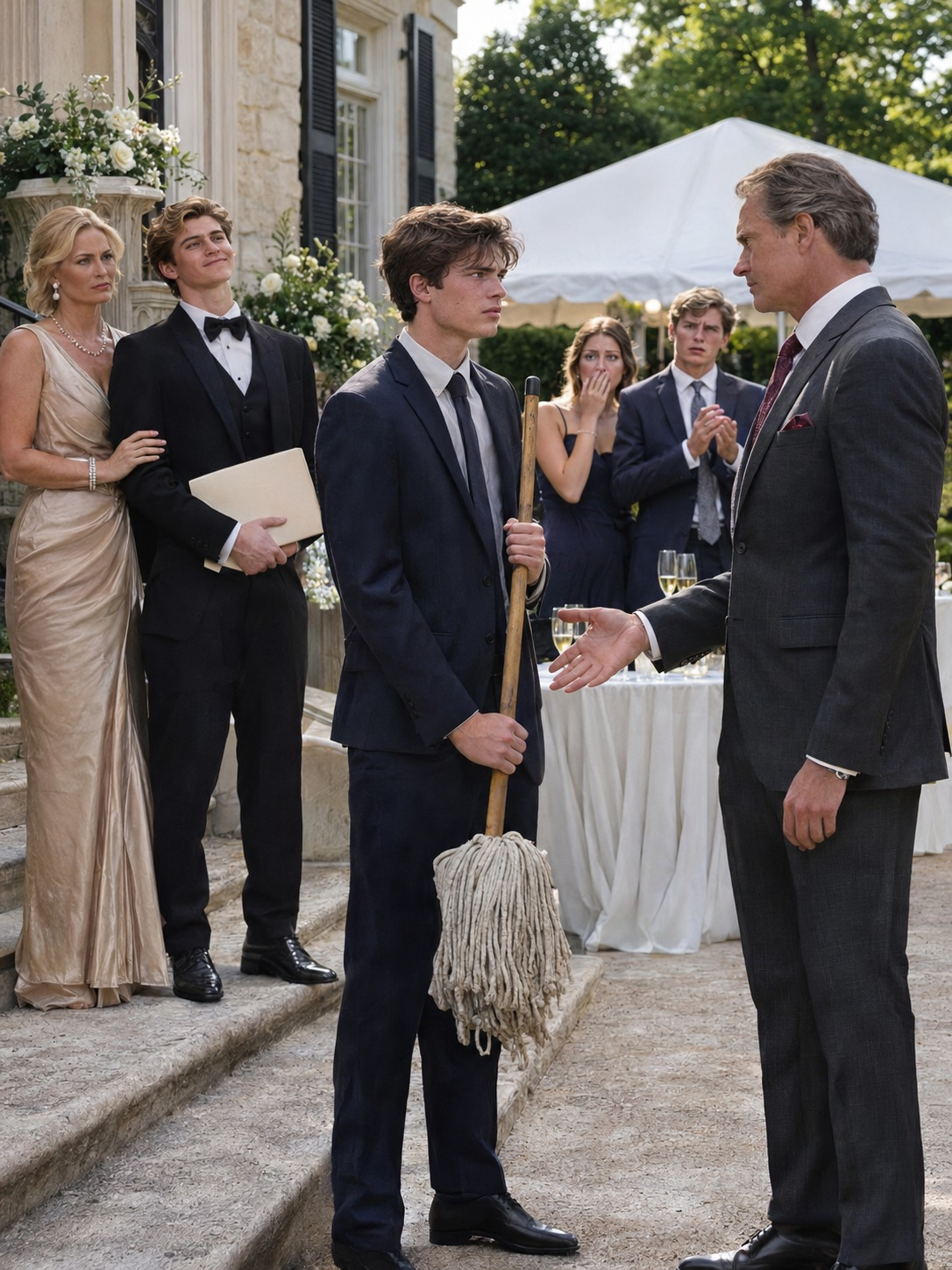
I was tearing the gray plastic off my graduation present when my father laughed.
"Here's something you'll actually be good at."
He stood beside the grand staircase, holding a microphone and watching two hundred guests stare at me.
The package contained a commercial janitor's mop.
A small white inventory tag was attached to its wooden handle.
Briarwood Hall — Facilities Department.
I looked at the mop.
Then I looked at my twin brother holding a $50,000 check.
That was the moment I stopped expecting my parents to love me equally.
My name is Ethan Mercer. I was eighteen years old, and my twin brother, Harrison, had been born four minutes before me.
In our family, those four minutes had somehow become the explanation for everything.
Harrison was the leader.
Harrison was the businessman.
Harrison was the son who would inherit Briarwood Hall.
I was the practical one.
The computer guy.
The person who fixed problems nobody else wanted to deal with.
And apparently, according to my father, the person who deserved a mop for graduating with straight A's.
But I'm getting ahead of myself.
To understand why I didn't throw that mop across the lawn, you need to understand what growing up in the Mercer family was like.
We lived at Briarwood Hall, our family's luxury event venue in Ashford, Ohio.
It was a beautiful property.
The main building was a historic stone mansion with tall windows, a sweeping staircase, and elegant white columns. Behind it were landscaped gardens, a fountain, and a ballroom large enough to accommodate several hundred guests.
People traveled from neighboring cities to hold their weddings there.
Local companies booked our conference facilities.
We hosted charity dinners, political fundraisers, anniversary celebrations, and expensive corporate retreats.
My parents, Richard and Diane Mercer, were well-known in town.
My father had spent decades building the business into something respectable.
My mother managed the social side of the operation and knew almost everyone worth knowing in Ashford.
They loved being recognized.
They loved having important people congratulate them on their success.
And they loved Harrison.
He fit perfectly into the image they wanted the Mercer family to project.
He had expensive clothes, perfectly styled hair, and an easy smile that made strangers feel like they were already friends.
When we were sixteen, our parents bought him a sports car.
They said it was a reward for his maturity.
I received an older laptop that had belonged to the office manager.
I wasn't particularly upset about the laptop.
I actually loved computers.
The difference was that Harrison's gift was presented as proof of his potential, while mine was treated as a practical necessity.
That pattern followed us through high school.
Harrison attended networking events with Dad.
He was introduced to business owners as the future of Briarwood Hall.
He talked constantly about entrepreneurship and once announced that he was developing a technology startup.
Nobody ever asked what the startup actually did.
I spent my weekends downstairs in the basement office.
I repaired computers.
Updated the booking software.
Organized spreadsheets.
Helped the accounting staff reconcile invoices.
When the kitchen needed extra hands, I carried supplies.
When the event staff couldn't connect their laptops to the wireless network, they called me.
I never complained.
I thought my parents would eventually notice.
I believed that if I worked hard enough, I would earn the same respect Harrison received simply by walking into a room.
My father had a favorite sentence.
"Harrison has the personality for business. You're better with the practical stuff."
He repeated it so often that I started believing it.
But I had plans of my own.
During my junior year, I began teaching myself software development.
I used free online resources, borrowed textbooks from the library, and spent late nights writing small applications.
At first, I built simple scheduling tools.
Then I started experimenting with databases and user interfaces.
I discovered that I enjoyed solving problems that affected real people.
That discovery changed everything.
At the Ashford Community Technology Center, I met Daniel Brooks, the program director.
He was in his early forties, patient, observant, and unusually good at recognizing potential in young people.
One afternoon, I was helping an elderly man figure out how to make a video call to his daughter.
He had been trying for nearly an hour.
His hands shook whenever he touched the screen.
After I showed him the process twice, he finally managed to connect.
His daughter's face appeared.
The man's expression changed immediately.
"That's my girl," he whispered.
He spent the next fifteen minutes talking to her.
When the call ended, he shook my hand.
"Thank you, son."
It was a small moment.
But it stayed with me.
That evening, I told Daniel about an idea.
"What if we connected teenagers who understood technology with older residents who wanted to learn?" I asked.
"Not just one-time lessons. A real mentorship program."
Daniel leaned back in his chair.
"Tell me more."
I explained that students could learn coding while helping older adults navigate online services, video calls, email, and digital security.
We could create a schedule matching volunteers with participants.
We could track progress.
We could develop simple tutorials that people could follow at home.
Daniel listened without interrupting.
When I finished, he smiled.
"Build something useful, Ethan. I'll help you make it work."
For the next five months, I worked after school and on weekends.
I developed the scheduling platform.
I wrote beginner-friendly tutorials.
I recruited students.
I organized coding classes.
Daniel helped arrange access to the computer lab and introduced me to volunteers.
Eventually, the program became much bigger than I had imagined.
More than two hundred people participated.
Teenagers learned coding and communication skills.
Older residents learned how to use computers without feeling embarrassed about asking basic questions.
Some learned to pay bills online.
Others learned to access medical appointment portals or communicate with relatives who lived far away.
A retired teacher named Margaret told us that she had finally learned how to video call her grandson in California.
A former factory worker named Robert started helping other seniors after completing his lessons.
The program had become something real.
Something useful.
Something I was proud of.
Then, in the spring of my senior year, Daniel walked into the computer lab holding an envelope.
"Ethan, I think you're going to want to see this."
I opened it.
It was an invitation from the Ashford City Council.
They wanted me to present the mentorship program at their annual Community Voices Gala.
My name was printed clearly on the letter.
Founder and Program Developer.
I read it twice.
Then a third time.
I couldn't believe it.
For once, somebody important had recognized my work.
I brought the invitation home in my backpack.
I planned to show my parents after dinner.
But Harrison found it first.
I was downstairs checking a maintenance issue when he walked into the kitchen.
"What's this?"
I heard the paper unfolding.
I came upstairs.
"That's mine."
He held up the invitation.
"The city council wants you to present this?"
"Yes."
His expression changed.
It was subtle.
Just a slight tightening around his mouth.
Then he turned toward the living room.
"Mom!"
Within minutes, my father joined us.
He took the invitation from Harrison and read it carefully.
At first, he seemed impressed.
Then something changed.
"This could be useful," he said.
I frowned.
"What could?"
He placed the letter on the dining table.
"The city is considering a major municipal events contract. They're looking at local businesses that demonstrate community involvement."
I nodded.
"Okay."
"Briarwood Hall could benefit from being associated with a successful community initiative."
I looked between my parents.
"The program is run through the technology center."
"Of course," Dad replied. "But the connection is important."
He began explaining how we could present the program as part of Briarwood Hall's charitable outreach.
I immediately understood where the conversation was heading.
"What do you mean by present it?"
"Harrison would be the public director," he said.
I stared at him.
"Why?"
My father looked almost surprised by the question.
"Because he understands business. He knows how to speak to important people."
"But he hasn't worked on the program."
Harrison leaned against the counter.
"Come on, Ethan. You know I can help take it to the next level."
"You haven't even visited the technology center."
"I don't need to. You're handling the technical side."
I turned back to Dad.
"I built the entire platform. I organized the volunteers. I wrote the lessons. Daniel helped me get the program started."
Mom approached and placed her hand over mine.
"Ethan, nobody is taking anything away from you."
I looked at her.
"Then why would Harrison be introduced as the director?"
She sighed.
"You're very talented, sweetheart. But your brother has the personality for these opportunities."
There it was again.
The same sentence.
The same division.
Harrison was the future.
I was the person who made the future work.
Dad folded the invitation.
"This family provides everything you need. We're asking you to contribute."
"I already contributed."
His expression hardened.
"Don't turn this into an argument."
I looked at Harrison.
He was smiling.
Not because the situation was funny.
Because he had already decided he was going to win.
I knew arguing wouldn't change anything.
So I lowered my eyes.
"Fine."
Mom immediately relaxed.
"That's the right attitude."
Harrison clapped my shoulder.
"See? We're going to make a great team."
I didn't answer.
Over the following three weeks, I watched him prepare for the gala.
He hired a designer.
Ordered glossy brochures.
Bought a new suit.
Practiced a speech about leadership and community responsibility.
He even arranged a professional photograph of himself for the promotional material.
He never visited the technology center.
He never met Margaret or Robert.
He never spoke to the teenagers who volunteered every Saturday.
He didn't even know how the scheduling platform worked.
One afternoon, a box of brochures arrived at Briarwood Hall.
I happened to be in the office when Harrison opened it.
He pulled out the top brochure and smiled.
"These look incredible."
I picked one up.
On the cover was his professional photograph.
Underneath, the headline read:
HARRISON MERCER — FOUNDER AND DIRECTOR OF THE ASHFORD COMMUNITY TECHNOLOGY MENTORSHIP INITIATIVE.
I turned the page.
There were descriptions of the program, photographs of students working with older residents, and a short paragraph about community development.
I recognized almost every sentence.
I had written the original proposal.
Near the bottom of the final page, I found my name.
Ethan Mercer.
Technical and Administrative Support.
I read those words several times.
Five months of work.
Reduced to one line.
Harrison noticed me looking.
"Pretty good, right?"
I placed the brochure back on the desk.
"Where did you get those photographs?"
"From the center."
"Did Daniel approve this?"
Harrison shrugged.
"Dad handled it."
I looked at the cover again.
"You know you didn't create this program."
His smile disappeared for a moment.
Then he leaned closer.
"Listen, little brother. Nobody cares who writes the code. People care who can sell the idea."
I said nothing.
He picked up the brochure.
"And that's something you'll never understand."
I walked out.
That evening, I called Daniel.
I told him what my family was planning.
He listened quietly.
When I finished, he asked one question.
"Do you still have your original development records?"
"Everything."
"Your proposals?"
"Yes."
"Source code?"
"Every version."
"Emails and project documentation?"
"All of it."
"Good."
There was a pause.
Then Daniel said something I never forgot.
"Keep copies of everything, Ethan. People can argue about titles. They can't change dates."
I opened my laptop that night and organized every document.
The original proposals.
The development files.
The volunteer schedules.
The emails.
The meeting notes.
The program documentation.
I backed everything up.
I had no idea how important that decision would become.
Then Friday arrived.
My graduation reception.
Two hundred guests.
A string quartet.
Expensive food.
Photographers.
My parents had spent a fortune making sure the event looked perfect.
Harrison spent most of the evening talking to business owners about his upcoming gala presentation.
He wore a cream-colored designer suit.
I wore an older navy suit.
Nobody mentioned the difference.
I stood near the back, watching my classmates celebrate.
For a little while, I allowed myself to believe that perhaps my parents would surprise me.
Perhaps they would acknowledge my grades.
Perhaps Dad would mention the technology program.
Perhaps Mom would tell the guests that both her sons had achieved something special.
After dinner, Dad tapped his glass.
The conversations gradually stopped.
"Today we're celebrating the bright future of our family."
He called Harrison toward the staircase.
Mom stepped forward with an oversized envelope.
"Harrison, we're incredibly proud of your leadership and ambition."
She opened the envelope.
Inside was a ceremonial check.
Fifty thousand dollars.
The guests applauded.
Harrison raised it proudly.
Photographers moved closer.
My mother kissed his cheek.
Dad shook his hand.
I watched from a few feet away.
Then Dad returned to the microphone.
"And we have something for Ethan, too."
For one brief second, I thought this might be the moment.
I walked toward the staircase.
Dad handed me a long package wrapped in gray plastic.
"Open your graduation present."
I pulled away the wrapping.
The mop appeared.
A few guests laughed uncertainly.
My father smiled.
"Your brother is heading into business. You've always been good at keeping things in order. There's a future in that."
Mom touched Harrison's shoulder.
"Everyone has their own strengths."
Harrison lifted his phone.
"Come on, Ethan. Give us a smile."
I looked at the mop.
Then at my brother.
Then at my parents.
Something inside me became very quiet.
I didn't feel like shouting.
I didn't feel like crying.
I didn't even feel particularly surprised.
I simply understood.
They knew what I had accomplished.
They knew how much work I had done.
They knew I had earned that invitation.
And they had still chosen to make me the joke.
I leaned the mop against the stone staircase.
"I'm going to pack my things."
Dad chuckled.
"Don't make such a big deal out of a graduation gift."
I didn't answer.
I walked through the crowd.
Up the stairs.
Down the hallway.
Into my bedroom.
And for the first time in my life, I began packing with no intention of coming back.
I put four days of clothes into my backpack.
My documents.
My old laptop.
My charger.
A notebook containing the original project plans.
I checked the room one final time.
Then I picked up my bag and walked downstairs.
The reception was still going.
I could hear music from the lawn.
When I reached the front door, Harrison was waiting.
He looked at my backpack.
Then at my face.
"You're actually leaving?"
"Yes."
He gave a short laugh.
"You'll be back tomorrow."
I reached for the door handle.
Then he stepped directly into my path.
His smile faded.
"Before you go, there's something you need to understand about the gala."






Comments 0