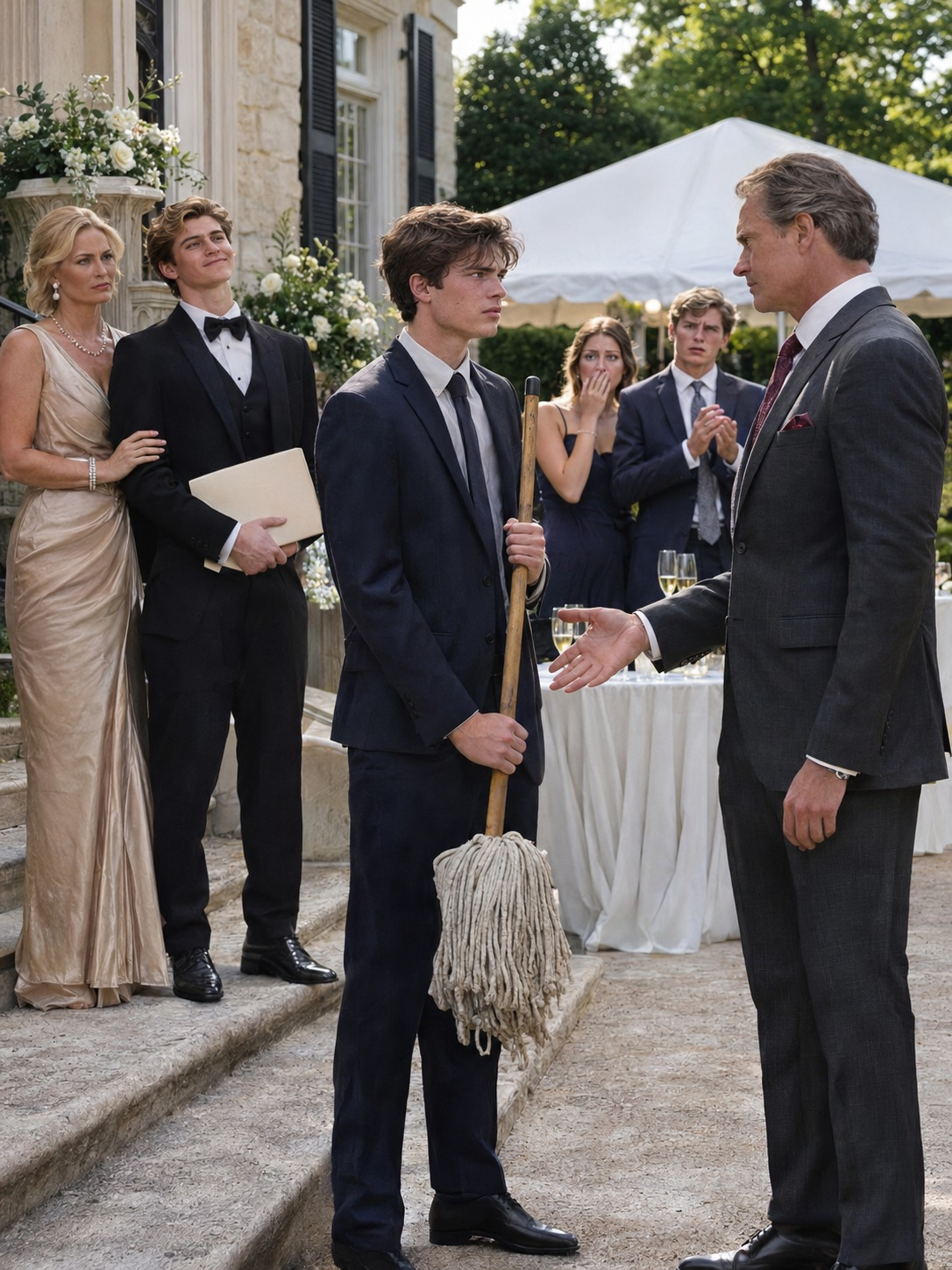
I zoomed in on the photograph until the letters became sharp enough to read.
The document was titled TRANSFER OF PROJECT REPRESENTATION AND ADMINISTRATIVE AUTHORITY.
My name appeared beneath the declaration.
The date was March 14.
And the witness signature belonged to Harrison Mercer.
I stared at the screen.
March 14.
That was the Saturday I had spent nearly seven hours at the Ashford Community Technology Center teaching volunteers how to use the new scheduling platform.
I remembered that day clearly.
Margaret had brought homemade cookies.
Caleb had accidentally deleted part of the registration database.
Daniel and I had stayed late restoring the information.
I hadn't been anywhere near Briarwood Hall.
I hadn't signed anything.
And Harrison had apparently witnessed me signing a document that I had never seen.
I read the page again.
According to the declaration, I had voluntarily authorized Harrison to become the public director of the mentorship program. I had also supposedly agreed that Briarwood Hall could use the program's name, materials, and promotional content for its charitable outreach.
There was another paragraph.
It stated that I had acknowledged Harrison's leadership role and agreed not to challenge his public representation of the initiative.
I felt my jaw tighten.
This wasn't an administrative misunderstanding.
Someone had created a document designed to make my silence look like consent.
I called Rebecca immediately.
She answered after two rings.
"Ethan, did you receive the photograph?"
"Yes."
"Have you seen that document before?"
"No. Never."
"Do you recognize the witness signature?"
I looked at the screen.
"It's my brother's."
"Are you certain?"
"I've seen him sign things hundreds of times. That's his signature."
Rebecca paused.
"All right. I need you to understand that we're treating this as a disputed document. We haven't made any conclusions about how it was created or submitted."
"I understand."
"Do you have evidence of where you were on March 14?"
I turned toward Daniel.
He was already standing beside my desk.
"I was at the technology center."
"Can you document that?"
Daniel answered before I could.
"We have volunteer attendance records, computer lab access logs, and emails from that afternoon."
Rebecca sounded relieved.
"Please preserve those records. Don't alter the originals. I'll arrange a meeting so we can review them."
"When?"
"Tomorrow morning."
I looked at the clock.
It was already late afternoon.
"Okay."
"One more thing, Ethan."
"Yes?"
"Your father has contacted the council several times today. He's requesting that the review be postponed until after the Community Voices Gala."
I glanced at the photograph again.
"Why?"
"He says your family needs time to resolve the matter privately."
I almost laughed.
My father had been given three days to explain why his presentation listed Harrison as the founder.
Instead, he had submitted a document with my name on it.
Now he wanted more time.
"I don't think postponing the review would be appropriate," I said.
"Neither do I. But the decision will be made by the review committee."
After the call ended, I forwarded the photograph to Daniel.
He enlarged the document on his computer.
Then he leaned back.
"Your father is becoming desperate."
"Or he thinks he can get away with it."
Daniel looked at me.
"Those two things aren't mutually exclusive."
I sat down.
For the first time since leaving Briarwood Hall, I felt genuinely angry.
Not because of the money.
Not because Harrison had received a ceremonial check.
Not even because my father had handed me a mop.
It was the realization that they had taken something I had built with care and were now trying to erase the person who created it.
I had never asked them for money.
I had never demanded that they advertise the program.
I had never expected them to provide volunteers or equipment.
All I had wanted was to be allowed to present my own work.
Apparently, even that had been too much.
Daniel opened the attendance system.
"We should start with March 14."
He searched the database.
A few seconds later, a list appeared.
My name was there.
ETHAN MERCER — COMPUTER LAB ACCESS: 9:12 A.M.
The system showed another entry.
ETHAN MERCER — COMPUTER LAB ACCESS: 4:47 P.M.
I pointed at the screen.
"That's the day."
Daniel nodded.
"There's more."
He opened the volunteer attendance sheet.
Several students had signed in that morning.
Margaret had signed in shortly before lunch.
Robert had attended the afternoon digital security session.
Daniel himself had recorded the attendance.
"Do you remember what happened that day?" he asked.
"Caleb deleted part of the registration database."
Daniel smiled faintly.
"That's right."
We searched the archived email correspondence.
There it was.
An email I had sent Daniel at 2:36 p.m.
Subject: Registration database recovery
The message included a screenshot of the restored database and a short explanation of the changes I had made.
I opened the attachment.
The file properties showed the date and time.
March 14.
2:31 p.m.
I looked at Daniel.
"Would this be enough?"
"It's useful supporting evidence. We'll preserve the original file and let the council determine what else it needs."
He copied the relevant records into a separate folder.
Then he did something I hadn't expected.
He opened the original proposal.
"There's something I want you to read."
I leaned toward the screen.
It was the first document I had created when the program was still an idea.
At the top, I had written:
Technology should make people feel more connected, not more dependent on those who understand it.
I remembered typing that sentence at two in the morning.
I had spent an entire weekend rewriting the proposal because the first version sounded too complicated.
Daniel scrolled down.
There were sections about student mentorship, accessibility, digital confidence, and community participation.
Every page contained my name in the document history.
"Your father wants to use this as a business asset," Daniel said.
I nodded.
"But the original proposal explains why we built it. This isn't something you created to promote an event venue."
He closed the document.
"Make sure Rebecca understands that distinction."
I looked toward the computer lab.
A student was helping Margaret practice opening an email attachment.
Margaret laughed when she finally managed it.
The moment reminded me why I had started the program.
Not for a contract.
Not for a photograph in a brochure.
Not for a title.
I had wanted people to feel capable of doing things they had once found intimidating.
And I wasn't going to let my family's ambition destroy that.
At 7:18 p.m., my phone rang again.
Harrison.
I let it ring.
He called a second time.
Then a third.
Finally, a message appeared.
HARRISON: Pick up. We need to settle this.
I stared at it.
Then I answered his fourth call.
"What?"
His voice came through immediately.
"What did you tell Rebecca?"
"The truth."
"Which truth?"
"That I created the program."
He laughed.
"That's not what I'm talking about."
"Then what are you talking about?"
"That document."
I sat upright.
"What document?"
"The transfer agreement."
I remained silent.
He continued.
"Look, Dad said you saw it. There's no reason to turn this into a huge problem."
"Did you sign it?"
A pause.
Then he said, "I'm listed as the witness."
"That's not what I asked."
"You're being ridiculous."
"Did you sign it?"
He exhaled.
"Yes."
I looked at Daniel.
He had stopped working.
"Why?"
"Because Dad asked me to."
"What did you witness?"
Harrison didn't answer.
I waited.
Finally, he said, "I was told you'd agreed to the arrangement."
"Did you see me sign it?"
Another pause.
"No."
I felt my stomach tighten.
"Then why did you sign as a witness?"
"Because Dad said it was already handled."
I closed my eyes.
There it was.
He hadn't witnessed anything.
He had simply signed a document because our father told him to.
"Harrison, you understand what that means, right?"
"Don't start lecturing me."
"You're listed as a witness to something you never saw."
"Look, I didn't write the document."
"Who did?"
He hesitated.
"Probably Dad's office."
"Probably?"
"Why are you interrogating me?"
I lowered my voice.
"Because you put your name under mine."
His tone changed.
"Ethan, listen. The gala is tomorrow. The council is already asking questions. If this gets out, the whole family looks bad."
I stared at the desk.
"You mean if people find out I built the program?"
"No. I mean if they find out we had an internal disagreement."
I almost laughed.
An internal disagreement.
That was how Harrison described everything.
He had received the money.
He had received the recognition.
He had received the title.
I had received the mop.
But according to him, the real problem was that people might discover the arrangement.
"Did you ever write a single line of code for the platform?" I asked.
"That's irrelevant."
"Did you attend one volunteer session?"
"You're missing the point."
"Did you write one tutorial?"
"Stop."
"Did you even know how many people were participating?"
He went quiet.
I could hear someone speaking in the background.
Then Harrison said something I hadn't expected.
"Do you think I wanted all of this?"
I frowned.
"What?"
"You think I asked Dad to make you look bad?"
I didn't answer.
He continued.
"He's the one who decided I should lead the presentation. He's the one who said you were better off handling the technical side."
I gripped the edge of the desk.
"You accepted."
"Because it was an opportunity."
"And when they put your photograph on the brochure, you accepted that too."
He said nothing.
"Then they handed you fifty thousand dollars while I stood there holding a mop."
"That was Dad's idea."
"But you laughed."
His breathing became audible.
For a moment, I thought he might apologize.
Instead, he said, "You always act like everything is happening to you. Maybe if you stopped being so difficult, things would be different."
I looked at the phone.
There was nothing left to say.
"I'm done, Harrison."
"Ethan—"
I ended the call.
Daniel had heard enough to understand what had happened.
"Did he admit signing it?"
"Yes."
"Did he admit he didn't witness you signing?"
"Yes."
Daniel nodded slowly.
"Write down everything you remember about that conversation while it's fresh."
I opened a document.
I recorded the time, the statements, and the questions I had asked.
I didn't embellish anything.
I didn't guess what Harrison had intended.
I simply wrote down what he had said.
The following morning, I woke up to a message from Rebecca.
She had arranged a meeting for ten o'clock.
Daniel drove me to the council building.
I carried the original attendance records, the email archive, and my laptop.
Rebecca was waiting in the conference room.
Another person sat beside her.
A woman in her late fifties with short brown hair and a navy blazer.
"Ethan, this is Laura Bennett. She's assisting with the document review."
We shook hands.
Laura opened a folder.
"We've examined the materials submitted by Briarwood Hall," she said. "There are several issues we need to clarify."
I nodded.
She placed the disputed transfer agreement on the table.
"First, we need your statement confirming that you did not sign this document."
"I can confirm that."
"Second, we need to establish where you were on March 14."
I handed her the attendance records.
Daniel explained the center's access system.
Laura examined the original email timestamps and compared them with the document date.
Then she turned to Rebecca.
"These records appear consistent."
Rebecca looked at me.
"Did you ever discuss transferring the program to Harrison?"
"No."
"Did you give your father permission to sign on your behalf?"
"No."
"Did you authorize Briarwood Hall to claim ownership of the program?"
"No."
Laura made notes.
Then she opened another folder.
"This is where the situation becomes more complicated."
I leaned forward.
"What do you mean?"
She placed a printed brochure on the table.
It was the same brochure I had seen in Harrison's hands.
His photograph was on the cover.
His title appeared beneath it.
But this version contained an additional page.
A page I had never seen.
It described the proposed municipal events contract and listed the community technology initiative as one of Briarwood Hall's principal community development projects.
At the bottom was a financial projection.
The document suggested that the initiative would help the venue qualify for a multi-year municipal partnership.
I looked at the figures.
The projected value was substantial.
My father hadn't simply wanted Harrison to present my program.
He wanted to use it to strengthen Briarwood Hall's application for a major business opportunity.
Rebecca folded her hands.
"Your father's application describes the mentorship program as a Briarwood Hall initiative. The council needs to determine whether the venue has any legitimate role in its development or administration."
"It doesn't," I said.
Laura glanced at the brochure.
"Was Briarwood Hall involved in the program before your family submitted this application?"
"No."
"Did the venue provide funding?"
"No."
"Did it provide facilities?"
"No."
"Did it provide staff?"
"No."
Daniel confirmed the same information.
Laura wrote something down.
Then Rebecca looked at me.
"There's another issue."
I felt my shoulders tighten.
"What?"
"The original transfer agreement wasn't the only document submitted."
She opened another folder.
Inside was a letter addressed to the city council.
It carried my name.
My supposed signature.
And a paragraph explaining that I had withdrawn from the Community Voices Gala because I preferred to remain behind the scenes.
I stared at the page.
I had never written that letter.
Rebecca watched my expression.
"Did you send this?"
"No."
"Did you authorize anyone to send it?"
"No."
She closed the folder.
"All right. We'll add it to the review."
I looked at Daniel.
He seemed just as stunned as I was.
My parents hadn't merely assigned Harrison my position.
They had prepared a version of events in which I had voluntarily stepped aside.
A version in which my absence was evidence of my consent.
And they had submitted it before I ever knew what they were doing.
After the meeting, Rebecca walked us to the reception area.
"Ethan, I want to be clear about something. The council hasn't made a final decision about the application."
"I understand."
"But the disputed documents will need to be addressed before we proceed."
"What happens to the gala?"
"That depends on the review."
I nodded.
I didn't ask her to cancel Harrison's presentation.
I didn't ask her to embarrass my parents.
I only wanted the council to know who had actually created the program.
Outside, Daniel stopped beside the car.
"How are you holding up?"
I looked at the building.
"Honestly?"
"Honestly."
"I'm tired."
He nodded.
"That's understandable."
"I thought leaving would be the hardest part."
Daniel opened the driver's door.
"Sometimes leaving is just the beginning."
I got into the car.
On the way back, my phone vibrated.
A message from Mom.
MOM: Your father knows about the meeting. He wants you at Briarwood Hall tonight. Please don't make this worse.
I didn't respond.
A second message arrived.
MOM: Harrison is very upset. You need to think about your brother's future.
I stared at the words.
Not my future.
Not the future of the students.
Not the older residents who depended on the program.
Harrison's future.
I locked the phone.
That afternoon, I received an unexpected email from Daniel.
He had forwarded a message from one of the volunteers.
The subject line read:
Question About Tomorrow's Gala
The volunteer explained that Harrison had contacted several program participants, inviting them to attend the event.
He had told them the gala would celebrate his leadership and the expansion of the mentorship initiative.
I read the message twice.
Then I noticed the attachment.
It was a seating arrangement.
The names of the volunteers were listed beneath the Briarwood Hall sponsorship table.
My name wasn't included.
At the bottom of the document was another note.
Founder and Executive Director: Harrison Mercer.
I closed the email.
My father was preparing to introduce Harrison to the city council as the person responsible for a program he had never built.
And now the people who had actually helped me were being invited to applaud him.
I called Daniel.
"Did you see this?"
"Yes."
"What do we do?"
He was quiet for a moment.
"Tomorrow, we tell the truth. We don't interfere with the event. We don't confront anybody before the council has reviewed the evidence."
I nodded, even though he couldn't see me.
"Okay."
Then he added, "There's one more thing you should know."
"What?"
"Rebecca called me a few minutes ago."
I sat upright.
"What did she say?"
"She asked whether you could attend the Community Voices Gala as originally invited."
I looked at the invitation sitting beside my laptop.
My name was still printed on it.
Founder and Program Developer.
"She wants me there?"
"Yes."
I looked toward the computer lab.
Students were beginning to arrive for their afternoon class.
For three weeks, Harrison had been preparing to stand on a stage and tell people he had created something he knew almost nothing about.
Tomorrow, I might finally get the chance to speak for myself.
Then my phone rang.
It was Harrison.
I answered.
His voice was no longer amused.
"Ethan, listen carefully. You cannot come to the gala tomorrow."
I frowned.
"Why?"
He hesitated.
Then he said something that made my blood run cold.
"Because Dad just found out who Rebecca invited to sit at the main table."
I heard a door slam in the background.
Then Harrison whispered:
"And it's not just you she's bringing."






Comments 0