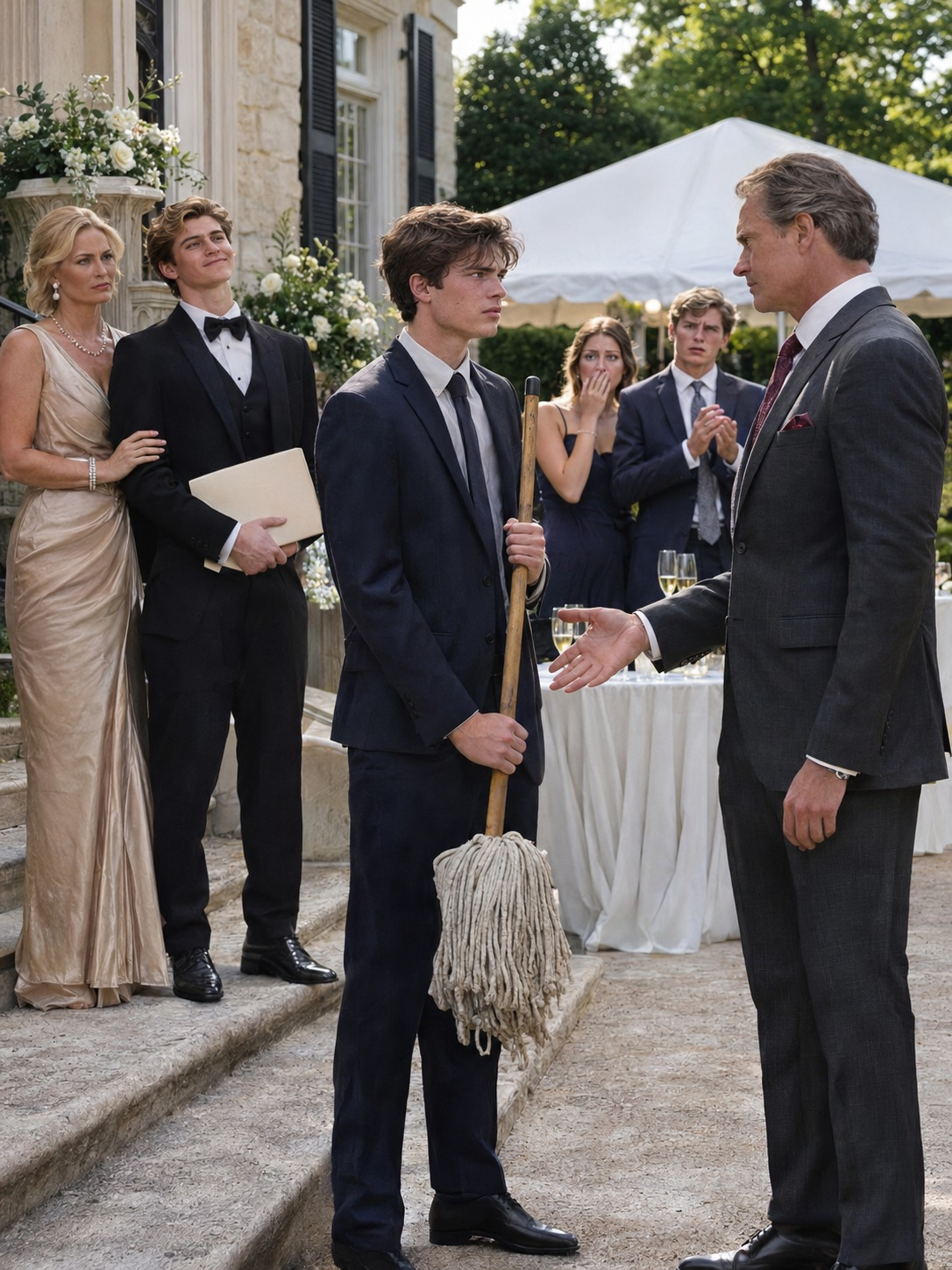
"Your father didn't choose the mop as a joke. He had a reason for humiliating you in front of those guests."
My mother stood in the narrow corridor outside the ballroom.
Her face was pale.
Behind her, the sound of the string quartet drifted through the closed doors. Guests were arriving. Waiters were carrying trays of champagne. My father was probably greeting business owners and pretending nothing had happened.
I looked at her.
"What reason?"
She glanced toward Harrison.
He stood beside the wall, holding the printed email from Dad's office.
"Your father wanted everyone to see you as someone who belonged behind the scenes," she whispered.
I frowned.
"What does that have to do with the mop?"
Mom took a shaky breath.
"Everything."
I waited.
She continued.
"Before graduation, your father had already heard that the city council wanted to speak directly with you. Rebecca Sullivan had contacted him twice. She wanted to understand how the mentorship program had started and who was responsible for developing it."
I felt my stomach tighten.
"Why didn't anyone tell me?"
"Your father didn't want you speaking to them independently."
"Why?"
She looked at Harrison.
Then back at me.
"Because he was afraid you would tell them the program belonged to you."
I stared at her.
"But it does."
"I know."
The answer came so quietly that I almost missed it.
She looked down at her hands.
"Your father had already submitted the application naming Harrison as the public director. He believed that if the council saw you as someone who was simply responsible for maintenance and technical support, they would be less likely to question his decision."
I felt something cold settle in my chest.
"You're telling me he gave me a mop because he wanted people to believe I wasn't capable of building the program?"
Mom nodded.
"He wanted to establish a difference between you and Harrison."
I looked toward the ballroom.
Two hundred people had watched my father hand me that mop.
Some had laughed.
Others had looked uncomfortable.
At the time, I thought he was simply making another cruel joke at my expense.
But he had planned it.
The graduation reception had been more than a celebration.
It had been a public performance.
My brother received a fifty-thousand-dollar check.
I received a cleaning tool.
And everyone was supposed to understand exactly where my parents believed we belonged.
I looked at Mom.
"Did you know this before graduation?"
She started crying.
"Yes."
I stepped backward.
She reached toward me.
"Ethan, please."
I shook my head.
"You knew?"
"I didn't think he would go that far."
"But you knew why he was doing it."
She wiped her cheeks.
"Your father said it was necessary."
I stared at her.
"Necessary for what?"
She couldn't answer.
I turned toward Harrison.
He was looking at the floor.
Neither of us spoke.
Then I heard the ballroom doors open.
My father appeared in the corridor.
His expression changed when he saw the three of us standing together.
"What is going on?"
Mom immediately wiped her face.
"Nothing."
Dad looked at the paper in Harrison's hand.
Then at me.
"Give me that."
Harrison didn't move.
Dad stepped closer.
"I said give it to me."
Harrison tightened his grip.
For the first time, he didn't obey immediately.
"Dad, why did you do it?"
My father stared at him.
"Do what?"
"The graduation presentation."
Dad glanced toward me.
"Not now."
Harrison shook his head.
"No. I want to know."
Dad lowered his voice.
"You have a presentation to prepare. Go downstairs."
"I'm asking you a question."
"And I'm telling you to stop."
Harrison looked at me.
Then he turned back to our father.
"Did you give Ethan the mop because you wanted people to think he was incapable of running the program?"
My father said nothing.
That silence answered more than any explanation could have.
Dad finally turned toward me.
"You've always been too sensitive about these things."
I almost laughed.
"These things?"
"Family responsibilities. Business decisions. Public appearances."
I looked at him.
"You planned to humiliate me."
He sighed.
"I wanted to establish clear roles."
"By making me look like a janitor?"
His expression hardened.
"There's nothing wrong with honest work."
I nodded slowly.
"You're right. There's nothing wrong with honest work."
For a moment, he seemed satisfied.
Then I continued.
"But there is something wrong with stealing somebody's work and pretending someone else created it."
His jaw tightened.
"Watch your tone."
I looked at the man who had spent eighteen years explaining why Harrison was better suited for business.
I had heard that sentence so many times that I could almost repeat it in my sleep.
Harrison had personality.
I had practical skills.
Harrison could lead.
I could support.
Harrison had a future.
I had a mop.
But now the council had the original records.
The community center had the correspondence.
The trust had the grant agreement.
And my father couldn't change those documents by raising his voice.
"Are you going to tell the guests what happened?" he asked.
I looked at him.
"I'm going to tell them what I actually built."
He stepped closer.
"That isn't what I asked."
"Then ask a different question."
His face darkened.
Mom moved between us.
"Richard, please."
He turned toward her.
"Stay out of this."
She flinched.
I noticed.
And for a moment, I understood that my mother had spent years learning how to avoid becoming the target of his anger.
But that didn't excuse what she had done.
Dad pointed toward the ballroom.
"Harrison is presenting tonight. That's final."
Harrison finally spoke.
"No, Dad."
My father turned.
"What?"
"I'm not presenting it as my work."
Dad stared at him.
"Don't be ridiculous."
"I'm serious."
"You have no idea what you're throwing away."
Harrison looked at the paper in his hand.
"I think I do."
Dad's face became expressionless.
Then he turned toward the ballroom.
"Both of you are making a terrible mistake."
He walked away.
The doors closed behind him.
Mom looked at us.
"Please don't make this worse."
I picked up my folder.
"Mom, it was already worse."
At seven fifteen, the gala officially began.
The ballroom was filled with guests.
Business owners, local officials, community representatives, and families from Ashford sat around the decorated tables.
A large screen stood behind the stage.
The Briarwood Hall logo appeared in elegant white lettering.
My father stood near the entrance, greeting people.
He looked completely different from the man who had just threatened us in the corridor.
He smiled.
He shook hands.
He introduced Harrison to several guests.
"That's my son," he said proudly. "He's leading our new technology initiative."
Harrison stood beside him.
He smiled politely.
But he didn't repeat the claim.
I entered with Daniel.
Margaret and Robert were already seated near the front.
Caleb waved when he saw me.
I walked over.
"Everything okay?" he whispered.
"Yes."
He looked toward the stage.
"Your brother is speaking?"
"Apparently."
Caleb frowned.
"Does he know how the program works?"
I smiled faintly.
"Not really."
Caleb shook his head.
"That's going to be awkward."
I sat down.
Daniel took the chair beside me.
Rebecca and Patricia were seated at the main table.
They greeted us.
"Good evening, Ethan."
"Good evening."
Rebecca glanced toward the stage.
"Are you prepared?"
I nodded.
"I brought the original materials."
"Excellent."
Patricia added, "We'll allow the planned presentation to proceed, but the council will ask questions afterward."
I looked at the screen.
"Understood."
Across the ballroom, my mother was standing beside Harrison.
She looked toward me.
For a moment, she seemed ready to approach.
Then my father called her name.
She turned away.
At seven thirty, Dad tapped the microphone.
The conversations gradually stopped.
"Good evening, everyone."
He smiled.
"Thank you for joining us at Briarwood Hall. Tonight is a special occasion for our family and for the community of Ashford."
The guests applauded politely.
He continued.
"For years, our family has believed that successful businesses should contribute to the communities that support them."
I looked at Daniel.
He remained expressionless.
Dad gestured toward Harrison.
"Tonight, I'm proud to introduce a young man who represents the next generation of leadership at Briarwood Hall."
Harrison walked toward the stage.
The screen changed.
His photograph appeared.
Underneath it was the title:
HARRISON MERCER — FOUNDER AND DIRECTOR.
I felt Caleb shift in his chair.
Margaret leaned toward Robert.
My father continued.
"Harrison has worked tirelessly to develop a technology initiative designed to connect generations through education."
Harrison reached the microphone.
He looked at the audience.
Then he looked at the screen.
His prepared speech was sitting on the podium.
I could see the printed pages.
He picked them up.
For several seconds, he said nothing.
Then he lowered them.
"Good evening."
The room became quiet.
"My father has introduced me as the founder of the Ashford Community Technology Initiative."
I looked at him.
Harrison swallowed.
"But that isn't accurate."
A murmur moved through the ballroom.
My father's smile disappeared.
Harrison continued.
"The program was created by my twin brother, Ethan."
I felt Daniel turn toward me.
Harrison looked directly at the audience.
"He developed the scheduling platform. He organized the volunteers. He wrote the tutorials. He taught the classes."
He paused.
"I didn't do those things."
Nobody moved.
My father stood near the side of the stage.
"Harrison."
My brother ignored him.
"I was supposed to represent the program tonight. But I haven't earned that title."
A woman near the front began applauding.
Then another guest joined her.
Within seconds, several people were clapping.
Harrison waited until the room quieted.
"I also need to clarify something about the fifty-thousand-dollar check I received at graduation."
My father's face turned red.
Harrison continued.
"I believed it was a personal gift from my parents. I later learned that the amount was connected to a restricted community development grant intended to support the mentorship initiative."
The applause stopped.
People began whispering.
Patricia leaned forward.
Rebecca opened her folder.
Harrison looked down.
"I received the money. I used some of it for personal expenses. I should have asked more questions before accepting it, and I take responsibility for that."
My mother covered her mouth.
My father stepped toward the stage.
"That's enough."
Harrison finally looked at him.
"No, Dad. It isn't."
The room became completely silent.
I had never heard my brother speak to our father like that.
He continued.
"I don't know everything that happened with the grant. But I know Ethan didn't receive that money, and I know he wasn't responsible for the financial reports."
Patricia stood.
"Thank you, Harrison. We appreciate your clarification."
My father reached the stage.
He took the microphone.
"I think everyone needs to understand that this is a family matter being taken out of context."
Rebecca stood as well.
"Richard, the grant is a public funding matter. We will address it through the appropriate review process."
My father looked around.
For the first time, I saw him realize that the audience wasn't going to follow his lead.
He turned toward me.
"Ethan, perhaps you'd like to explain your version."
I stood.
Daniel looked at me.
I nodded.
Then I walked toward the stage.
The microphone felt cold in my hand.
I looked at the audience.
Two hundred people.
Some familiar.
Some I had never met.
My parents sat near the front.
Harrison stood beside the podium.
I took a breath.
"Thank you for giving me a few minutes."
I looked at the screen.
My brother's photograph was still displayed.
The word FOUNDER remained beneath his name.
"I want to talk about why this program was created."
I explained how the idea had started.
I described meeting older residents who struggled to use basic online services.
I talked about students who knew how to use technology but didn't know how to teach it.
I explained how we brought those groups together.
I described the first class.
The first scheduling system.
The first volunteer meeting.
And the moment Margaret successfully made her first video call with her grandson.
She smiled from her seat.
The audience listened.
I didn't mention the mop.
I didn't mention the graduation check.
I didn't accuse my father.
I simply explained the work.
"Technology should make people feel more connected," I said. "That was the idea from the beginning. Not to create a business opportunity. Not to build someone's personal reputation. Just to help people."
I looked toward the students.
Caleb nodded.
I continued.
"The program belongs to the community center and the people who participate in it. I was fortunate enough to help build the system that supports it."
I paused.
"Whatever happens with the grant review, I hope the students and older residents don't lose the opportunity to continue learning together."
For a moment, nobody spoke.
Then Margaret stood.
She began applauding.
Robert followed.
Caleb stood.
Daniel stood.
Soon, the entire front section was on its feet.
The applause spread through the ballroom.
I stepped away from the microphone.
My father remained seated.
My mother was crying.
And Harrison was looking at me with an expression I had never seen before.
It wasn't jealousy.
It wasn't superiority.
It was something closer to respect.
After the presentation, guests began approaching me.
A local business owner asked about the scheduling platform.
A teacher wanted to know whether her students could volunteer.
Another guest offered to donate several refurbished computers.
I thanked everyone and gave them Daniel's contact information.
Rebecca approached with Patricia.
"That was an excellent explanation, Ethan."
"Thank you."
Patricia nodded.
"We'll need to continue the financial review, but your program documentation was extremely helpful."
I appreciated the distinction.
The grant issue wasn't resolved.
My family wasn't suddenly innocent.
And the money hadn't magically returned.
But the work itself was finally being recognized.
Then Daniel touched my shoulder.
"Ethan, there's someone I'd like you to meet."
He introduced me to a woman named Laura Bennett.
She was a director at a regional nonprofit technology organization.
"I've heard a lot about your scheduling platform," she said.
I shook her hand.
"Thank you."
"We're currently looking for someone to help expand our digital literacy programs across several Ohio communities."
I listened.
She explained that her organization had been searching for a developer who understood both the technical and human sides of community education.
"Would you be interested in discussing an internship?"
I looked at Daniel.
He smiled.
"Absolutely," I said.
Laura handed me her business card.
"We can arrange a meeting next week."
I thanked her.
For the first time, someone was offering me an opportunity because of what I had actually done.
Not because of my last name.
Not because of Harrison.
Not because my father knew the right people.
Because of my work.
At nine thirty, I found Harrison standing alone near the staircase.
He was holding a glass of water.
I approached.
"Hey."
He looked up.
"Hey."
For a few seconds, we stood quietly.
Then he said, "I should have done that a long time ago."
I nodded.
"Yes."
He looked toward the ballroom.
"Dad isn't speaking to me."
I didn't respond.
"He says I ruined everything."
I looked at him.
"Did you?"
Harrison shook his head.
"I don't know."
I leaned against the railing.
"You told the truth."
He stared at his glass.
"I should have done it before I spent the money."
"Yes."
"I should have stopped him when he started using your work."
"Yes."
He nodded.
"I know I don't deserve forgiveness just because I admitted it tonight."
I looked at him.
That was the first thing he had said all evening that sounded completely honest.
"No," I replied. "You don't."
He accepted the answer.
Then he asked, "Do you think we can ever be brothers again?"
I looked toward the main entrance.
For eighteen years, we had been twins.
But being born four minutes apart hadn't made us equals in our parents' eyes.
Harrison had benefited from that difference.
I had suffered because of it.
"I don't know," I said. "But we can start by being honest."
He nodded.
"I'd like that."
I turned to leave.
Then he spoke again.
"Ethan?"
I stopped.
"Thank you for not trying to destroy me tonight."
I looked at him.
"I wasn't there to destroy you."
He lowered his head.
"I know."
I walked away.
At ten fifteen, Daniel and I were preparing to leave.
I had just collected my folder when my phone vibrated.
A message from Rebecca.
REBECCA: Please call me when you're available. We have received additional documentation relating to the original grant authorization. It may significantly affect the review.
I frowned.
I showed Daniel.
He read it.
"Did something else happen?"
"I don't know."
My phone rang.
Rebecca.
I answered.
"Hello?"
"Ethan, I'm sorry to call so late."
"That's okay."
"We've just received a new document from the Community Development Trust's archive."
"What kind of document?"
"A copy of the original grant conditions."
I looked toward the ballroom.
"Is that different from the agreement we already have?"
"Yes."
She paused.
"The document contains a clause that appears to have been omitted from the version submitted by Briarwood Hall."
My stomach tightened.
"What does the clause say?"
Rebecca took a breath.
"It establishes that the original developer retained ownership of the software and all related intellectual property unless a separate transfer agreement was signed voluntarily."
I stared at Daniel.
"Then the program's ownership never transferred?"
"That's what the clause suggests. But we need to verify the complete record."
I looked at my folder.
"Does the council have the original document?"
"Yes."
"Who signed it?"
Rebecca hesitated.
"That's the problem, Ethan."
"What problem?"
"The original grant agreement contains two signatures from Briarwood Hall."
I closed my eyes.
"Which signatures?"
She answered.
"Your parents'."
I waited.
Then she added something else.
"But the final authorization page contains a third signature."
My heart began beating faster.
"Whose?"
Rebecca lowered her voice.
"The signature of the person who originally recommended Briarwood Hall as the grant administrator."
I gripped the phone.
"Who was it?"
There was a pause.
Then Rebecca said a name I hadn't heard in years.
"Your grandfather, William Mercer."
I went completely still.
My grandfather had died when I was twelve.
He had been the one person in the family who always encouraged me to build things.
And now his name had appeared in the original grant records.
Rebecca continued.
"There's a handwritten note attached to his signature. We believe it may explain why he selected Briarwood Hall in the first place."
I looked toward the ballroom.
My father was standing near the entrance.
Watching me.
And when he saw my expression, his face suddenly changed.
Because he knew exactly which document Rebecca had just found.






Comments 0