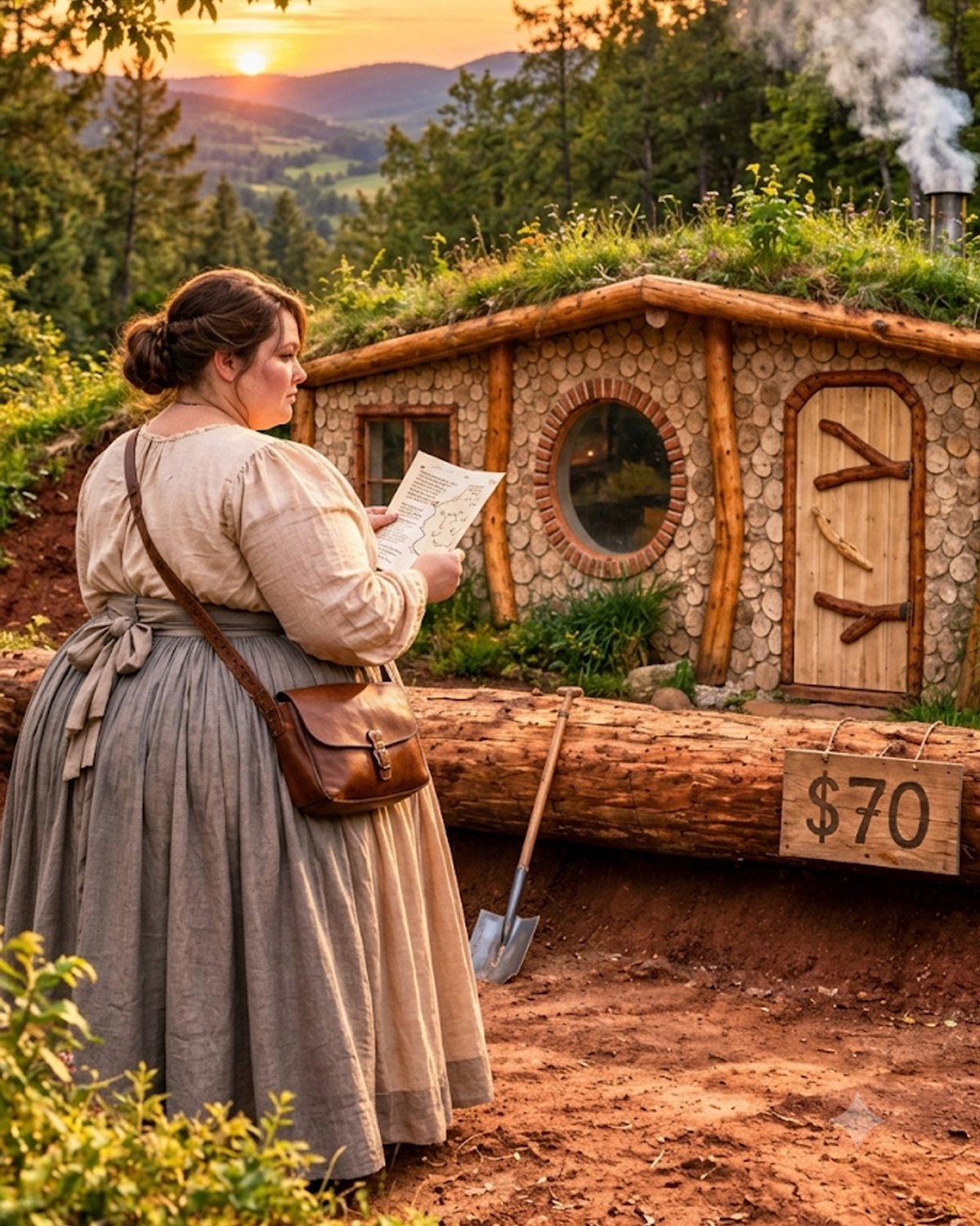
I slammed my shoulder against the wooden door for the third time.
"Please, just let me in!"
The brass key had turned, but the swollen wood refused to move.
Behind me, my last two bundles lay in the mud.
I had eleven dollars left.
And if this door didn't open, I had nowhere else to go.
I stepped backward, pressed my boots into the wet earth, and threw my entire weight against it.
Something cracked.
The door swung inward.
I stumbled into the darkness, caught myself against a cold iron stove, and stood there trying to catch my breath.
Then I looked up.
A faded blue apron hung from a wooden peg across the room.
I knew that apron.
I had watched my mother wear it while kneading bread, washing dishes, and mending the sleeves of my childhood dresses. I had seen her tie it around her waist thousands of times.
It was the same apron she had worn during the final weeks of her life.
My mother's apron.
I stopped breathing.
"Mama?"
The word escaped before I could stop it.
There was no answer.
Only the faint sound of wind moving through the trees outside.
I approached the wall slowly. My fingers trembled as I touched the faded fabric.
It was real.
The little patch near the lower pocket was still there. So was the uneven stitching along the left side, where Mama had repaired a tear herself.
I remembered sitting beside her as a child, watching her sew it.
"You have to take care of the things that take care of you, Avis," she had told me.
I had laughed then.
I wasn't laughing now.
My mother, Clara Bellweather, had been dead for three weeks.
I had held her hand when she stopped breathing. I had watched the undertaker close the coffin. I had stood beside her grave until the last shovel of earth covered the flowers.
There was no possible explanation for that apron being here.
Especially because the house had been empty for two years.
I looked around the room again.
A small wooden table stood near the round window. An iron stove occupied one corner. A few shelves held carefully arranged jars and household objects.
The place was old, dusty, and cold.
But it wasn't completely abandoned.
Someone had arranged the shelves.
Someone had left a folded cloth beside the stove.
And someone had hung my mother's apron where it could be seen immediately upon entering.
I took another step toward the table.
A piece of paper lay beside a small wooden bowl.
It was folded twice.
I opened it.
The handwriting was unmistakable.
My mother's handwriting.
"The inlet must be opened before lighting the stove. Never forget the water."
I read it once.
Then again.
What inlet?
What water?
I turned the paper over.
A date had been written on the back.
October 1860.
My hands went cold.
My mother had lived in this house twenty-five years earlier.
I had been twelve years old.
Why had she never told me?
I lowered myself into the nearest chair. Its wooden legs creaked beneath my weight.
For several minutes, I simply stared at the paper.
Three weeks earlier, I had been sitting beside my mother's bed, holding her hand and promising that she didn't have to worry about anything.
She had been too weak to speak clearly.
I had asked whether she wanted water.
She had shaken her head.
I had asked whether she wanted me to call someone.
Again, she had shaken her head.
Then she had looked at me with tired eyes.
"Avis," she had whispered.
"I'm right here, Mama."
She had tried to say something else.
I leaned closer.
But the words never came.
Her breathing became shallow.
And then it stopped.
I had spent the following days arranging a funeral I could barely afford.
The funeral cost twelve dollars.
Twelve dollars was not much money, but it was everything I could spare for the woman who had spent her entire life making sure I never went hungry.
Afterward, I returned to the rented room we had shared.
The landlord's wife was waiting.
She stood beside the narrow doorway with her arms crossed.
"I'm sorry, Avis," she said. "But your mother's rent contribution is gone now. We can't keep the room open for nothing."
I had looked at the floor.
"I'll find work."
"You already work."
"I'll find more."
She sighed.
"I need the room next week."
I didn't argue.
The bed belonged to the landlord. The stove belonged to him too. So did the chairs, the table, and almost everything else in that little room.
Mama and I had spent two years there.
Seven years before that, we had moved between rented rooms, following whatever washing, sewing, and cleaning work my mother could find.
I had never owned a house.
I had never even imagined owning one.
And now I was sitting inside a stone dwelling that apparently belonged to a woman I had buried three weeks earlier.
I looked back at the apron.
There was something strange about its position.
It wasn't covered in dust.
The fabric was faded, but the peg beneath it looked clean.
I reached toward the lower pocket.
Something hard pressed against the fabric.
I slipped my fingers inside.
A small brass button fell into my palm.
It was old and slightly tarnished.
Mama had always kept spare buttons in her apron pocket.
I closed my hand around it.
For the first time since her death, I felt as though she had left something behind specifically for me.
But why here?
I stood and examined the rest of the room.
The rounded table had scratches along its surface. A wooden bowl sat in the middle. Beside it was a small oil lamp and a bundle of folded papers.
There were three shelves.
The first held jars, some empty and some containing dried herbs.
The second held a few old cooking utensils.
The third was nearly hidden behind a hanging piece of rough cloth.
I pulled the cloth aside.
A narrow opening appeared between the shelves and the stone wall.
I leaned closer.
There was a small wooden door.
Its handle was made of iron.
I tried it.
Locked.
I pulled harder.
Nothing.
A strange chill moved through me.
I remembered the note.
Never forget the water.
I looked toward the stove.
The iron pipe rose through the ceiling, disappearing into the roof.
There was no firewood nearby.
I had brought a small bundle of kindling, but the note had warned me not to light the stove before opening something called an inlet.
I had no intention of burning the house down on my first evening.
I placed the kindling beside the stove and returned to the table.
Under the folded papers, I found a small leather-bound notebook.
Its cover was cracked.
The corners were worn.
A thin red thread held it closed.
I carefully untied the thread.
The first page contained my mother's handwriting.
October 1860.
I frowned.
That was impossible.
Mama had been born in 1823.
She would have been thirty-seven in 1860.
But the date wasn't the most disturbing thing.
The notebook contained detailed drawings of the house.
Measurements.
Notes about stone walls.
Sketches of pipes and drainage channels.
And several pages describing a spring beneath the hillside.
I turned another page.
A small drawing showed the house from above, with a line extending beneath the pantry.
The line ended at a circular chamber.
Beside it, Mama had written:
"Spring chamber. Keep the lower channel clear."
I looked toward the narrow wooden door behind the shelves.
My heart began beating faster.
The house had a water system.
But why had Mama built it?
And why had she abandoned it?
I continued reading.
Most entries described repairs and measurements. Some contained lists of materials.
Then I reached the final pages.
The handwriting changed.
The letters became larger and less even.
The ink was darker.
It looked as though Mama had written the words in a hurry.
One sentence caught my attention.
"I cannot keep this place alone anymore. The water is coming back, and I have no one to help me."
I read it several times.
The water was coming back.
What did that mean?
Had the spring flooded?
Had something collapsed beneath the house?
I turned the page.
There were several blank sheets.
Then, at the bottom of the last written page, I found another sentence.
"I have written to Avis. The letter is ready. I will send it on Monday."
I stopped.
My name.
My mother's handwriting.
A letter.
I had never received one.
I checked the date.
It was twenty-five years old.
My stomach tightened.
I tried to remember whether Mama had ever mentioned writing me a letter when I was twelve.
I remembered the year clearly.
She had been working long hours at a boardinghouse outside town. I had spent most afternoons with an elderly neighbor named Mrs. Harlan.
Mama had returned home late one evening carrying a small wooden box.
I remembered asking what was inside.
"Something for later," she had answered.
I had forgotten about it.
Now I wondered whether the letter had been inside that box.
I turned the notebook over.
A loose piece of paper slipped from between its final pages.
It landed on the floor.
I bent to pick it up.
It was not a letter.
It was a small hand-drawn diagram of the house.
At the bottom, Mama had written:
"Find the lower inlet before the first frost."
I stared at the words.
Then I heard something.
A faint sound.
Drip.
Drip.
Drip.
I turned toward the pantry.
The sound was coming from behind the narrow wooden door.
I walked closer.
The handle felt cold beneath my fingers.
I tried it again.
Locked.
Then something moved on the other side.
Not footsteps.
Not a voice.
A sudden rush of water.
I stepped backward.
The sound stopped.
I stood perfectly still, listening.
A few seconds passed.
Then I heard three distinct knocks.
From beneath the floor.
I looked down.
There was a narrow gap between two floorboards beside the pantry.
A faint line of moisture had appeared along its edge.
I remembered Mama's final notebook entry.
The water is coming back.
My fingers tightened around the old brass button.
I wanted to leave.
But where would I go?
I had spent six nights sleeping outside to reach this place. I had given up nearly everything I owned to secure it.
And now I was standing inside the only home my mother had ever secretly prepared for me.
I returned to the table and carefully placed the notebook beside the note.
There had to be an explanation.
Mama had written about this house.
She had drawn its water system.
She had left instructions.
And she had written a letter that had never reached me.
I looked at the faded apron one last time.
Then I noticed something I hadn't seen before.
A small envelope was tucked behind the wooden peg.
Its edges were yellow.
My name was written across the front.
Avis.
My hands began to shake.
I reached for it.
But before I could pull it free, the narrow pantry door suddenly clicked.
Once.
Then again.
And slowly, the iron handle began to turn from the other side.
Điểm dừng hiện tại: Chapter 1 kết thúc tại khoảnh khắc tay nắm cánh cửa bí mật bắt đầu xoay từ phía bên kia.
Chapter tiếp theo sẽ nối thẳng từ khoảnh khắc này, không kể lại nội dung cũ, không thay đổi nhân vật hay các sự kiện đã thiết lập.






Comments 0