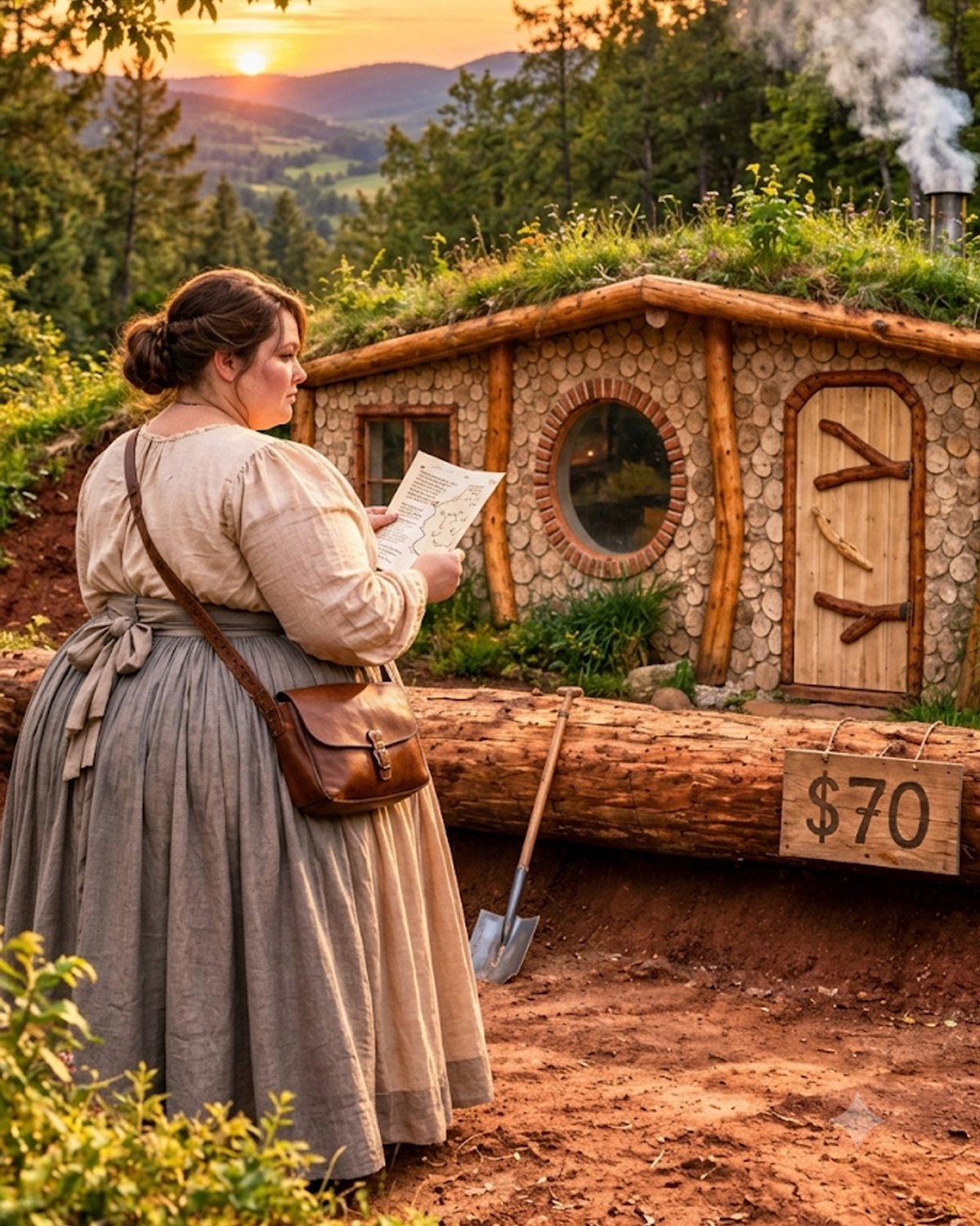
"Are you Avis Bellwether?"
The woman's voice carried up the muddy trail.
I stood in the doorway, gripping the edge of my coat.
For several seconds, I couldn't answer.
The stranger was perhaps sixty years old. She wore a dark charcoal traveling coat buttoned to her throat, a faded brown hat, and sturdy leather shoes. Her gray hair was tucked neatly beneath the hat, although several strands had escaped around her temples.
She carried a small leather handbag in one hand.
In the other was a silver locket.
The same kind of locket I had just discovered beneath the house.
I glanced down at the one in my palm.
Then I looked back at her.
"Who are you?"
The woman stopped several feet from the entrance.
"My name is Eleanor Whitcomb."
The name struck me like a hand against my chest.
I had seen it in the documents.
On the photograph.
Beside my mother's name.
I tightened my fingers around the locket.
"Eleanor Whitcomb?"
She nodded.
"Your mother told me you might come here one day."
I couldn't move.
For a moment, I forgot about the cold, the dampness, and the exhaustion that had followed me for six nights.
All I could think about was the woman standing in front of me.
She knew my mother.
She knew about the house.
And she had somehow known I would arrive.
"How do you know my mother?"
Eleanor lowered her eyes.
"Because Clara was the closest thing I ever had to a sister."
I stared at her.
"My mother never mentioned you."
A painful expression crossed Eleanor's face.
"I know."
"Then how am I supposed to believe you?"
She looked toward the circular window.
"Because I can tell you something no stranger would know."
I waited.
"Your mother used to sing while she worked. She never remembered the words properly, so she made up her own. She sang the same little tune every morning when she opened the kitchen shutters."
My throat tightened.
I knew that tune.
Mama had sung it when I was little, especially when she was making breakfast.
It had no proper lyrics.
Just a few gentle notes that rose and fell like someone humming to herself.
Eleanor continued.
"She also had a habit of keeping buttons in her left apron pocket. She said a woman should never be caught without a spare button."
I looked at the locket in my hand.
Those were things I had never told anyone.
Not even the people who had known my mother during her final years.
"How did you know?"
Eleanor's eyes filled with something I couldn't identify.
"Because I helped her sew that apron."
I stepped back.
The stranger looked toward the open doorway.
"May I come inside?"
I hesitated.
The warning in my mother's letter returned to me.
Do not mistake the first person who knocks for a friend.
I had no idea whether that warning referred to Eleanor.
But I couldn't ignore it.
"Why are you here?"
"To find out whether the house is still standing."
"Why?"
"Because I promised Clara I would look after it."
I almost laughed.
Not because anything was funny.
Because I had just spent six nights sleeping outside, paid my last seventy dollars for a property I barely understood, and discovered that my mother had apparently entrusted the place to a woman I had never met.
Now that woman was standing at my door, asking to come inside.
I wasn't ready to trust her.
"Who told you I was coming?"
Eleanor looked at me carefully.
"Nobody."
"Then how did you know?"
"I didn't know you would arrive today. I only knew someone had paid the outstanding balance on the property."
I frowned.
She reached into her handbag and produced a folded piece of paper.
"I received a notice from the county office three days ago. The property transfer had been completed. The name on the document was Avis Bellwether."
My stomach tightened.
Three days ago.
That was before I had reached the house.
"Why would the county notify you?"
"Because my name is still attached to part of the original property agreement."
I remembered the documents in the metal box.
The land transfer.
The spring rights.
Eleanor Whitcomb.
"What does that mean?"
"It means there are things about this property that haven't been explained to you."
I looked at her for a long moment.
Then I stepped aside.
"Come in."
Eleanor crossed the threshold slowly.
Her eyes immediately moved toward the blue apron hanging on the wall.
She stopped.
For several seconds, she simply looked at it.
Then she removed her hat.
"Oh, Clara."
Her voice broke.
She reached out, but stopped before touching the fabric.
I watched her carefully.
"You really knew her?"
Eleanor nodded.
"I knew her before you were born."
"Then why didn't she tell me about you?"
She lowered her hand.
"That is a question I have been asking myself for twenty-five years."
I felt something tighten in my chest.
"Twenty-five years?"
Eleanor looked toward me.
"Yes."
"She wrote about this house in 1860."
A strange expression crossed her face.
"Did you find the notebook?"
"Yes."
"And the letter?"
I stared at her.
"What letter?"
"The one Clara said she would leave for you."
I slowly reached inside my coat and removed the folded paper I had found behind the apron.
Eleanor recognized the handwriting immediately.
Her face changed.
"She left it here."
"You knew about it?"
"I helped her write it."
I took a step closer.
"What?"
Eleanor looked down at the letter.
"Clara was frightened that she might never have another chance to explain everything to you. She asked me to help her put the words together."
"Then why didn't she send it?"
"Because she changed her mind."
"Why?"
Eleanor shook her head.
"That is something I cannot answer without showing you what she was trying to protect."
I felt frustration rising inside me.
"Everyone keeps saying that. My mother left notes, drawings, and warnings. I've found a locked passage and a spring chamber. Now you tell me there is something she was protecting. Why can't anyone simply tell me the truth?"
Eleanor didn't become defensive.
She only looked at me with tired eyes.
"Because the truth is not always one thing, Avis."
She placed her handbag on the table.
"Sometimes it is a collection of promises. And sometimes keeping one promise means breaking another."
I didn't understand.
But I remembered those words.
I would remember them for years.
Eleanor noticed the muddy hem of my skirt and the bundle near the entrance.
"Have you been traveling alone?"
"Yes."
"How long?"
"Six days."
She looked at my boots.
"Have you eaten?"
I hesitated.
"Not much."
She opened her handbag and removed a small wrapped parcel.
Inside were two pieces of bread, a little cheese, and an apple.
"I brought these in case I found someone here."
I stared at the food.
It was such a simple thing.
But I hadn't eaten a proper meal since the previous morning.
I accepted the parcel.
"Thank you."
Eleanor pulled out a chair.
"Sit down, child."
I almost corrected her.
I was thirty-five years old.
I wasn't a child.
But the words reminded me of Mama, who had continued calling me that long after I had grown up.
I sat.
Eleanor remained standing near the window.
She looked around the room.
"The table is still here."
I followed her gaze.
"Did you make it?"
"No. Clara did."
"She made everything?"
"Not everything. The first stones were already here. But the walls, the roof, the stove, the shelves, and most of the interior were her work."
I looked at the stone walls.
"She built this house?"
"With help."
"From whom?"
Eleanor turned toward me.
"From people who needed somewhere safe to stay."
I stopped chewing.
"People?"
She nodded.
"Years ago, this place was more than a home. It was a shelter."
"For whom?"
"Women who had nowhere else to go."
I looked at the small room again.
The rounded window.
The stove.
The shelves.
Suddenly, the careful arrangement of everything seemed different.
The house had not been designed merely for one person.
It had been prepared to accommodate others.
"How many women?"
Eleanor didn't answer immediately.
"More than you might imagine."
I put the food down.
"Did my mother help them?"
"She did more than help them."
Eleanor approached the table and placed her fingertips against its surface.
"Clara believed that a woman should never have to choose between remaining in a dangerous place and sleeping in the cold. She wanted a place where someone could arrive with nothing and still be welcomed."
I looked at my muddy boots.
The irony was almost unbearable.
I had arrived with nothing.
And the house had been waiting.
"Then why did she leave?"
Eleanor's expression became serious.
"Because the spring began to change."
I remembered the water chamber.
"The water is coming back."
She looked at me sharply.
"Where did you read that?"
"In her notebook."
Eleanor sat down.
"How much did you see?"
"I found the spring chamber. There was water flowing through the channel. I also found a wooden panel covering a passage."
Eleanor's face lost some of its color.
"You opened the panel?"
"No."
She released a breath.
"Good."
"Why?"
"Because Clara sealed it for a reason."
I leaned forward.
"What is behind it?"
Eleanor looked toward the floor.
"I don't know everything."
"You don't know?"
"No. Clara never showed me what was beyond the lower passage. She only told me that the water had to remain controlled and that the entrance must never be opened while the upper channel was blocked."
I thought about the leaves and mud collecting near the inlet.
"The upper channel is blocked."
Eleanor closed her eyes briefly.
"Then we have less time than I hoped."
I stood.
"Less time for what?"
She looked at me.
"To understand why the spring is rising."
I felt a sudden chill.
"Is the house in danger?"
"Possibly."
"Can it collapse?"
"Not if the drainage system is still functioning. But if the lower chamber fills completely, water may begin pushing against the foundation."
I looked toward the stove.
I had almost lit it.
If I hadn't found the note, I might have started a fire without understanding the water system.
"How do we fix it?"
Eleanor studied me.
"First, we need to inspect the upper channel. Then we need to determine whether the emergency release is still working."
"Can you show me?"
She nodded.
"But not tonight."
I looked toward the window.
The last sunlight was disappearing behind the hills.
"Why not?"
"Because the chamber is dangerous in darkness. And because you have barely eaten."
I wanted to argue.
But my legs were trembling.
I had spent six days walking through mud and cold. My body had reached the point where even standing felt difficult.
Eleanor noticed.
She rose and moved toward the stove.
"Have you brought wood?"
"A small bundle."
"Good. We'll start with a little."
She examined the iron pipe and then checked the lower opening.
She seemed to know what she was doing.
But before she touched the kindling, she turned to me.
"Did Clara leave instructions about the inlet?"
I handed her the folded note.
She read it slowly.
Then she turned it over.
Her expression changed.
"What is it?" I asked.
She didn't answer.
She examined the date.
October 1860.
Then she looked at the handwriting again.
"This isn't the note I remember."
I frowned.
"What do you mean?"
"Clara wrote several versions of these instructions. But this one contains a mark she stopped using years ago."
She pointed toward the bottom corner.
A tiny symbol had been drawn beside the date.
A circle with a line through it.
The same symbol I had found on the stone beneath the spring.
Eleanor looked toward the pantry.
"Did you find anything else with this mark?"
"The metal box."
"What was inside?"
"Property records. A photograph. A letter. A locket."
At the mention of the locket, Eleanor's hand moved instinctively toward her neck.
She was wearing a thin chain beneath her collar.
I noticed a small silver shape resting against her blouse.
"Is that the same locket?"
She looked down.
"Yes."
I took mine from my pocket.
The two pieces were almost identical.
Eleanor stared at them.
Then she slowly removed her own locket from its chain.
"Clara gave me this one."
I looked at the photograph inside mine.
"Why did she give you hers?"
Eleanor opened her locket.
Inside was a tiny photograph of my mother.
The same woman.
The same apron.
The same stone house.
But the photograph was different.
Mama was standing beside a younger Eleanor.
Both women were holding a small wooden box.
I looked closer.
There was another person in the photograph.
A little girl.
She stood between them, wearing a pale dress and holding a flower.
Her face was turned slightly away from the camera.
"Who is that?"
Eleanor closed the locket.
"Someone Clara wanted to protect."
"Who?"
She looked at me.
"I think you should sit down."
I didn't move.
"Tell me."
Eleanor placed the locket on the table.
"That little girl was the reason your mother and I built this house."
I stared at her.
"What little girl?"
Eleanor's voice became quieter.
"Her name was Ruth."
I searched my memory.
I had never heard the name.
"Was she related to Mama?"
Eleanor shook her head.
"Not by blood."
"Then who was she?"
"She was the first child Clara brought here."
I felt my stomach tighten.
"How old was she?"
"About seven."
"What happened to her?"
Eleanor looked toward the blue apron.
"That is where everything became complicated."
I waited.
But she didn't continue.
Instead, she reached into her handbag and removed a small folded document.
It was old.
Its edges were worn.
She placed it in front of me.
"This is the original agreement between Clara and me."
I opened it.
Several names appeared near the top.
Clara Bellwether.
Eleanor Whitcomb.
Then, beneath them, another name.
Ruth Whitcomb.
I looked up.
"Whitcomb?"
Eleanor nodded slowly.
"She was my daughter."
I stared at the paper.
"Your daughter?"
"Yes."
"Then why was she with my mother?"
Eleanor's eyes filled.
"Because I had no way to protect her."
I couldn't speak.
Eleanor continued.
"Her father wanted to take her away. He had money, influence, and people who would believe anything he said. Clara helped me bring Ruth here. We thought the mountains would give us enough time to find a solution."
I looked at the photograph again.
The little girl stood between two women who appeared to love her.
"Did Ruth live here?"
"For a while."
"What happened?"
Eleanor lowered her eyes.
"One morning, she disappeared."
The room seemed to grow colder.
"Disappeared?"
"Her bed was empty. The back door was open. There were footprints near the creek, but no sign of where she had gone."
I stared at her.
"Did you find her?"
Eleanor shook her head.
"Not then."
"Not then?"
She looked at me.
"Clara believed she had found something that could help us. Something connected to the spring chamber. But before she could explain it, the house began flooding."
I remembered the notebook.
The water is coming back.
"Was Ruth inside the house when it flooded?"
Eleanor didn't answer.
Her fingers tightened around the edge of the table.
Then she whispered:
"Clara told me she had hidden the truth where no one would think to look."
I looked toward the pantry.
The lower passage.
The sealed wooden panel.
Everything seemed to be drawing me toward that dark opening.
I wanted to ask more.
I wanted to demand every detail.
But Eleanor suddenly turned toward the entrance.
Her face changed.
"What is it?" I asked.
She raised one hand.
"Listen."
I heard nothing at first.
Then came the sound of a horse outside.
Hooves.
Slow and deliberate.
Someone was approaching the house.
Eleanor stood.
"Did you tell anyone you were coming here?"
"No."
"Did anyone see you on the road?"
"I don't know."
The hoofbeats stopped.
A moment later, a heavy knock struck the front door.
Three times.
Eleanor went pale.
She looked at the blue apron.
Then at the document on the table.
"Don't open it," she whispered.
I stared at her.
"Who is it?"
She didn't answer.
The knock came again.
This time, a man's voice followed.
"Miss Bellwether?"
I felt my stomach tighten.
The voice was unfamiliar.
But the way he said my name made me feel as though he had been expecting me.
Eleanor moved closer.
"Stay behind me."
I looked through the small window beside the door.
A man stood outside wearing a dark coat and a black hat.
He held a leather case.
His face was partially hidden by the brim.
He knocked once more.
"Miss Bellwether, I have an official document concerning this property."
I glanced at Eleanor.
She was staring at the floor.
"What document?"
The man raised his voice.
"An order requiring you to leave the premises immediately."
My hands went cold.
"That's impossible," I whispered.
Eleanor looked up.
Her eyes were filled with fear.
Then the man outside reached into his coat and produced a folded paper.
He pressed it against the window.
I stepped closer.
At the top was the county seal.
Below it was my name.
Avis Bellwether.
And beneath my name was a second signature.
One I recognized from the documents inside the metal box.
Eleanor Whitcomb.
I turned toward her.
She looked as though she might collapse.
Then the man outside spoke again.
"There's one more thing, Miss Bellwether."
He unfolded another paper.
"This property was never legally transferred to your mother."
He paused.
"And according to the original agreement, the rightful owner is still alive."
I looked at Eleanor.
She slowly shook her head.
Then the man outside reached into his leather case and removed an old photograph.
He held it against the glass.
It showed a little girl standing between two women.
The same girl from the locket.
But this time, someone had written a name beneath her photograph.
Ruth Whitcomb.
The man leaned toward the door.
"Miss Bellwether," he said quietly.
"Before you decide whether to leave, you need to know that the woman who owns this house has just returned to Kentucky."
And then he placed his hand on the door handle.






Comments 0