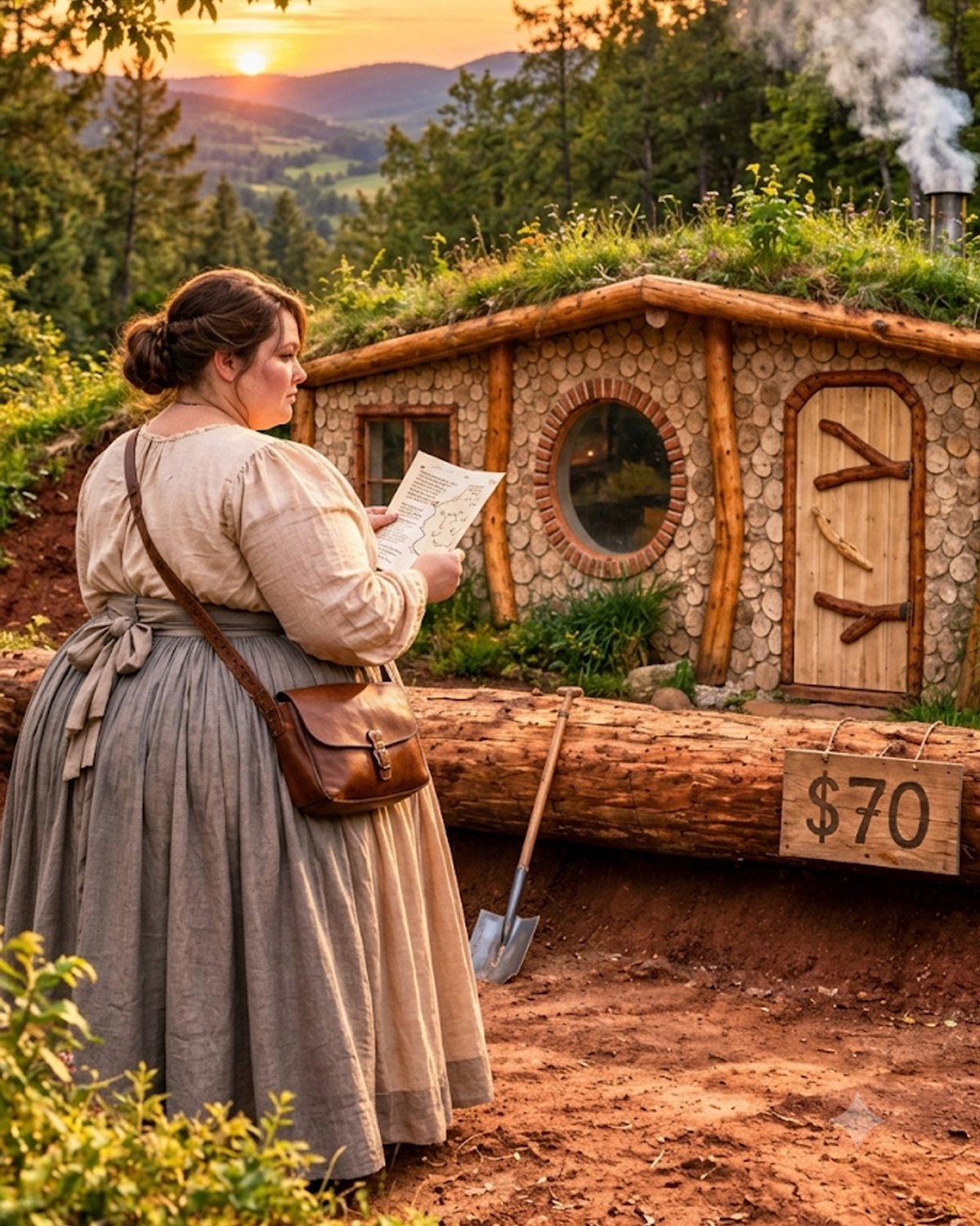
The man's hand rested on the door handle.
Eleanor grabbed my wrist.
"Don't let him inside."
I looked at her.
"What is happening?"
She didn't answer.
Outside, the man knocked once more.
"Miss Bellwether, I would strongly advise you to open the door. This matter concerns the legal ownership of the property."
I stepped away from Eleanor and approached the entrance.
"Who are you?"
The man removed his hat.
"Thomas Hale. I'm a representative of the county land office."
"Then why are you standing at my door after sunset?"
"Because I have been trying to locate this property for three days."
He held up the folded document.
"And because someone has made a claim against the transfer you recently completed."
I looked at the paper.
The county seal was visible through the glass.
I had paid seventy dollars. I had received confirmation from the land office. I had followed the instructions on the official notice.
Nobody had told me there could be another owner.
"I have the transfer papers," I said. "I paid the outstanding balance."
"I understand."
"Then the house belongs to me."
Mr. Hale glanced toward Eleanor.
"That depends on whether the original transfer was valid."
I felt my stomach tighten.
"What does she have to do with it?"
He lowered the document slightly.
"Mrs. Whitcomb is listed as a witness to the original agreement. Her testimony may determine whether the property can legally pass to you."
I turned toward Eleanor.
She was standing beside the table, her hands clasped tightly in front of her.
"You told me you were connected to the property," I said. "You didn't tell me there was a problem with the ownership."
"I didn't know the county would reopen the matter."
"Why would they?"
Eleanor looked toward the blue apron.
"Because someone has been searching for this house."
Mr. Hale interrupted.
"Someone has already found it."
He placed his leather case on the wooden step.
"Miss Bellwether, may I come inside?"
I hesitated.
Eleanor shook her head.
But I was tired of receiving pieces of information from people who seemed to know everything except how to explain it.
"Come in."
The man entered carefully, wiping his shoes against the wooden threshold.
He appeared to be in his early fifties, with neatly combed brown hair beginning to turn gray at the temples. His coat was well maintained, and his leather case looked expensive.
He glanced around the room.
His eyes stopped at the circular window.
Then at the iron stove.
Finally, they settled on the faded blue apron.
For a moment, his expression changed.
"You found it," he said.
I frowned.
"Found what?"
He pointed toward the apron.
"Clara's."
I looked at Eleanor.
She was watching him with an expression I couldn't understand.
"Did you know my mother?"
Mr. Hale shook his head.
"Not personally. But I've seen her name in these records for most of my career."
He opened his case and removed several documents.
"Your mother was involved in a property dispute that was never properly resolved."
I sat down.
"With whom?"
He placed a document on the table.
"Eleanor Whitcomb."
I looked toward Eleanor.
She didn't deny it.
"Why would my mother have a dispute with you?"
Eleanor slowly approached the table.
"It wasn't a dispute between us."
"Then what was it?"
She looked at Mr. Hale.
"Please tell her what you found."
He unfolded a large sheet of paper.
It contained a map of the hillside property, including the creek, the old mill site, and the logging trail.
I recognized the shape immediately.
It was almost identical to the map my mother had left inside the green tin box.
But there was something different.
A section of land beneath the house had been marked with a red boundary.
"What is this?"
"The original property division," Mr. Hale explained. "The house sits on a piece of land that was transferred separately from the surrounding hillside."
"To whom?"
He pointed to the bottom of the document.
The name was written in dark ink.
Ruth Whitcomb.
I stared at it.
The little girl in the photograph.
Eleanor's daughter.
"How old was she?"
"According to the records, she was seven when the original agreement was signed."
"But that was twenty-five years ago."
"Correct."
"Then she would be thirty-two now."
Mr. Hale nodded.
I looked at Eleanor.
"Where is she?"
Eleanor lowered her eyes.
"I don't know."
Mr. Hale removed another document.
"Someone claiming to be Ruth Whitcomb contacted the county office last week."
My fingers tightened around the edge of the table.
"Someone claiming?"
"She provided information that matched the original records. She also submitted a photograph of the property."
"Was it really her?"
"That's what we're trying to establish."
Eleanor suddenly spoke.
"It was her."
Mr. Hale looked at her.
"Mrs. Whitcomb, you haven't seen this woman in decades."
"I know my daughter's handwriting."
The room fell silent.
I looked between them.
"Your daughter is alive?"
Eleanor closed her eyes.
"I have prayed for that possibility every day."
I remembered the old photograph.
The little girl standing between Eleanor and my mother.
The wooden box.
The spring chamber.
The notebook.
All those years, I had believed my mother had lived an ordinary life of washing clothes and sewing dresses to earn enough money for our rented rooms.
But there had been another life.
A hidden one.
And somehow, I had been connected to it.
"Why did my mother keep this house for Ruth?"
Eleanor sat down.
"Because Clara believed Ruth would come back."
"After twenty-five years?"
"Yes."
"Why?"
Eleanor looked at me.
"Because Ruth knew something about this property that nobody else knew."
I waited.
She didn't continue.
Mr. Hale cleared his throat.
"There's another matter."
He removed a smaller paper from the case.
"This is the original notice concerning the seventy-dollar balance."
I recognized the document.
It was the same one I had received from the county office.
But now I noticed a line I hadn't paid attention to before.
The transfer was subject to an unresolved ownership claim.
I leaned closer.
"What does that mean?"
"It means the county accepted your payment to secure the property while the ownership matter was being reviewed. It does not mean the claim has been settled."
I felt the blood drain from my face.
"So I don't own the house?"
"You have a valid interest in the property. But the final transfer cannot be completed until the claim is resolved."
I looked at my hands.
Seventy dollars.
Almost everything I had.
I had sold my belongings, walked through the rain, and slept outside for six nights.
I had arrived believing that I had finally found somewhere to belong.
Now I was being told that someone else might take it away.
"Can I get my money back?"
Mr. Hale nodded.
"If the claim succeeds, the county can arrange reimbursement."
I looked up sharply.
"I don't want reimbursement."
He seemed surprised.
"I want the house."
Eleanor looked at me.
For the first time since she had arrived, her expression softened.
"I know, child."
I turned toward her.
"Then help me understand why everyone else seems to have a claim on something my mother left for me."
Eleanor lowered her head.
"I wish I could."
Mr. Hale gathered the documents into a neat stack.
"There's one thing I should tell you. The claimant has requested that no one disturb the lower spring chamber until she arrives."
My eyes moved toward the pantry.
"Why?"
"She believes something important may still be there."
I thought about the metal box.
The photograph.
The documents.
The sealed wooden panel.
I wondered how much else my mother had hidden beneath the house.
"Did she say what she was looking for?"
Mr. Hale shook his head.
"Only that the spring chamber contains evidence concerning the original agreement."
Eleanor rose abruptly.
"Thomas, you must not let her open that passage."
He looked at her.
"Mrs. Whitcomb, I cannot prevent the rightful owner from inspecting her own property."
"She doesn't know what is down there."
"Neither do you, apparently."
Eleanor's face tightened.
"I know enough."
Mr. Hale closed his case.
"I'll return tomorrow morning. Until then, I recommend that you avoid entering the lower chamber."
He turned toward me.
"Miss Bellwether, if Ruth arrives, please contact the office before making any agreements."
I nodded, although my thoughts were somewhere else.
He walked to the door.
Before leaving, he glanced at the apron once more.
"Your mother kept this place remarkably well preserved."
Then he stepped outside.
I watched him disappear down the muddy trail.
The sound of his footsteps faded.
When I turned around, Eleanor was still standing beside the table.
"Why did he say Ruth owns this house?"
Eleanor slowly sat down.
"Because the original agreement gave her the right to return."
"Return from where?"
"That is something I never learned."
"You said she disappeared."
"She did."
"Then how can she suddenly make a claim?"
Eleanor looked at the locket on the table.
"Because someone has been sending letters in her name for years."
I frowned.
"Letters?"
"At first, they came every few months. Then once a year. They were always short. They never included a return address."
"What did they say?"
Eleanor looked toward the window.
"That Ruth was alive. That she was safe. And that one day she would come home."
I felt a chill.
"Why didn't you tell my mother?"
"I did."
"What did she say?"
"She believed the letters were genuine."
"Then why didn't she tell me?"
Eleanor shook her head.
"I don't know."
I rose and walked toward the table.
The documents were still spread across it.
I picked up the photograph again.
The three figures stood beside the stone wall.
My mother.
Eleanor.
And little Ruth.
I examined the background.
Something caught my attention.
Behind them, near the circular window, was a wooden sign.
It was too small to read clearly.
I brought the photograph closer to the lamp.
There were three words.
BELLWETHER SPRING HOUSE.
I looked at Eleanor.
"Why is the house named after my family?"
She seemed startled.
"Where did you see that?"
"On the photograph."
She took it from me.
Her fingers moved across the faded writing.
For a long moment, she said nothing.
Then she whispered:
"Because Clara wanted it to carry your name."
I felt something rise in my throat.
"Why?"
"She wanted you to inherit something that could never be taken away by a landlord."
I looked around the little room.
The old table.
The iron stove.
The shelves.
The apron.
Suddenly, the house felt different.
It wasn't merely a forgotten building.
It had been created with me in mind.
But why had Mama never told me?
I returned the photograph to the table.
"I want to see everything."
Eleanor looked worried.
"Everything?"
"The spring chamber. The documents. The passage. All of it."
"Not tonight."
"Why not?"
"Because we need to clear the upper inlet first."
"Then let's do it tomorrow."
She hesitated.
"There is something else."
I waited.
"Clara told me never to open the lower passage without Ruth present."
My eyes moved toward the pantry.
"But you just said you don't know where she is."
"I know."
"Then how are we supposed to understand the house?"
Eleanor looked down at her hands.
"Perhaps we aren't supposed to understand it yet."
I felt anger rising again.
"I am tired of waiting for people to decide what I am allowed to know."
She didn't argue.
Instead, she walked toward the blue apron.
She gently lifted its lower edge.
There was a small pocket I hadn't noticed before.
She reached inside and removed a folded piece of cloth.
It was a handkerchief.
White, with a tiny embroidered letter R in one corner.
Eleanor held it carefully.
"Ruth's."
I stepped closer.
"How do you know?"
"Because I made it for her."
She turned it over.
A small date had been stitched into the corner.
October 1860.
I frowned.
The same date appeared on the notebook and the original documents.
But the embroidery looked much newer than the paper.
"Was this made when she disappeared?"
Eleanor nodded.
"Clara kept it here."
"Why?"
Eleanor looked toward the pantry.
"Because she believed Ruth had left something behind."
I examined the cloth.
There was a small dark mark near one edge.
At first, I thought it was dirt.
Then I noticed a line of stitching beneath it.
The thread formed a few tiny letters.
I moved closer.
The message was difficult to read.
But I could make out three words.
"Under the wheel."
I looked up.
"The wooden wheel?"
Eleanor's face changed.
"What?"
"The wheel in the spring chamber. There's something under it."
She took the handkerchief from me.
Her fingers trembled.
"Clara never told me that."
I remembered the wooden wheel beside the water channel.
I remembered the emergency release.
I remembered the metal box beneath the second stone.
There was something else.
Something my mother had hidden.
I looked toward the pantry door.
The passage was still open.
A faint sound of running water drifted upward.
Eleanor moved closer.
"We must not go down there tonight."
I looked at the handkerchief.
"Why?"
"Because I don't know what Clara left beneath that wheel."
"Then we'll find out tomorrow."
She nodded reluctantly.
I returned to the table and gathered the documents.
One paper had slipped beneath the edge of the notebook.
I pulled it free.
It was a small list written in my mother's handwriting.
Several names appeared on it.
Eleanor Whitcomb.
Ruth Whitcomb.
Clara Bellwether.
And beneath them, a fourth name.
Avis Bellwether.
I stared.
My name had been written beside a date.
The date was October 1860.
That was impossible.
I was born twenty-five years ago.
I turned the paper over.
There was another line.
"She must never know until the house is ready."
My mouth went dry.
I read it again.
She must never know.
I looked at Eleanor.
"Why did my mother write my name on a document dated before I was born?"
Eleanor approached the table.
When she saw the paper, she stopped.
Her face became completely still.
"Where did you find that?"
"Inside the notebook."
She took the paper from my hand.
For several seconds, she examined it without speaking.
Then she looked at me.
"Avis, there is something Clara never told you."
I felt my chest tighten.
"What?"
Eleanor slowly placed the paper on the table.
"Your mother didn't discover this house after you were born."
I stared at her.
"Then when did she find it?"
"Before she ever met your father."
I waited.
Eleanor looked toward the pantry.
"Clara came here because someone had already told her that a little girl named Avis would one day need this house."
I shook my head.
"That makes no sense."
"I know."
"Who told her?"
Eleanor's lips parted.
But before she could answer, a sudden knock struck the front door.
We both turned.
Three knocks.
Slow.
Deliberate.
I walked toward the entrance.
Eleanor caught my sleeve.
"Wait."
The knock came again.
Then a woman's voice spoke from outside.
"I know you're in there, Eleanor."
Eleanor went pale.
I looked at her.
"Who is it?"
She didn't answer.
The voice came again.
"Open the door. I've waited twenty-five years."
Eleanor stepped backward.
Her lips trembled.
Then the woman outside spoke four words that made the old house feel suddenly smaller.
"Tell Avis I'm Ruth."






Comments 0