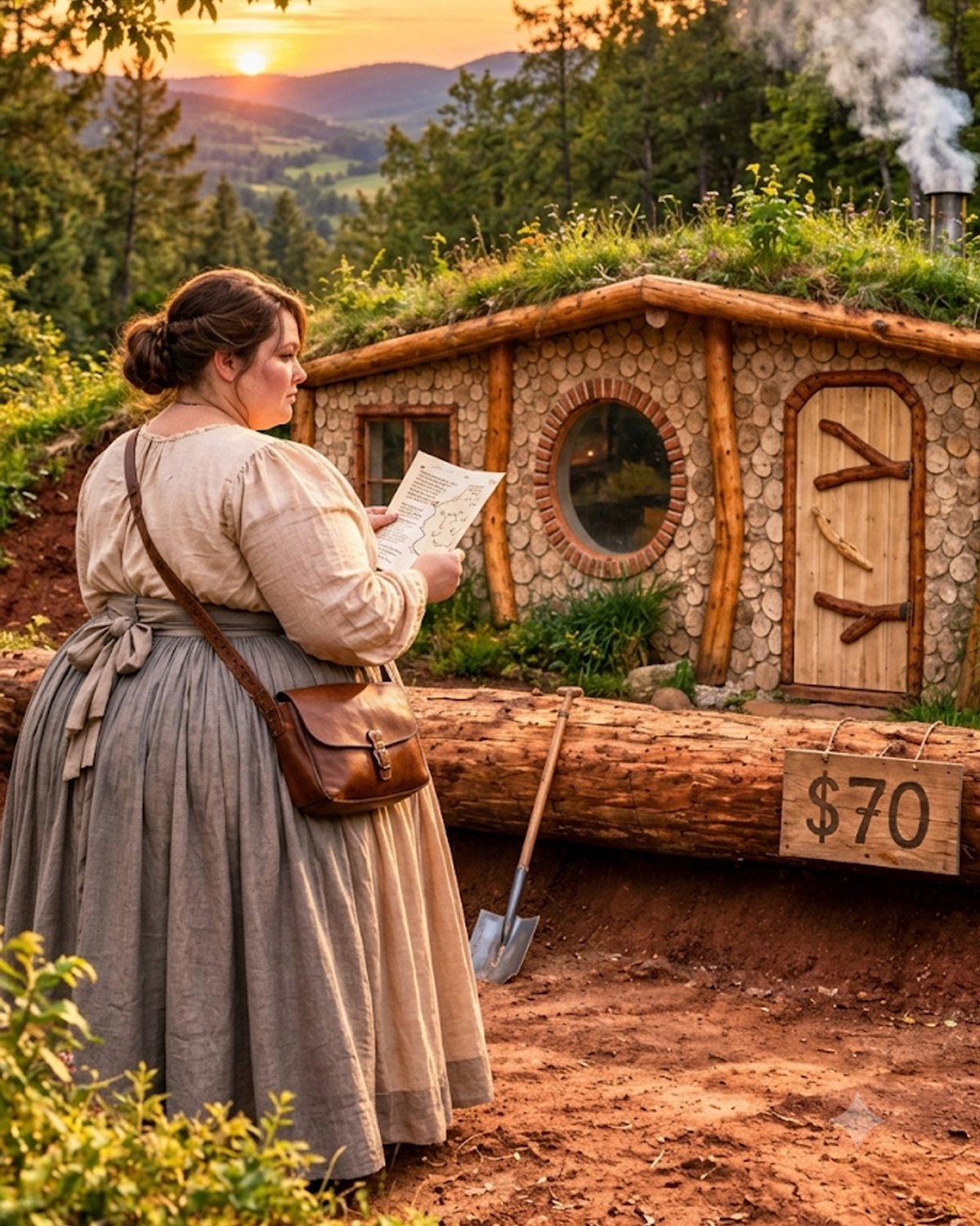
The iron handle turned again.
I stepped away from the pantry door so quickly that my chair struck the wooden table behind me.
For several seconds, I couldn't move.
The house was silent.
Then came another sound.
Click.
The handle stopped.
I stared at it, waiting for the door to open.
Nothing happened.
My heart was beating so hard that I could feel it in my throat.
"Hello?"
My voice sounded strange inside the little stone room.
I waited.
No answer.
I looked toward the entrance. The front door was still partly open, allowing a narrow strip of golden evening light to fall across the floor. Beyond it, the hillside was empty.
There was nobody outside.
I looked back at the pantry.
Perhaps the old mechanism had shifted. Perhaps the wood had expanded with the dampness. Perhaps the sound had come from the water system beneath the house.
I tried to convince myself of those explanations.
But I remembered the three knocks.
They had come from beneath the floor.
And now something had turned the handle.
I picked up the small brass key from the table and approached the door again.
My fingers wrapped around the iron handle.
It was cold.
I turned it slowly.
The handle moved a fraction of an inch before stopping.
Locked.
I leaned closer and examined the frame.
There was no ordinary keyhole on the outside. Instead, a narrow metal plate had been fitted beneath the handle. Its surface was covered in dark rust.
I ran my fingertips along the edges.
Something clicked beneath my hand.
A small section of wood shifted inward.
I pulled it gently.
A narrow compartment opened.
Inside lay a tiny iron key.
I stared at it.
It was much smaller than the brass key I had used to enter the house.
Someone had deliberately hidden it there.
I took it out and examined its teeth.
They were worn, but the key appeared usable.
I glanced toward the notebook on the table.
My mother's drawings.
The spring chamber.
The lower inlet.
The hidden door.
Everything seemed connected.
I returned to the table and opened the notebook to the page containing the drawing of the pantry.
The illustration showed the shelves, the stove, and a narrow passage running beneath the floor.
At the edge of the drawing, Mama had made a small mark.
A circle.
Beside it were three words.
"Key behind handle."
I stopped breathing for a moment.
She had known.
She had known exactly where the key would be.
I looked toward the pantry door again.
For twenty-five years, that little key had apparently been waiting for someone to find it.
I placed the notebook down and returned to the door.
This time, the key entered the lock.
It turned easily.
A soft metallic click followed.
I pulled the handle.
The door opened inward.
Cold air touched my face.
Behind it was a narrow stone passage, barely wide enough for one person to walk through comfortably. Wooden steps descended into darkness.
I could hear water somewhere below.
Not the occasional dripping I had heard earlier.
This was a steady, continuous sound.
A stream moving through a narrow channel.
I stood at the entrance, trying to see where the steps ended.
The passage smelled of wet stone and old earth.
I wanted to turn around.
I had no lantern, no proper tools, and no idea what waited below.
But then I remembered the words in Mama's notebook.
"I cannot keep this place alone anymore. The water is coming back, and I have no one to help me."
My mother had been afraid of something down there.
And she had written to me.
I looked at the envelope behind the wooden peg.
My name was still visible.
Avis.
I returned to the wall and carefully removed it.
The paper was yellowed with age, but the envelope was surprisingly well preserved. A thin line of red thread had been wrapped around it twice.
My fingers moved over the familiar handwriting.
I recognized the way Mama formed the letter A.
She always began with a small upward curve.
I had seen that handwriting on grocery lists, birthday cards, and notes she left beside my breakfast.
For a moment, I was twelve years old again.
I could almost hear her calling me from the kitchen.
"Avis, don't forget your scarf."
I swallowed.
The envelope was sealed.
I held it near the window, trying to see whether anything had been written on the back.
There was only one sentence.
"To my daughter, when she finally comes home."
I sat down.
The words seemed to move across the paper.
When she finally comes home.
My mother had expected me to find this house.
Perhaps not immediately.
Perhaps not even within a few years.
But she had expected me to come.
I carefully loosened the seal.
Inside was a single folded sheet.
The paper smelled faintly of cedar and something else I couldn't identify.
I unfolded it.
The first line nearly brought me to tears.
"My dearest Avis,"
I pressed my lips together.
Then I began reading.
"If you are holding this letter, it means you have found the house. I wish I could have been there to open the door for you. I wish I could have seen your face when you discovered the little window and the old stove."
I stopped.
She had known about the round window.
She had known about the stove.
I continued.
"I have wanted to tell you about this place many times. Each time I began, something stopped me. I thought I was protecting you. Perhaps I was only protecting myself."
My eyes blurred.
I wiped them with the back of my hand.
"I built this house with help from people who believed that a woman with no money could still make something lasting. I worked every stone into place. I cleared the spring, repaired the drainage, and made the little room warm enough to survive the coldest nights."
I looked around.
The stone walls.
The wooden table.
The stove.
All of it had been made by my mother.
I had spent my childhood believing we had never owned anything.
Yet she had once built an entire home.
Why had she hidden it?
The letter continued.
"I left because the water beneath the house changed. At first, it was only a little more than usual. Then the lower chamber began filling faster than I could drain it. I was afraid the foundation would weaken. I was also afraid of what might happen if someone discovered the passage."
I read that sentence twice.
What passage?
I looked toward the open pantry door.
The steps descended into darkness.
My fingers tightened around the letter.
"I promised someone I would keep this place safe. I have not forgotten that promise. But I have grown tired, Avis. I cannot do everything alone."
There was a long pause in the handwriting, as though Mama had stopped writing for a while.
The next paragraph was shorter.
"If you ever come here, do not light the stove until you understand the inlet. Water must have somewhere to go. Remember that."
I lowered the paper.
The same warning appeared on the note beside the table.
I turned the page over, expecting more.
There was nothing.
No explanation.
No name.
No signature.
Just one final sentence written near the bottom.
"Look beneath the second stone beside the spring."
I stared at it.
The second stone.
Beside the spring.
I folded the letter carefully and placed it inside my coat.
Then I looked toward the passage.
I had intended to spend the evening making the house livable. I needed to find dry wood, check the roof, and prepare something to eat.
But the letter had changed everything.
I couldn't simply sit down and pretend I hadn't read it.
I needed to know what my mother had left behind.
I took the oil lamp from the table.
It was nearly empty, but there was enough oil inside to provide some light.
I lit it using a small match from my bundle.
The flame flickered.
I approached the pantry.
The first wooden step creaked beneath my boot.
I held the lamp forward.
The stone walls were damp.
Small beads of water glistened along the joints between the stones.
The passage descended for perhaps ten feet before turning sharply to the left.
I moved carefully.
At the bottom, I found myself in a small underground chamber.
It was larger than I expected.
A stone channel ran along the floor. Water flowed through it, disappearing beneath an opening in the far wall.
There was a wooden wheel mounted beside the channel.
Its surface was dark with age.
A thick iron pipe extended upward toward the house.
I recognized the shape from my mother's drawings.
This was the spring chamber.
The water was still flowing.
I approached the wooden wheel and examined its position.
A small metal label had been attached to the wall.
"MAIN INLET."
Beneath it was another label.
"DRAINAGE."
The second label had been partially covered by a layer of dirt.
I wiped it clean.
There was a third line beneath the word.
"EMERGENCY RELEASE."
I looked toward the water.
It was flowing more quickly than I had first noticed.
A few leaves had collected against a narrow opening in the channel.
The water was passing around them, but not freely.
I crouched and examined the obstruction.
It appeared to be a mixture of leaves, mud, and small stones.
Perhaps this was what Mama had meant by clearing the inlet.
I reached toward it, then stopped.
The notebook had described several different channels.
I didn't know which one I should touch.
I took the letter from my coat and read the final sentence again.
Look beneath the second stone beside the spring.
I raised the lamp.
There were several large stones surrounding the water channel.
I counted them from left to right.
One.
Two.
The second stone was larger than the others and had a small carved mark on its surface.
A circle with a line through it.
I brushed away the dirt.
The stone appeared to have been moved before.
I pressed both hands against its edge.
It shifted slightly.
I pulled harder.
The stone slid away from the wall with a grinding sound.
Beneath it was a shallow recess.
Inside lay a small metal box.
I stared at it.
The box was wrapped in oilcloth.
Its surface was covered in rust, but the hinges remained intact.
I lifted it carefully.
It was heavier than I expected.
A small brass clasp held it shut.
I tried opening it.
Locked.
I searched the surrounding recess for a key.
Nothing.
Then I remembered the small iron key I had found behind the pantry handle.
I took it from my pocket.
It fit.
The clasp opened.
Inside were several folded documents, a small cloth pouch, and another envelope.
The documents appeared to be property records.
I lifted the first one.
The handwriting was not my mother's.
It was formal, with several official-looking seals.
I could make out the words "land transfer" and "spring rights."
I didn't understand the details.
But I recognized my mother's name.
Clara Bellweather.
Beneath it was another name.
Eleanor Whitcomb.
I had never heard that name before.
I placed the document aside and picked up the cloth pouch.
Something small and hard moved inside.
I opened it.
A silver locket rested in my palm.
It was oval-shaped, with a tiny engraved flower on the front.
I had seen it before.
Not in the house.
On my mother's neck.
She had worn it almost every day when I was a child.
I remembered asking her what was inside.
"Someone I loved very much," she had answered.
I had assumed it was a photograph of my father.
But Mama had never spoken about my father.
Not once.
I opened the locket.
Inside was a small photograph.
Two women stood beside a stone wall.
One was my mother.
The other was much younger, with dark hair tied behind her head.
They were smiling.
Behind them, the house was clearly visible.
I recognized the circular window.
I turned the photograph over.
Two names had been written in faded ink.
"Clara and Eleanor. October 1860."
My hands went numb.
Why was Eleanor standing beside my mother?
And why had Mama hidden her name inside the spring chamber?
I returned the photograph to the locket.
The documents beneath it were arranged carefully.
Some described the purchase of the property.
Others contained measurements of the spring and the surrounding land.
One sheet included a sketch of the underground chamber.
Another showed a narrow tunnel extending beyond the foundation.
I looked toward the far wall.
There was a dark opening behind the water channel.
It was partially covered by a wooden panel.
I moved closer.
The panel had been reinforced with iron brackets.
Someone had tried to seal it.
On its surface, I noticed a small piece of paper.
I pulled it free.
A short message had been written across it.
"Do not open this until the upper channel is clear."
I felt a chill move through my body.
The upper channel.
The inlet.
The drainage.
Everything seemed to connect.
I looked back at the water.
The leaves and mud were still collecting near the opening.
Perhaps the channel had been blocked for years.
Perhaps clearing it would allow the water to move properly.
But the notebook had warned that the water was coming back.
I couldn't be certain what would happen if I touched anything.
I returned to the metal box.
There was one envelope left inside.
Unlike the first, this one had no name on the front.
Only a date.
October 1860.
The paper was sealed with dark wax.
I turned it over.
A small symbol had been pressed into the wax.
The same circle with a line through it that I had found carved into the stone.
I tried to open the envelope, but the seal broke unevenly.
Inside was a single page.
The writing was cramped and difficult to read.
I recognized my mother's handwriting immediately.
"To the person who finds this,"
I read the first line.
Then the second.
"If the water has returned, the house is no longer safe to leave unattended. The lower passage must remain closed until the spring is controlled."
I looked toward the wooden panel.
The lower passage.
"Someone may come looking for what was left beneath the house. Do not mistake the first person who knocks for a friend."
I stopped.
My eyes moved to the final lines.
"If Eleanor has returned, tell her I kept my promise."
I stared at the name.
Eleanor.
The woman in the photograph.
The woman whose name appeared on the property documents.
What promise had Mama made?
And why had she written as though Eleanor might return?
I folded the letter and placed it beside the others.
The lamp flame flickered.
A small sound came from the passage above me.
I turned.
It sounded like a footstep.
Then another.
I raised the lamp.
"Hello?"
Silence.
I climbed the first few steps.
Nothing was visible.
I listened.
The sound came again.
A soft scrape.
Then a pause.
I reached the top of the stairs and looked into the main room.
The front door was still partly open.
The table stood where I had left it.
The blue apron hung from its peg.
Everything appeared unchanged.
But the envelope I had placed beside the notebook was no longer there.
I stopped.
I was certain I had left it on the table.
I looked beneath the chair.
Nothing.
Then I noticed a small piece of paper near the front door.
It had not been there before.
I picked it up.
The handwriting was unfamiliar.
The message contained only one sentence.
"Clara promised this house would never belong to anyone else."
I read it again.
Then I looked outside.
The sun had almost disappeared behind the mountains.
Someone had been inside the house.
Someone had entered while I was below.
Someone knew my mother's name.
And someone knew about the promise.
I rushed to the front door and looked down the muddy trail.
At first, I saw nothing.
Then a figure appeared between the trees.
A woman.
She stood perfectly still, watching the house.
I couldn't see her face.
She wore a long dark coat and held something in one hand.
I stepped onto the threshold.
"Excuse me!"
The woman didn't answer.
I took another step.
"Are you looking for someone?"
She slowly raised her head.
Even from a distance, I could see that she was staring directly at me.
Then she lifted the object in her hand.
A small silver locket.
The same kind I had just found beneath the spring.
My stomach tightened.
I looked down at the locket in my hand.
Then back toward the woman.
She began walking up the trail.
And as she reached the first wooden fence post, she called out a name I had never expected anyone else to know.
"Clara's daughter..."
She stopped.
Then she spoke again.
"Are you Avis Bellwether?"






Comments 0