"Show her the emergency order."
My mother's voice carried through the front door as clearly as if she were standing beside me.
I stood frozen in the hallway, staring through the narrow window at the three people gathered on my porch.
It was 2:34 in the morning.
My six-year-old son was asleep upstairs with a swollen ear, exhausted from crying and answering questions at the hospital.
And my mother had arrived with two men and a document she apparently believed gave her the right to take him away.
"Whitney?"
Desmond's voice sounded distant through the phone.
"Are you still there?"
I swallowed.
"She's outside."
"Your mother?"
"Yes."
"Is the door locked?"
"Yes."
"Keep it that way."
The man holding the folder stepped closer to the porch light.
He was tall, probably in his fifties, with silver hair and an expensive charcoal suit beneath his overcoat.
I recognized him.
Martin Voss.
My mother's attorney.
I'd met him at family Christmas parties, charity dinners, and the occasional birthday celebration.
He always shook my hand as though we were business acquaintances.
He always called my mother Eleanor, never Mrs. Whitcomb.
And he always seemed to know things about my life that I hadn't personally told him.
Now he stood outside my home holding a document concerning my son's custody.
My mother moved beside him.
"Whitney, I know you're upset," she called. "But you're making this much worse than it needs to be."
I stared at her through the glass.
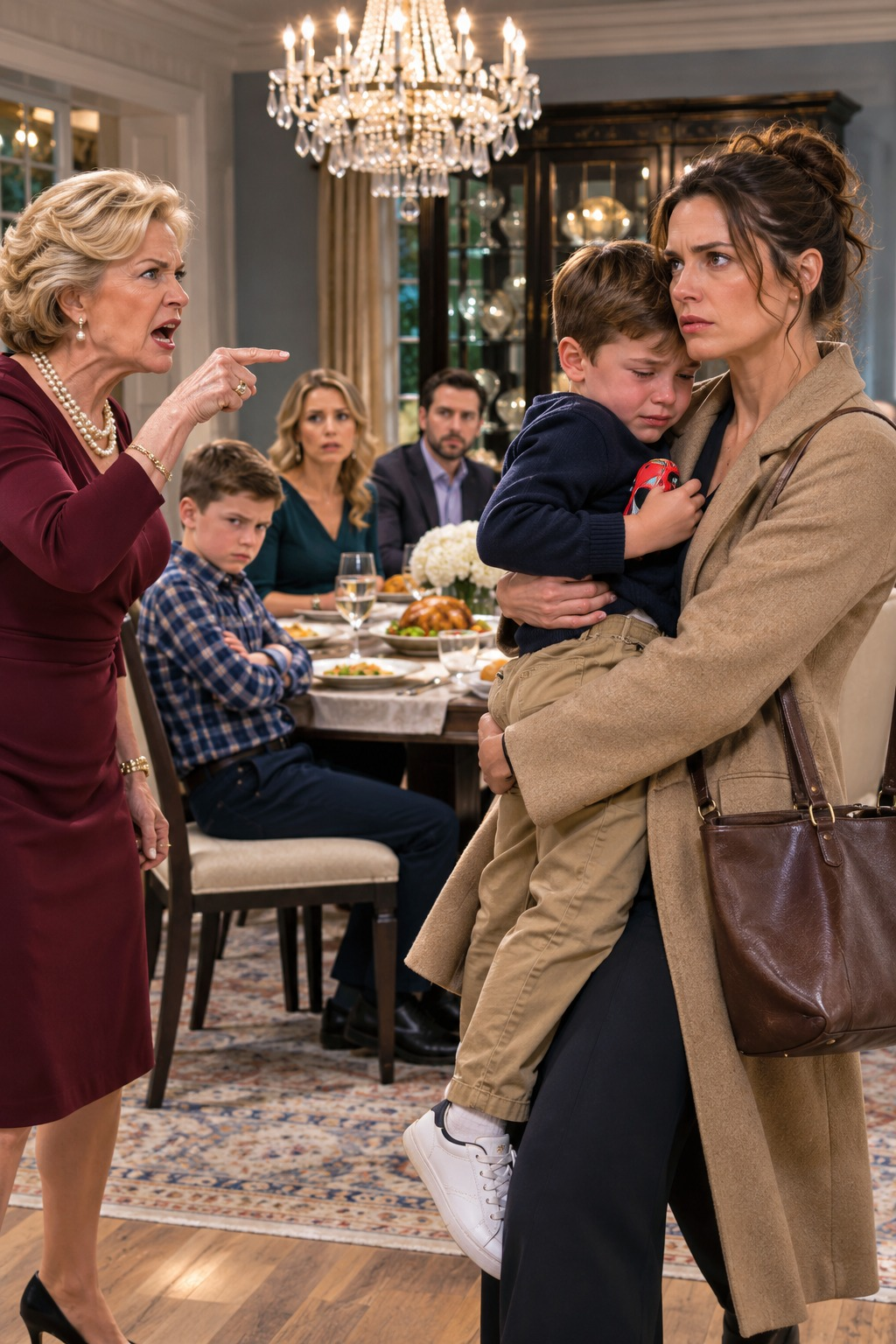
She had changed into a dark coat, but the burgundy dress was still visible beneath it.
Her pearls were still around her neck.
She looked exactly as she had at dinner.
Except now, instead of pointing at me across a dining table, she was standing on my porch with an attorney.
"Don't answer her," Desmond said.
I pressed the phone closer to my ear.
"She's saying I have to let them in."
"She doesn't get to decide that."
"What if the document is real?"
"Ask them to leave a copy. Do not open the door. An attorney delivering paperwork is not the same as a court officer enforcing a valid order."
I looked at the paper Martin held.
I could see the words Emergency Petition near the top.
But the rest was too small to read.
"Desmond, she has something with my signature."
"We'll examine it."
"What if I signed away my rights without knowing?"
His answer came immediately.
"Whitney, a signature on an estate-planning document does not automatically transfer custody of your child. And even a properly filed guardianship petition doesn't become an enforceable order simply because someone printed it."
I closed my eyes.
I wanted to believe him.
But my mother had spent my entire life making ordinary things sound terrifying.
A missed phone call became disrespect.
A disagreement became betrayal.
A late payment became proof that I couldn't manage my life.
Now she was using legal paperwork to make me believe I could lose my son.
And for one awful moment, it worked.
"Whitney!" my mother called again.
I stepped closer to the door.
"Go home, Mom."
Her expression changed.
She clearly hadn't expected me to answer without opening it.
"Open this door."
"No."
"Don't be childish."
I gripped the phone.
"Leave the documents on the porch."
Martin stepped forward.
"Mrs. Walker, I strongly recommend that you review these papers immediately."
"Then leave them."
He glanced at my mother.
She gave a small, impatient nod.
Martin placed a thick envelope on the bench beside the door.
But he didn't leave.
Instead, he looked directly at the window.
"Your mother is concerned about your emotional condition."
I felt my stomach tighten.
"My emotional condition?"
"She's informed us that you've been struggling since your husband's death."
I almost laughed.
Of course she had.
Cole's death.
The one wound she could always reopen.
"I took my injured child to the hospital," I said. "That's what happened tonight."
My mother folded her arms.
"You frightened everyone at dinner."
"You hit Tucker."
"I corrected him."
"You knocked him onto the floor."
Her face hardened.
"Whitney, lower your voice."
I stared at her.
Even now.
Even standing outside my locked home at nearly three in the morning, she expected to control how loudly I spoke.
Martin cleared his throat.
"Mrs. Walker, nobody is suggesting that you don't love your son."
"Then why are you here?"
He glanced at the folder.
"To discuss temporary arrangements while your family addresses certain concerns."
"What concerns?"
My mother answered.
"Your inability to make reasonable decisions."
I went completely still.
She continued.
"You dragged Tucker to an emergency room over a minor family disagreement. You embarrassed your sister. You threatened to keep my grandson away from me. And now you're refusing to speak with people who are trying to help."
My hands began shaking.
Not because I believed her.
Because I suddenly understood what she was doing.
She wasn't trying to apologize.
She was building a story.
A story in which I was unstable.
A story in which Tucker needed protection from me.
A story in which Eleanor Whitcomb was the generous grandmother forced to intervene.
And she'd begun preparing that story long before tonight.
I thought about the folder she'd brought to lunch three months after Cole died.
The documents she'd insisted I sign.
The way she'd smiled afterward.
I looked at Martin.
"Did you prepare the papers my mother gave me last year?"
He didn't answer immediately.
"What papers?"
"Estate-planning documents. I signed them at lunch."
My mother interrupted.
"That has nothing to do with this."
I kept my eyes on Martin.
"Did you prepare them?"
His expression became guarded.
"I would need to review the relevant file."
I heard Desmond speaking through the phone.
"Whitney, don't discuss the substance with them. We need copies first."
I nodded.
Then I looked at my mother.
"Leave."
Her face flushed.
"Excuse me?"
"Take your attorney and leave my property."
She stepped toward the door.
"After everything I've done for you?"
I felt the familiar pull.
The instinct to explain.
To apologize.
To tell her I appreciated the money, the dinners, the gifts, the help.
But then I remembered Tucker whispering that Grandma had locked him in the laundry room.
I remembered his little fingers pressed against his injured ear.
And I remembered the way he'd asked whether we were still allowed to go home.
"Mom," I said quietly, "you don't get to hurt my son and then use your money to threaten me."
Her expression went cold.
"You'll regret speaking to me this way."
I looked directly at her.
"You said that earlier."
Then I stepped away from the window.
My mother didn't leave immediately.
For another five minutes, she knocked, called my name, and insisted that I was making a terrible mistake.
I recorded the sounds from inside the house.
Desmond stayed on the phone.
He told me to keep the doors locked and contact the police if they refused to leave or attempted to enter.
Finally, Martin persuaded her to return to the car.
I watched through the window as she walked down the driveway.
Before getting inside, she turned and looked toward Tucker's bedroom.
The sight made my skin crawl.
Then the sedan pulled away.
I stood motionless until its taillights disappeared.
Only then did I realize how hard I was trembling.
"Whitney?" Desmond asked.
"They're gone."
"Good."
I sank onto the bottom stair.
"She really thinks she can take him."
"She may think she can frighten you into agreeing to something."
"What's the difference?"
"The difference is that fear isn't a court order."
I covered my face.
"I signed those papers, Desmond."
"We don't know what they say yet."
"What if I was stupid?"
"Whitney."
"What if I signed something terrible because I trusted her?"
His voice softened.
"Being deceived by someone you trusted doesn't mean you deserve what follows."
I swallowed.
"She was my mother."
"I know."
"She told me she was protecting Tucker."
"I know."
I looked toward the staircase.
My son's bedroom door was closed.
A faint strip of light glowed beneath it from his night-light.
"I can't lose him."
"You haven't lost him."
"But she's trying."
"Then we'll respond with facts, records, and the proper legal process."
I took a shaky breath.
"Okay."
"First, photograph the documents on the porch without putting yourself at risk. Then send me the images."
I waited until I was certain the car had gone.
I checked the security camera feed.
The driveway was empty.
Then I opened the door just far enough to retrieve the envelope.
The cold air hit my face.
I grabbed the papers and locked the door again.
For a moment, I stood with the envelope in my hands.
My name was written across the front.
Beneath it, in smaller letters, were three words.
Personal and Confidential.
I almost laughed.
My mother had spent years discussing my finances, marriage, parenting, and grief with anyone willing to listen.
Now she was suddenly concerned about confidentiality.
I carried the envelope to the kitchen.
Then I opened it.
The first page was a letter from Martin Voss.
It stated that his office represented Eleanor Whitcomb in matters concerning Tucker's welfare.
The letter claimed that my mother had serious concerns about my ability to provide a stable environment.
It referenced my husband's death.
My grief.
My alleged financial dependence.
And my supposed refusal to accept necessary family assistance.
I read the paragraph twice.
Then a third time.
It described me as a woman who had become increasingly isolated and emotionally volatile.
I stared at those words.
Emotionally volatile.
Because I'd taken my son to the hospital.
Because I'd refused to apologize.
Because I'd finally said no.
The next page was labeled Emergency Petition for Temporary Guardianship.
But as I read more carefully, I noticed something.
There was no judge's signature.
No court seal showing approval.
No signed order directing anyone to transfer custody.
It appeared to be a proposed filing, accompanied by a draft affidavit.
I felt a small wave of relief.
Then I turned the page.
And the relief vanished.
Attached was a copy of a document dated three months after Cole's death.
At the bottom was my signature.
Above it were the words:
Acknowledgment of Proposed Family Support and Contingent Care Arrangements.
I frowned.
That wasn't how my mother had described it.
She'd told me I was signing paperwork to make sure Tucker would be cared for if something happened to me.
I read the next paragraph.
It stated that I acknowledged my mother's willingness to provide financial support and assist with emergency care planning.
Another paragraph referred to possible temporary decision-making authority in the event of incapacity.
But the document didn't clearly establish that I had surrendered custody.
And it certainly didn't authorize my mother to take Tucker because we'd had an argument.
Still, I felt sick.
My signature was there.
And I remembered the day I'd written it.
We'd been sitting at a restaurant near my mother's office.
She'd ordered grilled salmon.
I'd ordered soup I barely touched.
Tucker was at school.
I was still sleeping in Cole's old T-shirts because they smelled faintly like him.
My mother had placed a folder beside my plate.
"Whitney, we need to be practical."
I'd looked at her.
"About what?"
"Your future."
I remembered being tired.
So tired.
She'd explained that I needed a plan for Tucker.
She said responsible mothers didn't leave things to chance.
She said if anything happened to me, someone would need authority to help.
Then she'd handed me a pen.
"Just sign where Martin marked the pages."
I hadn't read everything.
I was ashamed to admit that.
But grief had made ordinary tasks feel impossible.
I could barely remember to buy milk.
I couldn't imagine understanding complicated legal language.
And my mother had sounded so certain.
So helpful.
So much like the mother I'd always wanted.
After I signed, she'd squeezed my hand.
"There. Now you can stop worrying."
I remembered feeling grateful.
Actually grateful.
Now I sat at my kitchen table, staring at the same signature, wondering how much of that lunch had been planned.
I photographed every page and sent the images to Desmond.
He called back ten minutes later.
"I've reviewed what you sent."
I straightened.
"Tell me."
"First, the document they delivered is not an issued emergency custody order."
I closed my eyes.
"Thank God."
"It's a petition and supporting material. That distinction matters."
"Can she file it?"
"She can attempt to file a petition. Whether it meets the legal requirements and whether a court grants any relief are separate questions."
"What about my signature?"
"The acknowledgment is troubling, especially given how you describe the circumstances. But it doesn't appear to give Eleanor unrestricted guardianship authority."
I exhaled.
"So she can't just come take Tucker?"
"Not based on these papers alone."
I pressed my hand against my chest.
For the first time since the doorbell rang, I could breathe.
Then Desmond said, "But there's something else."
I went still.
"What?"
"The financial statement attached to the petition."
I flipped through the pages.
Near the back was a document titled Summary of Financial Assistance Provided to Whitney Walker.
It listed payments.
Mortgage assistance.
Household expenses.
Childcare.
Medical costs.
And several large transfers I didn't recognize.
The total at the bottom made my stomach drop.
$184,600.
I stared at the number.
"That's impossible."
"I agree."
"My mother never gave me anything close to that."
"Do you have records of the checks she actually sent?"
"Yes."
"Good. We'll compare them."
I looked at the statement again.
Some entries were labeled direct support.
Others were labeled family advances.
One line read:
Emergency mortgage stabilization — $42,000.
I nearly dropped the papers.
"Desmond, she says she paid forty-two thousand dollars toward our mortgage."
"Did she?"
"No!"
"Then we'll obtain the lender records."
I kept reading.
Another entry caught my eye.
Trust-related administrative expense — $18,500.
My mouth went dry.
"Why would she be charging me for trust administration?"
"She shouldn't be, unless there was a legitimate arrangement authorizing it."
"There wasn't."
"Then that's another issue we need to investigate."
I stared at the page.
For years, my mother had told everyone she'd saved us financially.
Now I was looking at a document that attempted to turn that story into an official record.
And the amounts weren't merely exaggerated.
Some appeared completely invented.
"Desmond," I whispered, "she's been preparing this."
He didn't answer immediately.
Then he said, "It certainly appears that these claims weren't created tonight."
I thought about the envelope.
Cole's missing letter.
The safe-deposit key.
The mysterious trust.
And my mother's obsession with Tucker's inheritance.
The pieces were beginning to form a picture.
I just didn't know what it showed.
At four in the morning, I finally went upstairs.
Tucker was still asleep.
I stood beside his bed and watched him breathe.
His small hand rested on the blanket.
Without the red car, his fingers curled around empty fabric.
I sat beside him.
"I'm going to fix this," I whispered.
I knew I couldn't fix everything.
I couldn't bring Cole back.
I couldn't erase the fear my mother had planted.
I couldn't undo the nights Tucker had spent believing he was responsible for my sadness.
But I could stop pretending.
I could stop giving my mother access to him.
And I could make sure that whatever happened next, he knew I would stand beside him.
I gently adjusted his blanket.
Then I noticed something on his bedside table.
A photograph.
Cole holding Tucker on his shoulders at the county fair.
Tucker had insisted on keeping it there after the funeral.
I picked it up.
Cole was smiling.
His eyes were half closed against the sunlight.
I traced his face with my thumb.
"You knew something," I whispered.
The second phone vibrated in my pocket.
A message from Desmond.
I found the attorney's correspondence concerning the missing envelope. Call me when you're awake.
I stared at the screen.
Then I called immediately.
He answered on the second ring.
"Whitney, you need to sleep."
"Tell me what you found."
He sighed.
"Martin Voss sent a letter to Cole's office six weeks before the accident."
I sat straighter.
"What did it say?"
"It acknowledged receipt of certain sealed materials."
"The yellow envelope?"
"Possibly."
"Why would Martin have it?"
"Because Cole had requested that the materials be held pending completion of a corporate review."
I frowned.
"That doesn't make sense. Why would Cole trust my mother's attorney?"
"At the time, Martin was also handling limited corporate matters for an affiliated investment entity. Cole later became concerned about conflicts of interest."
My heart began pounding.
"What happened?"
"According to the correspondence, Cole demanded the materials be transferred to independent counsel."
"To you?"
"Yes."
"And?"
"Martin acknowledged the request."
I held my breath.
"But he never sent the envelope."
"No."
I stared at the photograph in my hand.
"Did Cole know?"
"He knew there was a delay. He was trying to resolve it."
"Before the accident."
"Yes."
I closed my eyes.
Another unfinished task.
Another thing Cole had been trying to fix.
"Desmond, what's in that envelope?"
"I still don't know."
"But you have a theory."
He hesitated.
"Yes."
"Tell me."
"I think it may contain a written explanation of the transactions Cole was investigating, along with instructions concerning Tucker's trust."
I looked toward my sleeping son.
"Why would my mother keep it?"
"That's what we need to establish."
I swallowed.
"And the safe-deposit box?"
"I've contacted the bank's legal department. We should know the access requirements when they open."
I nodded.
"Okay."
"Whitney, there's something else."
I closed my eyes.
"Of course there is."
"Martin's correspondence mentions a second set of records."
My heart quickened.
"Where?"
"An independent repository."
"The safe-deposit box?"
"Possibly."
I looked at the silver key lying on the dresser.
C.H.W.
Box 214.
Cole had hidden it where I might eventually find it.
But why those letters?
Why put them on Tucker's toy car?
I thought about the little red vehicle.
Cole had given it to Tucker shortly before he died.
Maybe he'd wanted our son to carry something meaningful.
Or maybe the initials were simply a private family marking.
Cole had loved small sentimental details.
He'd carved our initials into the underside of the porch swing.
He'd written dates inside books.
He'd hidden notes in my coat pockets.
I didn't want to turn every memory into evidence.
But the coincidence was impossible to ignore.
"Desmond, I need that car back."
"What car?"
I explained the initials.
He went quiet.
Then he said, "Don't confront Eleanor about it yet."
"I know."
"Let me arrange a way to recover it without putting Tucker through another confrontation."
I looked at my son.
"Please."
By seven-thirty, I'd slept less than an hour.
I made coffee.
Checked on Tucker.
And opened my laptop.
I began gathering records.
Bank statements.
Mortgage payments.
Copies of my mother's checks.
The messages she'd attached to them.
Every document I could find.
I created folders.
One for financial support.
One for the house.
One for Tucker's medical records.
One for communications with my mother.
I wasn't trying to punish her.
I was trying to make sure nobody could replace the truth with a story that sounded more convenient.
At eight-fifteen, Lorna called.
I almost ignored it.
Then I answered.
"What?"
She sounded offended.
"Good morning to you too."
"What do you want, Lorna?"
"Mom says you refused to let Martin inside last night."
"That's correct."
"Whitney, do you have any idea how embarrassing this is?"
I stared at the wall.
"My son was injured."
"Mom didn't mean to hurt him."
"She struck him."
"You're exaggerating."
"There's a hospital record."
Lorna went silent.
Then she said, "You actually told the hospital Mom did that?"
"Yes."
"Oh my God."
I closed my eyes.
Not concern for Tucker.
Not horror at what had happened.
Only disbelief that I'd told someone outside the family.
"Whitney, you could ruin her reputation."
I looked toward the staircase.
"And Tucker's safety matters less?"
"That's not what I said."
"It's what you're acting like."
She sighed.
"Mom is just trying to protect the family."
"From what?"
"From all this drama."
I almost laughed.
Then I asked, "Lorna, did you know about the guardianship papers?"
Silence.
I sat straighter.
"Lorna?"
"I don't know what you're talking about."
"Mom sent Martin to my house at two-thirty in the morning with a guardianship petition."
Another silence.
Then Lorna whispered, "She wasn't supposed to do that yet."
My blood went cold.
"What?"
"Nothing."
"Lorna, what did you just say?"
"I have to go."
"Wait."
But she'd already hung up.
I stared at the phone.
She wasn't supposed to do that yet.
Not I didn't know.
Not What guardianship papers?
She knew.
My sister knew.
And whatever my mother was planning, it had been discussed before last night.
At nine o'clock, Desmond called with an update.
"The bank confirmed that Box 214 exists."
My heart jumped.
"And?"
"It's registered under Cole's name, with estate-related access provisions. They're reviewing the documents needed for you to enter."
"Can we go today?"
"Possibly this afternoon."
I looked at the key beside my laptop.
"Good."
"Whitney, I also reviewed the financial statement Eleanor attached to her petition."
"What did you find?"
"One of the listed transfers is especially unusual."
"Which one?"
"The forty-two-thousand-dollar mortgage payment."
"I told you she never made that payment."
"I believe you. But the statement identifies a source account."
I frowned.
"Whose account?"
"An account associated with a holding company."
"What holding company?"
Desmond paused.
"Whitcomb Family Holdings."
My mother's company.
The business she'd inherited from my grandfather and spent decades expanding.
I knew the name.
I'd seen it on charity invitations.
Real estate documents.
Family tax correspondence.
But I had never been involved in its operations.
"Okay," I said slowly. "What does that mean?"
"It means the statement may be describing an internal transfer rather than a payment made to your mortgage lender."
"Then why list it as support for me?"
"That's exactly what we need to determine."
I rubbed my forehead.
"Could it be a mistake?"
"Possibly. But the same document contains several other entries that need verification."
I looked at the stack of records on my kitchen table.
My mother had always been meticulous about money.
She remembered every dollar she'd ever given me.
Every birthday gift.
Every college expense.
Every check.
She didn't make careless financial mistakes.
Not usually.
"Desmond?"
"Yes?"
"Do you think she's been moving money around and calling it support for us?"
"I think we need to examine the underlying transactions before reaching a conclusion."
I appreciated his caution.
But I could hear the concern in his voice.
And it frightened me.
At ten-thirty, Tucker came downstairs.
He wore dinosaur pajamas and carried his favorite blue blanket.
His hair stuck up in every direction.
He looked exhausted.
But when he saw me, he smiled.
"Morning, Mommy."
I opened my arms.
He climbed into my lap.
"How's your ear?"
"A little better."
"Good."
He rested his head against my shoulder.
"Can we have pancakes?"
I smiled.
"Absolutely."
"With chocolate chips?"
"Extra chocolate chips."
He grinned.
For a moment, he looked like himself again.
Not the frightened little boy from dinner.
Just Tucker.
My sweet, funny, stubborn son.
We made pancakes together.
He insisted on stirring the batter.
I let him sprinkle chocolate chips into the pan.
When one pancake came out shaped like a lopsided heart, he laughed.
"Daddy used to make them like that."
I smiled through the ache in my chest.
"He did."
"He said ugly pancakes taste better."
I laughed.
"That sounds like your dad."
Tucker took a bite.
Then he looked at me.
"Mommy?"
"Yes?"
"Are we going to see Grandma today?"
I shook my head.
"No."
His shoulders relaxed.
"Good."
I reached across the table and squeezed his hand.
He smiled.
And for the first time since Sunday dinner, I felt something close to hope.
Then the doorbell rang.
Tucker froze.
His fork stopped halfway to his mouth.
I stood.
"It's okay, sweetheart."
"Is it Grandma?"
"I don't know."
I checked the security camera.
A woman stood on the porch.
She wore a navy coat and carried a leather folder.
Behind her was a county vehicle.
My heart began pounding.
I recognized the badge clipped to her jacket.
Child Protective Services.
I took a breath.
This was not unexpected.
The hospital had explained that a report would be made.
Still, seeing someone at my door made the situation feel painfully real.
I opened it.
The woman introduced herself as Angela Brooks.
She spoke calmly.
She explained that she was following up on the hospital's report and needed to discuss Tucker's safety.
I invited her inside.
Tucker watched from the kitchen.
Angela smiled gently at him.
"Hi, Tucker."
He didn't answer.
He looked at me.
I nodded reassuringly.
"It's okay."
Angela sat at the table.
She asked about the incident.
About the hospital visit.
About Tucker's relationship with my mother.
I answered honestly.
I showed her the discharge papers.
The photographs I'd taken of his ear.
The messages from my mother.
And the documents Martin had delivered overnight.
Angela reviewed them carefully.
Then she asked a question that made my stomach tighten.
"Mrs. Walker, has anyone else contacted you about your son's custody?"
I nodded.
"My mother's attorney came here last night."
"Did he serve you with a court order?"
"No. He left a petition and other documents."
Angela made a note.
"Has your mother threatened to remove Tucker from your care?"
"Not directly in those words. But she threatened my home, and her attorney said they were concerned about my emotional stability."
Angela looked at me.
"Have you spoken with your own attorney?"
"Yes."
"Good."
She paused.
"There's something I need to clarify."
I waited.
"Your mother contacted our office early this morning."
My heart stopped.
"What?"
"She made allegations concerning your ability to care for Tucker."
I stared at her.
"What allegations?"
Angela's expression remained professional.
"She claimed that you've been experiencing severe emotional difficulties and that Tucker may not be receiving appropriate supervision."
I felt my face grow hot.
"That's a lie."
Angela nodded slightly.
"My role is to assess the information available, not simply accept one person's account."
I swallowed.
"Okay."
"Your hospital visit and willingness to cooperate are relevant. So are the medical records and Tucker's statements."
I looked toward the kitchen.
Tucker was sitting quietly, drawing on a napkin.
Angela followed my gaze.
Then she lowered her voice.
"Mrs. Walker, there's another reason I came personally."
My stomach tightened.
"What reason?"
She opened her folder.
"Your mother provided a document she claims you signed."
I stared at her.
"The guardianship acknowledgment?"
Angela shook her head.
"No."
I felt cold.
"Then what?"
She removed a single sheet of paper.
At the top was a typed statement.
Below it was a signature.
My signature.
Or something that looked exactly like it.
Angela placed the page on the table.
I leaned forward.
And read the first sentence.
I, Whitney Walker, voluntarily acknowledge that I am presently unable to provide safe and consistent care for my minor son, Tucker Cole Walker.
I stopped breathing.
I'd never written those words.
I'd never said them.
And I'd certainly never signed a statement admitting I couldn't care for my child.
I looked at Angela.
"That's not mine."
She watched me carefully.
"You're saying you didn't sign this?"
"No."
I pointed at the page.
"I have never seen this document before."
Angela nodded.
Then she turned the paper over.
"There is an attached witness certification."
I looked down.
My mother's name appeared beneath the signature line.
Eleanor Whitcomb.
And below it was another name.
A name I recognized immediately.
A name that made my entire body go cold.
Martin Voss.
I stared at the page.
Then Angela said, "Mrs. Walker, according to the certification, this statement was signed in the presence of both witnesses."
I shook my head.
"No."
She continued.
"The date listed is the day you met your mother for lunch."
My heart hammered.
I looked at the signature again.
It looked like mine.
But the statement wasn't.
And as I examined the bottom of the page, I noticed something else.
A small handwritten notation beside the witness certification.
Three letters.
C.H.W.
The same letters on Tucker's red toy car.
The same letters on Cole's hidden key.
I reached for the paper.
My fingers trembled.
Angela leaned forward.
"Mrs. Walker?"
I looked at her.
"Where did my mother get this?"
Angela hesitated.
Then she said, "That's something we need to establish."
Before I could respond, my second phone began vibrating.
Desmond.
I answered immediately.
"Desmond, something's happened."
His voice was urgent.
"Whitney, don't say anything else until you hear me."
I froze.
"What?"
"I just received the bank's confirmation."
"About the safe-deposit box?"
"Yes."
My pulse raced.
"Can we open it?"
"Whitney, the bank says someone accessed Box 214 after Cole died."
I stared at the silver key lying on the kitchen counter.
"That's impossible."
Desmond was silent.
Then he said, "They've located the access record."
My mouth went dry.
"Who opened it?"
He took a breath.
"Whitney, the person who signed the access log used your name."
I couldn't move.
"And there's something else."
I gripped the phone.
"What?"
"The bank has security footage."
I looked at Angela.
Then at the forged statement on the table.
Desmond's next words were barely above a whisper.
"They've identified the person who entered the vault."
I closed my eyes.
"Who?"
He hesitated.
Then he said, "I'm sending you the photograph now."
The phone vibrated.
A new image appeared.
I opened it.
And the moment I saw the person standing beside the bank vault, my blood turned to ice.
Because I recognized the face.
And it belonged to someone who had been sitting at my mother's dinner table.






Comments 0