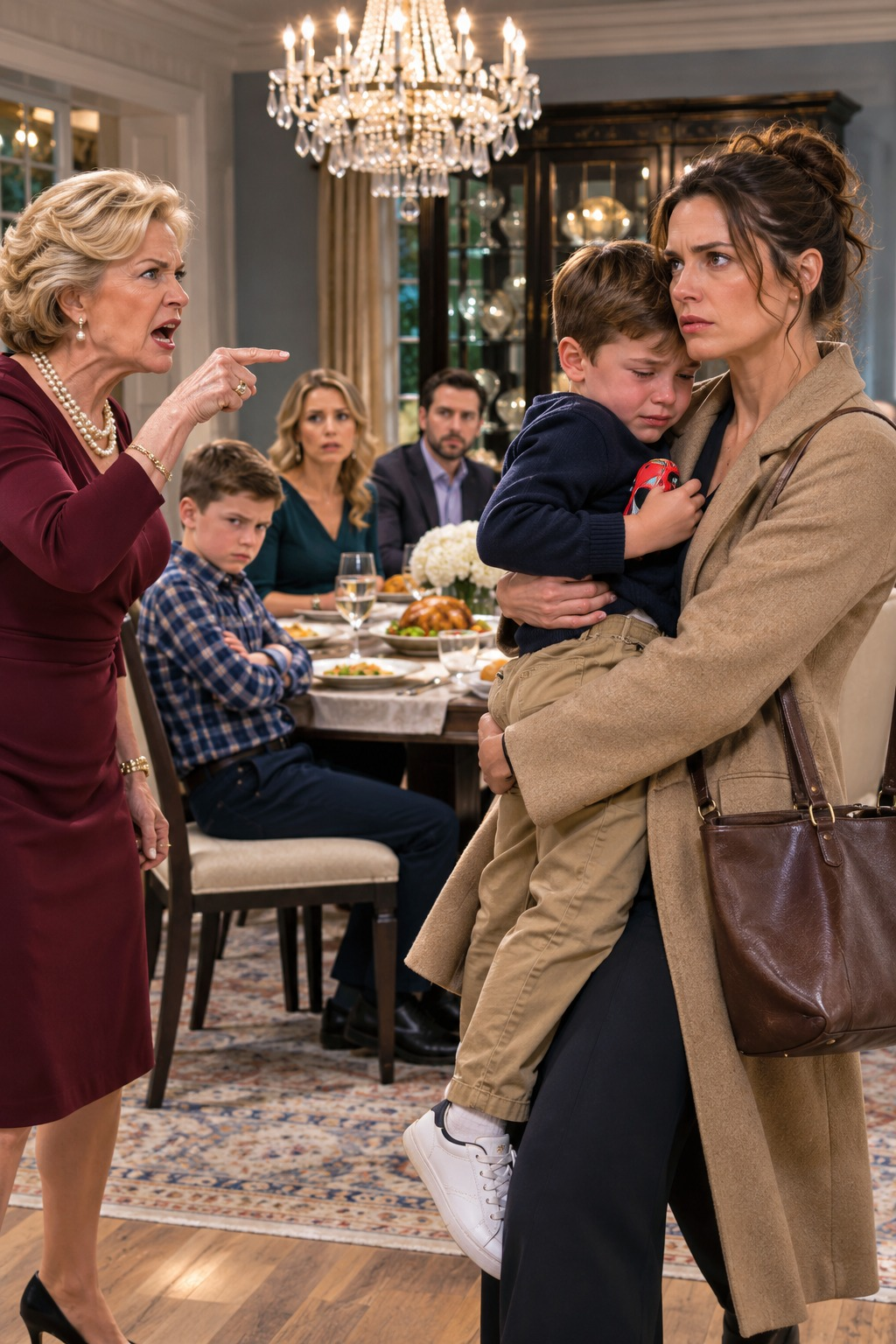
"She said she'd make Mommy cry again."
Tucker's voice was barely louder than a whisper.
Dr. Okonkwo stopped writing.
I sat beside my son, staring at him, trying to understand how a six-year-old child could carry so much fear without anyone noticing.
"What did Grandma say, sweetheart?" I asked.
Tucker pulled his knees closer together.
"She said you were already sad because Daddy died."
My throat tightened.
"And?"
He looked at the doctor before turning back to me.
"She said if I told you what happened, you'd cry all the time again. And it would be my fault."
For several seconds, I couldn't speak.
My mother had used my husband's death to frighten my child into silence.
She hadn't simply punished him.
She had convinced him that telling the truth would hurt the one person he depended on most.
I reached for his hand.
"Tucker, look at me."
He hesitated.
"Sweetheart, you could never make me sad by telling me the truth."
His eyes filled.
"But Grandma said—"
"Grandma was wrong."
I said it clearly.
Not angrily.
Not as a question.
For the first time that night, I didn't feel the need to explain my mother's behavior.
I didn't say she was old-fashioned.
I didn't say she had a temper.
I didn't say she'd probably misunderstood.
I simply told my son the truth.
"Grandma was wrong, and you did nothing to deserve what happened."
Tucker began crying.
Not loudly.
His little shoulders shook as he leaned into me.
I wrapped both arms around him.
Dr. Okonkwo waited quietly.
When his breathing steadied, she asked whether he wanted to tell us what had happened at Thanksgiving.
Tucker nodded.
And then my son began describing a day I thought I remembered perfectly.
Thanksgiving had been eleven months after Cole's death.
My mother had insisted on hosting.
She'd told me that Tucker and I needed to stop isolating ourselves and start acting like a normal family again.
I'd agreed because I was exhausted.
Because I didn't want another argument.
Because, somewhere deep inside, I still believed that if I tried hard enough, my mother might become the grandmother Tucker deserved.
That afternoon, I'd helped prepare dinner while Tucker played with Brady in the living room.
At some point, my mother asked me to drive to the grocery store for extra cream.
I'd been gone twenty-five minutes.
When I returned, Tucker was sitting silently at the dining table.
His eyes were red.
I asked whether he'd been crying.
My mother answered before he could.
"He had a little tantrum. It's over now."
I remembered looking at Tucker.
He'd nodded.
So I'd let it go.
Now, sitting in the hospital examination room, I learned what had actually happened.
Brady had been playing with a blue ceramic bowl on the kitchen counter.
He'd been told not to touch it.
But he'd picked it up anyway.
When it slipped from his hands and shattered on the tile floor, my mother rushed into the kitchen.
Brady immediately pointed at Tucker.
"He did it!"
Tucker had protested.
He'd told Grandma that Brady dropped the bowl.
But my mother didn't believe him.
Or perhaps she simply didn't care.
"She said Brady was a good boy," Tucker whispered.
I felt my stomach turn.
"And what did she say about you?"
He looked down.
"That I was always making trouble."
Dr. Okonkwo continued taking notes.
"What happened next?"
"She told me to say sorry."
"Did you?"
Tucker shook his head.
"Because I didn't break it."
I squeezed his hand.
"That's right, sweetheart."
He looked surprised.
As though he'd expected me to disagree.
Then he continued.
"Grandma got mad. She grabbed my arm and took me to the laundry room."
My heart began pounding.
"Did she hurt your arm?"
He nodded.
"A little."
"And then?"
"She shut the door."
"Was it locked?"
He nodded again.
I closed my eyes.
My mother's laundry room was a narrow space off the back hallway.
There was no window.
Only a washer, a dryer, shelves filled with cleaning supplies, and a ceiling light that sometimes flickered.
I knew because I'd spent hours in that room as a teenager, folding towels while my mother lectured me about responsibility.
I imagined Tucker standing there alone.
Five years old.
Missing his father.
Terrified of making his grandmother angry.
"How long were you inside?" Dr. Okonkwo asked.
Tucker thought carefully.
"I don't know."
"That's okay."
"I counted."
I looked at him.
"You counted?"
He nodded.
"To a hundred."
"Once?"
He shook his head.
"Four times."
Four hundred.
My little boy had counted to four hundred while waiting for someone to open the door.
I pressed my free hand against my mouth.
"Did Grandma come back?"
"She opened the door and asked if I was ready to say sorry."
"What did you tell her?"
"I said Brady broke it."
His voice grew smaller.
"Then she shut it again."
I felt something inside me go cold.
Dr. Okonkwo asked whether he remembered how much longer he stayed there.
Tucker shook his head.
"I got scared."
"Why?"
"Because the light went off."
I stared at him.
"What?"
"The light went off, and I couldn't find the switch."
His eyes began filling again.
"I called Grandma."
I could barely breathe.
"Did she come?"
He shook his head.
"I called louder."
"And?"
"She said I needed to think about what I'd done."
I turned away.
I couldn't let Tucker see the expression on my face.
For years, I'd convinced myself that my mother was difficult but harmless.
Controlling but generous.
Critical but loving underneath.
Now I was hearing what she'd done to my son when she believed I wasn't watching.
And I understood that my excuses had helped keep him silent.
"Whitney."
Dr. Okonkwo's voice brought me back.
She was looking at me carefully.
"Would you like a moment?"
I shook my head.
"No."
My voice sounded unfamiliar.
"Please document everything."
She nodded.
"Of course."
"Every word."
"I will."
I looked at Tucker.
He was rubbing the cuff of his sweater between his fingers.
"Sweetheart, did Grandma ever lock you somewhere else?"
He hesitated.
That hesitation frightened me more than anything.
Finally, he whispered, "Sometimes she made me sit in the basement."
I stared at him.
"Why?"
"When Brady said I was mean."
"Did you do anything mean?"
He shook his head.
Then he said, "Sometimes Brady told Grandma things that weren't true."
I felt tears gathering.
"Why didn't you tell me?"
His answer shattered me.
"Because you always said Grandma loved us."
Dr. Okonkwo asked a few more gentle questions before ending the conversation.
She explained that the hospital had procedures for documenting suspected child abuse and making the appropriate report.
I told her I understood.
I wanted everything recorded accurately.
Not exaggerated.
Not softened.
Not hidden.
Tucker's ear injury needed medical attention, but the deeper damage was something I was only beginning to understand.
A nurse brought him a small cup of apple juice.
He held it with both hands.
I watched him take a careful sip.
He looked so small sitting on that examination bed.
His feet didn't reach the floor.
His sneakers were untied.
A tiny tear had dried near the corner of his mouth.
And I suddenly remembered something Cole used to say.
"Children don't need perfect parents, Whit. They need parents who make them feel safe."
I'd thought I was doing that.
I'd worked.
I'd paid bills.
I'd kept routines.
I'd made sure Tucker ate vegetables and brushed his teeth.
I'd read bedtime stories even when I was so exhausted that the words blurred together.
But I'd also continued taking him to a house where he was frightened.
Because I wanted my mother to approve of me.
The realization was almost unbearable.
Tucker finished his juice.
"Mommy?"
"Yes, sweetheart?"
"Do we have to go to Grandma's next Sunday?"
I shook my head.
"No."
He looked at me uncertainly.
"What about Christmas?"
"No."
"Even if she gets mad?"
"Even then."
His shoulders relaxed.
It was such a small movement.
But I noticed.
And I wondered how long he'd been waiting for someone to tell him he didn't have to go back.
By the time Tucker was taken to speak with a child protection specialist, it was nearly eleven.
The specialist introduced herself as Rebecca Mills.
She had a gentle voice and wore a pale blue cardigan.
She explained that she wanted to talk with Tucker in a comfortable room where he could draw or play.
I asked whether I could stay.
She explained the process and told me where I could wait nearby.
Tucker looked frightened.
I knelt in front of him.
"You're not in trouble."
He nodded.
"Nobody is angry with you for telling the truth."
"Promise?"
"I promise."
He wrapped his arms around my neck.
I held him until he was ready to let go.
Then I watched him follow Rebecca down the hallway.
His small white sneakers made soft squeaking sounds against the polished floor.
At the doorway, he turned.
"Mommy?"
"I'm right here."
"Don't leave."
"I won't."
The door closed gently behind him.
And I sat down in the hallway.
Alone.
For the first time since dinner, I allowed myself to cry.
Not the quiet tears I'd been holding back.
I bent forward, covered my face, and cried until my chest hurt.
I cried for Tucker.
For Cole.
For the little girl I'd once been, who'd learned that keeping her mother happy mattered more than telling the truth.
And for every warning sign I'd ignored because admitting what my mother was capable of meant admitting something terrible about my own childhood.
When I finally lifted my head, my regular phone showed seventeen missed calls.
Eleven from my mother.
Four from Lorna.
Two from Grant.
There were messages, too.
My mother's first message read:
You embarrassed me in front of the entire family.
The second:
I expect an apology before tomorrow morning.
The third:
You need to understand that actions have consequences.
I stared at the screen.
Then I opened Lorna's messages.
Mom is furious.
You really need to stop being dramatic.
Brady is upset because you accused him of stealing.
And finally:
If you keep acting like this, don't expect Mom to keep helping you.
I read that last message twice.
Then I laughed.
It was a small, bitter sound.
They still believed I depended on my mother's checks.
They still believed the threat of losing money would bring me crawling back.
They had no idea.
Not about the savings account.
Not about Cole's arrangements.
And certainly not about the second phone.
Cole had given me that phone six weeks before he died.
We'd been sitting at our kitchen table after Tucker went to bed.
Cole looked unusually serious.
He placed a small black smartphone beside my coffee mug.
"What's this?" I asked.
"A backup."
"For what?"
"Just in case."
I laughed.
"Are you planning to become a spy?"
He didn't smile.
That should have frightened me.
Instead, I assumed he was worried about work.
Cole had been involved in financial operations for a regional investment company.
He rarely discussed confidential business matters at home.
But in the months before his death, he'd seemed distracted.
He took calls outside.
He worked late.
Sometimes he stared at his laptop long after midnight.
Once, I found him sitting in the dark living room, holding a folder.
When I asked what was wrong, he told me he was trying to fix something complicated.
I thought he meant a business problem.
Now I wasn't so sure.
That night at the kitchen table, he'd told me the phone had one important number saved in it.
Desmond Hale.
His closest friend.
They'd known each other since college.
Desmond was an attorney and financial adviser who had helped Cole with several major business decisions.
I'd met him dozens of times.
He was kind to Tucker.
He remembered birthdays.
And after Cole died, he'd quietly handled paperwork I couldn't bring myself to read.
"Why would I need a separate phone to call Desmond?" I'd asked.
Cole had looked toward the hallway.
Then he'd said, "Because sometimes the people you trust most are the people you need protection from."
I'd frowned.
"What does that mean?"
He'd reached across the table and taken my hand.
"Whit, if anything ever happens and you feel like someone is trying to control you, call him."
"Who would try to control me?"
Cole hadn't answered immediately.
Then he'd said, "Promise me you'll keep it somewhere safe."
I promised.
But I didn't understand.
After his death, I found the phone in the back of my dresser drawer.
I'd charged it occasionally.
Once, I almost called Desmond just to ask why Cole had been so worried.
But grief made everything difficult.
And there was always another bill.
Another school meeting.
Another night when Tucker couldn't sleep.
Eventually, the phone became one more painful reminder of my husband.
Until three weeks before Thanksgiving.
That was when Desmond contacted me through the device.
His message was brief.
Whitney, Cole left instructions. We need to talk when you're ready.
I'd called him that evening.
He'd explained that Cole had made arrangements involving an investment trust and a corporate board.
Some documents remained confidential.
Some decisions required my authorization.
Desmond had been careful not to overwhelm me.
He'd told me I didn't need to make any decisions immediately.
But he said something I'd never forgotten.
"Cole wanted to make sure nobody could use your grief to take advantage of you."
At the time, I thought he meant financial advisers.
Or insurance companies.
Or strangers.
I never imagined he might have been talking about my own mother.
At 11:40 p.m., the second phone vibrated inside my coat.
I pulled it out.
The screen glowed in the dim hallway.
A message from Desmond.
Board is assembled. Waiting on your word.
I stared at it.
The words made my heart beat faster.
I'd spoken to Desmond two weeks earlier about reviewing Cole's remaining business arrangements.
He'd mentioned that several board members were prepared to meet.
I'd asked him to wait.
I hadn't wanted to make major decisions while Tucker and I were still struggling.
But tonight had changed something.
I looked toward the closed door where my son was speaking with Rebecca.
Then I typed:
Call me.
The phone rang almost immediately.
"Whitney?"
Desmond's voice was steady.
Familiar.
For one second, I nearly broke down again.
"Desmond."
"What's wrong?"
I swallowed.
"It's Tucker."
His tone changed instantly.
"What happened?"
I told him.
About dinner.
About Brady taking the toy car.
About my mother striking Tucker.
About the threat.
And about the hospital.
Desmond didn't interrupt.
Not once.
When I finished, he was silent for several seconds.
Then he asked, "Is Tucker safe right now?"
"Yes. We're at the hospital."
"Has a doctor examined him?"
"Yes."
"Are they documenting what happened?"
"Everything."
"Good."
His voice was calm, but I heard something beneath it.
Anger.
Controlled, deliberate anger.
"Whitney, I need you to listen carefully."
I straightened.
"Okay."
"Do not go back to your mother's house tonight."
"I wasn't planning to."
"Do not sign anything she sends you."
I frowned.
"What?"
"And don't agree to meet her alone."
A cold sensation moved through my stomach.
"Desmond, why would she send me something to sign?"
He hesitated.
"Has Eleanor contacted you since you left?"
"Seventeen missed calls. Several messages."
"What did she say?"
"That I embarrassed her. That I need to apologize. That actions have consequences."
Desmond was quiet.
Then he asked, "Did she mention money?"
I looked down at the phone.
"Yes."
"What exactly did she say?"
I repeated the sentence.
"Without my money, you two would be homeless."
I heard Desmond exhale.
Slowly.
"She said that in front of everyone?"
"Yes."
"And Tucker heard it?"
"Yes."
Another silence.
Then Desmond said, "Cole was afraid something like this would happen."
My entire body went still.
"What?"
"Whitney, there's something I should have explained sooner."
I stood.
"What are you talking about?"
He didn't answer immediately.
I could hear papers moving on his end of the line.
Then he said, "Do you remember the financial review Cole started before the accident?"
I thought back.
"Vaguely."
"He was investigating irregularities involving several accounts connected to the company."
"Okay."
"Some of those accounts had ties to outside investors."
My heart began pounding.
"Desmond, please just tell me."
He lowered his voice.
"One of those investors was your mother."
I stared at the wall.
For a moment, I thought I'd misheard him.
"My mother?"
"Yes."
"That doesn't make sense."
"I know."
"She never liked Cole."
"That doesn't mean they didn't have business connections."
I pressed my fingers against my forehead.
"Are you saying Cole worked with my mother?"
"I'm saying he discovered something involving accounts connected to her."
"What did he discover?"
Desmond hesitated.
"That's part of what the board needs to review."
I felt frustration rising.
"Desmond, my son is in a hospital because my mother hurt him. I don't have the patience for half answers."
"You're right."
He paused.
"There's a notice that Cole prepared before he died."
"A notice?"
"A formal legal notice. It was never delivered."
"Why not?"
"Because Cole asked me to hold it until certain conditions were met."
I gripped the phone.
"What conditions?"
Desmond spoke carefully.
"He wanted you to have the opportunity to make your own decisions without pressure from your family."
I closed my eyes.
Cole.
Even after death, he was trying to protect us.
"What does the notice say?"
Desmond was silent.
Then he asked a question that made my skin turn cold.
"Whitney, has your mother ever asked you to sign documents related to Tucker's inheritance?"
I opened my eyes.
"No."
"Are you certain?"
"Yes."
Then I remembered something.
Three months after Cole died, my mother had invited me to lunch.
She'd brought a folder.
She said it contained estate planning documents.
She told me every responsible parent needed to prepare for the unexpected.
I'd been exhausted.
Still grieving.
Barely sleeping.
She'd pointed to several pages and told me where to sign.
I remembered the restaurant.
The white tablecloth.
The pen she'd handed me.
And the way she'd smiled when I finished.
My stomach dropped.
"Desmond."
"Yes?"
"I signed something."
The silence on the other end was immediate.
"When?"
"About three months after Cole died."
"What kind of document?"
"I thought it was estate planning paperwork."
"Did you keep a copy?"
I tried to remember.
"No. Mom said she'd have her attorney send one."
"Did he?"
"I don't think so."
Desmond said something under his breath.
I couldn't make out the words.
Then he asked, "Did the document mention guardianship?"
I felt dizzy.
"I don't remember."
"Whitney, think carefully."
I leaned against the wall.
"My mother said she wanted to make sure Tucker would be taken care of if anything happened to me."
"Did she mention a trust?"
"Maybe."
"Did she mention temporary authority?"
My mouth went dry.
"I don't know."
Desmond became very quiet.
Then he said, "I need to see whatever you signed."
"Why?"
"Because Cole specifically warned me about a document Eleanor might try to put in front of you."
I stared at the phone.
"What?"
"He believed she wanted control over certain assets."
"Whose assets?"
Desmond didn't answer immediately.
Then he said, "Tucker's."
I felt the hallway shift beneath my feet.
"That doesn't make sense. Tucker doesn't have any assets."
Desmond took a slow breath.
"Whitney, that's what your mother wanted you to believe."
I sank into the nearest chair.
For several seconds, I couldn't speak.
My son was six years old.
He owned a red toy car, a bicycle, a collection of dinosaur books, and approximately forty dollars in birthday money.
What assets could my mother possibly want?
"Desmond, you're frightening me."
"I'm sorry."
"Then explain."
"Cole established a trust before his death."
"I know he had life insurance."
"This is separate."
I stared at the floor.
"How separate?"
"The trust holds an interest in the company he helped build."
I blinked.
"An interest?"
"Yes."
"How much?"
Desmond hesitated.
"Enough that certain people would benefit from controlling the voting rights."
I rubbed my forehead.
"Why didn't Cole tell me?"
"He intended to."
The words hung between us.
I thought about my husband sitting at our kitchen table.
The hidden phone.
The late-night calls.
The way he'd looked at me when he said he wanted to protect us.
And then I thought about the accident.
The wet highway.
The other driver.
The police report.
I pushed that thought away.
There was no evidence that Cole's death had been anything other than a terrible accident.
I couldn't allow fear to turn every memory into a conspiracy.
But something was wrong.
Something had been wrong long before tonight.
"Desmond, what happens now?"
"First, you take care of Tucker."
"And then?"
"Then we review the documents you signed and determine whether anyone has tried to exercise authority they don't have."
I looked toward the specialist's room.
"What about my mother?"
Desmond's voice hardened.
"She doesn't get to decide what happens to your son."
I closed my eyes.
For the first time that night, I felt something other than fear.
Relief.
Not because everything was solved.
It wasn't.
But because someone finally understood that my mother's behavior wasn't normal.
And someone was willing to help me do something about it.
"Desmond?"
"Yes?"
"Whatever Cole was trying to protect, I want to understand it."
"You will."
"No more secrets."
He paused.
"Agreed."
I took a breath.
"And I want to know exactly what my mother had me sign."
"I'll have my office begin reviewing the available records."
"Tonight?"
"Tonight."
I looked at the clock.
12:06 a.m.
"Thank you."
"Whitney?"
"Yes?"
"One more thing."
I waited.
"If Eleanor contacts you about the house, don't argue with her."
I frowned.
"Our house?"
"Yes."
"Why would she contact me about our house?"
Desmond didn't answer.
"Desmond?"
Before he could speak, my regular phone began vibrating.
A new message.
From my mother.
I opened it.
Since you've decided to humiliate me, I've instructed my attorney to review the arrangement concerning your home. You have until Monday morning to call me and apologize.
My heart slammed against my ribs.
I read it again.
Then I looked at the second phone.
"Desmond."
"I'm here."
"She just threatened our house."
He was silent for a moment.
Then he said, "Forward me that message."
I did.
He read it.
And when he spoke again, his voice was completely different.
"Whitney, I need you to stay at the hospital until I call you back."
"Why?"
"Because I need to verify something before you go home."
I stood.
"Verify what?"
He didn't answer.
Instead, I heard him speaking to someone else.
"Get me the property file. Now."
My pulse raced.
"Desmond, what's happening?"
He came back on the line.
"Whitney, your mother may have just made a very serious mistake."
"What mistake?"
There was a brief silence.
Then he said, "The house she's threatening to take from you may not belong to the person she thinks it does."
Before I could ask another question, the hospital corridor door opened.
Rebecca Mills stepped outside.
Her face was serious.
"Mrs. Walker?"
I lowered the phone.
"Yes?"
"There's something Tucker told me that I think you need to hear."
I stood.
"What is it?"
Rebecca glanced toward the closed room behind her.
Then she looked back at me.
"It's about something your grandmother gave Brady to hide."
My heart stopped.
"Something?"
She nodded.
"A small envelope."
I gripped the edge of the chair.
Rebecca continued quietly.
"Tucker said Brady showed it to him before dinner. He said it had your husband's name written across the front."
I couldn't move.
"And according to Tucker, there was one more thing written underneath."
Rebecca opened her notebook.
She looked down at the page.
Then she read the words aloud.
"For Whitney. Only after I'm gone."






Comments 0