"Whitney, put down the box."
The voice came from behind Cole's office door.
My entire body went cold.
I was holding the blue metal box in one hand and my phone in the other.
Natalie Cross was still on the line.
"Whitney?" she asked. "Who's there?"
I couldn't answer.
The door opened another inch.
Then a familiar face appeared.
Grant.
My brother-in-law stood in the hallway, pale and breathing heavily.
There was blood on his shirt.
For a moment, neither of us moved.
Then he raised both hands.
"Please don't scream."
I stepped backward.
"Get out of my house."
"Whitney, listen—"
"Get out!"
His eyes moved toward the blue box.
"That's what Raymond wants."
I tightened my grip.
"How did you get inside?"
"The back door."
"It's locked."
"Someone forced the latch before I got here."
My stomach dropped.
Grant looked toward the staircase.
"Raymond's outside. I saw him near the fence."
I glanced at my phone.
"Natalie, call the police. Grant is inside my house."
"I'm doing it now," she answered.
Grant shook his head.
"Good. Call them. I need to tell them everything."
I stared at him.
The man who'd helped hide financial records.
The man who'd frightened my sister.
The man who'd stood silently while my mother struck Tucker.
Now he was standing in my dead husband's office, asking me to believe him.
"Why should I trust you?"
"You shouldn't."
His answer startled me.
Grant swallowed.
"But you should hear what I did."
I kept my distance.
"Start talking."
He looked at the blue box.
"I helped Martin Voss move money through Northbridge. I signed authorizations I knew weren't properly approved. I told myself the transactions were temporary."
My heart pounded.
"And Cole found out."
"Yes."
"Then what?"
Grant's voice broke.
"Then I made the worst decision of my life."
Grant sank against the wall.
He pressed a hand against his bleeding side.
I didn't approach him.
"Are you hurt?"
"Raymond caught me outside Lorna's friend's house. We fought. I got away."
I stared at him.
"Where's Lorna?"
"With the police."
"And Brady?"
"Safe with her."
I exhaled shakily.
Grant looked toward the window.
"Raymond thinks Cole's original records are in that box. He wants them destroyed."
"Why?"
"Because they show who authorized the transfers."
I swallowed.
"My mother?"
Grant closed his eyes.
"Your mother knew about some of the transactions. Martin convinced her they were necessary to keep Whitcomb Family Holdings solvent."
I felt sick.
"And you?"
"I knew more than she did."
I stared at him.
"Then why did you let her threaten me?"
He looked down.
"Because I was afraid she'd find out how much money I'd taken."
The room went silent.
"How much?"
He swallowed.
"Almost two million dollars over several years."
I gripped the desk.
"From whom?"
"Several accounts. Some belonged to outside investors. Some were connected to family trusts."
My heart hammered.
"Tucker's trust?"
Grant shook his head.
"We tried to obtain control over its voting authority, but Cole had structured it so we couldn't simply withdraw the assets."
I closed my eyes.
So that was why they wanted the guardianship papers.
Why they wanted my signature.
Why they kept insisting that Tucker needed an independent financial administrator.
They weren't trying to help us.
They were trying to reach something Cole had protected.
Grant looked at me.
"Your mother believed controlling Tucker's trust would give the company time to recover."
I stared at him.
"She was willing to take my child to save her company?"
He didn't answer.
He didn't have to.
"Tell me about the warehouse."
Grant went still.
For a moment, I thought he would refuse.
Then he nodded.
"Martin arranged a meeting. Eleanor told Cole she had the original records he wanted."
"Did she?"
"Some of them."
"And Raymond Pike?"
"Martin hired him as security."
I felt cold.
"Security with a gun?"
Grant looked ashamed.
"Raymond wasn't supposed to threaten Cole. At least, that's what Martin told me."
I stared at him.
"What happened?"
"Cole demanded the original authorizations. Martin refused. They argued."
"And my mother?"
"She wanted Cole to give her time to fix the company."
I swallowed.
"Did she know about the gun?"
Grant hesitated.
"She saw Raymond draw it."
My heart stopped.
"And she did nothing?"
"She told him to put it away."
"Did he?"
"Eventually."
I looked at the digital recorder inside the box.
Cole had recorded the meeting.
He'd known enough to protect the evidence.
But not enough to protect himself.
"Did Cole leave alive?"
"Yes."
"Then what happened on the road?"
Grant's face crumpled.
"Raymond followed him."
I gripped the edge of the desk.
"Why?"
"Martin wanted to know where Cole was taking the records. Raymond was supposed to follow him and report back."
"And?"
"Raymond tried to force Cole to pull over."
My breath caught.
Grant continued.
"He drove close behind him. Then he pulled alongside and swerved toward Cole's lane."
I covered my mouth.
"Cole tried to avoid him."
Grant nodded.
"He crossed toward the center line."
My knees weakened.
"The other car."
"Thomas Keller."
I stared at him.
"Raymond caused the accident."
Grant began crying.
"Yes."
"How do you know?"
"Because I was in the SUV."
The room seemed to tilt.
"You were there?"
Grant nodded.
"I was in the passenger seat. I kept telling Raymond to stop. He wouldn't listen."
I could barely breathe.
"You watched my husband die?"
His face twisted.
"I saw the collision. We stopped farther down the road. I wanted to go back."
"But you didn't."
"Raymond threatened me. He said if I talked, he'd tell the police I ordered it."
I stared at him.
"And you stayed quiet for eleven months."
Grant lowered his head.
"Yes."
Something inside me broke.
Not because I was surprised.
Because I'd spent eleven months believing Cole had died in an accident no one could have prevented.
And now I knew that men had chased him.
Threatened him.
And left him on the road.
I looked at Grant.
"You should have called for help."
"I know."
"You should have told the police."
"I know."
"You should have told me."
He began sobbing.
"I know."
A siren sounded outside.
Grant looked toward the window.
"That's them."
I stepped away from the door.
"Stay where you are."
He nodded.
I kept my phone connected to Natalie while I went to the hallway.
Two officers entered through the front door after I confirmed their identities.
They secured Grant, checked his injury, and called for medical assistance.
I told them about the blue box.
The recorder.
The financial records.
And Grant's confession.
Detective Marcus Reed arrived shortly afterward.
He looked at Grant.
"Are you willing to make a formal statement?"
Grant nodded.
"Yes."
The detective studied him.
"You understand that you may be admitting to serious offenses?"
"I understand."
Grant looked toward me.
"I'll tell you everything."
I didn't answer.
There was nothing left to say to him.
An officer escorted him downstairs.
I remained in Cole's office.
The blue box sat on the desk.
For a moment, I imagined Cole standing beside me.
His hand resting on my shoulder.
His voice telling me to breathe.
Then I heard Tucker calling.
"Mommy?"
I turned.
He stood in the hallway.
His eyes moved toward the officers.
Then toward the blue box.
"Did you find Daddy's secret?"
I knelt.
"Yes, sweetheart."
His face brightened.
"Was I right?"
I pulled him into my arms.
"You were exactly right."
He hugged me.
"Does that mean we get my car back?"
I closed my eyes.
Then I smiled through my tears.
"Yes, baby. We're going to get your car back."
The investigation moved quickly after Grant's statement.
Not overnight.
Not magically.
But for the first time, the people investigating Cole's death had evidence that could be tested against witness accounts.
The original recorder from the blue box contained the warehouse confrontation.
Cole's voice was clear.
So was Martin's.
So was my mother's.
And so was Raymond Pike's.
On the recording, Cole demanded the original financial authorizations.
Martin insisted the transfers had been approved.
Cole disagreed.
Then Raymond threatened him.
A metallic sound followed.
Cole said, "Put the gun away."
My mother could be heard saying, "Raymond, that's enough."
The recording didn't prove she had ordered anyone to hurt Cole.
But it proved she knew he had been threatened.
And it proved the meeting had been far more dangerous than she'd admitted.
The road footage supplied by Grant showed the dark SUV pursuing Cole's car.
Investigators compared it with traffic cameras, vehicle records, and Thomas Keller's original statement.
Grant's account matched details that hadn't been publicly released.
Raymond Pike was arrested two days later.
He initially denied involvement.
Then investigators recovered communications between him and Martin Voss.
The messages showed that Martin had instructed Raymond to follow Cole and recover the documents.
There was no evidence that Martin had explicitly ordered a killing.
But the investigation established that the pursuit and dangerous maneuvering had contributed to the collision.
Raymond was charged with offenses connected to the fatal crash, threats, and evidence interference.
Martin faced charges arising from the financial fraud, falsified documents, and his role in directing the pursuit.
Grant was also charged for his participation in the financial scheme and his concealment of evidence.
He cooperated with investigators.
That cooperation mattered.
But it didn't erase what he'd done.
The photograph dated March fourteenth was one of the last mysteries Natalie helped me understand.
The photograph hadn't been taken after Cole died.
It had been taken months earlier.
The date on the back was the date someone had attempted to use the photograph as supporting identification for an authorization packet.
Cole had written Do not trust the date because he discovered that an older image was being presented as proof of a later meeting.
Lorna had been photographed with Cole and Desmond during an ordinary corporate review.
Raymond Pike happened to be outside the Northbridge building that day.
The picture had been copied and reused in a misleading document trail.
It didn't mean Cole had survived his accident.
It meant someone had tried to manipulate the timeline.
Natalie explained that the original image metadata, correspondence, and witness accounts established when the photograph was actually taken.
I stared at the corrected timeline.
For days, I'd been terrified that everything I believed about Cole's death was false.
The truth was painful enough.
He had died that night.
He had not abandoned us.
He had not secretly disappeared.
And he had not chosen his company over his family.
He'd been trying to protect people from financial wrongdoing.
Including me.
Including Tucker.
The bank records revealed another part of the scheme.
Lorna had entered Safe-Deposit Box 214 using authorization documents that falsely identified her as acting for me.
She hadn't been entitled to do that.
Martin had arranged the paperwork.
Grant had helped obtain identifying information.
Lorna admitted that she'd known the authorization was questionable but had followed Grant's instructions.
The bank's internal review confirmed failures in its verification process.
The matter was referred to the appropriate authorities.
Lorna also explained the photograph showing Grant carrying Tucker's red toy car.
He'd taken it from Eleanor's house after the Sunday dinner.
Inside the car, beneath the damaged chassis, was a tiny memory card Cole had hidden months earlier.
Cole had marked the toy with his initials.
C.H.W.
He'd used the car as a backup hiding place because Tucker treasured it and rarely let anyone touch it.
But Brady had taken the toy at dinner.
And Eleanor's violent reaction had exposed how little she cared about Tucker's feelings.
Grant had later discovered the hidden card while examining the damaged car.
He'd carried it to the bank, hoping to compare its contents with the records removed from the box.
He'd eventually kept the card rather than destroy it.
That decision became part of his cooperation.
The memory card contained copies of financial ledgers and emails.
It wasn't the only evidence.
But it corroborated the blue box archive.
And it helped investigators trace the movement of money through Northbridge.
The financial investigation took months.
Natalie kept me informed.
Independent accountants reconstructed the transfers.
They found that Grant and Martin had used affiliated companies to conceal unauthorized transactions.
My mother had approved some transfers without understanding their full purpose.
She had also knowingly signed documents intended to make me appear financially dependent on her.
The $184,600 assistance statement was exposed as misleading.
The $42,000 mortgage stabilization entry had nothing to do with my mortgage.
The $18,500 trust administrative expense was actually a payment to Voss Strategic Advisory.
Other amounts had been assembled from unrelated transactions.
My mother's checks to me were real.
But they didn't establish the debt she claimed.
And the records showed that I'd deposited those checks into Tucker's savings account.
The house had never belonged to Eleanor.
It belonged to the Walker Family Living Trust.
My mother had no authority to evict us.
She'd known that her threat would frighten me.
And she'd used it anyway.
The forged statement claiming I couldn't care for Tucker was eventually traced to a document packet assembled through Martin's office.
The original signature page came from a different agreement I'd signed months earlier.
Investigators found evidence that the page had been reused with substituted text.
The guardianship petition was withdrawn.
No court found me unfit.
No one took Tucker from me.
And the disputed corporate appointment was set aside after the parties reviewed the execution history and obtained appropriate court orders.
Desmond's original authorization had been limited.
Martin had expanded the filed language without proper consent.
Desmond had made serious mistakes by relying on him.
But the investigation did not establish that Desmond participated in the fraud.
He cooperated fully.
He provided the original drafts.
He testified about the changes.
And he apologized to me.
Not once.
Several times.
I didn't immediately forgive him.
Trust didn't return simply because someone said the right words.
But eventually, I understood that Cole had trusted Desmond for a reason.
He'd made mistakes.
He'd also helped expose them.
And he accepted responsibility for his part.
The hardest conversation happened six weeks after Raymond's arrest.
My mother requested a meeting.
Natalie advised me that I didn't have to go.
I knew that.
For the first time in my life, I truly knew it.
But I wanted to look Eleanor Whitcomb in the eyes.
Not as a frightened daughter.
As Tucker's mother.
We met in a conference room at Natalie's office.
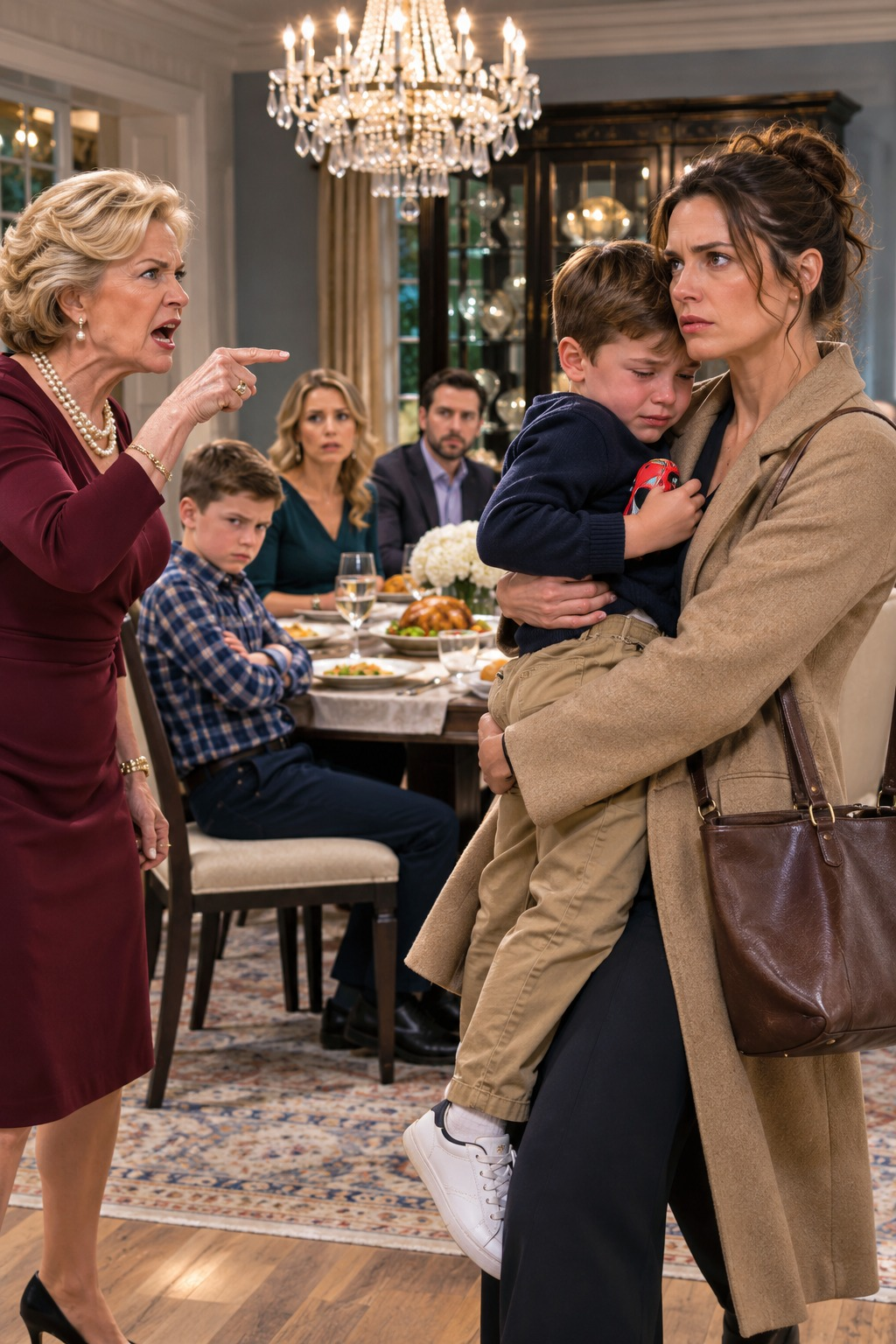
My mother arrived wearing a burgundy jacket and her pearls.
For a moment, she looked exactly as she had at Sunday dinner.
Elegant.
Controlled.
Certain that everyone would eventually do what she wanted.
Then she saw me.
And something in her expression changed.
"Whitney."
"Mother."
She sat down.
Her attorney remained beside her.
Natalie sat beside me.
For several seconds, no one spoke.
Then Eleanor said, "I never wanted Cole to die."
I looked at her.
"I believe you didn't want him dead."
Her eyes filled.
"But you knew he was threatened."
She lowered her gaze.
"Yes."
"And you didn't tell me."
"No."
"Why?"
She swallowed.
"Because I was afraid."
I stared at her.
"Of what?"
"Losing the company. Losing everything your grandfather built."
I shook my head.
"You were afraid of losing money."
She flinched.
"It was more complicated than that."
"No."
My voice remained steady.
"You made it complicated because you refused to accept that you couldn't control everything."
She looked away.
I leaned forward.
"You threatened my home. You tried to take Tucker. You lied about supporting us. And you hurt him."
Tears slipped down her cheeks.
"I made terrible mistakes."
I shook my head.
"You made choices."
She closed her eyes.
For the first time, she didn't argue.
Then she whispered, "Can I see him?"
My heart tightened.
I thought about Tucker sitting on the hospital bed.
His small hand in mine.
The way he'd whispered that Grandma locked him in dark rooms.
The way he'd asked whether she was coming back.
"No."
My mother began crying.
"Whitney, please."
"No."
She covered her face.
I waited until she looked at me.
"Tucker is safe now. He is getting help from a counselor. He is learning that adults aren't allowed to hurt him just because they're angry."
My mother nodded weakly.
"And I won't undo that progress to make you feel better."
She stared at me.
"Will you ever forgive me?"
I took a breath.
"I don't know."
Her face crumpled.
"But forgiveness isn't permission to hurt us again."
I stood.
"Goodbye, Mother."
And I walked out.
She didn't follow me.
The courts eventually imposed financial penalties and restitution obligations connected to the fraudulent transactions.
Martin and Raymond were convicted after the criminal proceedings concluded.
Grant entered a guilty plea and received a sentence reflecting both his offenses and his cooperation.
My mother faced civil consequences for her role in the misleading documents and unauthorized financial arrangements.
She was removed from positions that allowed her to influence the affected accounts.
She agreed to permanent restrictions on contacting Tucker without my authorization.
I obtained a protective order addressing her conduct toward him.
She could no longer use money, lawyers, or threats to force herself into our lives.
Lorna made a different choice.
She cooperated.
She admitted what she'd done.
She apologized without making excuses.
She told me she'd spent years being afraid of our mother.
I understood that fear.
I'd lived with it too.
But I told her something she needed to hear.
"Being afraid doesn't excuse letting someone hurt a child."
She cried.
"I know."
For a long time, I kept my distance.
Then, slowly, we began rebuilding something.
Not the old relationship.
That one had been built on silence.
Something new.
Something honest.
Brady wrote Tucker a letter apologizing for taking his toy car.
Tucker read it carefully.
Then he asked if Brady could come over someday.
I told him we'd decide together when he felt ready.
Eventually, they met at a park.
They played on the swings.
They laughed.
And for the first time, neither child had to worry about pleasing Grandma.
One year after Cole's death, I took Tucker to the cemetery.
He carried his repaired red toy car.
The tiny memory card had been removed and preserved as evidence.
The car itself had been returned to us.
A specialist had fixed the broken wheel.
The paint was still chipped.
But Tucker didn't care.
He loved it.
We stood beside Cole's grave.
The afternoon sun warmed our faces.
Tucker placed a small drawing beside the flowers.
It showed three people holding hands.
Daddy.
Mommy.
Tucker.
Above them, he'd drawn a bright yellow sun.
I knelt beside him.
"That's beautiful, sweetheart."
He smiled.
"Do you think Daddy can see it?"
I swallowed.
"I don't know exactly how that works."
He nodded thoughtfully.
Then he placed the red car beside the drawing.
"I wanted to show him I fixed it."
My eyes filled.
"You did a wonderful job."
Tucker looked at the gravestone.
"Daddy, Mommy helped me."
I covered my mouth.
He continued.
"And I'm not scared of Grandma anymore."
Tears slipped down my cheeks.
He turned toward me.
"Mommy?"
"Yes?"
"Can we tell Daddy about the pancakes?"
I laughed through my tears.
"Of course."
So we sat on the grass.
And we told Cole everything.
About Tucker's school.
His new bicycle.
His favorite dinosaur book.
The chocolate-chip pancakes we made every Saturday.
The garden we'd planted behind the house.
And the puppy we'd adopted from the shelter.
A golden retriever named Biscuit.
Tucker laughed when I reminded him that Biscuit had eaten an entire loaf of bread.
For the first time, the cemetery didn't feel like a place where our story had ended.
It felt like a place where we could remember someone we loved.
Without fear.
Without secrets.
Without shame.
By the following spring, the trust was stable.
Natalie helped appoint independent professionals to oversee the remaining corporate interests.
Tucker's inheritance was protected.
The financial records were transparent.
And I no longer had to wonder whether someone was using my son's future as collateral for a failing business.
I kept working as a bookkeeper.
Then I started my own small accounting firm.
At first, I worked from Cole's old office.
I replaced the damaged floorboard.
Repainted the walls.
And moved his favorite photograph to the shelf above my desk.
In the picture, Cole was holding newborn Tucker.
He looked exhausted.
Happy.
Completely in love.
Every morning, I looked at that photograph before starting work.
And every morning, I remembered something important.
Cole hadn't left us helpless.
He'd left us love.
He'd left us evidence.
He'd left us people who were willing to help.
And he'd left us a future that belonged to us.
Not my mother.
Not Martin Voss.
Not Northbridge.
Us.
On Tucker's eighth birthday, we held a party in our backyard.
There were balloons.
Chocolate cake.
A dinosaur-shaped piñata.
And twelve children running across the grass.
Sarah helped with the food.
Natalie stopped by with a gift.
Desmond brought a model airplane.
Lorna and Brady arrived with a carefully wrapped present.
And Biscuit stole three hot dogs before anyone noticed.
Tucker laughed so hard that he fell onto the grass.
I stood near the porch, watching him.
For a moment, I remembered the little boy who'd sat trembling in a hospital bed.
The boy who'd been afraid to tell me what his grandmother had done.
The boy who'd believed that losing Grandma's money meant losing our home.
Now he was laughing beneath the sunshine.
Safe.
Loved.
Free.
Tucker ran toward me.
"Mommy!"
I knelt.
"What is it, birthday boy?"
He held out his red toy car.
"Look."
I smiled.
"What am I looking at?"
He turned it over.
The initials were still there.
C.H.W.
Cole Harrison Walker.
Tucker traced them with his finger.
"Can we put my initials on it too?"
My throat tightened.
"Of course."
He grinned.
"Then it'll belong to both of us."
I looked at the little car.
The chipped paint.
The repaired wheel.
The initials his father had engraved.
And I smiled.
"It already does."
Tucker threw his arms around my neck.
"I love you, Mommy."
I held him tightly.
"I love you more than anything."
He pulled back.
"Even more than chocolate cake?"
I laughed.
"Much more."
He pretended to look shocked.
"That's a lot."
"It certainly is."
Then he grabbed my hand.
"Come on! It's time for presents!"
I let him pull me toward the backyard.
Toward the laughter.
Toward the people who loved us without demanding anything in return.
And as I stepped into the sunshine, I realized something.
For years, my mother had told me that without her money, Tucker and I would be homeless.
She'd been wrong.
We had a home.
A real one.
A place where doors were locked to keep danger out, not children in.
A place where mistakes could be admitted.
Where love didn't come with conditions.
Where a little boy could laugh without checking whether an adult approved.
That night, after the guests left, Tucker fell asleep on the couch with Biscuit curled beside him.
His red toy car rested in his hand.
I carried him upstairs.
Tucked him into bed.
And kissed his forehead.
"Goodnight, sweetheart."
He opened one sleepy eye.
"Mommy?"
"Yes?"
"Are we going to be okay?"
I looked at my son.
At his peaceful face.
At the little car his father had given him.
At the home we'd fought to protect.
Then I smiled.
"Yes, baby."
I brushed the hair from his forehead.
"We already are."






Comments 0