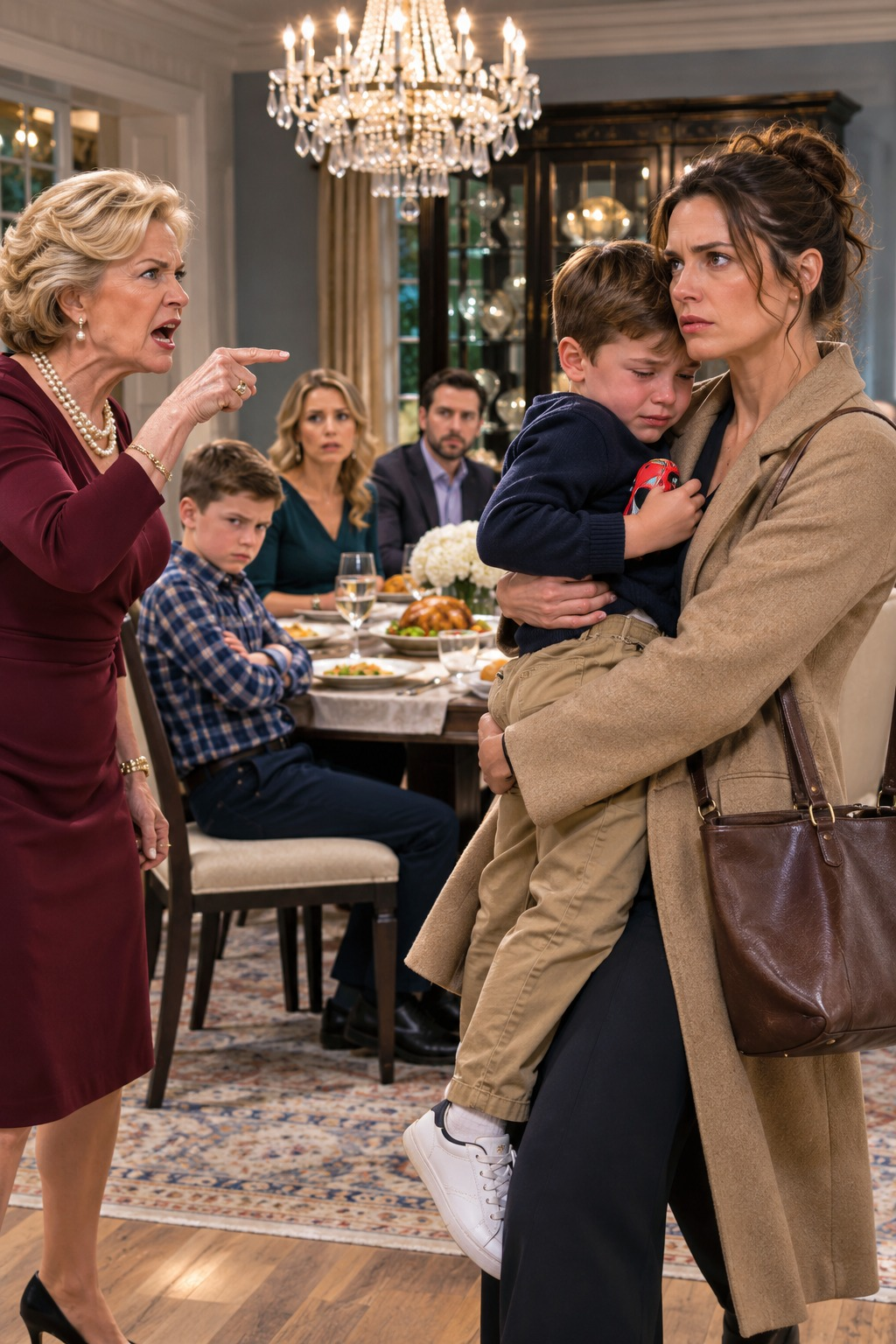
"Your husband left a message for you," Rebecca said.
I stared at the child protection specialist standing in the hospital hallway, unable to understand why my dead husband's name had suddenly become part of my son's story.
"What kind of message?"
Rebecca glanced at her notebook.
"Tucker said Brady had an envelope with Cole's name on it. He remembered the words written underneath."
My heart hammered.
For Whitney. Only after I'm gone.
Cole had been dead for eleven months.
And somehow, an envelope bearing his name had ended up in my mother's house.
I gripped my second phone so tightly that my fingers hurt.
"Where is it?"
Rebecca shook her head.
"I don't know. Tucker said Brady showed it to him before dinner."
"Did he say where Brady got it?"
"He believes it came from your grandmother's desk."
I closed my eyes.
Of course.
My mother's desk.
The enormous mahogany desk in her private study, where she kept everything she considered important.
Tax documents.
Investment statements.
Property records.
And the little black notebook containing information she never allowed anyone else to see.
When I was a teenager, she'd forbidden me from entering that room without permission.
Once, at sixteen, I'd gone inside looking for a stapler.
She caught me opening a drawer.
She didn't speak to me for three days.
I'd spent those three days apologizing.
Now I wondered what else she'd been hiding behind that locked study door.
"Whitney?"
Desmond's voice came from the phone still pressed against my ear.
I'd almost forgotten he was there.
"Desmond, I need to call you back."
"What's happened?"
I looked at Rebecca.
Then toward the room where Tucker was waiting.
"There's an envelope."
"What envelope?"
"Something Cole apparently left for me. My mother has it."
The silence on the other end was immediate.
Then Desmond asked, "Did you say Cole's envelope?"
I felt my stomach drop.
"You know about it?"
"Whitney, listen carefully. What color was it?"
I turned to Rebecca.
"Did Tucker describe the envelope?"
She checked her notes.
"He said it was yellow. A large yellow envelope."
I repeated that to Desmond.
He inhaled sharply.
"Was there a red mark on the front?"
Rebecca looked down again.
"Tucker mentioned a red circle."
I froze.
"Desmond?"
His voice had changed.
"That envelope was supposed to be delivered to you after Cole's death."
My mouth went dry.
"Then why wasn't it?"
"I don't know."
"Who had it?"
A pause.
"Your mother's attorney."
For a moment, the entire hallway seemed to tilt.
"My mother's attorney?"
"Yes."
"Why?"
"Because Cole had asked him to witness certain documents before their relationship deteriorated. The attorney was supposed to transfer the sealed envelope to my office if Cole died before the review was completed."
I leaned against the wall.
"And he didn't?"
"No."
"Did you ask him about it?"
"Repeatedly."
"What did he say?"
"That he couldn't locate it."
I stared at the hospital floor.
My mother had spent eleven months telling me that Cole hadn't planned properly for our future.
She'd criticized his finances.
Questioned his judgment.
Suggested that his death had left me dependent on her generosity.
And all that time, she'd apparently possessed something he'd intended for me.
Something important enough for Desmond to recognize from a child's description.
"What was inside?" I asked.
"I don't know. Cole sealed it himself."
"Didn't he tell you?"
"He told me it contained information you might need if certain people attempted to interfere with Tucker's inheritance."
My chest tightened.
"Certain people."
"Yes."
"Meaning my mother."
Desmond didn't answer.
He didn't need to.
I asked Rebecca whether I could see Tucker.
She nodded.
"He's finished speaking with me for now."
I entered the room.
My son sat on a soft green beanbag chair, holding a blue crayon.
He'd drawn a small house with a yellow sun above it.
Beside the house stood two stick figures.
One tall.
One small.
I recognized us immediately.
There was no third figure.
No Daddy.
I swallowed hard.
"Hey, sweetheart."
He looked up.
"Mommy!"
He put down the crayon and hurried toward me.
I knelt and hugged him.
His little arms wrapped around my neck.
"Are we going home?"
"Soon."
"To our house?"
"Yes, baby."
He pulled back.
"Grandma can't come?"
I looked into his frightened eyes.
"No one is coming into our home unless I say it's okay."
He studied my face.
Then he nodded.
I sat beside him.
"Rebecca told me about the envelope Brady showed you."
Tucker looked down.
"Am I in trouble?"
"No."
"Brady said I wasn't supposed to tell."
"You're not in trouble for telling me anything."
He twisted the hem of his sweater.
"Brady said it was a secret."
"What kind of secret?"
"He said Grandma kept it because it was important."
I tried to keep my voice gentle.
"Did Brady open it?"
Tucker shook his head.
"He tried."
"How?"
"He pulled the flap."
"Did it tear?"
"A little."
"Did you see anything inside?"
He thought carefully.
"Paper."
I almost smiled despite everything.
"Okay. What kind of paper?"
"White paper."
"Anything written on it?"
He nodded.
My heart quickened.
"What did it say?"
He frowned.
"I couldn't read all of it."
"That's okay."
He looked at me.
"But I saw Daddy's name."
I took his hand.
"Where?"
"On the paper."
"Anything else?"
He hesitated.
Then he said, "Grandma came in and got really mad."
My stomach tightened.
"At you?"
"At Brady."
That surprised me.
"She was angry with Brady?"
Tucker nodded.
"She yelled, 'Where did you get that?'"
I pictured my mother entering the study, seeing the envelope in Brady's hands.
For once, her favorite grandson had done something she couldn't excuse.
"What happened next?"
"Brady said he found it."
"And Grandma?"
"She took it."
"Did she say anything?"
Tucker looked toward the door.
Then leaned closer.
"She said we weren't supposed to touch Daddy's things."
My throat tightened.
"Did she say why?"
He shook his head.
"Then she told Brady to go wash his hands."
"And you?"
"She told me to stop staring."
I closed my eyes.
Even now, I could hear her voice.
Sharp.
Controlling.
Certain that children existed to obey.
I kissed Tucker's forehead.
"Thank you for telling me."
He leaned against my shoulder.
"Mommy?"
"Yes?"
"Can Daddy still send letters from heaven?"
The question nearly broke me.
I looked at his drawing.
The little house.
The two stick figures.
The empty space where Cole should have been.
"No, sweetheart," I whispered. "But sometimes people leave letters before they go away."
Tucker considered that.
"Like when Daddy wrote my birthday card?"
I nodded.
"Exactly."
Cole had written Tucker's sixth birthday card two months before the accident.
He'd bought it early because he'd found one with a race car on the front.
After the funeral, I discovered it in his desk drawer.
I'd given it to Tucker on his birthday.
He'd slept with it beneath his pillow for a week.
Now my son looked at me with sudden hope.
"Maybe Daddy left you a card too."
I hugged him.
"Maybe he did."
But deep inside, I knew the envelope contained something much more complicated than a birthday card.
At 12:32 a.m., Desmond called again.
I stepped into the hallway while Tucker remained with Rebecca.
"I found the property records," he said.
My heart began racing.
"And?"
"Whitney, your mother doesn't own your house."
I closed my eyes.
I'd known that.
Or at least, I'd believed it.
Cole and I had purchased our home together.
We'd made every mortgage payment.
We'd paid property taxes.
We'd spent weekends painting bedrooms and replacing broken fixtures.
But after his death, my mother had repeatedly referred to the house as something she'd helped us keep.
She'd told relatives she'd prevented foreclosure.
She'd told Lorna she was paying my bills.
And eventually, I'd stopped correcting people because arguing seemed pointless.
"Then why is she threatening it?"
"Because she may believe she has leverage through a document you signed."
"The estate paperwork?"
"Possibly."
I pressed my hand against my forehead.
"Desmond, I don't remember what was in that folder."
"That's what concerns me."
He paused.
"I pulled the recorded deed. The property is held by the Walker Family Living Trust."
I frowned.
"That sounds familiar."
"Cole established it when you bought the house. You're the surviving trustee."
"And Tucker?"
"He's the designated beneficiary under the trust terms."
I exhaled.
"So Mom can't take it?"
"She can't simply take ownership because she's angry with you. But we need to examine any document she persuaded you to sign."
I leaned against the wall.
"What could she have done?"
"She may have attempted to obtain limited authority over certain financial matters. Whether anything she prepared is valid or enforceable depends on what it actually says."
"Could she have changed the trust?"
"Not merely by getting you to sign an unrelated document. But I won't speculate until we have the paperwork."
For the first time, I appreciated how carefully Desmond chose his words.
He wasn't promising miracles.
He wasn't pretending everything was simple.
He was trying to protect us with facts.
Something my mother had rarely done.
"There's more," he said.
I straightened.
"What?"
"The monthly checks Eleanor sent you."
My stomach tightened.
"What about them?"
"Did you deposit them?"
"Every one."
"Did you spend any?"
"No."
"Good."
"Why?"
"Because she may try to characterize them as loans or financial support tied to an agreement."
I stared at the wall.
"They were gifts."
"Do you have the messages she sent with them?"
"Yes."
"Save them."
I swallowed.
"Desmond, what exactly are we dealing with?"
He was quiet.
Then he said, "I think your mother has been preparing a version of events in which you're financially unstable and unable to manage Tucker's interests."
I felt sick.
"Why would she do that?"
"Control."
"Of what?"
"Potentially the trust's voting rights. Potentially decisions involving Tucker's assets. We need evidence before we can say more."
I thought about the money.
The threats.
The constant reminders that I couldn't survive without her.
And suddenly, my mother's behavior looked different.
Not just cruel.
Calculated.
By one in the morning, Tucker had been medically cleared to leave with follow-up instructions.
Dr. Okonkwo explained what symptoms to watch for and recommended that I contact his pediatrician.
She also told me the hospital would preserve its documentation and follow the required reporting procedures.
I thanked her.
Then I asked for copies of everything I was entitled to receive.
She nodded.
"That's a good idea."
Before leaving, Tucker reached into his pocket.
His face changed.
"Mommy."
"What is it?"
"My car."
I felt my heart sink.
Brady still had it.
I crouched beside him.
"I know."
His eyes filled.
"Daddy's car."
"We're going to try to get it back."
"What if Grandma throws it away?"
The possibility made my chest tighten.
I knew my mother.
She hated losing control.
And when she couldn't control people, she sometimes destroyed the things they cared about.
When I was thirteen, she'd thrown away my favorite stuffed rabbit because I refused to attend a family dinner.
When I was twenty-two, she'd donated a box of my college notebooks after an argument.
When I married Cole, she'd threatened to discard my childhood photographs unless I apologized for excluding one of her friends from the wedding.
I had spent years telling myself those incidents were misunderstandings.
Now I saw the pattern.
I took Tucker's hands.
"We'll do everything we can to get Daddy's car back."
He nodded.
But he didn't smile.
We left the hospital shortly after one-thirty.
Tucker fell asleep before we reached the highway.
I drove carefully, checking the rearview mirror every few minutes.
My regular phone kept lighting up.
I ignored it.
At a red light, I glanced at the newest message.
It was from Lorna.
Mom says you're trying to turn Tucker against her.
Another followed.
She wants everyone at the house tomorrow morning to settle this.
Then:
You know how she gets when she's upset. Just apologize.
I stared at those words.
Just apologize.
My entire childhood in two words.
Apologize when she shouted.
Apologize when she insulted someone.
Apologize when she embarrassed me.
Apologize when she hurt me.
Apologize when she hurt my son.
I typed a response.
Mom struck Tucker. He's been examined at the hospital. I will not apologize for protecting him. Do not contact him or bring him to Mom's house.
I read it twice.
Then I sent it.
Lorna replied almost immediately.
You're being ridiculous.
I turned the phone off.
For once, I didn't need the last word.
I needed peace.
And Tucker needed safety.
Our house stood on a quiet suburban street lined with maple trees.
It wasn't enormous.
Three bedrooms.
Two bathrooms.
A small front porch.
A backyard with a wooden swing set Cole had assembled himself.
But it was ours.
Cole had painted the front door blue because Tucker liked the color.
He'd planted roses beside the walkway because I'd once mentioned that my grandmother grew them.
And he'd built a bookshelf in Tucker's bedroom that leaned slightly to the left.
I'd offered to hire someone to fix it.
Cole had laughed.
"That's character, Whit."
After he died, I couldn't bring myself to change anything.
His jacket still hung in the hall closet.
His coffee mug sat on the kitchen shelf.
And his work boots remained beneath the bench near the back door.
Some people might have called it unhealthy.
I called it surviving.
I parked in the driveway and sat for a moment.
The porch light was on.
I'd left it burning when we went to dinner.
Tucker slept in the back seat.
His face looked peaceful for the first time all evening.
I wanted to carry him inside.
Put him in bed.
Lock the doors.
And pretend the world outside our little house didn't exist.
But I knew tomorrow would bring consequences.
My mother wouldn't accept what had happened.
She would call relatives.
She would rewrite the story.
She would describe Tucker as spoiled and me as unstable.
And she would expect everyone to believe her.
The frightening part was that many of them probably would.
I carefully lifted Tucker from his seat.
He stirred.
"Mommy?"
"I'm here."
"Are we home?"
"Yes."
He wrapped his arms around my neck.
"Good."
That one word nearly made me cry.
Inside, I carried him upstairs.
I helped him change into pajamas without disturbing his sore ear.
Then I tucked him beneath his dinosaur blanket.
He reached for the space beside his pillow.
His fingers searched automatically.
For the red car.
When he realized it wasn't there, his face crumpled.
I sat beside him.
"Sweetheart."
He looked at me.
"Can you tell Daddy I'm sorry?"
My heart broke all over again.
"Sorry for what?"
"For losing his car."
I brushed the hair away from his forehead.
"Daddy wouldn't be angry."
"How do you know?"
"Because I knew your daddy better than almost anyone."
Tucker thought about that.
Then he whispered, "Would he be proud of me?"
I kissed his cheek.
"So proud."
He closed his eyes.
I stayed until his breathing became slow and steady.
Then I went downstairs.
And for the first time since Cole died, I opened the drawer of his desk.
Cole's desk stood in the corner of our home office.
It was a simple wooden desk with scratches along one edge.
Tucker had made those scratches when he was three, using a toy dinosaur as a hammer.
Cole had refused to sand them away.
"Someday," he'd told me, "I'll miss those little marks."
I ran my fingers over them.
Then I opened the top drawer.
Pens.
Receipts.
A calculator.
An old photograph of Tucker at the beach.
I picked up the picture.
Cole was standing behind our son, holding him beneath the arms as a wave rolled toward them.
Both were laughing.
I stared at the photograph for a long time.
Then I placed it carefully beside the desk lamp.
I searched the remaining drawers.
Folders.
Bank statements.
Insurance documents.
Nothing unusual.
Then I noticed a small metal key taped beneath the back edge of the lowest drawer.
I froze.
Cole had always been organized.
He labeled everything.
He didn't hide keys beneath furniture.
I peeled away the tape.
The key was small and silver.
Attached to it was a faded paper tag.
Three letters had been written in Cole's handwriting.
C.H.W.
My breath caught.
The same letters Tucker had seen on the bottom of his red toy car.
I stared at the key.
Then at Cole's photograph.
"What were you trying to tell me?" I whispered.
I turned the tag over.
There was a number on the back.
214.
I searched the desk again.
No matching lock.
No box.
No explanation.
Then I remembered something.
Cole had rented a safe-deposit box years earlier.
He'd mentioned it once when we were organizing our important papers.
I hadn't thought about it since.
I opened my laptop and searched our financial records.
After several minutes, I found a payment to a local bank.
Annual safe-deposit rental.
Box 214.
My heart began pounding.
I looked at the key in my hand.
Cole had left something behind.
Something he'd hidden even from me.
And the letters on Tucker's toy car were somehow connected.
At 2:18 a.m., I called Desmond.
He answered immediately.
"Whitney?"
"I found something."
"What?"
"A key."
"To what?"
"A safe-deposit box."
He went silent.
"Desmond?"
"Where did you find it?"
"Under Cole's desk drawer."
"What number?"
"214."
I heard a chair move on his end.
"Whitney, are you certain?"
"Yes."
"Is there anything written on the tag?"
I looked at the small piece of paper.
"C.H.W."
Desmond didn't speak.
"Those letters are on Tucker's toy car too."
Another silence.
Then he asked, "Did Cole ever explain what they meant?"
"No."
"Keep the key somewhere secure."
"Desmond, what is going on?"
He exhaled.
"I think Cole left you a second set of records."
"Records of what?"
"The transactions he was reviewing before he died."
My mouth went dry.
"Why hide them?"
"Because he was concerned that someone with access to the company might interfere with the investigation."
I looked toward the staircase.
Tucker was sleeping upstairs.
My mother was probably planning how to punish me.
And somewhere in a bank vault sat a box my husband had apparently wanted me to find.
"Can we open it?"
"We'll need to verify the bank's access requirements and your authority under the account."
"How soon?"
"Tomorrow, if everything is in order."
I nodded, although he couldn't see me.
"Okay."
"Whitney?"
"Yes?"
"Don't tell your mother about the key."
I almost laughed.
"Trust me. I won't."
I was about to hang up when the doorbell rang.
The sound startled me so badly that I nearly dropped the phone.
I looked at the clock.
2:26 a.m.
Nobody should have been at my door.
Not at that hour.
I walked toward the front window.
A dark sedan was parked along the curb.
Its headlights were off.
A man stood on my porch.
He wore a gray overcoat and held a leather briefcase.
I didn't recognize him.
"Desmond," I whispered.
"What?"
"There's someone at my house."
"Who?"
"I don't know."
"Don't open the door."
The bell rang again.
Then the man knocked.
Three slow knocks.
I stepped back.
"Whitney?" Desmond said sharply. "Are your doors locked?"
"Yes."
"Good. Stay inside."
I looked through the narrow window beside the front door.
The man reached into his coat.
For one terrifying second, I thought he was reaching for a weapon.
Instead, he removed an envelope.
He held it toward the glass.
My name was written across the front.
Whitney Walker.
Beneath it was the logo of a law firm.
A firm I recognized.
The same firm my mother had used for years.
I felt my stomach drop.
"Desmond."
"What is it?"
"He's from my mother's attorney's office."
"How do you know?"
"He's holding an envelope with their letterhead."
Desmond's voice became urgent.
"Do not open that door."
The man knocked again.
Then he spoke loudly enough for me to hear through the glass.
"Mrs. Walker, I have documents that require your immediate attention."
I didn't answer.
He waited.
Then he added, "Your mother asked me to deliver them personally."
My pulse raced.
At two-thirty in the morning?
What kind of attorney sent someone to a grieving widow's home in the middle of the night?
I stepped away from the window.
"Desmond, what should I do?"
"Don't engage. Document what you can safely observe. If he refuses to leave or you feel threatened, call the police."
I looked toward the staircase.
Tucker was asleep upstairs.
I couldn't risk waking him.
I couldn't risk another confrontation.
Then the man said something that made me stop breathing.
"Mrs. Walker, this concerns your son's guardianship."
I froze.
Desmond heard him.
"What did he say?"
I whispered the words.
"Guardianship."
There was a sharp silence.
Then Desmond said, "Whitney, listen to me. Do not sign anything."
The man placed the envelope on the porch bench.
He stepped back.
For a moment, I thought he was leaving.
But then he removed another document from his briefcase.
He held it against the window.
I could see only part of the page.
A heading.
A signature.
And a date.
Three months after Cole's death.
The same day my mother had taken me to lunch.
The same day she'd handed me a folder and told me I was being responsible.
I stared at the signature.
It looked exactly like mine.
Then I saw the title printed above it.
PETITION FOR TEMPORARY GUARDIANSHIP AUTHORITY.
My knees nearly gave way.
I hadn't signed anything believing I was giving my mother guardianship authority over Tucker.
I'd thought I was updating estate documents.
I pressed my hand against the wall.
"Desmond."
"I'm here."
"There's a guardianship petition."
"Don't open the door."
"My signature is on it."
His voice hardened.
"Whitney, I need you to photograph what you can through the window."
I raised my regular phone.
My hands shook.
I took one picture.
Then another.
The man lowered the document.
He looked directly toward the window.
And smiled.
Not warmly.
Not apologetically.
As though he'd been waiting for me to see it.
Then he turned toward the sedan.
I watched him walk down the driveway.
He opened the passenger door.
Someone was sitting inside.
I couldn't see the person's face.
But when the interior light came on, I recognized a flash of burgundy fabric.
My mother's dress.
The same dress she'd worn at dinner.
I stepped closer to the window.
My breath caught.
The passenger door opened wider.
A woman began climbing out.
And then I heard the unmistakable sound of my mother's voice.
"Whitney, sweetheart, we need to talk."
I backed away.
The phone trembled against my ear.
Desmond was still speaking.
But I barely heard him.
Because my mother wasn't alone.
Another person stepped out of the car.
A man carrying a thick folder.
He looked toward the upstairs bedroom window.
Toward Tucker's room.
Then he turned to my mother and asked a question that made my blood run cold.
"Mrs. Whitcomb, is the child still inside?"
My mother nodded.
The man opened the folder.
And I saw the first page.
It bore the heading of a court filing.
My son's full name was printed beneath it.
Tucker Cole Walker.
Then the man reached for another paper.
My mother glanced toward the front door.
And said, "Show her the emergency order."






Comments 0