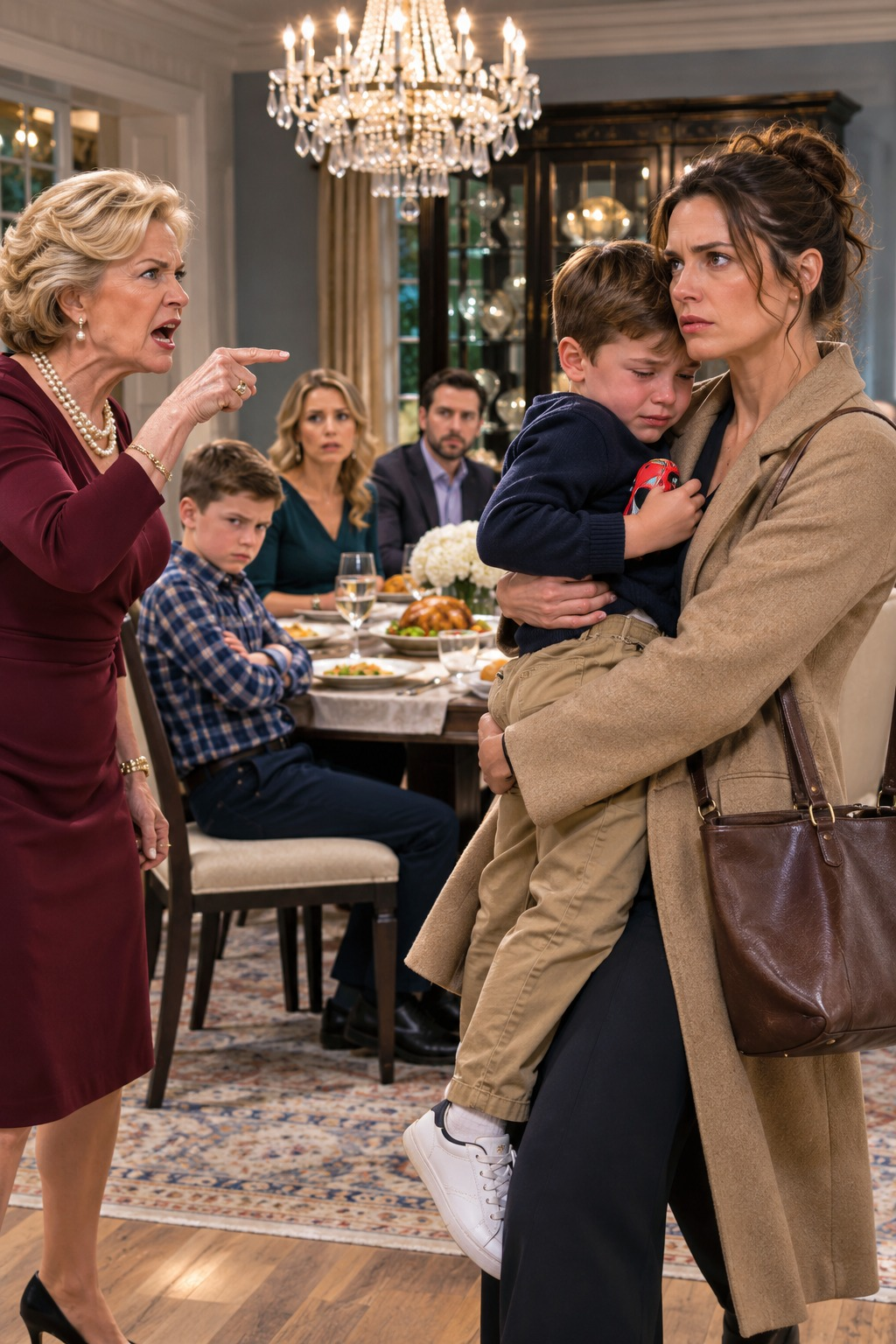
"Mommy! Grandma hurt me!"
My six-year-old son stumbled backward and landed on the hardwood floor.
My mother stood over him, her diamond-covered hand still raised, while his little red toy car lay beneath the dining table.
On the bottom of that car were three tiny letters.
C.H.W.
My mother's expression changed when she saw them.
And suddenly, I knew this wasn't just about a toy.
For one terrible second, nobody moved.
Not my sister Lorna, who was sitting beside her husband with a glass of white wine in her hand.
Not my nephew Brady, who had started the whole thing.
Not the other relatives gathered around my mother's expensive dining table.
And certainly not my mother.
My little boy sat on the floor, one hand pressed against his left ear, his face twisted in pain.
"Mommy," he whispered again.
That was what finally broke the spell.
I pushed my chair back so hard it scraped against the floor.
"Tucker!"
I rushed around the table and dropped to my knees beside him.
His cheeks were already wet.
He reached for me with both hands.
I pulled him close, carefully moving his fingers away from his ear.
"Sweetheart, look at me."
He tried.
But his lower lip was trembling so badly that he could barely speak.
"It hurts."
"I know, baby. I'm here."
Behind me, my mother made an impatient sound.
"Oh, for heaven's sake, Whitney. Don't encourage this."
I turned my head.
My mother, Eleanor Whitcomb, stood beside her chair in a burgundy dress that probably cost more than my monthly grocery bill.
Her perfectly styled blonde hair hadn't moved.
Her pearl necklace rested neatly against her collarbone.
And her expression showed absolutely no concern for the child she'd just knocked to the floor.
"Don't encourage what?" I asked.
"The dramatics."
I stared at her.
"Tucker is hurt."
"He was misbehaving."
"He was trying to get his toy back."
My mother folded her arms.
"Children need to learn to share."
I looked toward Brady.
My eight-year-old nephew was sitting beside Lorna, holding Tucker's red toy car so tightly that his knuckles had turned white.
"Brady," I said, struggling to keep my voice steady. "Give Tucker his car."
Brady looked at his mother.
Lorna immediately pulled him closer.
"Whitney, seriously? You're making a scene over a toy?"
I couldn't believe what I was hearing.
"It's not just a toy."
Lorna rolled her eyes.
"Oh, here we go."
I felt Tucker's small fingers tighten around my sleeve.
The little red car had belonged to his father.
Cole had bought it three weeks before the accident.
Three weeks before a state trooper appeared at my front door and told me that my husband wasn't coming home.
Three weeks before I learned that a person could survive having their entire future ripped away.
Cole had been thirty-six.
He'd kissed Tucker goodbye that morning, promised to be home before dinner, and left for a meeting that was supposed to last less than two hours.
He never made it back.
The police said another driver had crossed the center line on a wet stretch of highway.
They said Cole had died before the ambulance arrived.
They said there was nothing anyone could have done.
For months, I'd repeated those words to myself because the alternative was unbearable.
Tucker had been five.
At the funeral, he'd asked whether Daddy could still hear him from heaven.
I'd told him I hoped so.
Then he'd taken the little red car from his pocket and placed it against Cole's closed casket.
"I'll keep it safe for you," he'd whispered.
Since then, that car had gone everywhere with us.
To school.
To the grocery store.
To the dentist.
And to every Sunday dinner at my mother's house.
Sometimes Tucker slept with it beneath his pillow.
Sometimes he whispered things to it when he thought nobody was listening.
Once, I heard him say, "Daddy, I was brave today."
I had to shut myself in the bathroom afterward because I couldn't stop crying.
And now Brady was holding that car like a prize he'd won.
"Give it back," I said again.
My mother stepped between us.
"Whitney, that's enough."
"No, Mom. It isn't."
Her eyes narrowed.
I knew that look.
I'd known it since I was a little girl.
It was the look that meant I was about to be reminded who paid for my clothes, my education, my wedding, and every other thing she believed entitled her to control me.
"You're upsetting everyone," she said.
I looked around the table.
Nobody met my eyes.
Lorna stared at her plate.
Her husband, Grant, adjusted his napkin.
My uncle Richard took a long drink of water.
Everyone was uncomfortable.
But nobody was uncomfortable enough to speak.
That was how my family worked.
My mother created the problem.
Everyone else pretended the problem was my reaction.
And eventually, I apologized.
I'd apologized when she criticized my wedding dress.
I'd apologized when she told Cole he wasn't ambitious enough.
I'd apologized when she announced, during Thanksgiving dinner, that my husband's family had never amounted to much.
I'd even apologized after she accused me of being ungrateful for the money she'd sent after Cole died.
Every apology had bought a few days of peace.
Then the cycle began again.
But this time, Tucker was the one paying for it.
I looked down at my son.
His eyes were closed.
His breathing came in small, uneven bursts.
And I realized he was trying not to cry loudly.
He was six years old, hurt and frightened, and already trying to make himself less inconvenient.
Something cold settled inside my chest.
"Mom," I said, "you struck him."
She lifted her chin.
"I corrected him."
"You knocked him down."
"He lost his balance."
"He was reaching for something that belonged to him."
"Your son needs discipline."
"My son needs to know that adults don't get to hurt him because they're angry."
My mother's mouth tightened.
Then she said something that made the entire room feel smaller.
"Perhaps if Cole had been a better father, Tucker wouldn't be so difficult."
I went completely still.
Lorna looked up.
Even Grant stopped moving.
My mother knew exactly what she'd said.
She'd chosen those words carefully.
Cole had been dead for eleven months.
Eleven months of birthdays without him.
Eleven months of Tucker waking up and asking whether Daddy would remember what he looked like.
Eleven months of me trying to keep our small world standing.
And my mother had just used his death to win an argument.
"Don't," I whispered.
She raised an eyebrow.
"Don't what?"
"Don't talk about my husband."
"Then stop making everything about him."
I felt the blood rushing in my ears.
For a moment, I was twenty years old again, standing in her kitchen while she explained why my college major was embarrassing.
Then I was twenty-seven, listening to her tell me that marrying Cole would ruin my future.
Then I was thirty-three, sitting on my bedroom floor after the funeral while she complained that I hadn't thanked her properly for the flowers.
The memories came so quickly that I could barely separate them.
And through all of it, Tucker was still crying.
My mother glanced toward the table.
"Now, can we please finish dinner?"
I looked at her.
Really looked at her.
The expensive dress.
The polished jewelry.
The perfectly arranged hair.
The woman who had spent my entire life teaching me that love was something I had to earn.
Then I asked a question I'd never dared ask before.
"Do you even love him?"
The room went silent.
My mother's expression hardened.
"Excuse me?"
"Tucker. Do you love him?"
"Of course I do."
"Then why is he sitting on the floor crying while you're worried about dinner?"
Her face flushed.
"How dare you speak to me that way in my own house?"
"Answer me."
She took one step closer.
"You have become incredibly disrespectful since Cole died."
I almost laughed.
Not because anything was funny.
Because the cruelty was so familiar.
She could turn any tragedy into an accusation.
Any boundary into an insult.
Any disagreement into proof that I was ungrateful.
And then she delivered the sentence that changed everything.
"Without my money, you two would be homeless."
The words rang through the dining room.
Nobody moved.
Nobody challenged her.
My sister lowered her eyes.
My mother waited for me to react.
I knew what she expected.
An apology.
A promise to do better.
Perhaps a few tears.
She expected me to beg her not to withdraw her financial support.
Because she'd spent years convincing everyone that she was the reason Tucker and I had a roof over our heads.
There was just one problem.
It wasn't true.
After Cole died, my mother had started sending monthly checks.
Sometimes five hundred dollars.
Sometimes a thousand.
Occasionally more, particularly when she wanted to remind someone how generous she was.
Every check came with a message.
For Tucker. Since someone has to think about his future.
Or:
Please try to be responsible with this.
Once:
Don't make me regret helping you.
I'd deposited every single check into a separate savings account in Tucker's name.
Not one dollar had paid our mortgage.
Not one dollar had bought groceries.
Not one dollar had kept the lights on.
Cole and I had been careful with money.
We'd lived beneath our means.
We'd saved.
And although his death had changed everything, I had continued working part-time as a freelance bookkeeper while managing the savings we'd built together.
We weren't wealthy.
But we weren't homeless.
And we weren't dependent on Eleanor Whitcomb.
My mother simply didn't know that.
I'd never corrected her.
At first, because I was grieving.
Later, because correcting her meant starting another fight.
And eventually, because I was ashamed of how much power I'd allowed her to have.
Now, looking at Tucker's frightened face, I understood that my silence had consequences.
I carefully lifted him into my arms.
He immediately wrapped his legs around my waist and buried his face against my shoulder.
His small body shook.
"I'm sorry, Mommy," he whispered.
I closed my eyes.
Those three words hurt worse than anything my mother had said.
"What are you sorry for, sweetheart?"
"For making Grandma mad."
I held him tighter.
"You didn't do anything wrong."
He didn't answer.
Behind us, my mother sighed dramatically.
"Whitney, put him down. He's perfectly capable of walking."
I stood.
"No."
Her eyebrows rose.
"No?"
"I'm taking Tucker to the hospital."
Lorna gave a short, disbelieving laugh.
"Oh, come on. You're not seriously taking him to the emergency room over this."
I turned toward her.
"Your son took something that belonged to mine."
"They're children."
"And Mom hurt Tucker."
"She barely touched him."
I looked at Brady.
He was still holding the red car.
"Brady, please give that back."
For a second, he seemed ready to obey.
Then my mother spoke.
"Keep it, Brady."
I stared at her.
She smiled thinly.
"Perhaps Tucker will learn that he can't always get his way."
Tucker lifted his head.
"Mommy, Daddy's car."
His voice cracked.
I wanted to walk across the room and take it.
I wanted to tell Brady exactly what he'd done.
I wanted to scream at every adult sitting silently around that table.
But Tucker needed medical attention.
And I wasn't going to make him wait another minute while I argued with people who had already decided his pain didn't matter.
"We'll get it back," I whispered.
My mother folded her arms.
"You are not leaving this house in the middle of dinner."
I looked at her.
"Watch me."
I walked toward the front door.
My heels struck the hardwood with a steadiness I didn't feel.
Behind me, my mother called my name.
"Whitney!"
I kept walking.
"Don't you dare walk away from me!"
I reached the entryway.
Tucker clung to my neck.
My mother followed us.
I could hear the sharp rhythm of her shoes.
"You are making a terrible mistake."
I stopped with my hand on the brass doorknob.
For thirty years, I'd been afraid of making my mother angry.
Afraid she'd withdraw her approval.
Afraid she'd tell everyone I was selfish, dramatic, or ungrateful.
But holding my son, I finally understood something.
Her approval had never protected us.
It had only kept us obedient.
I turned around.
"Tucker does need to learn something today," I said.
My mother looked satisfied.
"Finally."
"He needs to learn that nobody gets to hurt him and call it love."
Her smile disappeared.
I opened the door.
Cold evening air swept into the entryway.
My mother stood perfectly still.
Then she said, very quietly, "You'll regret this."
I looked directly at her.
"No, Mom. I won't."
I carried Tucker outside.
The door closed behind us.
For the first time in my life, I didn't look back.
My car was parked near the end of the circular driveway.
I carefully buckled Tucker into his booster seat.
He winced when the seat belt brushed his shoulder.
I checked his ear beneath the porch light.
The outer edge was red and swollen, with a small spot of blood near the skin.
My stomach tightened.
"I'm going to have a doctor look at this, okay?"
He nodded.
"Will it hurt?"
"I'll be right there with you."
He reached for my hand.
"Promise?"
"Promise."
I kissed his forehead.
Then I climbed into the driver's seat.
For several seconds, I sat without starting the engine.
My hands were shaking.
I gripped the steering wheel.
Breathed in.
Breathed out.
And thought about Cole.
If he'd been alive, he would have been furious.
Not the loud kind of furious.
Cole rarely raised his voice.
He would have gotten very quiet.
He would have picked Tucker up.
And he would have told my mother that she would never put her hands on his son again.
I could almost hear him.
Whit, you don't owe anyone access to our child.
He'd said something similar once, after my mother humiliated me at Christmas.
I'd laughed it off.
Told him she didn't mean anything by it.
He hadn't laughed.
"People don't have to mean to hurt you for it to count," he'd said.
I wished I'd listened.
From the back seat came a small voice.
"Mommy?"
"Yes, baby?"
"Is Grandma going to take our house?"
I turned around.
Tucker was looking at me with enormous, frightened eyes.
I felt something inside me crack.
"No, sweetheart."
"But she said—"
"I know what she said."
"She said we don't have money."
I reached back and touched his knee.
"Grandma was wrong."
He considered that.
Then he whispered, "Are we still going home?"
"Of course we are."
"To our real home?"
"Yes, Tucker. Our real home."
He nodded slowly.
But he didn't look convinced.
I started the engine.
As we pulled away, I glanced in the rearview mirror.
My mother's front door had opened.
She stood beneath the porch light, watching us leave.
Even from that distance, I recognized her posture.
Rigid.
Furious.
Certain that I'd come back.
I turned onto the main road.
And kept driving.
The emergency room was twenty minutes away.
Halfway there, Tucker grew quiet.
I checked the mirror repeatedly.
His eyes were open.
He was staring at his hands.
"Sweetheart, you okay?"
He nodded.
Then, after a long silence, he asked, "Was Daddy mad when he died?"
The question nearly made me miss the turn.
"What?"
"Was he mad at me?"
My throat tightened.
"No, baby. Why would you think that?"
"Because I broke his blue truck before he went away."
I remembered.
A plastic truck.
A missing wheel.
Cole had laughed and told Tucker they would fix it together.
They never got the chance.
"Oh, sweetheart."
"I didn't mean to break it."
"I know."
"Maybe that's why he didn't come home."
I pulled into a gas station parking lot.
I couldn't keep driving while my son believed that.
I unbuckled my seat belt and turned toward him.
"Tucker, listen to me very carefully."
His eyes filled.
"Daddy loved you more than anything in the world. Nothing you did made him leave. Nothing you could ever do would make him stop loving you."
A tear slid down his cheek.
"Even when I'm bad?"
"Even when you make mistakes. And protecting your car wasn't a mistake."
He looked down.
"Grandma says I make trouble."
I went still.
"When did she say that?"
He shrugged.
"Sometimes."
"What do you mean, sometimes?"
His fingers twisted together.
"When you go to the kitchen."
I felt the first real chill of fear.
Not anger.
Fear.
"Has Grandma said other things to you when I'm not there?"
He didn't answer.
"Tucker?"
He looked toward the window.
Then he whispered, "She said I wasn't supposed to tell."
I stared at him.
My heart began pounding.
"What weren't you supposed to tell me?"
He pulled his sleeves over his hands.
"She said you'd be sad again."
I couldn't breathe.
"Sweetheart, you can tell me anything."
He shook his head.
"She said it would be my fault."
I reached for him.
But before he could say another word, my phone started ringing.
My mother's name appeared on the screen.
I rejected the call.
It rang again.
Then a message appeared.
Come back immediately. We need to discuss your behavior.
I turned the phone facedown.
Tucker watched me.
"Are you in trouble?"
"No, sweetheart."
"Are you sure?"
I swallowed.
"Very sure."
But I wasn't sure of anything else.
Not anymore.
At the hospital, a nurse checked Tucker's vital signs and asked what had happened.
I told her.
Clearly.
Without minimizing.
Without saying it had been an accident.
"My mother struck my six-year-old son during dinner. He fell and injured his ear."
The nurse looked at Tucker.
Then back at me.
Her expression changed.
She wrote something on her clipboard.
"We'll have a doctor examine him."
I nodded.
Tucker held my hand.
His fingers were cold.
While we waited, I kept thinking about what he'd said.
She told me not to tell.
How many secrets had my mother demanded from him?
How many times had he been frightened in that house?
And how many times had I mistaken his silence for good behavior?
I thought about Thanksgiving.
Tucker had been unusually quiet afterward.
He'd refused to eat dinner.
When I asked what was wrong, he'd said he was tired.
My mother had told me he was being difficult.
I'd believed her.
I thought about his birthday.
He'd cried when I mentioned inviting Grandma.
I'd assumed he was overwhelmed.
My mother had called him spoiled.
I'd believed her again.
A terrible realization began forming.
Maybe Tucker hadn't been shy around my mother.
Maybe he'd been afraid.
I held his hand tighter.
"I'm sorry," I whispered.
He looked up.
"For what?"
"For not understanding sooner."
He leaned against me.
"It's okay, Mommy."
But it wasn't okay.
Not even close.
Dr. Amara Okonkwo entered the examination room shortly afterward.
She was a calm, soft-spoken woman with kind eyes.
She introduced herself to Tucker first.
Then she crouched so they were at the same height.
"Hi, Tucker. I hear your ear is hurting."
He nodded.
"Would it be okay if I took a look?"
He glanced at me.
I squeezed his hand.
"It's okay."
The doctor examined him carefully.
She explained each step.
She asked whether he felt dizzy.
Whether he could hear normally.
Whether anything else hurt.
Tucker answered in a whisper.
When she finished, she sat beside us.
"We're going to take good care of you," she said.
Then she asked a question.
"Tucker, has anyone hurt you like this before?"
I opened my mouth.
I was about to say no.
Of course not.
This was the first time.
I'd never seen anything like it.
But then I stopped.
Because I remembered the gas station.
And Tucker's words.
She told me not to tell.
I looked at my son.
He stared at his shoes.
Dr. Okonkwo waited.
She didn't rush him.
She didn't repeat the question.
Finally, Tucker whispered, "Grandma said I'd be in trouble."
My heart stopped.
Dr. Okonkwo leaned forward slightly.
"In trouble for what, sweetheart?"
He looked at me.
His eyes filled with tears.
"For telling Mommy."
I felt the room tilt.
"Telling me what?" I whispered.
Tucker's mouth trembled.
Then he said something that made the blood drain from my face.
"About Thanksgiving."
I remembered the holiday.
The blue bowl.
The strange silence afterward.
My mother telling me Tucker had been naughty.
I remembered how he'd refused to go into the laundry room for weeks.
And suddenly, all those memories connected.
Dr. Okonkwo spoke gently.
"What happened at Thanksgiving, Tucker?"
My little boy took a shaky breath.
Then he looked straight at me.
"Mommy, Grandma locked me in the laundry room."
I couldn't move.
He swallowed.
"And she said if I told you why, she'd—"






Comments 0