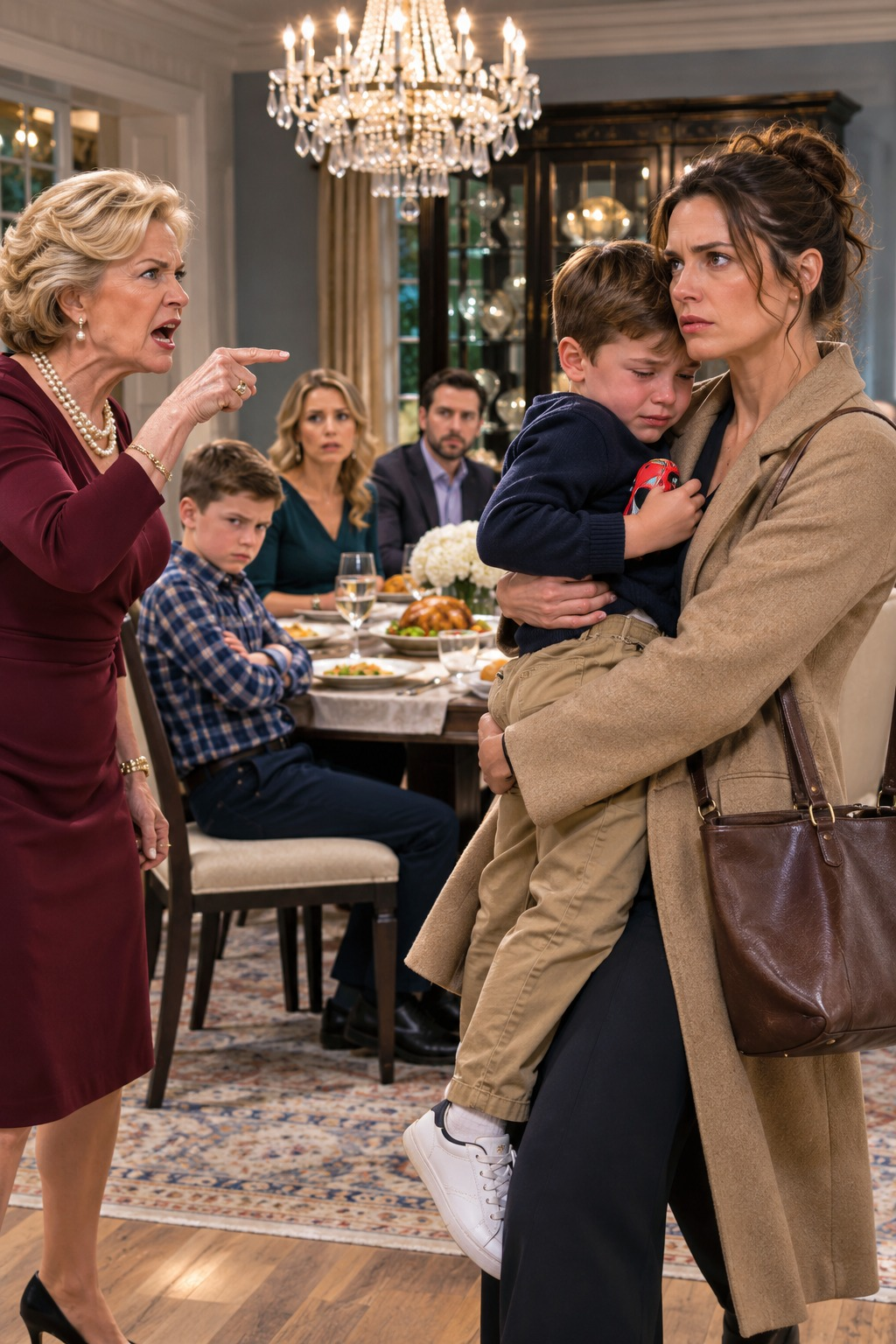
"She's here now."
Those were the last three words the stranger said before the call disconnected.
I stood in my kitchen with the phone pressed against my ear, listening to the empty line.
For several seconds, I couldn't move.
Someone had called to tell me he knew what had been taken from Cole's safe-deposit box.
Someone who claimed to have worked at the bank.
And just as he was about to explain the woman in the surveillance photograph, he'd sounded terrified.
I called the number back.
Once.
Twice.
Three times.
Each call went straight to voicemail.
No greeting.
No name.
Just a mechanical voice asking me to leave a message.
I didn't.
Instead, I opened my conversation with Desmond.
Someone just called me. He says he worked at the bank and knows what was taken from Cole's box. He sounded frightened. The call ended suddenly.
Desmond replied almost immediately.
Don't contact him again until we verify who he is. Save the call record. I'm calling you.
My second phone rang.
I answered.
"Whitney, are you alone?"
"Tucker's upstairs."
"Is he safe?"
"Yes."
"Good. Tell me exactly what the caller said."
I repeated every word.
Desmond listened without interrupting.
When I finished, he was quiet.
Then he asked, "Did he identify himself?"
"No."
"Did he mention a branch?"
"No."
"Did he say how he got your number?"
I froze.
My second phone.
The phone nobody at dinner knew existed.
The phone I'd purchased months earlier after Cole's death, when I became tired of my mother demanding access to every part of my life.
Only a handful of people had the number.
Desmond.
My attorney's office.
Tucker's pediatrician.
And one former colleague who'd helped me set it up.
"Desmond," I whispered, "how did he get this number?"
There was a pause.
"That's an important question."
I stared at the phone.
My mother didn't know about it.
Lorna didn't know about it.
And Grant certainly shouldn't have known.
Yet a stranger connected to Cole's bank had called me directly.
"Could someone have gotten it from the bank?" I asked.
"Possibly, if it was included in a communication or an authorized contact record. But we shouldn't assume that."
"What do I do?"
"Preserve the call details. I'll contact the bank's legal department through the established channel. Don't arrange to meet anyone based on an anonymous call."
I nodded.
Then I looked toward the living room.
Tucker's little sneakers sat beside the couch.
One had a loose shoelace.
Cole used to tie those shoes every morning.
I suddenly missed him so much that I could barely breathe.
"Desmond?"
"Yes?"
"Do you think Cole knew this would happen?"
He was silent.
"I think Cole knew certain financial records needed protecting," he said finally. "I don't think he could have imagined what happened to Tucker."
I closed my eyes.
Neither could I.
The next morning, I woke to the sound of Tucker calling my name.
"Mommy?"
I hurried upstairs.
He was sitting in bed, clutching his dinosaur blanket.
His hair was flattened on one side.
His eyes were wide.
"What's wrong, sweetheart?"
He looked toward the bedroom door.
"I dreamed Grandma came here."
My chest tightened.
"What happened in the dream?"
"She took my toys."
I sat beside him.
"That sounds scary."
He nodded.
"She said I had to go with her."
I pulled him into my arms.
"You're here with me."
He buried his face against my shoulder.
"Can you lock my window?"
I looked toward the window.
It was already locked.
But I understood what he was really asking.
He wanted to know whether anyone could take him away.
I stood, checked the latch, and showed him.
"See? It's locked."
He nodded.
Then he whispered, "Can we check the front door too?"
"Of course."
We went downstairs together.
I showed him the deadbolt.
The security camera.
The alarm panel.
I explained that grown-ups were responsible for keeping children safe.
He listened carefully.
Then he asked, "Even from other grown-ups?"
My throat tightened.
"Yes, baby. Even from other grown-ups."
He considered that.
Then he reached for my hand.
"Okay."
I wished the answer could be enough.
I wished safety were something I could promise with absolute certainty.
But after the last two days, I understood how much work protecting him might require.
At nine-fifteen, Desmond called.
"I have a name."
I sat straighter.
"The man from the phone?"
"Possibly. The bank confirmed that a former employee named Daniel Mercer recently contacted its compliance department regarding irregular access records."
My heart began racing.
"Did he work in the vault?"
"He worked in customer operations and sometimes assisted with safe-deposit access procedures."
"Is he the person who called me?"
"We haven't confirmed that."
"Can we speak to him?"
"Not directly yet. The bank has referred the matter to its internal investigators, and I've asked that any relevant information be preserved."
I rubbed my forehead.
"Desmond, this is taking forever."
"I know."
"Meanwhile, my mother is telling people I'm unstable, Lorna is lying, and someone has been inside Cole's box."
"I understand your frustration."
"Do you?"
My voice came out sharper than I intended.
Desmond didn't respond immediately.
Then he said quietly, "Whitney, I stood beside Cole's hospital bed. I promised him that if you ever needed help understanding the company, I would be there."
I stopped breathing.
"You spoke to him?"
"Before he died."
My hand tightened around the phone.
"You never told me that."
"I told you we spoke, but not everything we discussed."
I stared at the wall.
Cole's accident had happened on a rainy Thursday evening.
By the time I reached the hospital, he was unconscious.
I'd never heard his voice again.
For eleven months, I'd carried that silence.
And now Desmond was telling me Cole had spoken to him.
"What did he say?"
Desmond took a breath.
"He asked me to make sure you understood that the company's problems were not your responsibility."
Tears filled my eyes.
"What else?"
"He said he was worried you'd blame yourself for trusting the wrong people."
I covered my mouth.
Cole knew me.
He knew how easily my mother could make me feel responsible for things I hadn't done.
He'd seen it during our marriage.
He'd watched me apologize after family dinners.
He'd listened when I explained why I couldn't refuse another invitation.
He'd told me more than once that love shouldn't require surrendering my judgment.
And I'd always promised to work on it.
"Why didn't you tell me?" I whispered.
"Because you were grieving, and I believed the immediate corporate issues could be handled without placing them on your shoulders."
I wiped my face.
"That wasn't your decision to make."
"You're right."
His answer surprised me.
No excuses.
No lecture.
Just an acknowledgment.
"I'm sorry, Whitney."
I stared at Cole's photograph on the bookshelf.
"Did he say anything about Tucker?"
Desmond's voice softened.
"He said to tell Tucker that being kind didn't mean letting people hurt him."
I began crying.
Not loudly.
Not dramatically.
Just tears I couldn't stop.
Cole had understood something I was only beginning to learn.
And now our son was paying the price for how long it had taken me.
At eleven, I received an email from Martin Voss.
The subject line read:
Urgent Family Resolution Proposal.
I almost deleted it.
Instead, I forwarded it to Desmond.
Then I read it.
The message stated that my mother remained deeply concerned about Tucker's welfare.
It suggested that the family could avoid further conflict if I agreed to a temporary arrangement.
Under the proposal, Tucker would spend several days each week at my mother's home.
I would participate in a family-selected counseling program.
And an independent financial manager would review the Walker Family Investment Trust.
I stared at the screen.
There it was.
The connection.
My son's living arrangements.
My emotional condition.
And the trust.
All placed in the same proposal.
As though one naturally required the others.
I read the next paragraph.
It said Eleanor was willing to continue providing financial assistance if I demonstrated cooperation.
I felt my face grow hot.
My mother was still treating money like a leash.
I forwarded the email to Desmond with one sentence.
This is what she wants.
He called within minutes.
"I've read it."
"She wants Tucker in her house."
"Yes."
"And someone she chooses to review the trust."
"Yes."
"Isn't that enough to prove what she's doing?"
"It's evidence of what she's proposing. We still need to establish her motives and whether any improper conduct occurred."
I exhaled sharply.
"You're always so careful."
"I have to be."
"Why?"
"Because if we're going to challenge false documents and questionable transactions, we need our facts to withstand scrutiny."
I knew he was right.
I hated that he was right.
"Don't respond to Martin," he added. "I'll handle the legal correspondence."
"Okay."
"And Whitney?"
"Yes?"
"Don't let the proposal convince you that you need to negotiate Tucker's safety."
I looked toward the backyard.
Tucker was sitting on the porch steps, drawing with sidewalk chalk.
He'd made a blue house.
A yellow sun.
And a red car.
I swallowed.
"I won't."
That afternoon, I drove Tucker to his pediatrician for the recommended follow-up.
Dr. Patel examined his ear carefully.
She asked whether he had dizziness, trouble hearing, or worsening pain.
Tucker answered in his small, serious voice.
She explained that the injury appeared to be improving, though she wanted us to continue monitoring him.
Then she asked how he was sleeping.
Tucker looked at me.
"Bad dreams."
Dr. Patel nodded.
"That can happen after something frightening."
She recommended a child therapist experienced in trauma and grief.
I accepted the referral.
On the way home, Tucker was unusually quiet.
I glanced at him in the rearview mirror.
"Everything okay, buddy?"
He nodded.
Then he asked, "Mommy, why does Grandma like Brady more?"
The question hit me harder than anything my mother had said.
I tightened my grip on the steering wheel.
"Sweetheart, grown-ups sometimes behave unfairly. That's their responsibility, not yours."
He looked out the window.
"Brady gets presents."
"I know."
"And Grandma says he's a good boy."
I swallowed.
"You're a good boy too."
He shook his head.
"She says I make things difficult."
I pulled into a parking lot.
Then I turned around.
"Tucker, look at me."
He did.
"You are not difficult because you have feelings. You are not bad because you want to keep something that belongs to you. And you never deserve to be hurt."
His eyes filled with tears.
"Even when I don't share?"
"Even then."
He stared at me.
Then he whispered, "Daddy said I could keep the car forever."
My heart ached.
"I know."
"Do you think Brady broke it?"
I reached back and took his hand.
"I don't know, sweetheart. But we're trying to find it."
He nodded.
Then he asked, "Can we go home?"
"Yes."
I started the car.
And I promised myself that whatever happened with the trust, the company, or my mother, I wouldn't let Tucker believe his worth depended on how well he pleased other people.
At four-thirty, Desmond arrived with another update.
He looked tired.
His tie was loosened.
He carried a sealed folder.
"Is Tucker home?"
"He's upstairs playing."
"Good."
We sat at the kitchen table.
Desmond placed the folder between us.
"The bank has provided additional information."
I leaned forward.
"About Daniel Mercer?"
"Yes."
"Is he safe?"
"We don't have confirmation that anything happened to him. But the bank says he stopped reporting for scheduled shifts before his employment ended."
My stomach tightened.
"When?"
"Shortly after the March access."
I stared at him.
"After Lorna went into the vault?"
"Yes."
"Was he fired?"
"The bank hasn't disclosed the circumstances of his departure."
I looked at the folder.
"What else?"
Desmond opened it.
Inside was a printed copy of an internal access report.
He pointed to a line.
"On March fourteenth, the system recorded a manual authorization override."
I frowned.
"What does that mean?"
"Someone approved access outside the ordinary verification process."
"Who?"
"The approval was entered under a supervisor's credentials."
"Was that allowed?"
"That depends on the circumstances and the bank's procedures. But the compliance team flagged it for review."
I stared at the page.
"Could Lorna have known someone there?"
"Possibly."
"Could Martin have arranged it?"
"We don't know."
I rubbed my forehead.
"Every answer leads to another question."
Desmond nodded.
"Unfortunately."
Then he removed a second page.
"This is more important."
I looked down.
It was a scanned receipt.
At the top were the words:
Safe-Deposit Access — Supplemental Item Record.
Below that was a handwritten description.
One sealed yellow envelope.
My heart stopped.
"The envelope."
Desmond nodded.
"The bank recorded it among the materials associated with the box."
I stared at him.
"But Tucker saw a yellow envelope at my mother's house."
"Yes."
"Then someone took it from the box."
"That is one possible explanation. We need to compare the dates and descriptions."
I looked at the receipt again.
There was a notation beside the envelope.
Three letters.
C.H.W.
My breath caught.
"Those initials."
Desmond nodded.
"The same marking on the key and Tucker's toy car."
I leaned back.
Cole had connected them.
Somehow.
A key.
A toy.
An envelope.
And a set of records that people were apparently desperate to control.
"Desmond, what does C.H.W. stand for?"
He shook his head.
"I don't know."
I stared at the page.
Then I remembered something.
A conversation from years earlier.
Cole and I had been sitting on the back porch.
Tucker was a baby.
Cole had been talking about the future.
He'd said he wanted to build something that would belong to our son.
Not just money.
Something meaningful.
He'd mentioned a project.
A name.
I closed my eyes.
"Wait."
Desmond looked at me.
"What?"
"Cole used those letters before."
"Where?"
"He had a notebook. A black notebook."
My heart began racing.
"He kept it in his office at home."
"Do you still have it?"
"I think so."
I stood.
"Come with me."
We searched Cole's office for nearly forty minutes.
Drawers.
Shelves.
Storage boxes.
Old files.
Finally, I found the notebook behind a row of technical manuals.
It was small.
Black.
Worn along the edges.
I recognized Cole's handwriting immediately.
He'd written his name on the first page.
Cole Walker.
Beneath it were the initials:
C.H.W.
Desmond leaned closer.
I turned the page.
There were notes about investment structures.
Company meetings.
Trust provisions.
And several names I didn't recognize.
Then I found a page with a heading.
Cole Henry Walker — Private Record Index.
I stared at it.
"Henry."
Desmond looked at me.
"Cole's middle name."
I nodded.
Of course.
C.H.W.
Cole Henry Walker.
Not a secret company.
Not a coded organization.
His own initials.
A simple way to mark the records he wanted kept together.
I almost laughed.
We'd been searching for some elaborate explanation.
And the answer had been his name.
But beneath the heading was something more important.
A numbered list.
1. Original financial ledger.
2. Personal statement for Whitney.
3. Digital archive.
4. Duplicate authorization records.
I stopped.
"Four items."
Desmond leaned closer.
"What?"
"The inventory you had listed three."
He studied the page.
"You're right."
I pointed at the fourth entry.
"Duplicate authorization records."
Desmond's expression changed.
I turned the page.
There was a handwritten note.
If access is disputed, compare all signatures against the original authorization packet.
My heart began pounding.
Cole had anticipated a dispute.
Not necessarily the one we were facing.
But enough to preserve duplicate records.
I looked at Desmond.
"Where's the original packet?"
He studied the notebook.
Then pointed toward the bottom of the page.
A reference number.
Archive File 7B.
I frowned.
"What's that?"
Desmond shook his head.
"I don't know."
I turned another page.
A small diagram showed three boxes connected by arrows.
One labeled Bank.
One labeled Counsel.
One labeled Home.
My pulse quickened.
"Home."
Desmond leaned forward.
"Keep reading."
Beneath the diagram, Cole had written:
Primary copies remain separate. Home archive contains verification material only.
I stared at the words.
"There's something here."
Desmond nodded.
"Possibly."
I looked around the office.
The bookshelves.
The desk.
The filing cabinet.
The old printer.
Cole had hidden a key beneath a drawer.
What else might he have left behind?
We searched until the sun began to set.
Desmond checked the filing cabinet.
I examined the storage boxes.
We found tax returns.
Old contracts.
Photographs.
Receipts.
But nothing labeled 7B.
Eventually, Tucker appeared in the doorway.
"Mommy?"
I looked up.
"Hey, sweetheart."
"What are you doing?"
"Looking for some of Daddy's papers."
He stepped inside.
His eyes moved across the open drawers.
"Are you looking for his treasure?"
I froze.
Desmond looked at him.
"What treasure, buddy?"
Tucker smiled faintly.
"Daddy said he had a treasure box."
My heart began racing.
"Where?"
Tucker pointed toward the bookshelf.
"Behind the big books."
I looked at Desmond.
We'd already searched there.
But Tucker continued.
"Not the books you can see."
I knelt.
"What do you mean?"
He walked toward the shelf.
Then pointed at the bottom.
"Daddy said the secret books were underneath."
I stared at the wooden base.
Cole had built that bookshelf himself.
I'd always assumed the bottom panel was decorative.
Desmond crouched beside it.
He ran his fingers along the edge.
Then pressed gently.
The panel shifted.
My breath caught.
There was a narrow compartment behind it.
Inside sat a small metal case.
I reached for it.
The case was dusty.
A strip of masking tape ran across the lid.
Written in Cole's handwriting were two characters.
7B.
I stared at it.
Desmond looked at me.
"Whitney."
I nodded.
My hands were shaking.
I carried the case to the desk.
It had a small combination lock.
I looked at Tucker.
"Did Daddy ever tell you how to open it?"
He thought carefully.
Then shook his head.
"He said it was Mommy's treasure."
I swallowed.
Desmond examined the lock.
"Do you know the combination?"
I shook my head.
Then I noticed a small note taped beneath the case.
Four numbers.
0-6-1-8.
June eighteenth.
Our wedding anniversary.
I entered the combination.
The lock clicked.
For a moment, I couldn't move.
Then I lifted the lid.
Inside was a sealed plastic pouch.
A small flash drive.
And a folded letter.
My name was written across the front.
Whitney.
I stared at Cole's handwriting.
For eleven months, I'd wished I could hear his voice again.
Now I was holding words he'd left for me.
I opened the letter.
The first line made my eyes fill.
Whit, if you're reading this, something has gone wrong with the records I was trying to protect.
I pressed my hand against my mouth.
Desmond stepped back.
He gave me space.
I continued reading.
I don't know whether the problem will be a misunderstanding, a legal dispute, or someone deliberately misusing authority. But I need you to know that you have the right to ask questions, even when the person answering is someone you love.
Tears blurred the page.
Cole.
Always Cole.
He knew exactly what I struggled with.
I wiped my eyes and kept reading.
The documents in this case are not proof that anyone has committed a crime. They're copies of records that need independent review. Please don't confront anyone based on assumptions. Take them to someone you trust who can verify what they mean.
I swallowed.
Then I reached the final paragraph.
And Whitney, if anyone ever tries to make you believe that protecting Tucker makes you ungrateful, remember this: our son is not a debt you owe to anyone.
I began crying.
Desmond placed a hand on my shoulder.
I held the letter against my chest.
For a moment, the entire room disappeared.
I could almost hear Cole saying those words.
Calm.
Patient.
Certain.
Then Tucker tugged gently at my sleeve.
"Mommy?"
I looked down.
"Yes, baby?"
"Did Daddy leave you a treasure?"
I knelt and hugged him.
"Yes, sweetheart."
He smiled.
"Good."
After Tucker went upstairs to wash his hands before dinner, Desmond and I examined the remaining contents.
The plastic pouch held photocopies of several authorization forms.
Some were signed by Cole.
Others were blank templates.
There were handwritten notes identifying which documents required independent verification.
The flash drive was labeled:
ARCHIVE 7B — READ ONLY.
Desmond looked at it.
"We shouldn't alter anything on this device."
I nodded.
"Can we see what's on it?"
"Yes, but we should have a qualified forensic specialist make a verified copy first."
I stared at the small black drive.
It was barely larger than my thumb.
Yet people had apparently been fighting over records like these for months.
My mother.
Lorna.
Grant.
Martin.
And perhaps someone at the bank.
I looked at Desmond.
"What if the files prove they lied?"
"Then we'll determine the appropriate next steps."
"And if they don't?"
"Then we'll keep investigating until we understand the facts."
I nodded.
For once, that answer was enough.
Then Desmond's phone rang.
He glanced at the screen.
His expression changed.
"Excuse me."
He stepped into the hallway.
I watched him through the doorway.
He listened.
Asked a question.
Then another.
His face grew serious.
When he returned, he looked directly at me.
"Whitney, the bank has located Daniel Mercer."
My heart jumped.
"Is he okay?"
"He's alive. He's agreed to speak with investigators."
I exhaled.
"Thank God."
"But there's something you need to know."
I stood.
"What?"
"Daniel says the March vault access wasn't the first irregularity."
My stomach tightened.
"What do you mean?"
"He says someone attempted to obtain Cole's records before the accident."
I stared at him.
"Before Cole died?"
Desmond nodded.
"Yes."
I looked down at the letter in my hands.
Cole had known there was a problem.
He'd prepared copies.
He'd hidden a key.
He'd left instructions.
And someone had apparently been trying to reach those records while he was still alive.
"Who?" I whispered.
Desmond hesitated.
"Daniel says he remembers the person because of something unusual about the authorization request."
My heart hammered.
"What was unusual?"
"The person claimed to be acting on Cole's behalf."
I stared at him.
"Who was it?"
Desmond looked toward the office door.
Then he lowered his voice.
"Whitney, Daniel gave the investigators a name."
I gripped the edge of the desk.
"Tell me."
Desmond opened his mouth.
But before he could speak, my regular phone began ringing.
I glanced at the screen.
Lorna.
Again.
I almost ignored it.
Then a message appeared beneath the missed call.
Whitney, please answer. Mom doesn't know I'm telling you this.
Another message arrived.
I found Tucker's car.
My heart stopped.
Then a third message appeared.
But there's something inside it.
I stared at the screen.
Something inside the car?
The toy was small.
A simple red vehicle with black wheels.
Cole had bought it at a gas station during a road trip.
At least, that's what I'd always believed.
My fingers trembled as I opened the next message.
Brady dropped it. The bottom came loose.
I swallowed.
Then the final message arrived.
Whitney, I need you to see what fell out.
A photograph began loading.
I watched the progress circle turn.
Once.
Twice.
Then the image appeared.
It showed Tucker's red toy car lying on Lorna's kitchen counter.
The bottom panel had been removed.
Beside it was a tiny folded piece of paper.
And on that paper, written in Cole's unmistakable handwriting, were five words.
THE ORIGINAL IS NOT MISSING.
I stared at the screen.
My heart hammered.
Then another message appeared.
There's more written on the other side.
A second photograph began loading.
I waited.
The image sharpened.
I saw the folded paper.
I saw Cole's handwriting.
And beneath it, I saw a name.
A name that made me look slowly toward Desmond.
Because it was the same name he had been about to tell me.
And before I could say a word, someone knocked on our front door.
Three slow knocks.
Desmond went still.
I looked toward the hallway.
The knock came again.
Then a familiar woman's voice called through the door.
"Whitney, open up. I brought Tucker's car."
It was Lorna.
But she wasn't alone.
A man's voice spoke behind her.
A voice I hadn't heard in almost a year.
A voice I knew from hundreds of ordinary mornings, whispered goodnights, and the last voicemail I still couldn't bring myself to delete.
And when he said my name, I stopped breathing.
"Whitney. We need to talk."






Comments 0