Wyatt.
My older brother's signature appeared on the witness line.
I stared at it until the letters seemed to move across the page.
There was no mistaking the distinctive way he formed the first letter of his name. He had been signing birthday cards, school permission slips, and family photographs that way for as long as I could remember.
My brother had witnessed a signature I had never written.
According to the document, he had been present when I voluntarily agreed to surrender certain ownership interests in Crestwood Industries.
But I had never attended such a meeting.
I had never agreed to surrender anything.
Until that afternoon, I hadn't even known I possessed ownership interests worth surrendering.
I pushed my chair away from the kitchen table.
"No."
The word escaped my mouth before I realized I had spoken.
I stood up and walked toward the window.
Outside, a woman was carrying groceries into the neighboring apartment building. A delivery driver was struggling with a large package. Somewhere downstairs, a television was playing.
The world continued as though nothing had happened.
Meanwhile, everything I understood about my family was falling apart.
I thought about calling Wyatt.
I wanted to hear his voice.
I wanted him to explain why his signature appeared beneath mine.
Perhaps there was some misunderstanding.
Perhaps someone had forged his signature too.
I desperately wanted that possibility to be true.
But then I remembered his expression in the Crestwood parking lot.
His questions about the documents.
His warning about unnecessary distractions.
And the way he had driven away when I asked what he expected me to find.
I returned to the table.
My mother's letter remained open beside the agreement.
She had instructed me to read everything before speaking to my father.
For once, I decided to follow her advice without questioning it.
I sat down and unfolded the second page.
My dearest Nolan,
I wish I could explain these things to you in person. I have tried several times, but every conversation seems to end before I find the courage to tell you what needs to be said.
You have always wanted your father's approval. I know that because I have watched you spend years trying to earn something that should never have been conditional.
I stopped reading.
There were things mothers noticed that their children believed they had successfully hidden.
Apparently, mine had noticed everything.
I remembered the evenings I stayed late at Crestwood, hoping my father would recognize my dedication.
I remembered showing him reports I had spent weekends preparing.
I remembered his dismissive comments and the way I pretended they didn't hurt.
My mother had seen all of it.
She had simply never told me.
I continued.
When Crestwood was established, your father and I agreed that the company would eventually provide security for both of our children. We worked hard, made sacrifices, and took risks that frightened us more than we admitted.
But as the company grew, your father began to think differently about ownership.
He wanted control. Not responsibility, Nolan. Control.
I looked toward the corporate documents.
For the first time, I wondered whether my father's obsession with authority had begun long before my mother's death.
She continued describing disagreements that had taken place behind closed doors.
Richard wanted to expand rapidly, acquire competitors, and attract investors who would increase the company's valuation.
Eleanor wanted sustainable growth.
She wanted financial reserves, employee protections, and safeguards that would prevent a single individual from making decisions that endangered the entire business.
Their disagreements had become increasingly serious.
Eventually, she had consulted Marshall about restructuring portions of her ownership.
I read that sentence twice.
My mother had made legal arrangements involving Crestwood.
Arrangements my father apparently hadn't supported.
I believed that protecting the company meant protecting it from anyone who might place personal ambition above its future. That included your father. It also included me.
No one should possess unlimited authority over something that supports so many lives.
I leaned back.
That sounded exactly like Eleanor.
Even in a private letter written near the end of her life, she refused to portray herself as someone incapable of making mistakes.
My father would never have written those words.
He believed his position entitled him to unquestioned loyalty.
My mother believed authority created obligations.
The difference had apparently become impossible to reconcile.
I turned another page.
Several years ago, I arranged for certain interests in Crestwood to be held for your benefit. There were conditions attached, and those conditions were intended to protect you while you gained experience.
I wanted you to learn the business without feeling entitled to it.
My hands became still.
Held for my benefit.
I looked at the agreement again.
Suddenly, the words ownership and beneficiary no longer seemed abstract.
My mother had left something for me.
Something more substantial than photographs, notebooks, or childhood memories.
Something my father had never mentioned.
I continued reading.
Your brother was provided for through separate arrangements. I tried to make decisions that reflected each of your circumstances, rather than simply treating you as identical people.
Unfortunately, your father believed those arrangements interfered with his plans.
I thought about Wyatt's executive position.
His expensive home.
His luxury vehicles.
The opportunities Richard had placed in front of him.
For years, I had assumed my brother received those things because our father considered him more capable.
Now I wondered whether they represented something else.
A reward.
An incentive.
Perhaps even compensation for his silence.
I hated myself for considering it.
Wyatt was my brother.
We had grown up together.
We had shared bedrooms during family vacations, argued over video games, and helped each other survive our father's impossible expectations.
When I was eight, Wyatt had punched a neighborhood bully who knocked me off my bicycle.
When I was fourteen, he taught me how to throw a football.
When I left for college, he helped carry my belongings into the dormitory.
Somewhere between those memories and the signature on my kitchen table, something had changed.
I just didn't know when.
My mother's letter continued.
I discovered irregularities in documents that were presented as evidence of your consent. I knew immediately that something was wrong because you had never discussed these matters with me.
When I confronted your father, he insisted that everything had been handled appropriately.
I did not believe him.
I felt my jaw tighten.
There was something particularly disturbing about reading those words in her handwriting.
My mother had known.
She had confronted Richard.
And he had lied to her.
I requested copies of the relevant documents. Some were provided. Others were not. I began preserving whatever records I could obtain.
The agreement dated June 18 is one of them.
My signature on that agreement was obtained before the final version was completed. I did not authorize anyone to add your consent afterward.
I picked up the document.
The page contained her genuine signature.
Mine appeared beside it.
Wyatt's appeared beneath them.
Someone had taken a document my mother signed and apparently transformed it into something she had never intended to approve.
I felt sick.
This wasn't simply a disagreement about inheritance.
If her account was accurate, someone had manipulated corporate records while relying on the appearance of legitimate family consent.
And that manipulation might have affected years of decisions.
I looked at the date again.
June 18.
I remembered the professional training program I had attended that week.
It had been held at a conference center in Ohio.
My employer at the time had covered my registration and hotel expenses.
There would be records.
Emails.
Receipts.
Perhaps even photographs.
I opened my laptop and searched through my old email account.
It took several minutes to locate the confirmation.
Then I found it.
A registration email dated June 12.
The program ran from June 16 through June 20.
I opened another message.
It contained the hotel reservation.
Then another.
A colleague had sent me photographs from a group dinner on June 18.
I downloaded everything.
For the first time since opening the lockbox, I felt something resembling certainty.
I wasn't imagining things.
I hadn't forgotten a meeting.
I had been hundreds of miles away when the document claimed I appeared before a witness.
My brother couldn't have watched me sign it.
I had proof.
I created a folder on my computer and saved copies of the records.
Then I photographed the agreement.
I wasn't sure what Marshall would need, but I wanted to preserve everything exactly as I had found it.
My phone vibrated.
Wyatt.
For a moment, I wondered whether he somehow knew what I was doing.
I answered.
"Hello?"
"Hey. Dad said you got everything out of Mom's office."
"Most of it."
"Good."
He sounded unusually cheerful.
I looked at his signature.
"Wyatt?"
"Yeah?"
"Do you remember June 18, eight years ago?"
There was silence.
"What?"
"June 18. Eight years ago."
"Why would I remember some random date?"
"I was attending a training program in Ohio."
"Okay?"
"Do you remember that?"
He laughed nervously.
"Nolan, I barely remember what I had for lunch yesterday."
I studied the agreement.
"Fair enough."
Another pause.
"What's this about?"
"Nothing. I found some old things in Mom's office. They brought back memories."
"What kind of things?"
I closed my eyes.
He had done it again.
The moment I mentioned our mother's belongings, his curiosity became immediate.
"Just memories."
"Right."
His voice changed.
"Listen, if you found any paperwork, you should probably let Dad look through it."
"Why?"
"Because some of that stuff might be confidential."
"Mom's personal belongings?"
"You know what I mean."
"Actually, I don't."
He exhaled.
"Don't turn this into something, Nolan."
I almost laughed.
I was sitting in front of a document suggesting my own brother had helped take something from me.
And somehow, he was already accusing me of creating a problem.
"I have to go," I said.
"Wait."
I remained silent.
"Seriously. Did you find anything?"
I looked at the witness line.
"Good night, Wyatt."
I disconnected.
My hands were shaking again.
I wanted to believe he was innocent.
But every conversation made that belief harder to maintain.
I returned to my mother's letter.
I know you may feel angry when you discover who was involved. You have every right to feel whatever you feel.
But please remember that discovering someone's actions is not the same as understanding their reasons.
Your brother has made decisions that disappointed me deeply. I hope someday he will find the courage to explain them to you himself.
I stopped.
That was as close to an accusation as Eleanor had written.
She knew Wyatt was involved.
She had known before she died.
And she had still hoped he might eventually tell me the truth.
I wondered how many opportunities he had been given.
Five Christmases.
Five birthdays.
Five years of family dinners.
Five years of watching our father ridicule me for failing to achieve the kind of success that might have been taken from me.
Not once had Wyatt said anything.
Instead, he had called me unsuccessful.
He had laughed at my apartment.
He had encouraged me to find a better job.
The cruelty of those memories became almost unbearable.
I stood up and poured myself a glass of water.
Then I returned to the table.
My mother's letter wasn't finished.
There is something else you need to know.
Your father's interest in these arrangements extends beyond the ownership of shares. He has been attempting to remove restrictions that prevent him from exercising certain powers without additional consent.
If those restrictions disappear, decisions can be made that would otherwise require your involvement.
I read the paragraph carefully.
My involvement.
For years, Richard had told me I wasn't qualified to participate in executive decisions.
Yet according to my mother, there were decisions he might not have been entitled to make without me.
I looked at the other bundles inside the lockbox.
There were trust-related documents, correspondence, corporate resolutions, and pages containing financial calculations.
I didn't have the legal expertise to understand how everything fit together.
But I could see the outline of something enormous.
My father hadn't merely preferred Wyatt.
He might have needed me out of the way.
Removing me from Crestwood had ensured I wouldn't see certain records.
Keeping me away from my mother's office had prevented me from discovering what she had preserved.
Treating me like a disappointment had made me less likely to question his authority.
And perhaps discrediting me had served another purpose.
If I ever challenged him, people would already believe I was bitter, unsuccessful, and desperate for money.
I thought about how carefully that reputation had been constructed.
My father had spent years telling relatives that I lacked ambition.
Brenda had described me as emotionally unstable whenever I defended my mother's memory.
Wyatt had suggested that I was jealous of his success.
Individually, those comments had seemed like ordinary family cruelty.
Together, they looked like preparation.
I turned to the final page.
The handwriting became increasingly uneven.
Some words were darker than others, as though my mother had struggled to maintain pressure against the paper.
I am sorry I could not resolve this before leaving you.
I thought I had more time.
That sentence broke me.
I lowered my head.
For several minutes, I cried at my kitchen table.
Not because of the company.
Not because of the documents.
Not because of whatever money might have been involved.
I cried because my mother had spent her final months worrying about what would happen to me.
While her body was failing, she had been gathering records.
While I believed she was resting, she had been writing letters.
While my father stood beside her hospital bed pretending to be a devoted husband, she had apparently been trying to protect me from decisions he had made.
I remembered one of our final conversations.
She had asked whether I was happy at Crestwood.
I told her I was.
She had smiled, then taken my hand.
"Promise me you'll never become someone you don't recognize."
I had assumed she was offering ordinary parental advice.
Now I understood that she might have been asking me to survive something she knew was coming.
I wiped my face and continued reading.
Whatever happens next, please do not confuse justice with revenge.
There are good people at Crestwood. People who have given years of their lives to the company. They deserve stability, honesty, and leadership that respects them.
Protect them if you can.
And protect yourself.
You do not need to become cruel simply because others have been cruel to you.
I placed my hand over the letter.
Even now, she was thinking about the employees.
That was Eleanor.
That was the woman Richard had reduced to a paragraph on the company website.
The final lines were short.
Speak to Marshall. He knows the history of the original arrangements, although he may not know everything that happened afterward.
Trust Martha. She understands what Crestwood was supposed to become.
And remember that no document, no inheritance, and no amount of money could ever determine your value to me.
You were my son before you were anything else.
You always will be.
Love,
Mom.
I folded the letter carefully.
For a long time, I sat without moving.
The apartment had become dark while I was reading.
I hadn't noticed the afternoon disappear.
I turned on the kitchen light and began organizing the remaining documents.
I placed the original letter inside a protective sleeve.
I separated the agreements by date.
I photographed the contents of the lockbox and made a list of everything I had discovered.
Then I opened the correspondence bundle.
Several letters were addressed to Marshall.
Others came from financial advisers and corporate administrators.
One document appeared to be an internal ownership summary prepared before my mother's illness became severe.
I recognized Richard's name.
I recognized Eleanor's.
I recognized the names of several longtime investors.
But the figures meant little to me without understanding the different ownership categories.
I decided not to draw conclusions.
I needed professional advice.
I searched my contacts for Marshall's number.
He had attended my mother's funeral, but we hadn't spoken in years.
I wondered whether he would remember me.
Before I could call, my phone vibrated.
The unknown sender.
Did you read her letter?
I stared at the message.
Yes.
A response arrived.
Then you understand why she needed you to find it.
I typed quickly.
I understand some of it. Wyatt signed as a witness.
Several minutes passed.
Then the sender replied.
Eleanor was devastated when she discovered that.
My chest tightened.
Were you there when she found out?
No answer.
I tried another question.
Why won't you tell me who you are?
This time, the response came immediately.
Because you need to verify the documents before trusting anyone's version of events. Including mine.
I considered those words.
Whoever was communicating with me seemed determined not to influence my interpretation beyond directing me toward the evidence.
That was strangely reassuring.
But I still wanted to know their identity.
I'm calling Marshall.
Good.
Then another message appeared.
Do not give Richard the originals.
I looked at the papers covering my kitchen table.
I had no intention of doing that.
I dialed Marshall's number.
He answered after several rings.
"Marshall speaking."
"Mr. Marshall? It's Nolan."
There was a brief silence.
"Eleanor's Nolan?"
The way he said my name nearly brought tears to my eyes again.
"Yes."
"My goodness. How have you been?"
"I need your help."
His tone became serious.
"What's happened?"
"I found something in my mother's office."
"What sort of thing?"
"A brass lockbox."
Silence.
Not ordinary silence.
The kind that made me check whether the call had disconnected.
"Marshall?"
"Where are you right now?"
"At home."
"Are you alone?"
"Yes."
"Have you spoken to Richard?"
"Not about the box."
He released a slow breath.
"Good."
I looked at the documents.
"Did you know about it?"
"I knew your mother kept certain records privately. I didn't know where."
"There's an agreement dated June 18."
He didn't respond.
"It has my signature on it," I continued. "Except I never signed it."
"Are you certain?"
"I was in Ohio. I have photographs and hotel records."
Another silence.
Then Marshall asked a question that made my stomach tighten.
"Is there an ownership summary in the box?"
"I think so."
"Look for a document with a blue cover sheet. It should have Eleanor's initials in the upper-right corner."
I searched through the remaining papers.
There it was.
A blue cover sheet.
My mother's initials.
A date from several years before her death.
"I found it."
"Don't read the figures on the first page. Turn to the attached schedule."
I followed his instructions.
Several names appeared beside different categories of shares and voting rights.
"Do you see your name?"
"Yes."
"Look at the column marked beneficial interest."
I found it.
For several seconds, I couldn't understand what I was seeing.
"Marshall, this can't be right."
"What does it say?"
I read the number aloud.
He remained silent.
"Is that supposed to be mine?" I asked.
"Nolan, we need to meet before discussing this further."
"But what does it mean?"
He sighed.
"It means your mother's concerns may have been considerably more serious than I realized."
I looked at the figure again.
My father had spent years telling me I owned nothing.
Now a document suggested otherwise.
"Why didn't anybody tell me?"
"That's one of the questions we're going to answer."
I heard papers moving on Marshall's end of the call.
"Bring everything to my office tomorrow morning. I'll clear my schedule."
"Okay."
"And Nolan?"
"Yes?"
"Check the bottom of the attached schedule. There should be a reference to an additional agreement."
I looked down.
There was a handwritten reference number.
Beside it, my mother had drawn a small arrow.
I searched the box again.
Beneath the last bundle lay a thin sealed envelope I hadn't noticed earlier.
It was addressed to Marshall.
Across the front, Eleanor had written:
Open only in the presence of Nolan.
"I found another envelope," I said.
"What does it look like?"
I described it.
Marshall went completely silent.
"Do you know what it is?" I asked.
He didn't answer immediately.
When he finally spoke, his voice sounded different.
"Nolan, listen carefully. Whatever Richard has told you about your mother's estate, don't assume any of it is accurate."
I gripped the phone.
"Why?"
"Because if that envelope contains what I think it contains, your father may have been exercising authority he never legally possessed."
I stared at the sealed envelope.
Then someone knocked on my apartment door.
Three sharp knocks.
I froze.
"Nolan?" Marshall asked.
Another knock followed.
I walked quietly toward the entrance and looked through the peephole.
Wyatt stood outside.
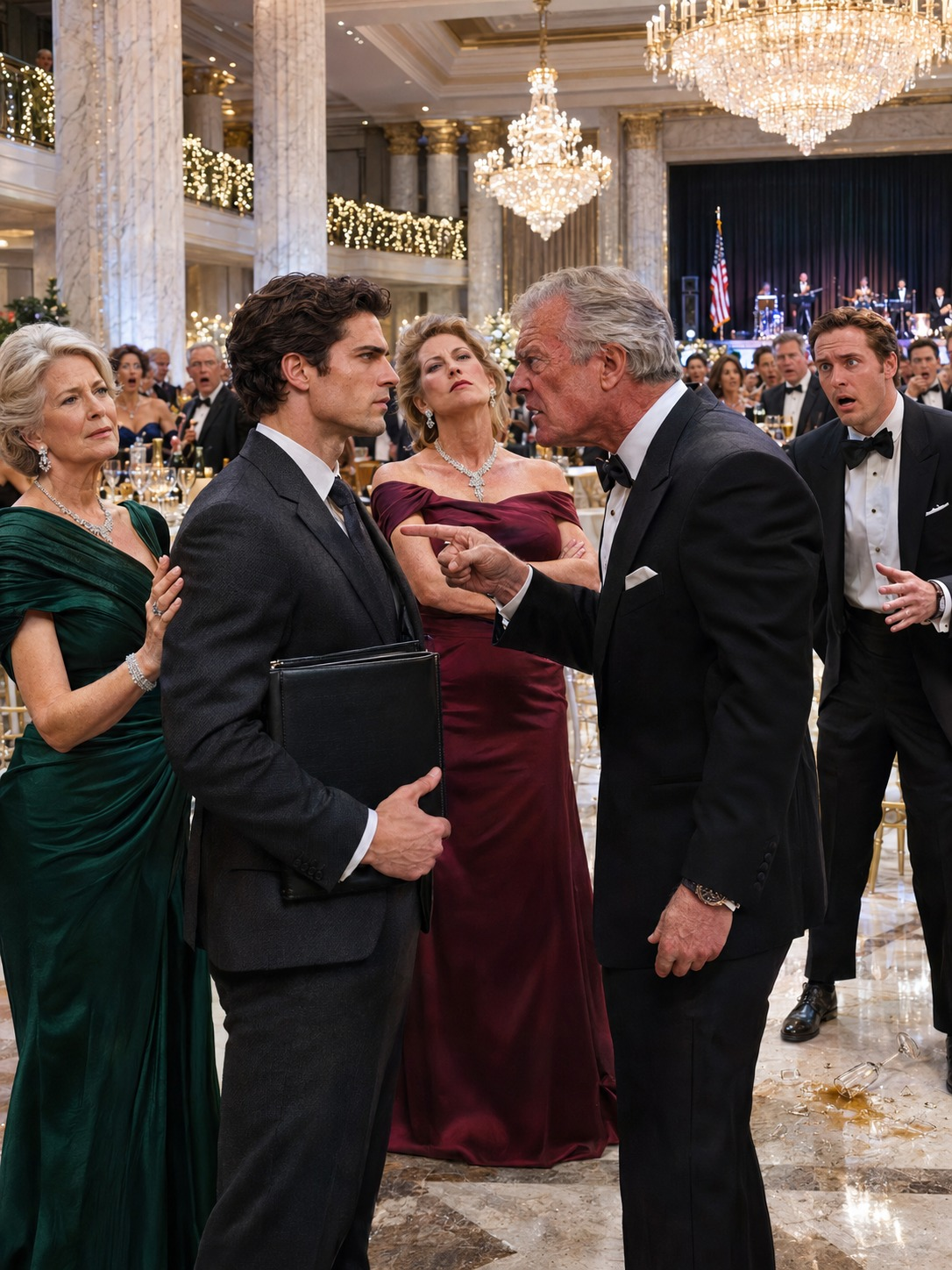
He wasn't alone.
My father was standing beside him.






Comments 0