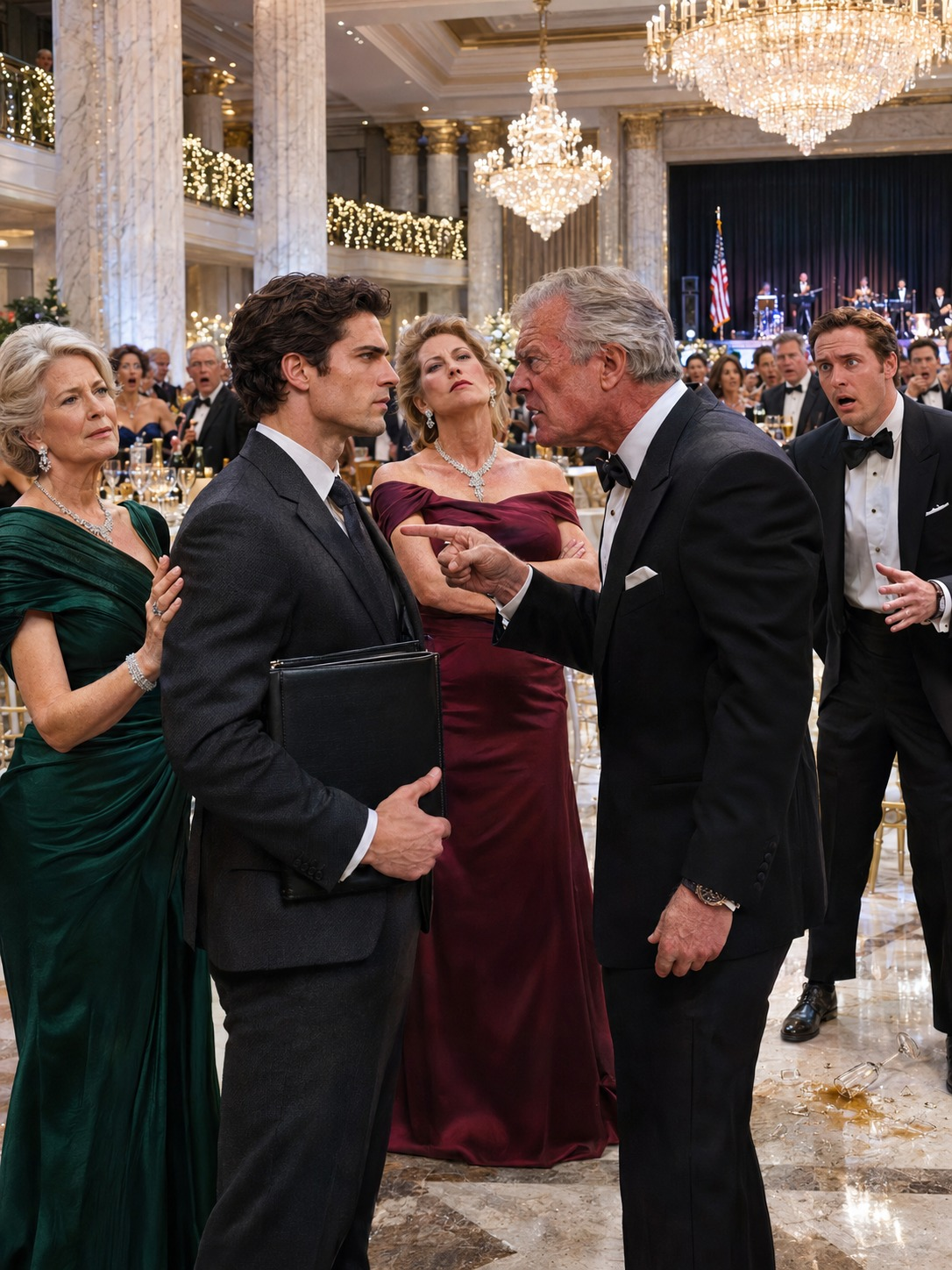
"Get out, Nolan!" my father shouted, thrusting his finger toward my chest.
Richard stood beneath a crystal chandelier, staring at the black folder beneath my arm.
Inside was a document bearing my mother's signature.
Underneath her signature was a date he had spent five years trying to bury.
My father was threatening the wrong man.
He just didn't know it yet.
"Five seconds," he continued. "Turn around, or security will drag you out."
I didn't move.
Around us, conversations began to disappear. Champagne glasses stopped halfway to people's mouths. A woman wearing a diamond necklace leaned toward her husband and whispered something.
My father noticed the attention.
Instead of lowering his voice, he raised it.
"You were specifically told not to come tonight."
"I received your message."
"Then apparently you can't read."
His wife, Brenda, appeared beside him.
She wore a burgundy evening gown that probably cost more than three months of my rent. Diamonds rested against her throat, catching the light every time she moved her head.
She looked at me the way someone might look at an unpleasant stain on a white tablecloth.
"Did you come begging for the ten thousand dollars?" she asked. "That offer is gone."
"I'm not here for your money."
She laughed.
It was a small, dismissive sound.
"Of course you are."
My father stepped closer.
"You own nothing here. You never have."
I looked at him for several seconds.
There had been a time when those words would have destroyed me. I would have spent the drive home wondering what I had done wrong. I would have apologized for making him angry, even when I couldn't identify my offense.
But that night, standing beneath the chandeliers of the Grand Oak Haven Hotel, I felt something different.
Relief.
For the first time in thirty-two years, I wasn't waiting for my father to tell me who I was.
"Richard."
The woman standing beside me finally spoke.
Martha Bennett was sixty-four, a senior director at Crestwood Industries, and one of the few people in that ballroom who remembered what the company had been before my father began treating it like his personal kingdom.
Her hand rested gently against my arm.
"He's here with me."
My father glanced at her.
"This is a family matter, Martha."
"Not entirely."
Brenda's smile weakened.
"What exactly is that supposed to mean?"
Martha didn't answer.
She didn't need to.
Across the ballroom, my older brother Wyatt stood beside a banquet table, staring at us.
A broken champagne flute lay near his shoes.
I had watched him drop it when I entered.
He hadn't even attempted to clean it up.
A waiter approached with a towel, but Wyatt barely noticed him. His attention remained fixed on the folder beneath my arm.
That was interesting.
My father saw an unwanted son.
Brenda saw a failed negotiation.
Wyatt saw something else.
And judging by the color draining from his face, he understood exactly how dangerous it might be.
My father followed my gaze.
"Don't look at your brother. He's actually earned his place here."
I almost smiled.
Earned.
That was a word Richard loved using whenever he wanted to explain why someone else deserved what he had taken from me.
Wyatt had earned his executive position.
Brenda had earned her influence.
Richard had earned the right to make every important decision at Crestwood Industries.
And I, apparently, had earned nothing.
Not even an invitation to a New Year's Eve party celebrating the company my mother had built.
"You should be grateful," Brenda said. "Your father has been extraordinarily patient with you."
"Has he?"
Her eyes narrowed.
"Don't embarrass yourself."
I glanced around the ballroom.
Nearly three hundred guests had gathered for the annual celebration. Investors, executives, attorneys, suppliers, and people whose names appeared regularly in business publications stood beneath enormous crystal chandeliers.
There were white flowers on every table.
Gold decorations lined the balconies.
A live band performed near a stage framed by dark curtains.
An American flag stood beside the podium.
Everything looked expensive, polished, and respectable.
My mother would have hated it.
Not because she disliked beautiful things, but because she believed money should have a purpose beyond convincing strangers that you possessed it.
When Crestwood celebrated its twentieth anniversary, she had insisted that warehouse employees attend alongside executives.
My father had called the idea inappropriate.
She had invited them anyway.
I remembered watching her dance with a forklift operator who had worked for the company since its first warehouse opened.
Richard had spent most of that evening networking with investors.
Eleanor had spent it remembering people's names.
That was the difference between them.
And that difference had eventually become the reason I was standing in this ballroom with documents my father desperately needed to remain hidden.
Richard checked his watch.
"I have an announcement to make."
"Congratulations."
His eyes hardened.
"When I'm done on that stage, I'll have you arrested."
Martha shifted beside me.
"On what grounds?"
"Trespassing, for starters."
"He's an invited guest."
"Not anymore."
"You don't have the authority to revoke my invitation simply because you dislike the person accompanying me."
Richard stared at her.
For a moment, I wondered whether he might threaten her position on the board.
It wouldn't have surprised me.
He had spent years surrounding himself with people who understood that disagreement carried consequences.
But Martha wasn't one of them.
She had known my mother before Crestwood occupied an entire office building. She had been present when the company struggled to make payroll, when suppliers demanded payment in advance, and when Eleanor personally negotiated the contracts that saved hundreds of jobs.
She remembered too much.
That made her inconvenient.
It also made her invaluable.
"Enjoy your evening, Richard," she said.
A chime sounded through the ballroom speakers.
Guests began turning toward the stage.
My father straightened his jacket.
The transformation was immediate.
The angry man who had threatened his youngest son disappeared behind the practiced smile of a successful American businessman.
He extended a hand toward Brenda.
"Come on, sweetheart."
She took his arm.
Before leaving, she leaned toward me.
"You really should have taken the check."
I met her eyes.
"You really should have kept it."
Her expression changed.
Only slightly.
But I saw it.
For the first time that evening, Brenda looked uncertain.
Then she turned away.
I watched them walk toward the stage.
People greeted my father as he passed. Men shook his hand. Women smiled. An investor congratulated him on the upcoming announcement.
Richard accepted every compliment as though he had personally invented success.
Martha released my arm.
"Are you ready?"
I looked down at the folder.
"I've been ready for five years."
"That's not what I asked."
I understood.
Discovering the truth was one thing.
Allowing other people to see it was another.
Once the documents became public, there would be consequences beyond anything I could control. Crestwood's reputation could suffer. Investors might panic. Employees might become frightened about their jobs.
My father's attorneys would come after me.
Brenda would call me vindictive.
Wyatt would probably insist that I had misunderstood everything.
And somewhere beneath all of that would remain the simple fact that these people were my family.
At least, they had once been.
"I don't want the employees hurt," I said.
"Neither do I."
"And I don't want this turned into some kind of circus."
Martha nodded.
"That's why Marshall has been careful."
Across the ballroom, beside the audiovisual control desk, Marshall stood with his glasses resting low on his nose.
He had been my mother's attorney.
Now he was mine.
He caught my attention and gave me a small nod.
Nothing dramatic.
Nothing anyone else would notice.
But it was the signal we had agreed upon.
Everything was ready.
I looked toward Wyatt again.
He was moving toward me.
His steps were uneven, and his expression reminded me of the afternoon he had accidentally crashed our mother's car when he was seventeen.
Back then, I had helped him explain what happened.
I had even offered to accept part of the blame.
He had never thanked me.
"Nolan," he whispered.
"Wyatt."
He glanced at Martha.
"Can we talk privately?"
"No."
His eyes dropped toward the folder.
"What did you bring?"
"Some paperwork."
"What paperwork?"
"The kind people usually read before signing."
He swallowed.
"You don't understand what you're doing."
"That's possible."
"I'm serious."
"So am I."
He looked toward the stage.
Our father had reached the podium.
Brenda stood nearby, smiling for photographs.
Wyatt lowered his voice further.
"Whatever you think you found, there's an explanation."
I studied his face.
"I haven't told you what I found."
He froze.
There it was.
The mistake.
For weeks, Marshall had warned me that suspicion wasn't proof. Familiar names on documents didn't automatically establish wrongdoing. Unusual payments could have legitimate explanations.
We had needed records.
Dates.
Original signatures.
Independent confirmation.
But watching my brother struggle to explain something I hadn't accused him of told me more about his fear than any spreadsheet could.
"Just go home," he said.
"Why?"
"Because Dad's about to close the biggest deal in company history."
"Then he should have nothing to worry about."
Wyatt rubbed his forehead.
"You always do this."
"Do what?"
"Make everything about Mom."
I felt my jaw tighten.
For the first time that evening, my composure nearly broke.
Our mother had died five years earlier.
She had worked through illnesses, missed vacations, and sacrificed opportunities because she believed Crestwood could become something lasting.
She had loved both her sons.
Even when Wyatt disappointed her.
Even when I disappointed her.
And after she died, the people she trusted most had systematically removed her from the company she had created.
Her photographs disappeared.
Her policies disappeared.
Her name disappeared from company presentations.
Now my brother was suggesting that remembering her was an inconvenience.
"She built this company," I said.
"Dad built it too."
"Then he shouldn't be afraid of her paperwork."
Wyatt looked at me.
His mouth opened.
Nothing came out.
The ballroom speakers crackled.
"Ladies and gentlemen."
Our father's voice filled the room.
Applause followed.
Wyatt turned toward the stage, then back toward me.
"Please."
It was the first time in years that he had used that word when speaking to me.
I wondered whether he was afraid for our father.
Or for himself.
Richard smiled beneath the stage lights.
"For decades, Crestwood Industries has stood for integrity, family values, and trust."
More applause.
I looked at Martha.
She closed her eyes briefly.
The irony wasn't lost on either of us.
My father continued speaking about responsibility, growth, and the importance of protecting the company's future.
He mentioned his leadership.
His vision.
His sacrifices.
Not once did he mention Eleanor.
I thought about the morning he had sent his message to our family group chat.
Don't bother showing up tonight, Nolan. You're written out of the will. Don't ruin it for the rest of us.
Brenda had responded with a thumbs-up.
Wyatt had written:
It's for the best, little brother. You always make things awkward.
I hadn't replied.
Instead, I had called Marshall.
"Are we still moving forward tonight?" I had asked.
"That's your decision."
I had looked at my mother's photograph on the kitchen counter.
Then I had given him my answer.
Now, hours later, I stood watching Richard prepare to announce a merger worth millions.
A merger he believed he had the unrestricted authority to approve.
He lifted his champagne glass.
"As the controlling authority of Crestwood Industries, I am proud to announce that our company is entering a remarkable new chapter."
People began applauding before he finished.
Wyatt grabbed my sleeve.
"Nolan. Stop this."
I gently removed his hand.
Across the room, Marshall reached toward the audiovisual control board.
The enormous presentation screen behind my father went black.
Richard turned.
The applause stopped.
A technician looked up from his equipment.
Brenda's smile vanished.
My brother whispered something I could barely hear.
"Oh, God."
I watched the dark screen.
Three weeks earlier, I hadn't known any of this was possible.
I had been an ordinary supply chain manager with a disappointing career, an inexpensive apartment, and a father who treated my existence as a professional inconvenience.
Then Brenda had ordered me to empty my mother's old office.
I had opened a drawer that refused to close properly.
Behind it, I had discovered a brass lockbox.
And inside that lockbox was a cream envelope bearing my name.
But the letter wasn't the only thing my mother had left behind.
There was another document.
One my father had apparently believed was gone forever.
The screen flickered.
A scanned page began appearing behind Richard.
He recognized the signature before anyone else did.
His champagne glass slipped from his hand.
And then my mother's name appeared.






Comments 0