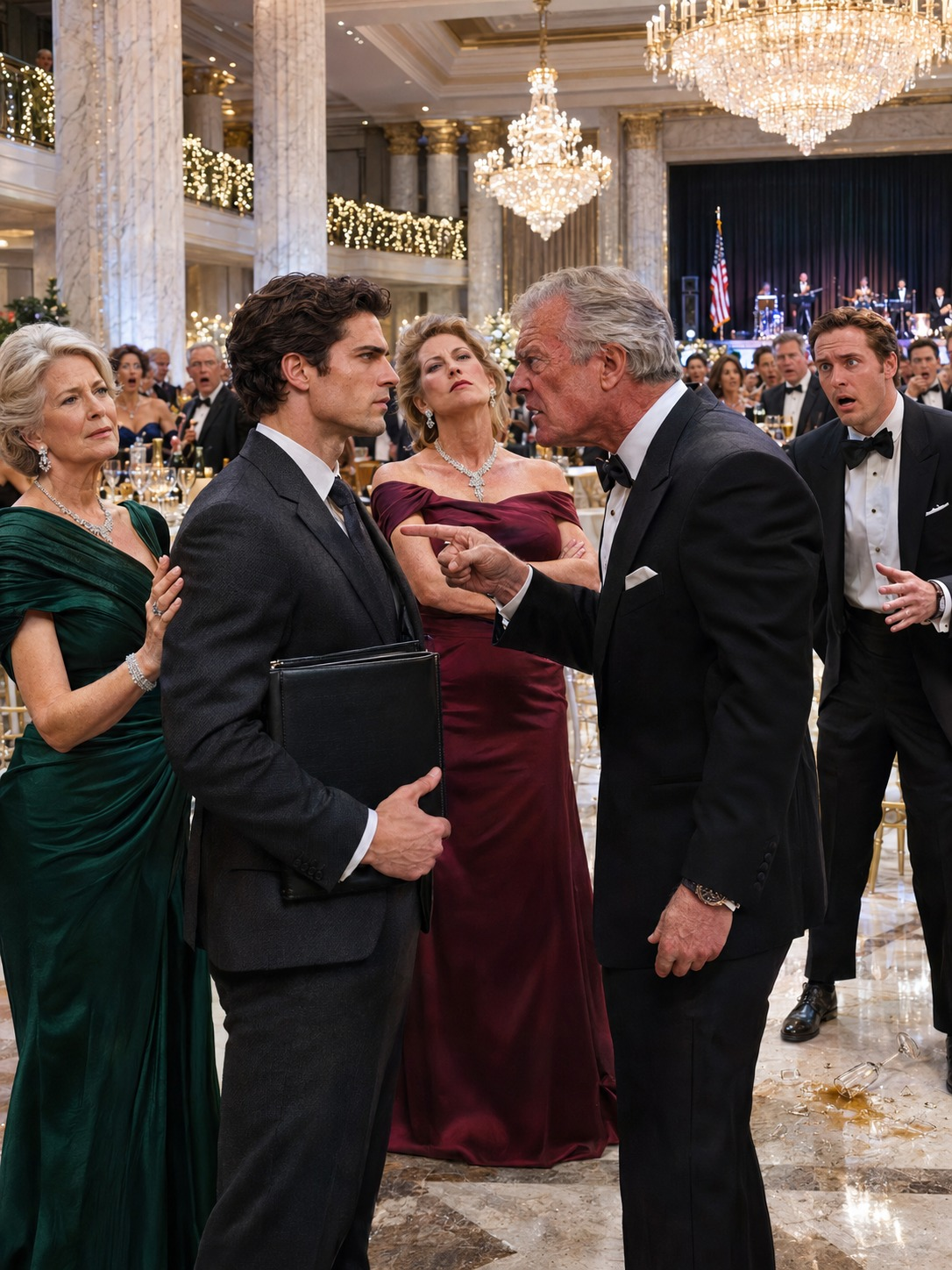
Five years before my father threatened to have me arrested, he stood beside my mother's coffin and promised he would take care of me.
"I'll make sure our boys never have to worry about their future," he told the mourners.
People wiped their eyes.
Someone applauded softly.
I believed him.
That was probably the most expensive mistake I ever made.
My mother, Eleanor, had died on a Tuesday morning. She was fifty-eight years old, and until the final months of her life, she had continued answering emails from her hospital bed.
Even when she could barely hold her phone, she worried about suppliers, employee benefits, and families who depended on Crestwood Industries for their livelihoods.
My father worried about something else.
Three days before her funeral, I found him searching through the drawers in her home office.
"What are you looking for?" I asked.
He slammed a drawer shut.
"Insurance documents."
"Marshall probably has copies."
"I know what I'm doing, Nolan."
I apologized and left.
Back then, apologizing had become almost instinctive.
I apologized when my father raised his voice. I apologized when Wyatt blamed me for something. I apologized when I asked questions nobody wanted to answer.
My mother used to tell me that kindness was a strength.
My father had taught me that kindness was something other people could exploit.
It took me years to understand the difference.
At twenty-seven, I was working in a junior operations position at Crestwood. I had graduated with a degree in supply chain management and spent several years learning the business from the ground up.
My mother had insisted on that.
"You can't manage people whose jobs you don't understand," she told me on my first day.
While Wyatt attended executive meetings, I spent mornings checking inventory and afternoons reviewing shipping schedules.
I knew which suppliers delivered late, which warehouse employees worked overtime, and which customers needed special accommodations.
I enjoyed the work.
There was something satisfying about solving problems that mattered to ordinary people.
My father disagreed.
"You're too comfortable with the little things," he once told me.
"They aren't little things when someone's paycheck depends on them."
He shook his head.
"That's your mother talking."
He said it like an insult.
Six weeks after her funeral, Richard called me into his office.
Wyatt was already there.
He sat comfortably in a leather chair, wearing a new navy suit and an expensive watch.
My father gestured toward the empty seat.
"We've been discussing the company's future."
I sat down.
"Okay."
"Things are going to change around here. Your mother had her way of doing business. I have mine."
I nodded slowly.
"That's understandable."
"Wyatt will be taking on additional responsibilities."
My brother smiled.
"I've been promoted to vice president of strategic development."
I looked at him.
"Congratulations."
He seemed surprised by my response.
Perhaps he had expected jealousy.
But I genuinely wanted my brother to succeed. I still believed that if our family could survive losing Mom, we might become closer.
"What about my position?" I asked.
My father leaned back.
"We're eliminating it."
For several seconds, I thought I had misunderstood him.
"Eliminating it?"
"It's redundant."
"But we're expanding distribution next quarter. I just finished the supplier assessment."
"Someone else will handle that."
"Who?"
"That's not your concern."
I looked toward Wyatt.
He avoided my eyes.
"Am I being transferred?"
My father folded his hands across his stomach.
"We think it would be beneficial for you to gain experience outside the family business."
The words sounded carefully rehearsed.
I wondered how many times they had practiced saying them before calling me upstairs.
"Did I do something wrong?"
"No," Richard answered impatiently. "This isn't personal."
It was remarkable how often people said something wasn't personal immediately before doing something deeply personal.
"What would Mom have wanted?"
His expression changed.
"Your mother is gone."
The room became very quiet.
"You need to accept that," he continued. "I'm running this company now."
I stared at the desk.
It had belonged to her.
So had the leather chair he occupied.
Even the framed photograph behind him had once shown my mother shaking hands with Crestwood's first major customer.
Now the photograph was gone.
In its place hung a picture of Richard standing beside a state senator.
I hadn't noticed the change when I entered.
Suddenly, I couldn't look away from it.
"When do I leave?"
"Human resources will explain the details."
"Today?"
He glanced at his computer.
"That would be best."
Wyatt finally spoke.
"Don't make this harder than it needs to be, little brother."
I looked at him.
He smiled sympathetically.
It was the same expression people used when delivering bad news they secretly enjoyed.
I stood up.
"Congratulations again, Wyatt."
Neither of them stopped me when I left.
By lunchtime, I was carrying a cardboard box through the lobby.
Inside were a coffee mug, several notebooks, a photograph of my mother, and a small wooden plaque she had given me when I joined the company.
It read:
Do good work, even when nobody is watching.
I kept that plaque for the next five years.
It sat on my apartment desk through job applications, late-night spreadsheets, unpaid bills, and every disappointing family dinner that followed.
I eventually found another position as a supply chain manager at a regional distribution company.
The salary was modest, but the work was honest.
Nobody knew my father.
Nobody cared about my last name.
For the first time in my professional life, my accomplishments belonged entirely to me.
That should have made me happy.
And sometimes it did.
But every time I drove past Crestwood's headquarters, I remembered walking through those doors with my mother.
I remembered her introducing me to employees.
I remembered her telling people that someday, her sons would help protect what she had built.
I wondered whether she would have been disappointed in me for leaving.
What I didn't understand then was that I hadn't simply been pushed out of a job.
I had been removed from a place where I might eventually have discovered something.
And my father had every reason to keep me away.
Brenda entered our lives less than a year after Mom died.
Richard introduced her at a Sunday dinner.
She arrived carrying an expensive bottle of wine and wearing a perfume so strong that it lingered in the dining room long after she left.
She was charming.
At least, she was charming to people she considered important.
She complimented Wyatt's career, laughed at Richard's jokes, and asked me what I did for a living.
"I'm a supply chain manager."
"Oh," she replied. "That's nice."
Then she turned back toward Wyatt.
"Tell me more about your executive position."
That was our first conversation.
It established the pattern for nearly every interaction that followed.
Within months, Brenda had moved into my childhood home.
My mother's paintings disappeared from the walls.
Her gardening books vanished from the living room.
The blue ceramic dishes she had collected during family vacations were packed into boxes and donated.
When I asked about them, Brenda looked amused.
"You can't expect Richard to live in a museum."
"I just wanted to keep a few things."
"You should have said something sooner."
I had.
Nobody had listened.
Richard and Brenda married in a private ceremony the following spring.
I attended.
I smiled for photographs.
I congratulated them.
And when my father introduced Brenda as the woman who had brought happiness back into his life, I applauded with everyone else.
I wanted him to be happy.
I simply hadn't realized that his happiness required pretending my mother had never existed.
Brenda eventually became the public relations director at Crestwood.
She had no experience in industrial distribution, but Richard insisted she possessed exceptional communication skills.
Her first major project was redesigning the company's public image.
The old website had featured a photograph of my mother standing outside Crestwood's original warehouse.
The new website featured Richard.
The company history was rewritten.
References to Eleanor became shorter.
Eventually, her name appeared only in a brief paragraph describing the company's early years.
I discovered the changes one evening while sitting at my kitchen table.
I called Wyatt.
"Have you seen the new website?"
"Yeah. Looks great, doesn't it?"
"Where's Mom?"
He sighed.
"Nolan."
"They removed almost everything about her."
"It's branding."
"It's our history."
"You're being emotional."
I looked at the photograph beside my laptop.
Our mother stood between us, smiling at the camera during Wyatt's college graduation.
"Doesn't it bother you?"
"Honestly? No."
His answer hurt more than I expected.
"She built the company, Wyatt."
"And Dad's taking it forward. That's how business works."
I ended the call before saying something I might regret.
For the next hour, I searched old articles about Crestwood.
There were dozens featuring Eleanor.
Local business awards.
Community development projects.
Interviews about ethical supplier relationships.
Photographs of her standing beside warehouse workers.
She had been everywhere.
And yet, somehow, the people closest to her had convinced themselves that she was expendable.
I began saving those articles.
I downloaded photographs, archived interviews, and printed several profiles.
I wasn't investigating anything at the time.
I was simply afraid that one day, nobody would remember what she had accomplished.
Over the years, family gatherings became increasingly difficult.
At Thanksgiving, Richard asked Wyatt about quarterly projections and Brenda about upcoming publicity campaigns.
He asked me whether I was still renting my apartment.
"Yes."
"You know, at your age, I already owned property."
"Good for you, Dad."
Brenda laughed.
"Maybe Nolan needs a financial adviser."
Wyatt raised his glass.
"Or a better job."
Everyone smiled.
I smiled too.
That was how I survived those dinners.
I laughed when they insulted me.
I changed the subject when they compared us.
I helped clear the table while they discussed opportunities I would never be offered.
And afterward, I drove home wondering why I kept returning.
The answer was embarrassingly simple.
I wanted my father to love me.
Even after everything, I believed there might be some combination of patience, hard work, and achievement that would finally make him proud.
When my department reduced shipping costs by eighteen percent, I told him.
He asked whether that had earned me a promotion.
When my supervisor nominated me for a professional award, I invited him to the ceremony.
He said he had dinner plans.
When I bought my first car without financing, he looked at it and asked why I hadn't chosen something more impressive.
Every accomplishment became another opportunity for him to explain why it wasn't enough.
Then, one evening, Martha called.
I hadn't spoken to her in several months.
"Nolan, are you free for coffee tomorrow?"
"Of course."
"There's something I'd like to discuss."
We met at a small café near my office.
She arrived wearing a gray coat and carrying a leather handbag.
After ordering coffee, she studied my face.
"How are you really doing?"
The question caught me off guard.
"I'm fine."
"That's what you always say."
I smiled awkwardly.
"Occupational hazard."
She didn't smile back.
"Your mother would be proud of you."
I looked down at my coffee.
Nobody had said those words to me in years.
"Thank you."
"I mean it."
She reached across the table and touched my hand.
"Eleanor talked about you constantly. She admired how seriously you took your responsibilities."
"She probably wanted me to accomplish more."
"No, Nolan. She wanted you to remain yourself."
I swallowed.
Martha withdrew her hand and opened her handbag.
She removed an old photograph.
It showed my mother standing inside Crestwood's first warehouse, surrounded by boxes and handwritten inventory sheets.
Richard stood beside her.
They were young.
My mother was smiling.
"She gave me this years ago," Martha said. "I thought you should have it."
I turned the photograph over.
My mother's handwriting covered the back.
The beginning of something worth protecting.
I traced the words with my thumb.
"Thank you."
Martha watched me carefully.
"Do you ever wonder why Richard pushed you out so quickly?"
I looked up.
"What do you mean?"
"You were good at your job. Your performance reviews were excellent. Your department needed you."
"He wanted Wyatt to take over."
"Wyatt could have been promoted without removing you."
I considered that.
For years, I had assumed my father simply preferred my brother.
I had never seriously questioned whether there was another explanation.
"Maybe he didn't think I belonged there."
Martha's expression hardened.
"Your mother certainly believed you belonged there."
Something about her tone made me uneasy.
"Is there something you're not telling me?"
She glanced toward the café entrance.
Then she shook her head.
"Not something I can establish."
"What does that mean?"
"It means I don't want to burden you with suspicions."
She finished her coffee and stood.
"Keep the photograph somewhere safe."
I wanted to ask more questions.
But she was already putting on her coat.
Before leaving, she looked at me one last time.
"Don't let anyone convince you that your mother's contribution ended when she died."
I carried those words home.
For several weeks, I thought about our conversation.
I considered calling her again.
But work became busy, and the holidays approached.
Then, three weeks before New Year's Eve, my phone rang while I was preparing dinner.
Brenda's name appeared on the screen.
She rarely called me unless she wanted something.
"Nolan," she said when I answered. "We need you to come to Crestwood tomorrow."
I put down my kitchen knife.
"Why?"
"We're renovating the third floor."
"Okay."
"Your mother's old office is full of personal belongings. Richard wants everything removed."
I stared at the wall.
Her office had remained locked since her death.
For five years, I had asked whether I could collect her things.
For five years, my father had refused.
Now Brenda sounded irritated that the room hadn't already been emptied.
"What are you doing with the office?"
"Turning it into a private executive lounge."
I closed my eyes.
"Of course."
"Bring boxes. Anything you don't take will be thrown away."
"Does Dad know about this?"
"Who do you think approved it?"
She disconnected.
I stood in my kitchen, listening to the silence.
Then I called my father.
He answered on the fourth ring.
"What is it?"
"Brenda told me about Mom's office."
"Yes."
"Are you sure you want to do this?"
"It's wasted space."
"There might be important things in there."
"Everything important has already been removed."
His response came too quickly.
I frowned.
"By whom?"
"Don't start, Nolan."
"I was just asking."
"Go tomorrow. Take whatever sentimental junk you want. Leave the business records alone."
He hung up.
I looked at the phone.
Leave the business records alone.
Something about those words stayed with me.
The following morning, I arrived at Crestwood carrying four empty cardboard boxes.
A receptionist issued me a temporary visitor badge.
Five years earlier, I had entered that building as an employee.
Now I needed permission to visit the office of the woman who had founded it.
I stepped into the elevator and pressed the button for the third floor.
When the doors opened, I recognized the hallway immediately.
At the far end stood my mother's office.
The brass nameplate had been removed.
Two small screw holes remained where her name used to be.
Brenda waited beside the door.
She handed me a key.
"Try to finish before lunch."
Then she walked away.
I unlocked the door.
The room smelled of old paper and furniture polish.
My mother's oak desk stood near the window.
Her filing cabinets remained against the wall.
A dusty photograph of Wyatt and me rested on a bookshelf.
For a moment, I couldn't move.
Then I noticed something strange.
One of the drawers in her oak credenza was slightly open.
The wood around its handle was scratched.
Someone had tried to force it.
I placed my boxes on the floor and walked toward it.
Before I could touch the handle, my phone vibrated.
An unfamiliar number had sent me a message.
There was no greeting.
No explanation.
Just seven words.
Your father never found what she hid.






Comments 0